


St. John the Evangelist Church, Plymouth
The Church of Saint John the Evangelist in Plymouth is a Grade II listed Anglican parish church, rich in architectural and historical significance. Designed by architect Benjamin Ferrey, a student of Augustus Pugin, the church was constructed between 1851 and 1855 from local rag-stone with sandstone detailing. It was consecrated on June 21, 1855, by Bishop Henry Philpotts of Exeter.
The church's layout includes a chancel, nave, aisles, and a Lady Chapel, which was added in 1883 as a memorial and later restored after bomb damage in WWII. A notable feature is the spire, housing a single bell cast by Mears Bell foundry in London. The Lady Chapel holds striking stained glass depicting Our Lady, Star of the Sea, symbolizing Plymouth's maritime heritage, while its altar carving, crafted by the local Pinwell Sisters, survived wartime bombings and remains in use.
Inside, the church showcases various memorials and artworks donated by worshippers over the years, each piece reflecting moments of joy or sorrow. The intricately designed pulpit displays scenes from Saint John's life, complemented by an oak crucifix with an olive wood figure above. The sanctuary is adorned with a reredos depicting the Crucifixion, Resurrection, and Ascension, topped by a window featuring the four Evangelists.
The church's connection to local history is evident in its memorials to WWI soldiers and icons such as Saint Nicholas, patron of seafarers, paying homage to Plymouth's fishing community.
The church's layout includes a chancel, nave, aisles, and a Lady Chapel, which was added in 1883 as a memorial and later restored after bomb damage in WWII. A notable feature is the spire, housing a single bell cast by Mears Bell foundry in London. The Lady Chapel holds striking stained glass depicting Our Lady, Star of the Sea, symbolizing Plymouth's maritime heritage, while its altar carving, crafted by the local Pinwell Sisters, survived wartime bombings and remains in use.
Inside, the church showcases various memorials and artworks donated by worshippers over the years, each piece reflecting moments of joy or sorrow. The intricately designed pulpit displays scenes from Saint John's life, complemented by an oak crucifix with an olive wood figure above. The sanctuary is adorned with a reredos depicting the Crucifixion, Resurrection, and Ascension, topped by a window featuring the four Evangelists.
The church's connection to local history is evident in its memorials to WWI soldiers and icons such as Saint Nicholas, patron of seafarers, paying homage to Plymouth's fishing community.
Want to visit this sight? Check out these Self-Guided Walking Tours in Plymouth. Alternatively, you can download the mobile app "GPSmyCity: Walks in 1K+ Cities" from Apple App Store or Google Play Store. The app turns your mobile device to a personal tour guide and it works offline, so no data plan is needed when traveling abroad.
Download The GPSmyCity App



St. John the Evangelist Church on Map
Sight Name: St. John the Evangelist Church
Sight Location: Plymouth, England (See walking tours in Plymouth)
Sight Type: Religious
Sight Location: Plymouth, England (See walking tours in Plymouth)
Sight Type: Religious
Nearby Sights





Walking Tours in Plymouth, England

Create Your Own Walk in Plymouth
Creating your own self-guided walk in Plymouth is easy and fun. Choose the city attractions that you want to see and a walk route map will be created just for you. You can even set your hotel as the start point of the walk.
Plymouth Old Town Walking Tour
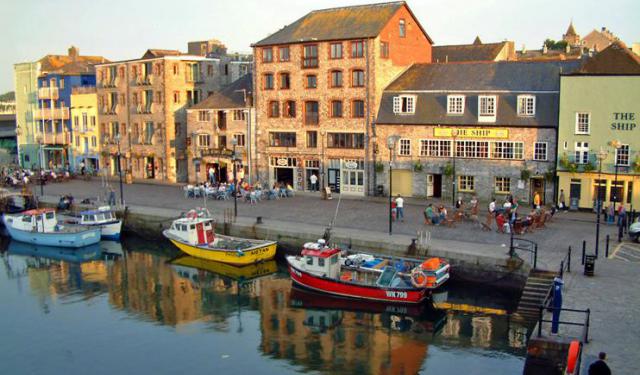
Plymouth's early history began in the Bronze Age when the first settlement emerged at Mount Batten. It is mentioned in Ptolemy's Geographia as a maritime outpost exporting bronze mirrors.
The settlement was a major port in the southwest of England in Roman times. It was surpassed as a port in the ninth century by the nearby wealthier village of Sutton, later called Plymouth.... view more
Tour Duration: 1 Hour
Travel Distance: 1.8 Km or 1.1 Miles
The settlement was a major port in the southwest of England in Roman times. It was surpassed as a port in the ninth century by the nearby wealthier village of Sutton, later called Plymouth.... view more
Tour Duration: 1 Hour
Travel Distance: 1.8 Km or 1.1 Miles

Plymouth Hoe Walking Tour
Plymouth Hoe, referred to locally as the Hoe, is a large south-facing open public space in Plymouth with commanding views of Plymouth Sound, Drake's Island, and further afield into Cornwall. The name derives from the Anglo-Saxon word hoh, which means a sloping ridge shaped like an inverted foot and heel.
This part of town has always been a meeting place, where people would come regularly... view more
Tour Duration: 1 Hour
Travel Distance: 0.7 Km or 0.4 Miles
This part of town has always been a meeting place, where people would come regularly... view more
Tour Duration: 1 Hour
Travel Distance: 0.7 Km or 0.4 Miles

Walking Along Plymouth's Pilgrim Fathers Trail
Back in the early 17th century, a group of English Puritans - nowadays reverently referred to as the Pilgrim Fathers - fled religious persecution in their homeland and established a colony in North America that later became known as Plymouth, Massachusetts. The Pilgrims embarked on their perilous journey across the Atlantic from Plymouth, England in 1620 aboard a ship called the Mayflower, which... view more
Tour Duration: 1 Hour
Travel Distance: 0.6 Km or 0.4 Miles
Tour Duration: 1 Hour
Travel Distance: 0.6 Km or 0.4 Miles
City Walks Overview
