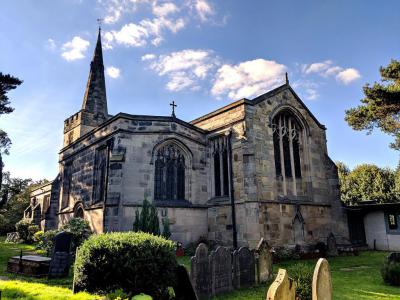


St. Leonard Church, Nottingham
Saint Leonard’s Church in Wollaton is a historic Church of England parish church with roots stretching back to the early 13th century. The oldest surviving part is the chancel, with the nave and tower added in the 14th century. Though modest in scale, the church is rich in heritage and holds a Grade II* listing for its architectural and historical significance.
The church’s interior tells a story of long-standing ties to the Willoughby family of nearby Wollaton Hall, one of Nottinghamshire’s most prominent noble lineages. Several funerary monuments and elaborate tombs commemorate generations of the family, including a tomb chest with effigies of Sir Henry Willoughby and his wives. Another notable memorial honours Robert Smythson, the pioneering Elizabethan architect who designed Wollaton Hall.
From the 1460s, the church used the Wollaton Antiphonal, a lavish medieval manuscript containing music and liturgical texts. In the Victorian era, the church underwent significant restoration, and again in the 20th century, helping to preserve its character and craftsmanship.
One interesting feature is the turret clock, installed in 1892 by Potts of Leeds, featuring Lord Grimthorpe’s innovative gravity escapement. The timepiece, displayed on cast iron skeleton dials glazed with opal glass and once lit by gas lamps, was eventually replaced in 1991, with the original mechanism now housed in the Leeds Industrial Museum.
Saint Leonard’s remains a peaceful, historically layered site, quietly anchoring centuries of Wollaton’s religious and social history.
The church’s interior tells a story of long-standing ties to the Willoughby family of nearby Wollaton Hall, one of Nottinghamshire’s most prominent noble lineages. Several funerary monuments and elaborate tombs commemorate generations of the family, including a tomb chest with effigies of Sir Henry Willoughby and his wives. Another notable memorial honours Robert Smythson, the pioneering Elizabethan architect who designed Wollaton Hall.
From the 1460s, the church used the Wollaton Antiphonal, a lavish medieval manuscript containing music and liturgical texts. In the Victorian era, the church underwent significant restoration, and again in the 20th century, helping to preserve its character and craftsmanship.
One interesting feature is the turret clock, installed in 1892 by Potts of Leeds, featuring Lord Grimthorpe’s innovative gravity escapement. The timepiece, displayed on cast iron skeleton dials glazed with opal glass and once lit by gas lamps, was eventually replaced in 1991, with the original mechanism now housed in the Leeds Industrial Museum.
Saint Leonard’s remains a peaceful, historically layered site, quietly anchoring centuries of Wollaton’s religious and social history.
Want to visit this sight? Check out these Self-Guided Walking Tours in Nottingham. Alternatively, you can download the mobile app "GPSmyCity: Walks in 1K+ Cities" from Apple App Store or Google Play Store. The app turns your mobile device to a personal tour guide and it works offline, so no data plan is needed when traveling abroad.
Download The GPSmyCity App



St. Leonard Church on Map
Sight Name: St. Leonard Church
Sight Location: Nottingham, England (See walking tours in Nottingham)
Sight Type: Religious
Sight Location: Nottingham, England (See walking tours in Nottingham)
Sight Type: Religious
Nearby Sights


Walking Tours in Nottingham, England

Create Your Own Walk in Nottingham
Creating your own self-guided walk in Nottingham is easy and fun. Choose the city attractions that you want to see and a walk route map will be created just for you. You can even set your hotel as the start point of the walk.
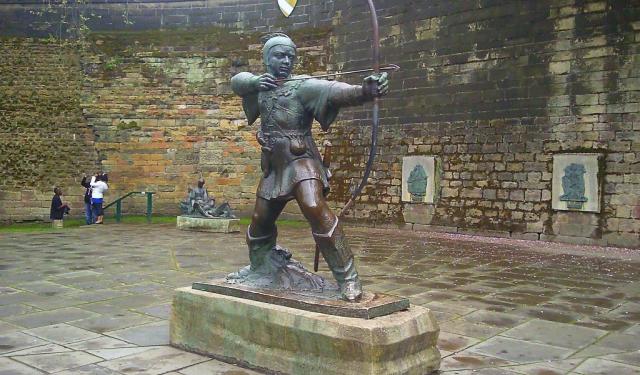
Robin Hood Trail
There's hardly anyone on this planet who hasn't heard of Robin Hood. Apparently, a Saxon nobleman born in 1160 in Loxley, this hero of numerous ballads, some dating back as far as the 14th century, earned fame by robbing from the rich and giving it back to the poor. A skilled archer and sword fighter as he was, Robin Hood famously defended villagers from attacks by corrupt noblemen,... view more
Tour Duration: 1 Hour
Travel Distance: 1.5 Km or 0.9 Miles
Tour Duration: 1 Hour
Travel Distance: 1.5 Km or 0.9 Miles

Nottingham's Historic City Center Walking Tour
Nottingham was known only as "The Place of Caves" in 600 AD. A Saxon chief named Snot ruled "Snotingaham", or, "the home of Snot's people." It was part of Danelaw in the 7th century, administered from a stone Hall on High Pavement, the first street of Nottingham.
In 1068 Norman invaders built a wooden motte-and-bailey fortress on a high sandstone promontory.... view more
Tour Duration: 2 Hours
Travel Distance: 2.5 Km or 1.6 Miles
In 1068 Norman invaders built a wooden motte-and-bailey fortress on a high sandstone promontory.... view more
Tour Duration: 2 Hours
Travel Distance: 2.5 Km or 1.6 Miles

Nottingham's Historical Buildings Tour
Given the variety of architectural styles and designs in Nottingham, England, it is safe to call it the city of contrasts. The tapestry of historical buildings found here, each weaving a unique story of the city's past, is quite rich and worthy of attention.
Among these architectural treasures is the Bell Inn, a charming establishment steeped in history and character. Its traditional... view more
Tour Duration: 2 Hours
Travel Distance: 3.9 Km or 2.4 Miles
Among these architectural treasures is the Bell Inn, a charming establishment steeped in history and character. Its traditional... view more
Tour Duration: 2 Hours
Travel Distance: 3.9 Km or 2.4 Miles
City Walks Overview
