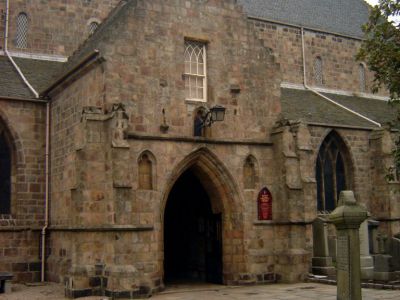


St. Machar's Cathedral, Aberdeen (must see)
Saint Machar's Cathedral, also known as Old Machar, was founded around 580 AD by Saint Machar, while he accompanied Saint Columba on his journey to Iona Island. The present building took shape between the late 14th and early 16th centuries and remains an active Church of Scotland parish church.
While in front of it, make sure to examine the imposing western façade. Two massive granite towers, topped with slender stone spires, give the cathedral an almost fortress-like appearance. Between them is the main entrance, with a row of seven narrow windows above it.
Once inside, look straight ahead along the central nave. Massive stone pillars support pointed Gothic arches, while stained-glass windows brighten the otherwise austere interior. Now, look up at the magnificent wooden ceiling. Installed in the 1520s, it features 48 colorful coats of arms representing European monarchs, Scottish nobles, and church figures.
At the eastern end of the nave, facing the communion table, you'll see a large stained-glass window depicting scenes from the life of Christ. Installed in 1953, it replaced an earlier window damaged during World War II.
Next, explore the south aisle, on your right when facing the communion table. At the entrance to the Mitchell Chapel stands the Sanctuary Cross, combining a 12th-century carved stone head with a modern shaft. The chapel also contains stained-glass windows by Victorian artist Daniel Cottier. Another interesting piece is the wooden Barbour Triptych, created by Roland Fraser in 1997 to commemorate John Barbour, a medieval Scottish poet.
Across the nave, in the north aisle, look for three medieval stone effigies depicting 15th-century clergymen. One represents Walter Idyll, who died in 1468, while another commemorates Bishop Henry Lichtoun, who died in 1440.
Finally, step outside to explore the historic churchyard. On the eastern side, you'll also see the remains of the cathedral's former transepts, including the richly decorated tomb of Bishop Gavin Dunbar, who died in 1532. These ruins recall the cathedral's much larger medieval layout, partly lost after its central tower collapsed in 1688.
As you explore the churchyard, you'll find the graves of several notable Scots, namely: novelist John Joy Bell, philanthropist James Edward Crombie, botanist George Dickie, and astronomer David Gill.
According to local lore, part of the remains of Scottish national hero William Wallace was also buried on the cathedral grounds, although this fact has never been conclusively established.
Want to visit this sight? Check out these Self-Guided Walking Tours in Aberdeen. Alternatively, you can download the mobile app "GPSmyCity: Walks in 1K+ Cities" from Apple App Store or Google Play Store. The app turns your mobile device to a personal tour guide and it works offline, so no data plan is needed when traveling abroad.
Download The GPSmyCity App



St. Machar's Cathedral on Map
Sight Name: St. Machar's Cathedral
Sight Location: Aberdeen, Scotland (See walking tours in Aberdeen)
Sight Type: Religious
Guide(s) Containing This Sight:
Sight Location: Aberdeen, Scotland (See walking tours in Aberdeen)
Sight Type: Religious
Guide(s) Containing This Sight:
Nearby Sights




Walking Tours in Aberdeen, Scotland
Create Your Own Walk in Aberdeen
Creating your own self-guided walk in Aberdeen is easy and fun. Choose the city attractions that you want to see and a walk route map will be created just for you. You can even set your hotel as the start point of the walk.

Aberdeen City Center Walking Tour
Aberdeen, a historic port city on Scotland's northeast coast, has a history stretching back almost a millennium. People have lived in this area for at least 8,000 years, although the city itself began taking shape much later. Its name comes from the Pictish word “aber,” meaning "river mouth," and the River Don, which flows into the North Sea here. So, Aberdeen essentially means... view more
Tour Duration: 2 Hours
Travel Distance: 2.4 Km or 1.5 Miles
Tour Duration: 2 Hours
Travel Distance: 2.4 Km or 1.5 Miles

Aberdeen Old Town Walking Tour
Established as a separate burgh in 1489, Old Aberdeen has been an important religious, political, and cultural center since the late Middle Ages. For centuries, it was a town in its own right, only becoming part of the city of Aberdeen in 1891. Today, much of its historic center is a protected conservation area, where medieval buildings stand alongside houses and other structures dating from the... view more
Tour Duration: 2 Hours
Travel Distance: 3.1 Km or 1.9 Miles
Tour Duration: 2 Hours
Travel Distance: 3.1 Km or 1.9 Miles
City Walks Overview
