


St. Michael's Church, Southampton
Saint Michael’s Church, established in 1070, is Southampton’s oldest building still in use. It is also the only surviving church of the five that once served Southampton’s medieval walled town.
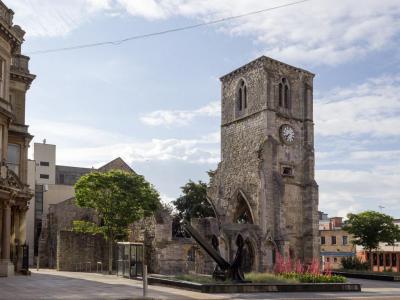
Spare a moment, before entering, to check out the stone exterior, particularly the tall tower and its slender spire, which rises approximately 165 feet above the ground. The church was enlarged during the 13th century as Southampton prospered, while its spire underwent several later alterations, including an increase in height in 1887. Remarkably, both the church and its spire survived the heavy bombing of Southampton during World War II.
Now, step inside and look along the central aisle toward the altar at the eastern end. Above it, you'll see the East Window, with stained-glass representations of Southampton’s five medieval churches: Saint Michael’s, Saint John’s, Saint Lawrence’s, Holyrood, and All Saints’. Of these, only Saint Michael’s remains standing today.
Next, turn around and look toward the opposite, western end of the church. Here, the West Window depicts Saint Michael, the church’s patron saint, defeating a dragon, a traditional symbol of the triumph of good over evil.
While you're facing west, look toward the left-hand corner, on the southwestern side of the church. Here stands the remarkable 12th-century baptismal font, carved around 1170 from a single block of black Tournai marble. Notice its solid, dark bowl supported by columns of Purbeck marble. It is one of only a handful of surviving fonts of this type in England.
As you explore the interior, look for the two medieval brass lecterns, both shaped like eagles. One dates from the early 15th century and was rescued from nearby Holyrood Church during the bombing of 1940. Take a closer look at its elegantly tapered body and individually defined wing feathers. The other eagle lectern, dating from the late 15th century, has a more conventional design.
Finally, make your way toward the northeastern corner of the church to find the tomb of Sir Richard Lyster, a prominent Tudor judge, who died in the 1550s. Look for the elaborate stone monument with classical columns and a sculpted effigy. Erected in 1567, it provides an interesting contrast to the church’s medieval architecture.
Want to visit this sight? Check out these Self-Guided Walking Tours in Southampton. Alternatively, you can download the mobile app "GPSmyCity: Walks in 1K+ Cities" from Apple App Store or Google Play Store. The app turns your mobile device to a personal tour guide and it works offline, so no data plan is needed when traveling abroad.
Download The GPSmyCity App



St. Michael's Church on Map
Sight Name: St. Michael's Church
Sight Location: Southampton, England (See walking tours in Southampton)
Sight Type: Religious
Guide(s) Containing This Sight:
Sight Location: Southampton, England (See walking tours in Southampton)
Sight Type: Religious
Guide(s) Containing This Sight:
Nearby Sights



Walking Tours in Southampton, England
Create Your Own Walk in Southampton
Creating your own self-guided walk in Southampton is easy and fun. Choose the city attractions that you want to see and a walk route map will be created just for you. You can even set your hotel as the start point of the walk.

Walking Through Southampton's Historic Old Town
Southampton is one of England’s most important port cities, with a history stretching back thousands of years. Archaeological evidence suggests that people have lived in this area since as early as the Stone Age. The Romans later established a settlement called Clausentum, near present-day Bitterne Manor, which served as a defensive outpost.
By the 8th century, the Anglo-Saxons had developed... view more
Tour Duration: 2 Hours
Travel Distance: 3 Km or 1.9 Miles
By the 8th century, the Anglo-Saxons had developed... view more
Tour Duration: 2 Hours
Travel Distance: 3 Km or 1.9 Miles

Titanic Tour in Southampton
Over a hundred years since the sinking of the Titanic, the echo of that tragedy still reverberates throughout Southampton. Indeed, nowhere else was the pain of the Titanic loss, one of the deadliest in maritime history, felt more intensely than here.
When the ship set sail for New York on April 10, 1912, most of its roughly 900 crew members were locals. Just five days later, in the early hours... view more
Tour Duration: 2 Hours
Travel Distance: 3.9 Km or 2.4 Miles
When the ship set sail for New York on April 10, 1912, most of its roughly 900 crew members were locals. Just five days later, in the early hours... view more
Tour Duration: 2 Hours
Travel Distance: 3.9 Km or 2.4 Miles

Southampton Waterfront Walk
A major seaport on the south coast of England, the city of Southampton abounds in attractions of various sorts. Southampton Waterfront, in particular, holds significant historical and cultural value, offering ample opportunities for sightseeing, shopping, dining, recreation, and entertainment.
At the heart of this vibrant area is the Pilgrims Fathers Memorial, commemorating the departure of... view more
Tour Duration: 1 Hour
Travel Distance: 1.9 Km or 1.2 Miles
At the heart of this vibrant area is the Pilgrims Fathers Memorial, commemorating the departure of... view more
Tour Duration: 1 Hour
Travel Distance: 1.9 Km or 1.2 Miles
City Walks Overview
