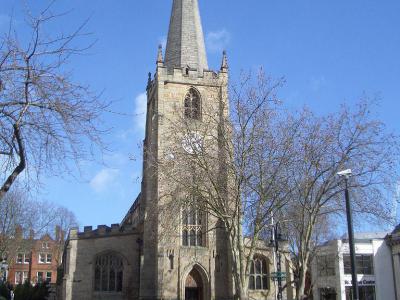


St. Peter's Church, Nottingham
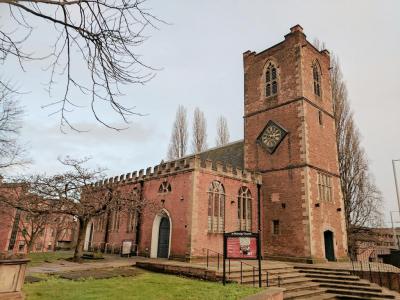
Saint Peter’s Church, officially The Church of Saint Peter with Saint James, is a Grade I listed Anglican parish church located in the heart of Nottingham city center. It is one of the city’s three medieval parish churches-alongside Saint Mary’s and Saint Nicholas'-and is considered the oldest building in continuous public use in Nottingham.
The church stands on a site first occupied around 1100, though the original structure was destroyed by fire. The present building began construction around 1180 and reveals a rich architectural timeline spanning centuries. In 1933, Saint Peter’s parish absorbed that of Saint James’ Church, Standard Hill (founded in 1807), and the new combined parish was formally renamed Saint Peter with Saint James. While Saint James’s Church was later demolished, some of its monuments now reside within Saint Peter’s.
Nestled just steps from the Old Market Square and surrounded by the city’s commercial bustle, Saint Peter’s is a peaceful refuge. Visitors are drawn not only by its historical and architectural features-such as the beautifully carved medieval rood screen, a striking modern reredos, and the poignant Workers' Memorial Window-but also by its vibrant role in community life.
The church has a proud and long-standing musical heritage. With a distinguished choir, regular Sunday services, and a popular Saturday morning concert series, Saint Peter’s continues to play a key cultural role. Its organ, originally installed in 1812, has been expanded and restored over time, incorporating parts from other historic instruments.
The church grounds include a welcoming churchyard and the Saint Peter’s Centre, home to a café and a shop offering fair-trade goods and books. Committed to serving all city residents-particularly the disadvantaged-Saint Peter’s is a living example of faith, heritage, and hospitality.
The church stands on a site first occupied around 1100, though the original structure was destroyed by fire. The present building began construction around 1180 and reveals a rich architectural timeline spanning centuries. In 1933, Saint Peter’s parish absorbed that of Saint James’ Church, Standard Hill (founded in 1807), and the new combined parish was formally renamed Saint Peter with Saint James. While Saint James’s Church was later demolished, some of its monuments now reside within Saint Peter’s.
Nestled just steps from the Old Market Square and surrounded by the city’s commercial bustle, Saint Peter’s is a peaceful refuge. Visitors are drawn not only by its historical and architectural features-such as the beautifully carved medieval rood screen, a striking modern reredos, and the poignant Workers' Memorial Window-but also by its vibrant role in community life.
The church has a proud and long-standing musical heritage. With a distinguished choir, regular Sunday services, and a popular Saturday morning concert series, Saint Peter’s continues to play a key cultural role. Its organ, originally installed in 1812, has been expanded and restored over time, incorporating parts from other historic instruments.
The church grounds include a welcoming churchyard and the Saint Peter’s Centre, home to a café and a shop offering fair-trade goods and books. Committed to serving all city residents-particularly the disadvantaged-Saint Peter’s is a living example of faith, heritage, and hospitality.
Want to visit this sight? Check out these Self-Guided Walking Tours in Nottingham. Alternatively, you can download the mobile app "GPSmyCity: Walks in 1K+ Cities" from Apple App Store or Google Play Store. The app turns your mobile device to a personal tour guide and it works offline, so no data plan is needed when traveling abroad.
Download The GPSmyCity App



St. Peter's Church on Map
Sight Name: St. Peter's Church
Sight Location: Nottingham, England (See walking tours in Nottingham)
Sight Type: Religious
Sight Location: Nottingham, England (See walking tours in Nottingham)
Sight Type: Religious
Nearby Sights


Walking Tours in Nottingham, England

Create Your Own Walk in Nottingham
Creating your own self-guided walk in Nottingham is easy and fun. Choose the city attractions that you want to see and a walk route map will be created just for you. You can even set your hotel as the start point of the walk.

Nottingham's Historical Buildings Tour
Given the variety of architectural styles and designs in Nottingham, England, it is safe to call it the city of contrasts. The tapestry of historical buildings found here, each weaving a unique story of the city's past, is quite rich and worthy of attention.
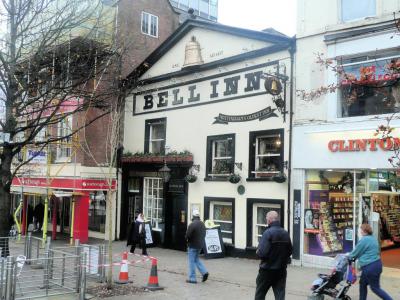
Among these architectural treasures is the Bell Inn, a charming establishment steeped in history and character. Its traditional... view more
Tour Duration: 2 Hour(s)
Travel Distance: 3.9 Km or 2.4 Miles
Among these architectural treasures is the Bell Inn, a charming establishment steeped in history and character. Its traditional... view more
Tour Duration: 2 Hour(s)
Travel Distance: 3.9 Km or 2.4 Miles

Nottingham's Historic City Center Walking Tour
Nottingham was known only as "The Place of Caves" in 600 AD. A Saxon chief named Snot ruled "Snotingaham", or, "the home of Snot's people." It was part of Danelaw in the 7th century, administered from a stone Hall on High Pavement, the first street of Nottingham.
In 1068 Norman invaders built a wooden motte-and-bailey fortress on a high sandstone promontory.... view more
Tour Duration: 2 Hour(s)
Travel Distance: 2.5 Km or 1.6 Miles
In 1068 Norman invaders built a wooden motte-and-bailey fortress on a high sandstone promontory.... view more
Tour Duration: 2 Hour(s)
Travel Distance: 2.5 Km or 1.6 Miles
Robin Hood Trail
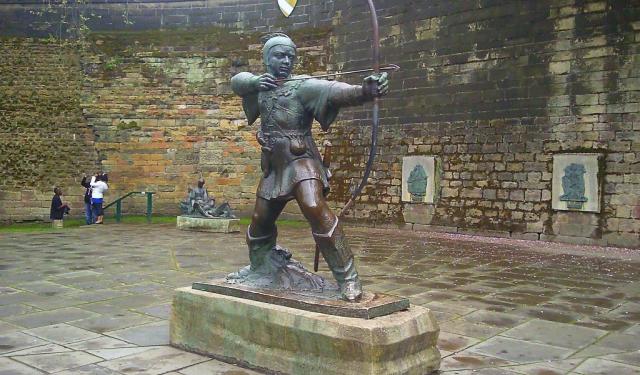
There's hardly anyone on this planet who hasn't heard of Robin Hood. Apparently, a Saxon nobleman born in 1160 in Loxley, this hero of numerous ballads, some dating back as far as the 14th century, earned fame by robbing from the rich and giving it back to the poor. A skilled archer and sword fighter as he was, Robin Hood famously defended villagers from attacks by corrupt noblemen,... view more
Tour Duration: 1 Hour(s)
Travel Distance: 1.5 Km or 0.9 Miles
Tour Duration: 1 Hour(s)
Travel Distance: 1.5 Km or 0.9 Miles