

Talaa Kebira (Great Slope Street), Fes
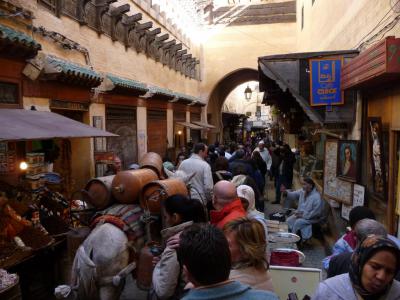
Cutting straight through Fès el-Bali and running all the way down to the Kairaouine Mosque and University, Talaa Kebira-which literally means “the Big Slope”-is the Medina’s main artery. It goes by different names along the way, but the experience stays the same: this street is less about ticking off monuments and more about letting your senses take the lead. Look up, and you’ll spot shop signs shaped like camel heads pointing the way to butchers.
Look around, and you’ll hear vendors bargaining over spices and slippers. Listen carefully, and you’ll also hear donkeys, doing the real heavy lifting as they haul goods up and down the uneven stone pavement. At the western end, the street starts out firmly focused on food. Produce stalls, butchers, and small grocery shops dominate this stretch, supplying both locals and restaurant kitchens.
As you pass the Bou Inania Madrasa, the scene shifts. The shops become more varied, selling everything from everyday essentials to items aimed at rural visitors who come into the city to trade. This is where Talaa Kebira begins to feel like a moving cross-section of Medina life.
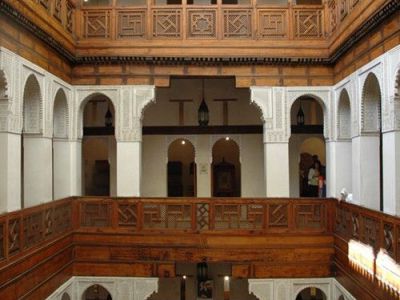
Keep going, and you’ll notice a cluster of old fondouks-just a few survivors from the roughly 200 that once filled Fès el-Bali. Built around the same period as the madrasa, these large two-storey buildings were medieval inns for traveling merchants and their animals. Rooms lined the upper floors, while the ground level opened onto wide courtyards designed for unloading goods and stabling mules.
One of the more interesting stops is Bousl Hame, at number 49 on the left, now home to a lively drum workshop where traditional rhythms take shape. About fifty metres further along, on the right, is Qaât Smen, a small market specializing in butter and honey. You’ll probably smell it before you see it-smen, an aged butter prized in Moroccan cooking, announces itself loudly.
A little farther down, also on the right, is the worn-down Fondouk Tazi, with a few pottery stalls still hanging on. Almost opposite, on the left, sits the largely abandoned Fondouk Lbbata, unmistakable for its stacks of sheepskins waiting to be cured. It’s not polished, it’s not subtle-but it’s very much Talaa Kebira doing what it has always done.
Look around, and you’ll hear vendors bargaining over spices and slippers. Listen carefully, and you’ll also hear donkeys, doing the real heavy lifting as they haul goods up and down the uneven stone pavement. At the western end, the street starts out firmly focused on food. Produce stalls, butchers, and small grocery shops dominate this stretch, supplying both locals and restaurant kitchens.
As you pass the Bou Inania Madrasa, the scene shifts. The shops become more varied, selling everything from everyday essentials to items aimed at rural visitors who come into the city to trade. This is where Talaa Kebira begins to feel like a moving cross-section of Medina life.
Keep going, and you’ll notice a cluster of old fondouks-just a few survivors from the roughly 200 that once filled Fès el-Bali. Built around the same period as the madrasa, these large two-storey buildings were medieval inns for traveling merchants and their animals. Rooms lined the upper floors, while the ground level opened onto wide courtyards designed for unloading goods and stabling mules.
One of the more interesting stops is Bousl Hame, at number 49 on the left, now home to a lively drum workshop where traditional rhythms take shape. About fifty metres further along, on the right, is Qaât Smen, a small market specializing in butter and honey. You’ll probably smell it before you see it-smen, an aged butter prized in Moroccan cooking, announces itself loudly.
A little farther down, also on the right, is the worn-down Fondouk Tazi, with a few pottery stalls still hanging on. Almost opposite, on the left, sits the largely abandoned Fondouk Lbbata, unmistakable for its stacks of sheepskins waiting to be cured. It’s not polished, it’s not subtle-but it’s very much Talaa Kebira doing what it has always done.
Want to visit this sight? Check out these Self-Guided Walking Tours in Fes. Alternatively, you can download the mobile app "GPSmyCity: Walks in 1K+ Cities" from Apple App Store or Google Play Store. The app turns your mobile device to a personal tour guide and it works offline, so no data plan is needed when traveling abroad.
Download The GPSmyCity App



Talaa Kebira (Great Slope Street) on Map
Sight Name: Talaa Kebira (Great Slope Street)
Sight Location: Fes, Morocco (See walking tours in Fes)
Sight Type: Attraction/Landmark
Guide(s) Containing This Sight:
Sight Location: Fes, Morocco (See walking tours in Fes)
Sight Type: Attraction/Landmark
Guide(s) Containing This Sight:
Nearby Sights
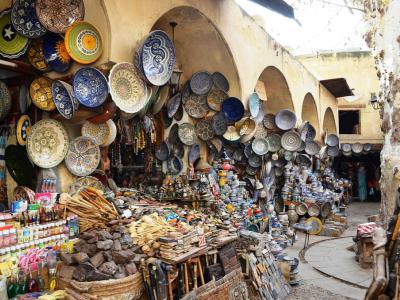
Walking Tours in Fes, Morocco

Create Your Own Walk in Fes
Creating your own self-guided walk in Fes is easy and fun. Choose the city attractions that you want to see and a walk route map will be created just for you. You can even set your hotel as the start point of the walk.
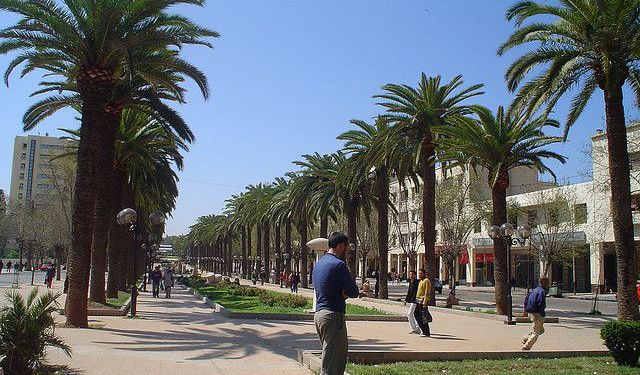
Fes New Town Walking Tour
While the Old Town-or Medina, as they call it-twists and turns on its own terms, the Ville Nouvelle, or the New Town of Fes, does things differently. Created by the French in the early 20th century and developed mainly in the 1910s, this district was designed to bring order, space, and modern infrastructure to the city. Wide streets replaced narrow lanes, open squares replaced hidden courtyards,... view more
Tour Duration: 1 Hour(s)
Travel Distance: 2.7 Km or 1.7 Miles
Tour Duration: 1 Hour(s)
Travel Distance: 2.7 Km or 1.7 Miles
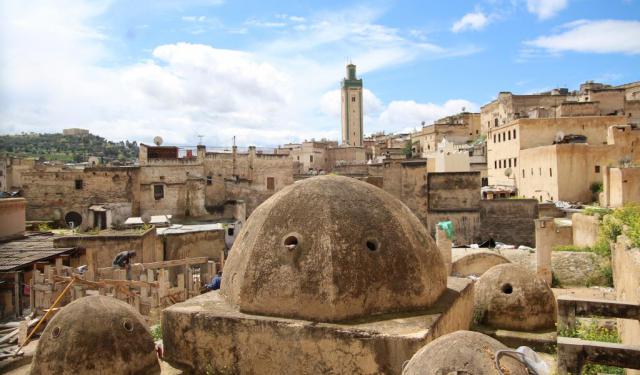
Fes Old Town Walking Tour
Fes-also known as Fez-is an ancient Moroccan city gathered around the Fes River like it’s been holding a long, serious conversation for over a thousand years. People have called it the “Mecca of the West” and the “Athens of Africa,” which is a lot of pressure for one place.
Its story began in 789, when Idris I-an Arab emir and founder of the Idrisid dynasty-established the city,... view more
Tour Duration: 2 Hour(s)
Travel Distance: 3.7 Km or 2.3 Miles
Its story began in 789, when Idris I-an Arab emir and founder of the Idrisid dynasty-established the city,... view more
Tour Duration: 2 Hour(s)
Travel Distance: 3.7 Km or 2.3 Miles