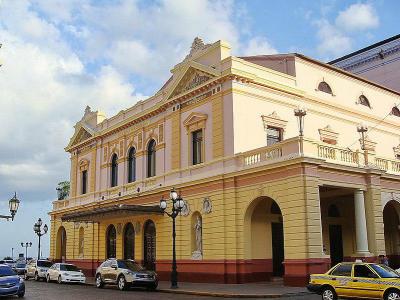


Teatro Nacional (National Theater), Panama City
The National Theater of Panama opened in 1908 and was built on the site of a former colonial religious complex, reflecting the practice of repurposing ecclesiastical land for civic use in the early republican period.
Over the course of the twentieth century, the building experienced periods of decline and adaptation. At various times, it functioned as a cinema and even as a social venue for elite gatherings, before its cultural role was gradually restored. Major conservation efforts were carried out in two phases: an initial restoration in the 1970s, followed by a more comprehensive program in the early 2000s, leading to the theater’s reopening in 2004.
The interior is richly decorated, featuring ornate balconies highlighted with gold detailing, large chandeliers, and a carefully restored auditorium. In the foyer and public spaces, busts of prominent literary figures underscore the theater’s connection to the performing arts and literary tradition. One of the theater’s most distinctive features is its ceiling frescoes, painted by Roberto Lewis, one of Panama’s most important early twentieth-century artists. These murals present scenes from Panamanian history framed through allegorical and classical imagery, drawing on the visual language of Greek mythology to convey national themes.
Today, the National Theater remains one of Panama’s principal cultural institutions, hosting theater productions, concerts, opera, and ballet, and serving as a key venue for the country’s artistic life.
Over the course of the twentieth century, the building experienced periods of decline and adaptation. At various times, it functioned as a cinema and even as a social venue for elite gatherings, before its cultural role was gradually restored. Major conservation efforts were carried out in two phases: an initial restoration in the 1970s, followed by a more comprehensive program in the early 2000s, leading to the theater’s reopening in 2004.
The interior is richly decorated, featuring ornate balconies highlighted with gold detailing, large chandeliers, and a carefully restored auditorium. In the foyer and public spaces, busts of prominent literary figures underscore the theater’s connection to the performing arts and literary tradition. One of the theater’s most distinctive features is its ceiling frescoes, painted by Roberto Lewis, one of Panama’s most important early twentieth-century artists. These murals present scenes from Panamanian history framed through allegorical and classical imagery, drawing on the visual language of Greek mythology to convey national themes.
Today, the National Theater remains one of Panama’s principal cultural institutions, hosting theater productions, concerts, opera, and ballet, and serving as a key venue for the country’s artistic life.
Want to visit this sight? Check out these Self-Guided Walking Tours in Panama City. Alternatively, you can download the mobile app "GPSmyCity: Walks in 1K+ Cities" from Apple App Store or Google Play Store. The app turns your mobile device to a personal tour guide and it works offline, so no data plan is needed when traveling abroad.
Download The GPSmyCity App



Teatro Nacional (National Theater) on Map
Sight Name: Teatro Nacional (National Theater)
Sight Location: Panama City, Panama (See walking tours in Panama City)
Sight Type: Attraction/Landmark
Guide(s) Containing This Sight:
Sight Location: Panama City, Panama (See walking tours in Panama City)
Sight Type: Attraction/Landmark
Guide(s) Containing This Sight:
Nearby Sights
Walking Tours in Panama City, Panama

Create Your Own Walk in Panama City
Creating your own self-guided walk in Panama City is easy and fun. Choose the city attractions that you want to see and a walk route map will be created just for you. You can even set your hotel as the start point of the walk.
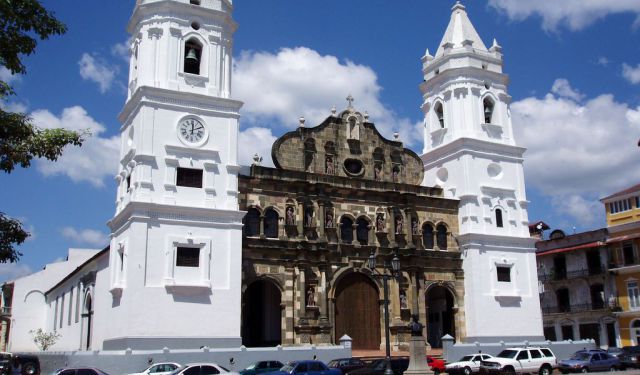
Historical Churches Tour
Caught between the lush green mountains and the ocean, the capital of Panama is a concentration of colors and styles. The evidence of Spanish influence is still vivid in the colonial landmarks, especially religious sites.
For centuries, colonial religious architecture has played an important role in the configuration of the urban layout of Panama City. By the 17th century, convents had an... view more
Tour Duration: 1 Hour(s)
Travel Distance: 1.0 Km or 0.6 Miles
For centuries, colonial religious architecture has played an important role in the configuration of the urban layout of Panama City. By the 17th century, convents had an... view more
Tour Duration: 1 Hour(s)
Travel Distance: 1.0 Km or 0.6 Miles
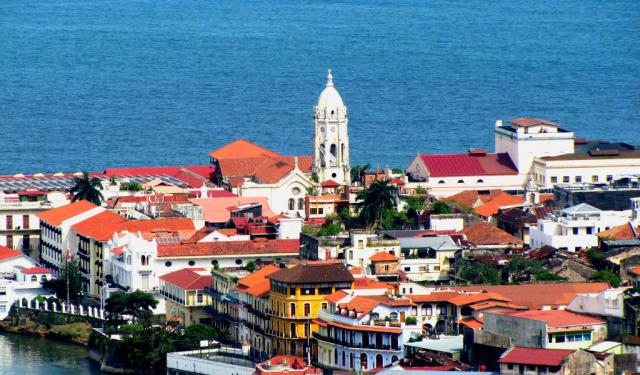
A Walk in Panama's Charming Old Town
German polymath and geographer Alexander von Humboldt, who analyzed the Isthmus of Panama as a natural crossroads in the early 19th century, famously described Panama as a place destined by nature to become the meeting point of nations.
Founded on 15 August 1519 by the Spanish conquistador Pedro Arias Dávila, Panama City was the first permanent European settlement on the Pacific coast of the... view more
Tour Duration: 1 Hour(s)
Travel Distance: 0.9 Km or 0.6 Miles
Founded on 15 August 1519 by the Spanish conquistador Pedro Arias Dávila, Panama City was the first permanent European settlement on the Pacific coast of the... view more
Tour Duration: 1 Hour(s)
Travel Distance: 0.9 Km or 0.6 Miles