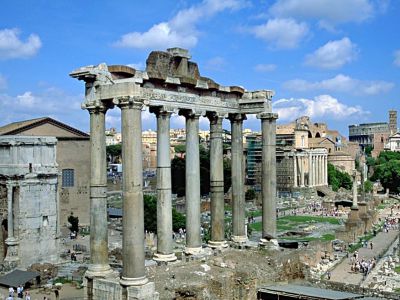


Tempio di Saturno (Temple of Saturn), Rome
The Temple of Saturn, one of the most recognizable ruins in the Roman Forum, stands as a testament to Rome’s ancient religious and financial traditions. Positioned at the base of the Capitoline Hill, near the Arch of Septimius Severus, its surviving columns are an enduring symbol of Rome’s legendary past.
The temple’s origins date back to 497 BC, when it was constructed under the rule of Tarquinius, the last king of Rome, just before the establishment of the Roman Republic. Over the centuries, the structure underwent multiple reconstructions due to fires and other damage. The present ruins belong to a 4th-century AD restoration, as indicated by an inscription on the architrave, which credits the Roman Senate for its rebuilding after a major fire.
Dedicated to Saturn, an ancient Roman deity associated with agriculture, wealth, and abundance, the temple also functioned as Rome’s public treasury. This role lasted throughout the Republican era and continued to some extent under the Empire. Saturn was later equated with the Greek god Kronos, further elevating his significance within Roman religion.
Architecturally, the Temple of Saturn was famous for its grand portico, featuring eight towering Ionic columns that once supported an elaborate pediment and frieze. Though much of the structure has vanished, the architrave inscription remains intact, reading: “The Senate and People of Rome restored what fire had consumed.” This highlights both the temple’s resilience and the collective civic duty of the Roman people.
Beyond its religious and financial roles, the temple played a key part in the Saturnalia festival, held annually on December 17th. This lively event, which later evolved into Christmas traditions, was characterized by role reversals-slaves were temporarily treated as equals to their masters-along with feasting, gift-giving, and general revelry. The festival culminated on December 25th, the Day of the Invincible Sun, marking a transition from Roman to Christian holiday customs.
Over time, the temple also housed a bank, a logical evolution given Saturn’s association with wealth. Today, what remains of this once-grand structure are its podium and eight massive granite and marble columns, offering a glimpse into its former splendor. Though much of the original temple is lost, its historical and cultural significance endures, inviting visitors to imagine its past glory at the heart of ancient Rome.
The temple’s origins date back to 497 BC, when it was constructed under the rule of Tarquinius, the last king of Rome, just before the establishment of the Roman Republic. Over the centuries, the structure underwent multiple reconstructions due to fires and other damage. The present ruins belong to a 4th-century AD restoration, as indicated by an inscription on the architrave, which credits the Roman Senate for its rebuilding after a major fire.
Dedicated to Saturn, an ancient Roman deity associated with agriculture, wealth, and abundance, the temple also functioned as Rome’s public treasury. This role lasted throughout the Republican era and continued to some extent under the Empire. Saturn was later equated with the Greek god Kronos, further elevating his significance within Roman religion.
Architecturally, the Temple of Saturn was famous for its grand portico, featuring eight towering Ionic columns that once supported an elaborate pediment and frieze. Though much of the structure has vanished, the architrave inscription remains intact, reading: “The Senate and People of Rome restored what fire had consumed.” This highlights both the temple’s resilience and the collective civic duty of the Roman people.
Beyond its religious and financial roles, the temple played a key part in the Saturnalia festival, held annually on December 17th. This lively event, which later evolved into Christmas traditions, was characterized by role reversals-slaves were temporarily treated as equals to their masters-along with feasting, gift-giving, and general revelry. The festival culminated on December 25th, the Day of the Invincible Sun, marking a transition from Roman to Christian holiday customs.
Over time, the temple also housed a bank, a logical evolution given Saturn’s association with wealth. Today, what remains of this once-grand structure are its podium and eight massive granite and marble columns, offering a glimpse into its former splendor. Though much of the original temple is lost, its historical and cultural significance endures, inviting visitors to imagine its past glory at the heart of ancient Rome.
Want to visit this sight? Check out these Self-Guided Walking Tours in Rome. Alternatively, you can download the mobile app "GPSmyCity: Walks in 1K+ Cities" from Apple App Store or Google Play Store. The app turns your mobile device to a personal tour guide and it works offline, so no data plan is needed when traveling abroad.
Download The GPSmyCity App



Tempio di Saturno (Temple of Saturn) on Map
Sight Name: Tempio di Saturno (Temple of Saturn)
Sight Location: Rome, Italy (See walking tours in Rome)
Sight Type: Attraction/Landmark
Guide(s) Containing This Sight:
Sight Location: Rome, Italy (See walking tours in Rome)
Sight Type: Attraction/Landmark
Guide(s) Containing This Sight:
Nearby Sights
Walking Tours in Rome, Italy

Create Your Own Walk in Rome
Creating your own self-guided walk in Rome is easy and fun. Choose the city attractions that you want to see and a walk route map will be created just for you. You can even set your hotel as the start point of the walk.
Rome Introduction Walking Tour I
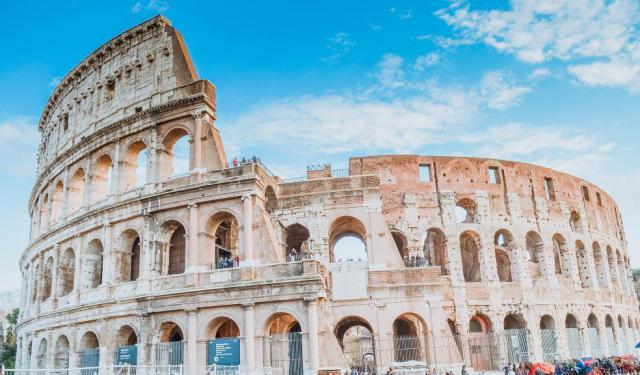
Often referred to as the Eternal City, Rome holds a unique place in the story of Western civilization. Its influence shaped European culture through language, governance, and monumental architecture.
The name “Rome” originates from Romulus, the mythical founder of the city, who, according to legend, was the son of the war god Mars and Rhea Silvia, the priestess of goddess Vesta. Both... view more
Tour Duration: 2 Hour(s)
Travel Distance: 3.7 Km or 2.3 Miles
The name “Rome” originates from Romulus, the mythical founder of the city, who, according to legend, was the son of the war god Mars and Rhea Silvia, the priestess of goddess Vesta. Both... view more
Tour Duration: 2 Hour(s)
Travel Distance: 3.7 Km or 2.3 Miles
Seven Pilgrim Churches of Rome Walking Tour
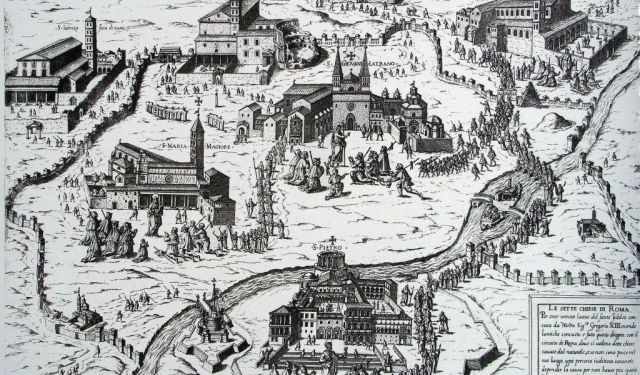
Rome has long played host to pilgrims-after all, it's home to the Pope, the Catholic Curia, and a treasure trove of relics linked to apostles, saints, and martyrs. Back in the day, the Via Francigena provided a straight shot for the faithful traveling from England to Rome. Upon arrival, it was tradition to visit the tombs of Saints Peter and Paul. When a Jubilee rolled around, the spiritual... view more
Tour Duration: 6 Hour(s)
Travel Distance: 17.4 Km or 10.8 Miles
Tour Duration: 6 Hour(s)
Travel Distance: 17.4 Km or 10.8 Miles
Fountains and Squares Walking Tour
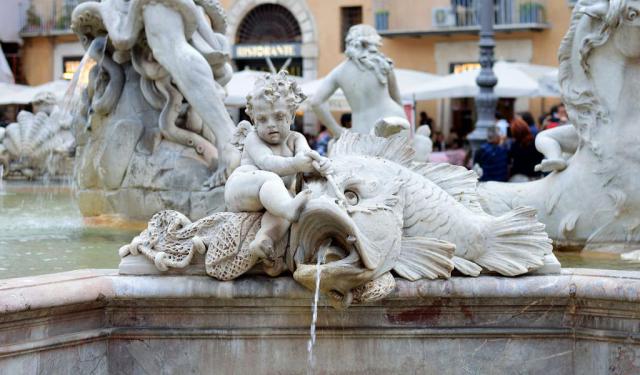
In Rome there is a lively piazza round almost every corner, each with its own unique atmosphere and its own story to tell. These public squares have been the center of Roman culture for centuries, and some of the city’s most popular attractions are located within them.
Most piazzas have a fountain in the center and a lot of cafes around. In fact, Rome holds the largest number of fountains in... view more
Tour Duration: 2 Hour(s)
Travel Distance: 4.1 Km or 2.5 Miles
Most piazzas have a fountain in the center and a lot of cafes around. In fact, Rome holds the largest number of fountains in... view more
Tour Duration: 2 Hour(s)
Travel Distance: 4.1 Km or 2.5 Miles

"Roman Holiday" Movie Walking Tour
Filmed entirely in the heart of Rome, Roman Holiday is one of those timeless films that beckons you to hop on a Vespa and lose yourself in the intoxicating beauty of the Italian capital. Released in 1953, this beloved classic has captured hearts across generations, thanks to its irresistible blend of romance, adventure, and charm-anchored by two of Hollywood’s brightest stars, Audrey Hepburn and... view more
Tour Duration: 4 Hour(s)
Travel Distance: 8.5 Km or 5.3 Miles
Tour Duration: 4 Hour(s)
Travel Distance: 8.5 Km or 5.3 Miles
Spanish Steps to Trevi Fountain
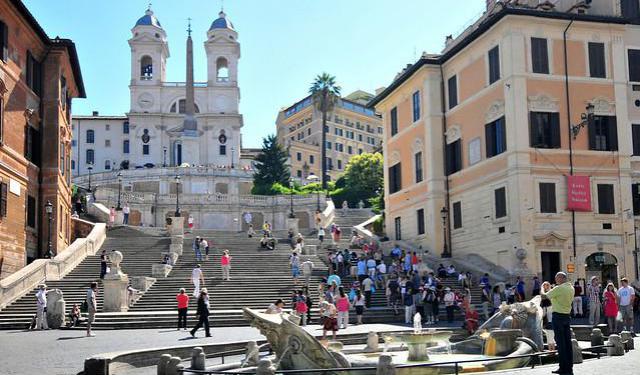
An established tourist mecca, today's Rome is hardly imaginable without two of its much loved attractions – the Spanish Steps and the Trevi Fountain. Magnets for tourists as they are, these two sights are connected to a number of other, not less worthy of attention locations, such as the Fountain of the Longboat or Piazza Colonna and its centerpiece, the Column of Marcus Aurelius, to... view more
Tour Duration: 1 Hour(s)
Travel Distance: 2.0 Km or 1.2 Miles
Tour Duration: 1 Hour(s)
Travel Distance: 2.0 Km or 1.2 Miles
Trastevere Walking Tour
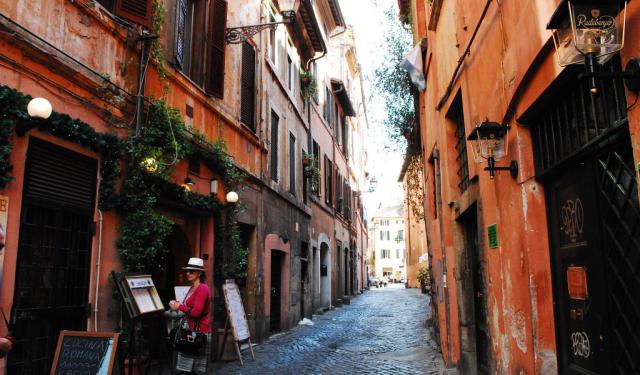
Heading down from the Vatican along the River Tiber, one is bound to find yet another city hidden within the city – Trastevere. This name translates literally to "across the Tiber". Indeed, crossing the picturesque Ponte Sisto (Sisto Bridge) to the west bank, you will find yourself in a charming neighborhood with a distinct character that sets it apart from any other part of Rome.
... view more
Tour Duration: 2 Hour(s)
Travel Distance: 3.0 Km or 1.9 Miles
... view more
Tour Duration: 2 Hour(s)
Travel Distance: 3.0 Km or 1.9 Miles
Useful Travel Guides for Planning Your Trip

17 Best Gelaterias in Rome Italy
For ice cream lovers and dabblers this guide is a treasure chest of Rome’s best gelato shops. There are gelaterias everywhere. Many visitors to Rome only have a few days to explore the city. You owe it to yourself to make the most of your time and find the gelato locals eat. Often the authentic...
10 Best Food Markets in Rome Italy
Of all the things Italy is most famous for (cars, music, fashion, movies, etc.), food is, undoubtedly, top of the list. Rome may well not be the whole Italy, but no Italy is whole without Rome... And the Romans, much as all their fellow-Italians, like it "fresco", hence the abundance of...

Souvenirs Shopping: 15 Authentic Italian Things To Buy in Rome
Rome is the Eternal City and, as such, the list of gift options available here is countless. Whether it's something edible, drinkable, wearable or pleasing to the eye that you want - you will find it all here in abundance. However, if time or budget is the factor, perhaps you might want to...