

The Granary, Limerick
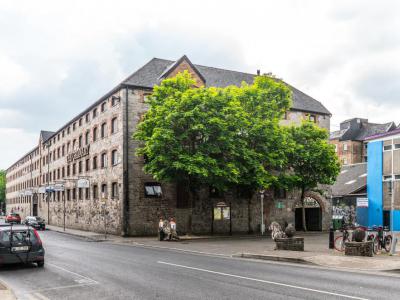
The Granary, located in the heart of Limerick, is a distinguished historical landmark, prominently positioned overlooking the Abbey River. Originally constructed in 1787 by the local merchant Philip John Roche, the Granary started as a warehouse, a testament to Limerick's industrious past. This L-shaped limestone building boasts a robust structure, characterized by its four-to-five-story facade that features six bays on the north side. Its historical architecture includes carriage arches on either side, leading to a charming enclosed courtyard.
The Granary's walls are built from large blocks of limestone, and the corners are neatly squared off. The arched windows have red brick frames and are updated with modern casement windows. Other design elements include small, narrow windows and red brick arches over the wooden gates. At the entrance on Michael Street, there are stone gate posts from the 1800s linked by decorative iron railings and gates, adding to the building's historical charm.
In its renovated form, the Granary now serves multiple community functions, housing the Trinity Rooms, the City Library, and various office spaces. This adaptive reuse not only preserved the building's architectural heritage but also repurposed it for civic, recreational, and office use, making it a vital part of the community.
Today, the Granary stands as a prime example of the adaptability of industrial architecture to modern needs, while still celebrating its historical significance. It remains one of the most iconic structures in Limerick, symbolizing the city’s rich industrial past and its dynamic present.
The Granary's walls are built from large blocks of limestone, and the corners are neatly squared off. The arched windows have red brick frames and are updated with modern casement windows. Other design elements include small, narrow windows and red brick arches over the wooden gates. At the entrance on Michael Street, there are stone gate posts from the 1800s linked by decorative iron railings and gates, adding to the building's historical charm.
In its renovated form, the Granary now serves multiple community functions, housing the Trinity Rooms, the City Library, and various office spaces. This adaptive reuse not only preserved the building's architectural heritage but also repurposed it for civic, recreational, and office use, making it a vital part of the community.
Today, the Granary stands as a prime example of the adaptability of industrial architecture to modern needs, while still celebrating its historical significance. It remains one of the most iconic structures in Limerick, symbolizing the city’s rich industrial past and its dynamic present.
Want to visit this sight? Check out these Self-Guided Walking Tours in Limerick. Alternatively, you can download the mobile app "GPSmyCity: Walks in 1K+ Cities" from Apple App Store or Google Play Store. The app turns your mobile device to a personal tour guide and it works offline, so no data plan is needed when traveling abroad.
Download The GPSmyCity App



The Granary on Map
Sight Name: The Granary
Sight Location: Limerick, Ireland (See walking tours in Limerick)
Sight Type: Attraction/Landmark
Sight Location: Limerick, Ireland (See walking tours in Limerick)
Sight Type: Attraction/Landmark
Nearby Sights


Walking Tours in Limerick, Ireland

Create Your Own Walk in Limerick
Creating your own self-guided walk in Limerick is easy and fun. Choose the city attractions that you want to see and a walk route map will be created just for you. You can even set your hotel as the start point of the walk.
A Walk in Limerick's Historic City Center
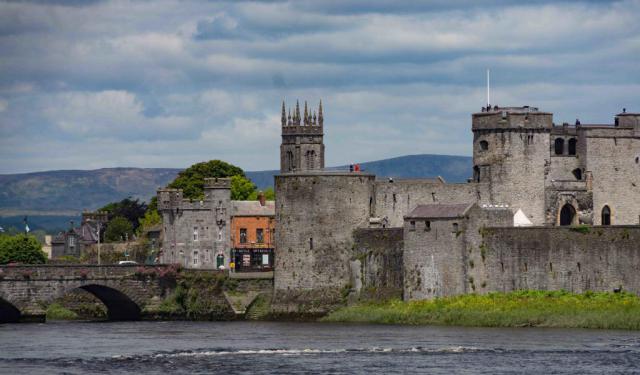
Claudius Ptolemy, the great geographer of the ancient world, drew a map of Ireland in 150 AD. Indicated on the map was a place now called King's Island. It is said generous King Cormac ruled here in the 4th century. Here is where St Patrick baptized King Carthann the Fair in 434. Here is the ancient heart of Limerick.
Saint Munchin had been the first bishop of Limerick in 652. In 812,... view more
Tour Duration: 2 Hours
Travel Distance: 3 Km or 1.9 Miles
Saint Munchin had been the first bishop of Limerick in 652. In 812,... view more
Tour Duration: 2 Hours
Travel Distance: 3 Km or 1.9 Miles
City Walks Overview
