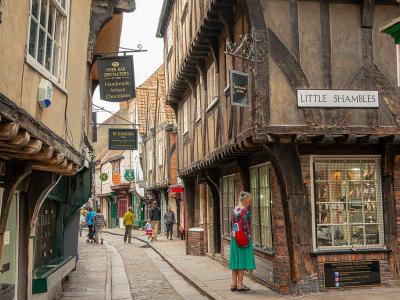


The Shambles, York (must see)
The Shambles is one of York’s most famous historic streets and one of the best-preserved medieval streets in England. The name refers to a meat market, and records of butchers’ stalls in the area appear as early as the 1086 Domesday Book. By 1426, the street was known as the Great Flesh Shambles, a name later shortened to simply The Shambles.
Most of the surviving buildings date from the 14th century, with many constructed before 1475. The narrow, cobbled street is lined with timber-framed buildings whose upper floors dramatically overhang the road. This distinctive design helped shelter the walls below and protect meat displayed outside the shops from direct sunlight. Slaughterhouses were located behind the butcher shops, while raised pavements made it easier to wash away blood and waste. As you walk along the street, make sure to look up at the jettied upper storeys, which lean closely together overhead, nearly blocking out the sky between the shop roofs.
Although butchers no longer dominate the street, some buildings still retain meat hooks and shelves that recall the street’s former trade. Pay attention to the weathered wooden beams on the shopfronts to spot the original wrought-iron meat hooks still fixed into the timber.
Today, the shops include restaurants, a bakery, a bookshop and other independent businesses. Nearby, Shambles Market operates daily between The Shambles and Parliament Street.
The street also has a connection to Saint Margaret Clitherow, known as the “Pearl of York”. She lived on The Shambles with her butcher husband and was martyred in 1586 for refusing to enter a plea to the charge of harbouring Catholic priests. A shrine to her can be found at No. 35 The Shambles, where a black oval plaque marks the façade of the building. Pause to look inside the quiet chapel dedicated to her memory.
The Shambles is also popularly associated with Diagon Alley from the Harry Potter films, although J.K. Rowling has denied that it directly inspired the fictional street. Regardless, its atmospheric medieval character makes the comparison easy to understand.
Be sure to explore the five snickelways leading off The Shambles. These narrow medieval alleys provide charming connections to the surrounding streets and offer another glimpse of York’s historic character. For instance, turn into Little Shambles, one of the narrow snickelways branching off the main lane, to follow the pedestrian route towards the bustling Shambles Market. Little Shambles is the northernmost of the five snickelways.
Most of the surviving buildings date from the 14th century, with many constructed before 1475. The narrow, cobbled street is lined with timber-framed buildings whose upper floors dramatically overhang the road. This distinctive design helped shelter the walls below and protect meat displayed outside the shops from direct sunlight. Slaughterhouses were located behind the butcher shops, while raised pavements made it easier to wash away blood and waste. As you walk along the street, make sure to look up at the jettied upper storeys, which lean closely together overhead, nearly blocking out the sky between the shop roofs.
Although butchers no longer dominate the street, some buildings still retain meat hooks and shelves that recall the street’s former trade. Pay attention to the weathered wooden beams on the shopfronts to spot the original wrought-iron meat hooks still fixed into the timber.
Today, the shops include restaurants, a bakery, a bookshop and other independent businesses. Nearby, Shambles Market operates daily between The Shambles and Parliament Street.
The street also has a connection to Saint Margaret Clitherow, known as the “Pearl of York”. She lived on The Shambles with her butcher husband and was martyred in 1586 for refusing to enter a plea to the charge of harbouring Catholic priests. A shrine to her can be found at No. 35 The Shambles, where a black oval plaque marks the façade of the building. Pause to look inside the quiet chapel dedicated to her memory.
The Shambles is also popularly associated with Diagon Alley from the Harry Potter films, although J.K. Rowling has denied that it directly inspired the fictional street. Regardless, its atmospheric medieval character makes the comparison easy to understand.
Be sure to explore the five snickelways leading off The Shambles. These narrow medieval alleys provide charming connections to the surrounding streets and offer another glimpse of York’s historic character. For instance, turn into Little Shambles, one of the narrow snickelways branching off the main lane, to follow the pedestrian route towards the bustling Shambles Market. Little Shambles is the northernmost of the five snickelways.
Want to visit this sight? Check out these Self-Guided Walking Tours in York. Alternatively, you can download the mobile app "GPSmyCity: Walks in 1K+ Cities" from Apple App Store or Google Play Store. The app turns your mobile device to a personal tour guide and it works offline, so no data plan is needed when traveling abroad.
Download The GPSmyCity App



The Shambles on Map
Sight Name: The Shambles
Sight Location: York, England (See walking tours in York)
Sight Type: Attraction/Landmark
Guide(s) Containing This Sight:
Sight Location: York, England (See walking tours in York)
Sight Type: Attraction/Landmark
Guide(s) Containing This Sight:
Nearby Sights

Walking Tours in York, England

Create Your Own Walk in York
Creating your own self-guided walk in York is easy and fun. Choose the city attractions that you want to see and a walk route map will be created just for you. You can even set your hotel as the start point of the walk.
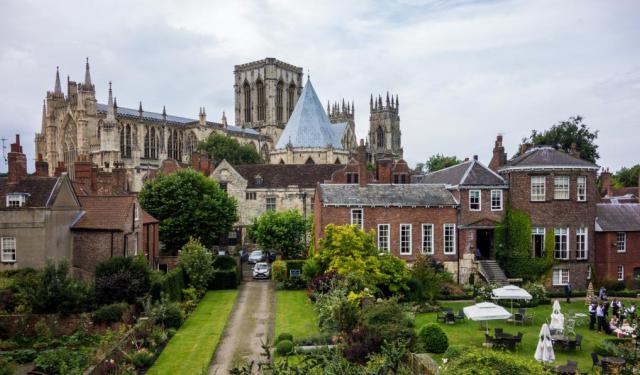
Walking Through York's Historical Old Town
King George VI famously said, “The history of York is the history of England.”
York’s Old Town is a remarkably well-preserved historic centre where more than 2,000 years of history unfold through its streets, buildings and ancient walls. Despite its relatively small size, the Old Town is packed with rich heritage, attracting visitors from around the world.
The story begins in AD 71,... view more
Tour Duration: 1 Hour(s)
Travel Distance: 1.3 Km or 0.8 Miles
York’s Old Town is a remarkably well-preserved historic centre where more than 2,000 years of history unfold through its streets, buildings and ancient walls. Despite its relatively small size, the Old Town is packed with rich heritage, attracting visitors from around the world.
The story begins in AD 71,... view more
Tour Duration: 1 Hour(s)
Travel Distance: 1.3 Km or 0.8 Miles
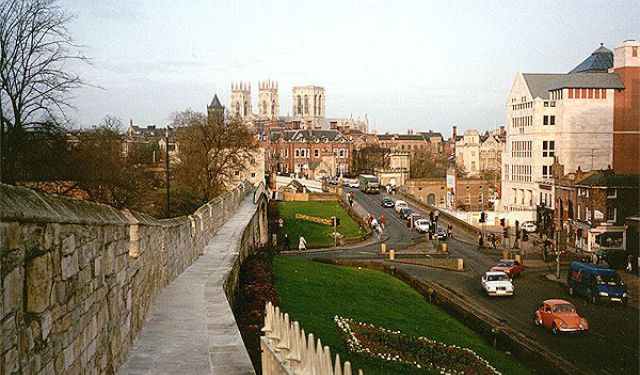
York City Wall Tour
York’s City Wall is one of the best-preserved medieval city defences in England, but its story begins long before the medieval period. Around 71–74 AD, the Romans established the fortress of Eboracum at the junction of the Rivers Ouse and Foss. Its earliest defences were probably made of earth and timber, but by around 107–108 AD, these had been replaced by substantial stone walls, including... view more
Tour Duration: 2 Hour(s)
Travel Distance: 3.8 Km or 2.4 Miles
Tour Duration: 2 Hour(s)
Travel Distance: 3.8 Km or 2.4 Miles
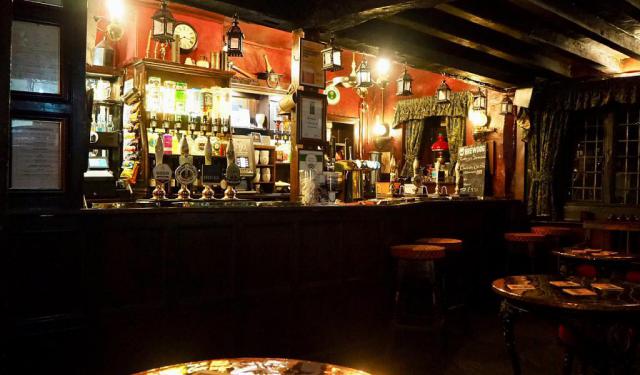
York's Historical Pubs Tour
Yorkshire is a haven for real ale enthusiasts and York does live up to this reputation. Many of local pubs are as old as churches, having served their clients for centuries.
There's a plethora of historic pubs in the heart of York, offering an array of quality cask ales alongside a menu of hearty British food, served in a cozy, traditional atmosphere. Low ceilings, wonky floors and open... view more
Tour Duration: 1 Hour(s)
Travel Distance: 1.3 Km or 0.8 Miles
There's a plethora of historic pubs in the heart of York, offering an array of quality cask ales alongside a menu of hearty British food, served in a cozy, traditional atmosphere. Low ceilings, wonky floors and open... view more
Tour Duration: 1 Hour(s)
Travel Distance: 1.3 Km or 0.8 Miles
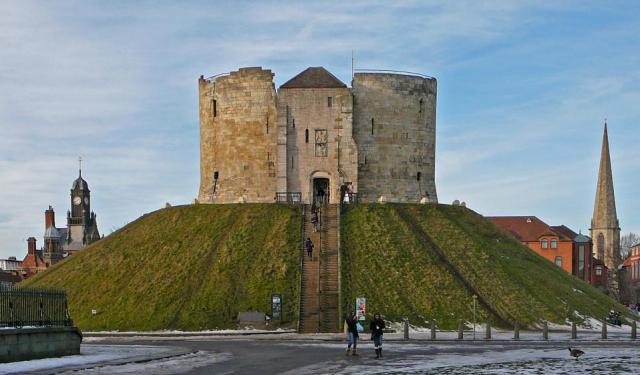
York's Historical Architecture
Being home to some of the best preserved historic architecture in England, York screams history and is undoubtedly the must-go destination for anyone keen on the country’s past. While the more recent history has also characterized York, it is the abundance of the ancient sites retained in their variety – from Medieval times to the Georgian and Victorian eras, and more – that makes the city... view more
Tour Duration: 2 Hour(s)
Travel Distance: 3.1 Km or 1.9 Miles
Tour Duration: 2 Hour(s)
Travel Distance: 3.1 Km or 1.9 Miles
Discovering York's Top Attractions on Foot
After visiting York in the early 18th century, English writer Daniel Defoe called it “a pleasant and beautiful city.”
York is one of England’s most historically layered cities: a vibrant city with Roman roots and a Viking past that has played a central role throughout much of England’s history.
York’s story stretches back thousands of years, but its importance as a city began with... view more
Tour Duration: 2 Hour(s)
Travel Distance: 2.6 Km or 1.6 Miles
York is one of England’s most historically layered cities: a vibrant city with Roman roots and a Viking past that has played a central role throughout much of England’s history.
York’s story stretches back thousands of years, but its importance as a city began with... view more
Tour Duration: 2 Hour(s)
Travel Distance: 2.6 Km or 1.6 Miles