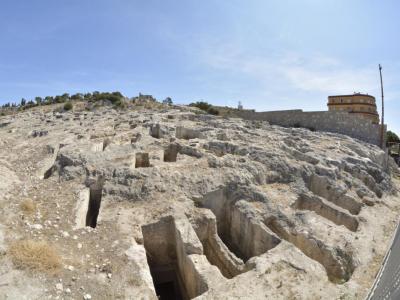


Tuvixeddu Necropolis, Cagliari
Tuvixeddu necropolis is an archaeological site situated on a vast hillside area that features burial chambers dating back to the Punic and Roman era. The necropolis contains over 1,200 graves, most of which are located on the ground while others are excavated in rock as hipogeus. There's a concrete path available for visitors to walk around, but certain areas are restricted. The entrance is free of charge with ample parking space outside.
The necropolis of Tuvixeddu is a Punic necropolis, the largest in the Mediterranean. It is located in a hill inside the city of Cagliari, Sardinia called Tuvixeddu (meaning "little cavity" in Sardinian). Between the 6th and 3rd centuries BC the Carthaginians chose this hill to bury their dead: these burials were reached through a well dug into the limestone rock (from two to eleven meters deep), a small opening introduced to the burial chamber. The burial chambers were beautifully decorated; there were found amphorae and ampoules for the essences. Of particular interest among the Punic tombs, the "Uraeus Tomb" and the "Fighter Tomb", decorated with paintings of palm trees and masks, still well preserved. Another famous tomb is that "of the Wheel". On the slopes of the Tuvixeddu hill there is a Roman necropolis, which overlooked the road at the exit of the city. The Roman necropolis consists mainly of arcosolium tombs and columbaria. The necropolis opened to the public in May 2014, during the XVIII edition of Monumenti Aperti. The archaeological area is large, it originally consisted of an area of about 80 hectares (200 acres). A 2017 Ancient DNA study by Claudia Viganó et al. found that a man buried ~2000 years ago in the necropolis of Tuvixeddu carried the cod39 mutation that cause Beta thalassemia. The paternal and maternal haplogroups of this individual, suggests that he was likely autochthonous of Sardinia.
The name comes from tuvu and means ‘little hole’. It is easy to see why: you will be amazed by a myriad of tunnels in the limestone rocks that cover most of the 18 hectares of Tuvixeddu, which together with Tuvumannu - separated by an artificial canyon - is one of the seven hills of Cagliari. The Carthaginians decided to bury their dead here, creating the largest existing Punic necropolis comprised of around a thousand ‘well’ tombs, used from the 6th to 3rd centuries BC and then reused in Roman times. The hill reveals a continuity of use that starts, in reality, from the ancient Neolithic, as documented by flint and obsidian remnants dating from the 6th to 5th millennium BC. The Punic necropolis served a large inhabited town that extended from the foot of the hill - now the Sant’Avendrace district - to the eastern shore of the Laguna di Santa Gilla. Remain from the ‘city of the living’, moving eastwards, are walls with a ‘shell’ structure and floors where the goddess Tanit appears, the main deity for the Carthaginians. The tophet, the children’s cemetery, was perhaps also located in the same area. In the upper part of Tuvixeddu, thanks to footbridges, one can observe the sepulchral chambers - one or more for each sepulchre - located at the base.
In the past, Sardinia has been populated by numerous civilizations, each of which has left an indelible print on the territory through the construction of various buildings, places of worship and burial sites. And indeed, in Sardinia, there are many Domus de Janas, prehistoric tombs excavated in the ground and known as fairy homes, as well as the so-called Tombs of the Giants. Tuvixeddu is among the most famous necropolis on the island, located on one of the seven hills of Cagliari, the capital city of Sardinia. The necropolis is part of the Tuvixeddu Park in the Sant’Avendrace district of the city and can be easily reached from the city center. If you are planning a trip to southern Sardinia and are an archaeology enthusiast, then I suggest you visit this unique site. Keep reading my guide, to find out more about the historical background and to get lots of practical information that will help you plan your visit. ***PH***
The necropolis of Tuvixeddu is a Punic necropolis, the largest in the Mediterranean. It is located in a hill inside the city of Cagliari, Sardinia called Tuvixeddu (meaning "little cavity" in Sardinian). Between the 6th and 3rd centuries BC the Carthaginians chose this hill to bury their dead: these burials were reached through a well dug into the limestone rock (from two to eleven meters deep), a small opening introduced to the burial chamber. The burial chambers were beautifully decorated; there were found amphorae and ampoules for the essences. Of particular interest among the Punic tombs, the "Uraeus Tomb" and the "Fighter Tomb", decorated with paintings of palm trees and masks, still well preserved. Another famous tomb is that "of the Wheel". On the slopes of the Tuvixeddu hill there is a Roman necropolis, which overlooked the road at the exit of the city. The Roman necropolis consists mainly of arcosolium tombs and columbaria. The necropolis opened to the public in May 2014, during the XVIII edition of Monumenti Aperti. The archaeological area is large, it originally consisted of an area of about 80 hectares (200 acres). A 2017 Ancient DNA study by Claudia Viganó et al. found that a man buried ~2000 years ago in the necropolis of Tuvixeddu carried the cod39 mutation that cause Beta thalassemia. The paternal and maternal haplogroups of this individual, suggests that he was likely autochthonous of Sardinia.
The name comes from tuvu and means ‘little hole’. It is easy to see why: you will be amazed by a myriad of tunnels in the limestone rocks that cover most of the 18 hectares of Tuvixeddu, which together with Tuvumannu - separated by an artificial canyon - is one of the seven hills of Cagliari. The Carthaginians decided to bury their dead here, creating the largest existing Punic necropolis comprised of around a thousand ‘well’ tombs, used from the 6th to 3rd centuries BC and then reused in Roman times. The hill reveals a continuity of use that starts, in reality, from the ancient Neolithic, as documented by flint and obsidian remnants dating from the 6th to 5th millennium BC. The Punic necropolis served a large inhabited town that extended from the foot of the hill - now the Sant’Avendrace district - to the eastern shore of the Laguna di Santa Gilla. Remain from the ‘city of the living’, moving eastwards, are walls with a ‘shell’ structure and floors where the goddess Tanit appears, the main deity for the Carthaginians. The tophet, the children’s cemetery, was perhaps also located in the same area. In the upper part of Tuvixeddu, thanks to footbridges, one can observe the sepulchral chambers - one or more for each sepulchre - located at the base.
In the past, Sardinia has been populated by numerous civilizations, each of which has left an indelible print on the territory through the construction of various buildings, places of worship and burial sites. And indeed, in Sardinia, there are many Domus de Janas, prehistoric tombs excavated in the ground and known as fairy homes, as well as the so-called Tombs of the Giants. Tuvixeddu is among the most famous necropolis on the island, located on one of the seven hills of Cagliari, the capital city of Sardinia. The necropolis is part of the Tuvixeddu Park in the Sant’Avendrace district of the city and can be easily reached from the city center. If you are planning a trip to southern Sardinia and are an archaeology enthusiast, then I suggest you visit this unique site. Keep reading my guide, to find out more about the historical background and to get lots of practical information that will help you plan your visit. ***PH***
Want to visit this sight? Check out these Self-Guided Walking Tours in Cagliari. Alternatively, you can download the mobile app "GPSmyCity: Walks in 1K+ Cities" from Apple App Store or Google Play Store. The app turns your mobile device to a personal tour guide and it works offline, so no data plan is needed when traveling abroad.
Download The GPSmyCity App



Tuvixeddu Necropolis on Map
Sight Name: Tuvixeddu Necropolis
Sight Location: Cagliari, Italy (See walking tours in Cagliari)
Sight Type: Attraction/Landmark
Sight Location: Cagliari, Italy (See walking tours in Cagliari)
Sight Type: Attraction/Landmark
Nearby Sights


Walking Tours in Cagliari, Italy

Create Your Own Walk in Cagliari
Creating your own self-guided walk in Cagliari is easy and fun. Choose the city attractions that you want to see and a walk route map will be created just for you. You can even set your hotel as the start point of the walk.
Cagliari Introduction Walking Tour
Welcome to Cagliari, Sardinia’s beating heart! Perched along the shimmering Mediterranean, this sun-soeaked city blends centuries-old history with modern charm. With stunning beaches, colorful lagoons, and lush greenery, it’s also a place where natural beauty meets cultural riches.
Cagliari’s story began long before our time. Around the 8th century BC, the Phoenicians founded Karaly as a... view more
Tour Duration: 2 Hours
Travel Distance: 2.9 Km or 1.8 Miles
Cagliari’s story began long before our time. Around the 8th century BC, the Phoenicians founded Karaly as a... view more
Tour Duration: 2 Hours
Travel Distance: 2.9 Km or 1.8 Miles