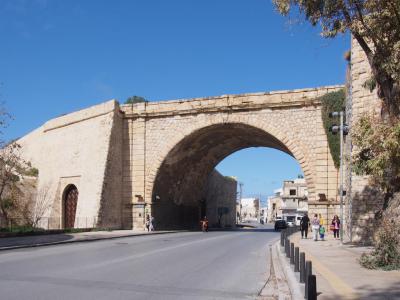


Venetian Walls and Tomb of Nikos Kazantzakis, Heraklion
The Venetian Walls of Heraklion stand as an impressive testament to the fortification architecture of the 16th century A.D. Regarded as one of the best-preserved monuments in the Mediterranean basin, these walls offer a captivating journey through the city's history. Extending approximately 4.5 kilometers, the walls form a protective triangle around the "Old Heraklion" of the 16th century, weaving together vivid memories of the city's glorious past.
The walk along the Heraklion Walls is a journey through time, where the citizens of Heraklion can explore the beauty that surrounds them and connect with the historical significance of these fortifications. The walls feature seven heart-shaped bastions (forts) and four remarkable city gates (portals), each with its unique character. Starting from the western end, visitors encounter bastions such as Saint Andrew, Pantocrator, Bethlehem, Martinengo, Jesus, Vitouri, and Sambionara, the Bastion of the Sand at the east end of Heraklion. The four gates include Pantokrator or Chania Gate, the reconstructed Bethlehem, the Jesus Gate (New Gate), and the Gate of St. George on Freedom Square in the city center.
The construction of the Venetian Walls began in 1462, marking the Byzantines' efforts to enclose the rapidly expanding city. Over the course of more than a century, the walls were strengthened, rebuilt, and enhanced, including the creation of the fortress of Koules, also known as Rocca del Mare, and the development of the harbor with its arsenals.
The walls withstood significant historical events, such as the 22-year siege where 100,000 lives were lost, and the Luftwaffe bombings during the Second World War. Despite the conflicts, the Heraklion Walls have persevered, standing as a remarkable example of architectural resilience and providing a tangible link to the city's diverse and enduring history.
The walk along the Heraklion Walls is a journey through time, where the citizens of Heraklion can explore the beauty that surrounds them and connect with the historical significance of these fortifications. The walls feature seven heart-shaped bastions (forts) and four remarkable city gates (portals), each with its unique character. Starting from the western end, visitors encounter bastions such as Saint Andrew, Pantocrator, Bethlehem, Martinengo, Jesus, Vitouri, and Sambionara, the Bastion of the Sand at the east end of Heraklion. The four gates include Pantokrator or Chania Gate, the reconstructed Bethlehem, the Jesus Gate (New Gate), and the Gate of St. George on Freedom Square in the city center.
The construction of the Venetian Walls began in 1462, marking the Byzantines' efforts to enclose the rapidly expanding city. Over the course of more than a century, the walls were strengthened, rebuilt, and enhanced, including the creation of the fortress of Koules, also known as Rocca del Mare, and the development of the harbor with its arsenals.
The walls withstood significant historical events, such as the 22-year siege where 100,000 lives were lost, and the Luftwaffe bombings during the Second World War. Despite the conflicts, the Heraklion Walls have persevered, standing as a remarkable example of architectural resilience and providing a tangible link to the city's diverse and enduring history.
Want to visit this sight? Check out these Self-Guided Walking Tours in Heraklion. Alternatively, you can download the mobile app "GPSmyCity: Walks in 1K+ Cities" from Apple App Store or Google Play Store. The app turns your mobile device to a personal tour guide and it works offline, so no data plan is needed when traveling abroad.
Download The GPSmyCity App



Venetian Walls and Tomb of Nikos Kazantzakis on Map
Sight Name: Venetian Walls and Tomb of Nikos Kazantzakis
Sight Location: Heraklion, Greece (See walking tours in Heraklion)
Sight Type: Attraction/Landmark
Sight Location: Heraklion, Greece (See walking tours in Heraklion)
Sight Type: Attraction/Landmark
Nearby Sights




Walking Tours in Heraklion, Greece

Create Your Own Walk in Heraklion
Creating your own self-guided walk in Heraklion is easy and fun. Choose the city attractions that you want to see and a walk route map will be created just for you. You can even set your hotel as the start point of the walk.
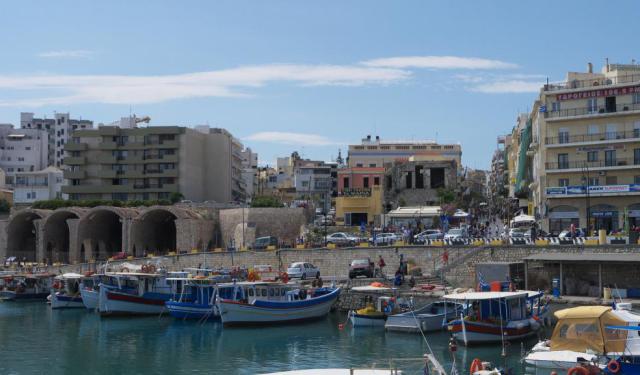
Heraklion Introduction Walking Tour
Legend tells that Heracles once set foot on Crete to capture the mighty Cretan Bull - a labor that tested both his strength and endurance. From that tale comes the name “Heraklion,” meaning “city of Heracles,” a fitting tribute to a place that has itself endured through centuries of change and conquest.
The area has been inhabited since the Neolithic era, but it first rose to... view more
Tour Duration: 2 Hours
Travel Distance: 2.3 Km or 1.4 Miles
The area has been inhabited since the Neolithic era, but it first rose to... view more
Tour Duration: 2 Hours
Travel Distance: 2.3 Km or 1.4 Miles
City Walks Overview
