

Victoria Leeds Shopping Arcades, Leeds
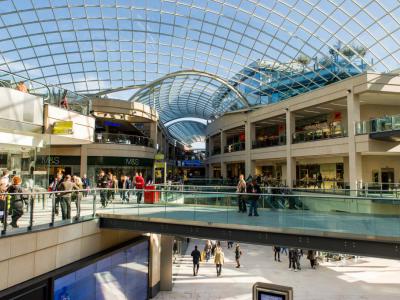
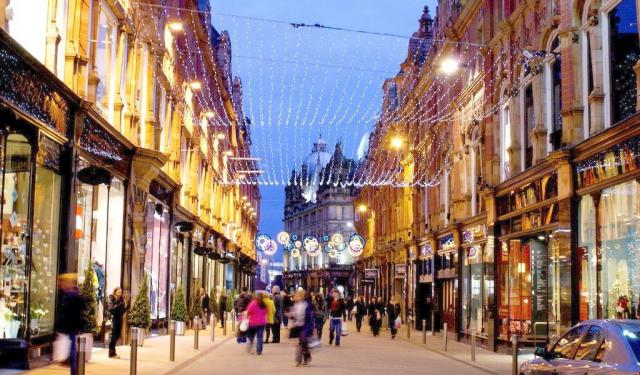
Victoria Leeds is an impressive shopping destination that successfully combines historic architecture with modern retail spaces. The venue consists of two main sections: the Victoria Quarter, with its beautifully restored Victorian and Edwardian arcades, and Victoria Gate, a contemporary shopping development opened in 2016. Together, they offer a wide range of designer boutiques, luxury brands, restaurants, and cafés.
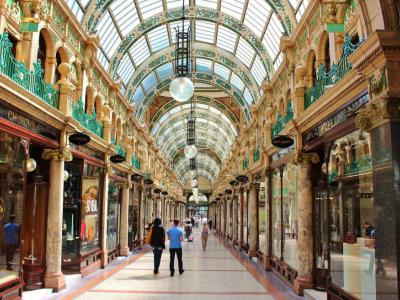
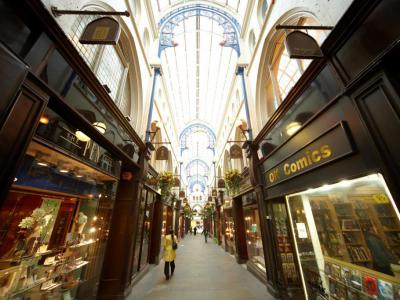
The historic Victoria Quarter is particularly worth exploring for its architecture. Designed by Frank Matcham, an architect better known for his elaborate theatres, the County Arcade and Cross Arcade were built around the turn of the 20th century. As you enter County Arcade, glance down at the intricate mosaic floor, then raise your eyes towards the vaulted glass ceiling. The passage is lined with polished marble columns, carved mahogany shopfronts, ornate ironwork, and decorative balconies. Matcham's theatrical background is evident in the lavish decoration.
Continue along County Arcade and pay particular attention to its three glazed domes. Around them are colourful mosaics made with tiles produced by the famous Burmantofts pottery of Leeds. Some depict female figures representing ideas such as Liberty, Commerce, and Justice, while others celebrate the industries that brought prosperity to the city. These details are easy to miss unless you look upwards.
The adjoining Cross Arcade shares much of the same architectural character. From here, make your way into Queen Victoria Street, where the most remarkable feature awaits overhead. Its enormous stained-glass canopy, designed by British artist Brian Clarke and completed in 1990, stretches for approximately 125 metres. Made from thousands of pieces of coloured, traditionally leaded glass, it was the world's largest secular stained-glass artwork when installed and remains Europe's largest stained-glass roof. Notice how the geometric patterns in blue, green, red, and yellow resemble woven fabric, a subtle reference to Leeds' textile-making heritage. On sunny days, the glass casts patches of colour onto the pavement below.
The Victoria Quarter underwent a major restoration between 1988 and 1990, led by architects Derek Latham and Company, earning architectural awards in 1991. Its historic buildings are now listed, while the modern Victoria Gate offers an interesting contrast with its contemporary geometric design. And for another piece of Leeds shopping history, the Victoria Quarter is also home to Harvey Nichols, which opened here in 1996 as the department store's first branch outside London.
Want to visit this sight? Check out these Self-Guided Walking Tours in Leeds. Alternatively, you can download the mobile app "GPSmyCity: Walks in 1K+ Cities" from Apple App Store or Google Play Store. The app turns your mobile device to a personal tour guide and it works offline, so no data plan is needed when traveling abroad.
Download The GPSmyCity App



Victoria Leeds Shopping Arcades on Map
Sight Name: Victoria Leeds Shopping Arcades
Sight Location: Leeds, England (See walking tours in Leeds)
Sight Type: Shopping
Guide(s) Containing This Sight:
Sight Location: Leeds, England (See walking tours in Leeds)
Sight Type: Shopping
Guide(s) Containing This Sight:
Nearby Sights
Walking Tours in Leeds, England
Create Your Own Walk in Leeds
Creating your own self-guided walk in Leeds is easy and fun. Choose the city attractions that you want to see and a walk route map will be created just for you. You can even set your hotel as the start point of the walk.
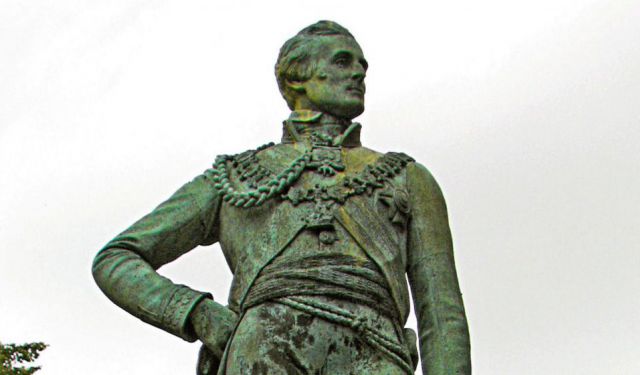
Discover Leeds' Historical Sculptures on Foot
In Leeds, statues adorn various corners, reflecting historical figures and cultural symbols. Some of them are hundreds of years old but still in remarkable condition.
One notable sculpture is that of Robert Peel, commemorating the 19th-century Prime Minister and founder of Britain's modern police force.
On the opposite side of the nearby Woodhouse Moor Park stands the regal Statue of... view more
Tour Duration: 2 Hours
Travel Distance: 3.2 Km or 2 Miles
One notable sculpture is that of Robert Peel, commemorating the 19th-century Prime Minister and founder of Britain's modern police force.
On the opposite side of the nearby Woodhouse Moor Park stands the regal Statue of... view more
Tour Duration: 2 Hours
Travel Distance: 3.2 Km or 2 Miles
A Walking Guide To Leeds City Center
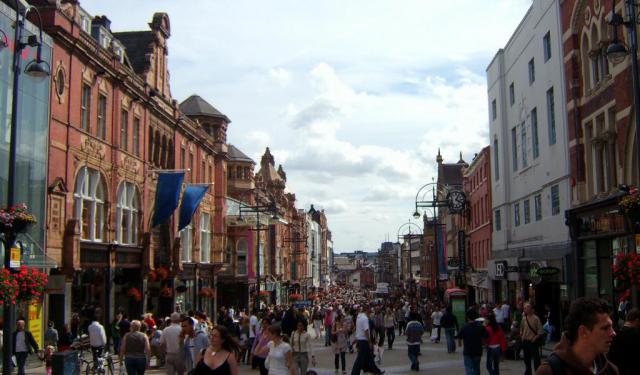
Leeds has come a long way from its beginnings as a small settlement beside the River Aire. Its name is possibly rooted in the ancient Brythonic word "Ladenses," which means "folks of the rapid river." In the 5th century, the area formed part of the kingdom of Elmet, and the 8th-century scholar, the Venerable Bede, referred to it as “Loidis.” Over time, the name evolved into... view more
Tour Duration: 2 Hours
Travel Distance: 2.7 Km or 1.7 Miles
Tour Duration: 2 Hours
Travel Distance: 2.7 Km or 1.7 Miles
Explore Leeds' Historical Shopping Venues on Foot
Leeds is a shopaholic’s paradise and a true world of retail scaled down to the size of a downtown area. Compactly located within walking distance from each other, the city's best boutiques are never far away from an eager shopper.
Here, the biggest brands and small independents are housed in some of the city’s most iconic buildings. Among them is the historic Kirkgate Market, the... view more
Tour Duration: 1 Hour
Travel Distance: 1.2 Km or 0.7 Miles
Here, the biggest brands and small independents are housed in some of the city’s most iconic buildings. Among them is the historic Kirkgate Market, the... view more
Tour Duration: 1 Hour
Travel Distance: 1.2 Km or 0.7 Miles
City Walks Overview
