

Wells-Richardson Complex, Burlington
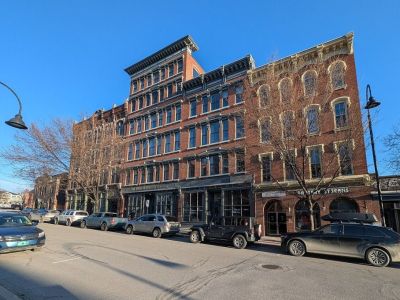
The Wells-Richardson Complex is a historic commercial and industrial block in downtown Burlington, offering a compact yet revealing glimpse into the city’s economic rise during the 19th and early 20th centuries. The complex occupies what was once a strategic location at the northern end of a major stagecoach route-today’s U.S. Route 7. Its proximity to Burlington’s civic centre made it a natural hub for business activity, and over time, the block evolved into a dense architectural record of nearly a century of urban development. Recognized for its historical value, the district was listed on the National Register of Historic Places in 1979.
The architecture here reflects this layered past. One of the oldest surviving structures, dating to the 1820s, stands along St. Paul Street, later expanded as part of the Burlington Steam Laundry. Across from City Hall Park, buildings constructed between 1872 and 1910 once operated as hotels, showcasing Colonial Revival and Commercial Italianate styles that still lend character to the streetscape. At the heart of the complex rises the former manufacturing plant of the Wells-Richardson Company-a four-story brick structure that anchors the block and recalls the city’s industrial momentum.
Under General William Wells, the company gained wide recognition for Paine’s Celery Compound, exporting it as far as Australia. As demand grew, it expanded into multiple buildings on the block, including offices and retail spaces. Despite early 20th-century regulations ending the patent medicine trade, the company continued operating for decades.
The architecture here reflects this layered past. One of the oldest surviving structures, dating to the 1820s, stands along St. Paul Street, later expanded as part of the Burlington Steam Laundry. Across from City Hall Park, buildings constructed between 1872 and 1910 once operated as hotels, showcasing Colonial Revival and Commercial Italianate styles that still lend character to the streetscape. At the heart of the complex rises the former manufacturing plant of the Wells-Richardson Company-a four-story brick structure that anchors the block and recalls the city’s industrial momentum.
Under General William Wells, the company gained wide recognition for Paine’s Celery Compound, exporting it as far as Australia. As demand grew, it expanded into multiple buildings on the block, including offices and retail spaces. Despite early 20th-century regulations ending the patent medicine trade, the company continued operating for decades.
Want to visit this sight? Check out these Self-Guided Walking Tours in Burlington. Alternatively, you can download the mobile app "GPSmyCity: Walks in 1K+ Cities" from Apple App Store or Google Play Store. The app turns your mobile device to a personal tour guide and it works offline, so no data plan is needed when traveling abroad.
Download The GPSmyCity App



Wells-Richardson Complex on Map
Sight Name: Wells-Richardson Complex
Sight Location: Burlington, USA (See walking tours in Burlington)
Sight Type: Attraction/Landmark
Guide(s) Containing This Sight:
Sight Location: Burlington, USA (See walking tours in Burlington)
Sight Type: Attraction/Landmark
Guide(s) Containing This Sight:
Nearby Sights
Walking Tours in Burlington, Vermont

Create Your Own Walk in Burlington
Creating your own self-guided walk in Burlington is easy and fun. Choose the city attractions that you want to see and a walk route map will be created just for you. You can even set your hotel as the start point of the walk.
Burlington Introduction Walking Tour
19th century American romantic poet and writer William Cullen Bryant described Lake Champlain as the most beautiful sheet of water he ever saw.
Burlington, the largest city in the U.S. state of Vermont, sits along the eastern shore of Lake Champlain, with views stretching toward the Adirondack Mountains. The city was chartered in 1763 by New Hampshire’s colonial governor, Benning Wentworth,... view more
Tour Duration: 2 Hour(s)
Travel Distance: 2.5 Km or 1.6 Miles
Burlington, the largest city in the U.S. state of Vermont, sits along the eastern shore of Lake Champlain, with views stretching toward the Adirondack Mountains. The city was chartered in 1763 by New Hampshire’s colonial governor, Benning Wentworth,... view more
Tour Duration: 2 Hour(s)
Travel Distance: 2.5 Km or 1.6 Miles