

Burlington Introduction Walking Tour (Self Guided), Burlington
19th century American romantic poet and writer William Cullen Bryant described Lake Champlain as the most beautiful sheet of water he ever saw.
Burlington, the largest city in the U.S. state of Vermont, sits along the eastern shore of Lake Champlain, with views stretching toward the Adirondack Mountains. The city was chartered in 1763 by New Hampshire’s colonial governor, Benning Wentworth, during a period of competing land claims in the region.
The origin of the name “Burlington” is not entirely certain, but it is widely believed to honor Richard Boyle, 3rd Earl of Burlington, a British nobleman known for his patronage of architecture and the arts. Like many colonial place names, it reflects ties to British influence during the 18th century.
Settlement progressed slowly at first due to conflicts such as the American Revolutionary War, but by the late 18th century, Burlington had begun to develop as a small trading and agricultural centre. Its location on Lake Champlain made it a strategic hub for transportation and commerce. During the War of 1812, the lake became an important military route, and nearby waters saw naval activity, including the American victory at the Battle of Plattsburgh.
In the 19th century, Burlington grew into a thriving lumber port, exporting timber harvested from Vermont’s forests. The arrival of the railroad further strengthened its role as a commercial centre, linking it to markets in New York and beyond. The city also became home to the University of Vermont, founded in 1791.
By the 20th century, Burlington transitioned from an industrial economy to a more diverse one focused on education, tourism, and local enterprise.
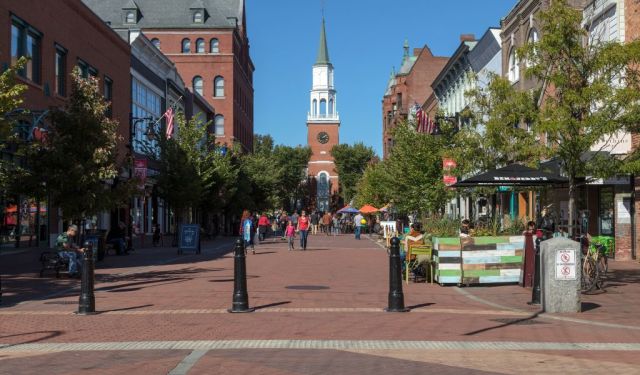
Walking through Burlington’s downtown, visitors move along the lively Church Street Marketplace, where brick-paved streets are lined with cafés, independent shops, and restaurants. Nearby, landmarks such as the Fletcher Free Library and the Chittenden County Superior Courthouse add a sense of history and civic presence. A short walk leads to Waterfront Park, where open green spaces and lake views create a relaxed connection to nature.
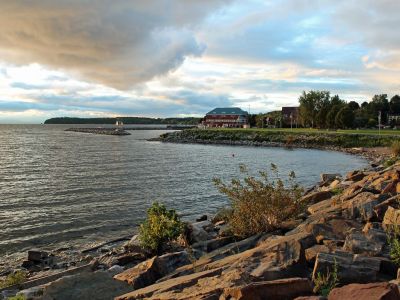
As you follow this walk, take a moment to pause by the water’s edge. With the light shifting across Lake Champlain and the Adirondacks rising in the distance, you may find yourself seeing exactly what captivated Bryant nearly two centuries ago—and understanding why he found this “sheet of water” so unforgettable.
Burlington, the largest city in the U.S. state of Vermont, sits along the eastern shore of Lake Champlain, with views stretching toward the Adirondack Mountains. The city was chartered in 1763 by New Hampshire’s colonial governor, Benning Wentworth, during a period of competing land claims in the region.
The origin of the name “Burlington” is not entirely certain, but it is widely believed to honor Richard Boyle, 3rd Earl of Burlington, a British nobleman known for his patronage of architecture and the arts. Like many colonial place names, it reflects ties to British influence during the 18th century.
Settlement progressed slowly at first due to conflicts such as the American Revolutionary War, but by the late 18th century, Burlington had begun to develop as a small trading and agricultural centre. Its location on Lake Champlain made it a strategic hub for transportation and commerce. During the War of 1812, the lake became an important military route, and nearby waters saw naval activity, including the American victory at the Battle of Plattsburgh.
In the 19th century, Burlington grew into a thriving lumber port, exporting timber harvested from Vermont’s forests. The arrival of the railroad further strengthened its role as a commercial centre, linking it to markets in New York and beyond. The city also became home to the University of Vermont, founded in 1791.
By the 20th century, Burlington transitioned from an industrial economy to a more diverse one focused on education, tourism, and local enterprise.
Walking through Burlington’s downtown, visitors move along the lively Church Street Marketplace, where brick-paved streets are lined with cafés, independent shops, and restaurants. Nearby, landmarks such as the Fletcher Free Library and the Chittenden County Superior Courthouse add a sense of history and civic presence. A short walk leads to Waterfront Park, where open green spaces and lake views create a relaxed connection to nature.
As you follow this walk, take a moment to pause by the water’s edge. With the light shifting across Lake Champlain and the Adirondacks rising in the distance, you may find yourself seeing exactly what captivated Bryant nearly two centuries ago—and understanding why he found this “sheet of water” so unforgettable.
How it works: Download the app "GPSmyCity: Walks in 1K+ Cities" from Apple App Store or Google Play Store to your mobile phone or tablet. The app turns your mobile device into a personal tour guide and its built-in GPS navigation functions guide you from one tour stop to next. The app works offline, so no data plan is needed when traveling abroad.
Burlington Introduction Walking Tour Map
Guide Name: Burlington Introduction Walking Tour
Guide Location: USA » Burlington (See other walking tours in Burlington)
Guide Type: Self-guided Walking Tour (Sightseeing)
# of Attractions: 9
Tour Duration: 2 Hour(s)
Travel Distance: 2.5 Km or 1.6 Miles
Author: Sandra
Sight(s) Featured in This Guide:
Guide Location: USA » Burlington (See other walking tours in Burlington)
Guide Type: Self-guided Walking Tour (Sightseeing)
# of Attractions: 9
Tour Duration: 2 Hour(s)
Travel Distance: 2.5 Km or 1.6 Miles
Author: Sandra
Sight(s) Featured in This Guide:
- Old Mill
- Fletcher Free Library
- Burlington Memorial Auditorium
- Chittenden County Superior Courthouse
- Church Street Marketplace
- Wells-Richardson Complex
- Follett House
- ECHO, Leahy Center for Lake Champlain
- Waterfront Park
1) Old Mill
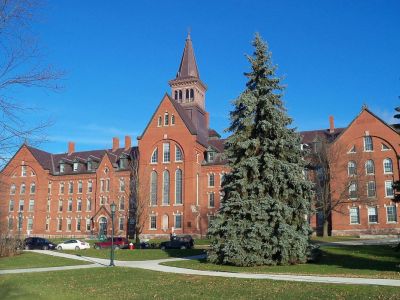
Old Mill is the oldest and most historically layered building on the campus of the University of Vermont. Originally known as the Main College Building, it traces its origins to the early years of the institution, rising in 1825 on the site of an earlier structure lost to fire just a year before. Its construction began with two separate wings, North and South College, built in stages. Their cornerstones were laid by prominent figures, including Vermont Governor Cornelius P. Van Ness and the visiting Marquis de Lafayette.
A third section, Middle College, was added in 1829, forming a trio of buildings spaced apart to reduce fire risk. Although joined in 1846, they remained internally separate for years. Over time, Old Mill underwent several renovations, including repairs, expansions, and nearby additions, while maintaining its central role on campus. It was recognized as part of the University Green Historic District on the National Register of Historic Places in 1975.
Today, Old Mill continues to serve as an academic centre, housing several humanities and social science departments alongside research programmes and cultural initiatives. Its long history, from early campus cornerstone to modern academic hub, reflects both continuity and adaptation within the university’s landscape.
A third section, Middle College, was added in 1829, forming a trio of buildings spaced apart to reduce fire risk. Although joined in 1846, they remained internally separate for years. Over time, Old Mill underwent several renovations, including repairs, expansions, and nearby additions, while maintaining its central role on campus. It was recognized as part of the University Green Historic District on the National Register of Historic Places in 1975.
Today, Old Mill continues to serve as an academic centre, housing several humanities and social science departments alongside research programmes and cultural initiatives. Its long history, from early campus cornerstone to modern academic hub, reflects both continuity and adaptation within the university’s landscape.
2) Fletcher Free Library
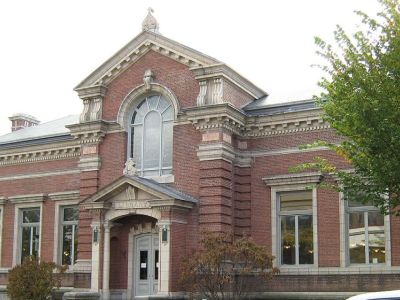
The Fletcher Free Library is Burlington’s main public library and one of the city’s key cultural institutions. Established in 1873 through a gift from Mary Martha Fletcher, it quickly outgrew its original home on Church Street, leading to the construction of a new building between 1901 and 1904 with funding from Andrew Carnegie—making it the first Carnegie library in Vermont.
Designed by local architect Walter R. B. Willcox in the Beaux-Arts style, the 1902 building stands at the corner of College Street and South Winooski Avenue. Built of brick with terra cotta detailing and set on a granite foundation, it features a projecting central bay, rusticated corner pilasters, and an ornate Corinthian cornice that give it a formal, balanced appearance.
The library faced a major setback in 1973 when structural issues, caused by its construction over a filled ravine, forced its temporary closure and raised the threat of demolition. A local citizens’ committee intervened, securing its listing on the National Register of Historic Places in 1976 and enabling restoration work to stabilize the structure. A modern three-story addition, completed in 1981, expanded the facility and introduced a new main entrance.
Designed by local architect Walter R. B. Willcox in the Beaux-Arts style, the 1902 building stands at the corner of College Street and South Winooski Avenue. Built of brick with terra cotta detailing and set on a granite foundation, it features a projecting central bay, rusticated corner pilasters, and an ornate Corinthian cornice that give it a formal, balanced appearance.
The library faced a major setback in 1973 when structural issues, caused by its construction over a filled ravine, forced its temporary closure and raised the threat of demolition. A local citizens’ committee intervened, securing its listing on the National Register of Historic Places in 1976 and enabling restoration work to stabilize the structure. A modern three-story addition, completed in 1981, expanded the facility and introduced a new main entrance.
3) Burlington Memorial Auditorium
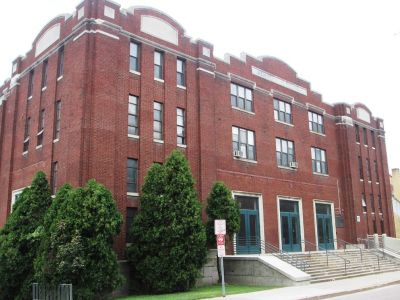
Burlington Memorial Auditorium is a historic multi-purpose arena in Burlington, recognized on the National Register of Historic Places. It was built between 1927 and 1928 to designs by local architect Frank Lyman Austin. It was conceived as a civic gathering space capable of hosting a wide range of events. The auditorium has seating for around 2,500 people and offers approximately 20,000 square feet of convention space. It once served as a central venue for performances, exhibitions, and community gatherings, with a large proscenium stage and additional smaller event rooms.
Operated by the city’s Department of Parks and Recreation, the building remained an active part of Burlington’s cultural life for decades. However, since 2016, it has been closed to the public after being deemed structurally unsafe. Its future remains under consideration, as the city explores ways to preserve and update the historic structure while meeting modern safety standards.
4) Chittenden County Superior Courthouse
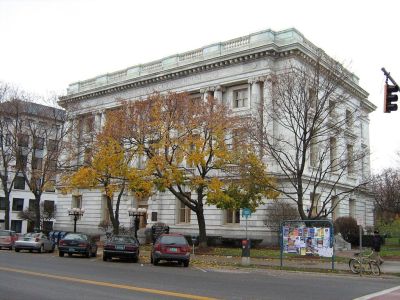
The Chittenden County Superior Courthouse is a historic civic landmark that reflects both the city’s architectural ambition and its evolving public life. Completed in 1906 and designed by architect James Knox Taylor, the building is one of Vermont’s finest examples of Beaux-Arts architecture. Originally constructed as a U.S. Post Office and Custom House, it served multiple federal functions for decades before transitioning into its current role. After Burlington’s previous county courthouse was destroyed by fire in 1982, the building was repurposed to house the Chittenden County Superior Court, continuing its long-standing connection to public service.
The structure itself is a substantial three-story masonry building, finished in marble and dressed granite, with a dignified presence along Main Street. Its principal façade is organized into five bays, with a ground level that reads as a raised basement, defined by heavy horizontal stonework and arched window openings.
Above, the second and third floors are arranged in a U-shaped plan opening to the south, with tall second-floor windows and shorter third-floor ones framed by paired Ionic columns. The composition is completed by a classical entablature, a dentillated cornice, and a low balustrade, lending the building a balanced and formal appearance.
The structure itself is a substantial three-story masonry building, finished in marble and dressed granite, with a dignified presence along Main Street. Its principal façade is organized into five bays, with a ground level that reads as a raised basement, defined by heavy horizontal stonework and arched window openings.
Above, the second and third floors are arranged in a U-shaped plan opening to the south, with tall second-floor windows and shorter third-floor ones framed by paired Ionic columns. The composition is completed by a classical entablature, a dentillated cornice, and a low balustrade, lending the building a balanced and formal appearance.
5) Church Street Marketplace
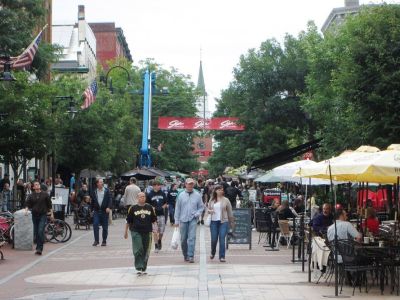
Church Street Marketplace is the social and commercial heart of Burlington, stretching across four pedestrian-friendly blocks between Main and Pearl Streets. Conceived as early as 1958 and brought to life in 1980–81, the space was designed by the Cambridge-based firm Carr, Lynch Associates as a welcoming urban promenade. Today, it functions as an open-air mall, where historic surroundings meet a lively, modern streetscape lined with around 86 storefronts.
The marketplace brings together a mix of national retailers and independent local shops, offering everything from clothing and books to home goods and specialty items. Beyond shopping, it serves as a year-round gathering place, with festivals, street performances, and community events animating the space. Cultural venues such as The Firehouse Gallery add an artistic dimension, while nearby events like the South End Art Hop further connect it to Burlington’s creative scene.
With dozens of restaurants, bars, and cafés spilling onto the pedestrian street, the area maintains a steady rhythm from morning coffee to evening dining. Recognized by the American Planning Association as one of the country’s “Great Public Spaces,” Church Street Marketplace stands as a model of how thoughtful design can shape a vibrant and enduring city centre.
The marketplace brings together a mix of national retailers and independent local shops, offering everything from clothing and books to home goods and specialty items. Beyond shopping, it serves as a year-round gathering place, with festivals, street performances, and community events animating the space. Cultural venues such as The Firehouse Gallery add an artistic dimension, while nearby events like the South End Art Hop further connect it to Burlington’s creative scene.
With dozens of restaurants, bars, and cafés spilling onto the pedestrian street, the area maintains a steady rhythm from morning coffee to evening dining. Recognized by the American Planning Association as one of the country’s “Great Public Spaces,” Church Street Marketplace stands as a model of how thoughtful design can shape a vibrant and enduring city centre.
6) Wells-Richardson Complex
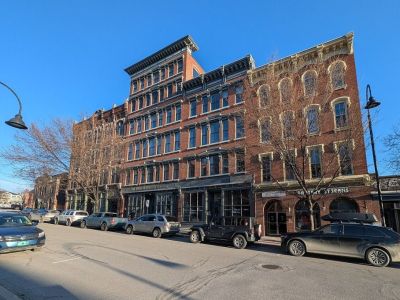
The Wells-Richardson Complex is a historic commercial and industrial block in downtown Burlington, offering a compact yet revealing glimpse into the city’s economic rise during the 19th and early 20th centuries. The complex occupies what was once a strategic location at the northern end of a major stagecoach route—today’s U.S. Route 7. Its proximity to Burlington’s civic centre made it a natural hub for business activity, and over time, the block evolved into a dense architectural record of nearly a century of urban development. Recognized for its historical value, the district was listed on the National Register of Historic Places in 1979.
The architecture here reflects this layered past. One of the oldest surviving structures, dating to the 1820s, stands along St. Paul Street, later expanded as part of the Burlington Steam Laundry. Across from City Hall Park, buildings constructed between 1872 and 1910 once operated as hotels, showcasing Colonial Revival and Commercial Italianate styles that still lend character to the streetscape. At the heart of the complex rises the former manufacturing plant of the Wells-Richardson Company—a four-story brick structure that anchors the block and recalls the city’s industrial momentum.
Under General William Wells, the company gained wide recognition for Paine’s Celery Compound, exporting it as far as Australia. As demand grew, it expanded into multiple buildings on the block, including offices and retail spaces. Despite early 20th-century regulations ending the patent medicine trade, the company continued operating for decades.
The architecture here reflects this layered past. One of the oldest surviving structures, dating to the 1820s, stands along St. Paul Street, later expanded as part of the Burlington Steam Laundry. Across from City Hall Park, buildings constructed between 1872 and 1910 once operated as hotels, showcasing Colonial Revival and Commercial Italianate styles that still lend character to the streetscape. At the heart of the complex rises the former manufacturing plant of the Wells-Richardson Company—a four-story brick structure that anchors the block and recalls the city’s industrial momentum.
Under General William Wells, the company gained wide recognition for Paine’s Celery Compound, exporting it as far as Australia. As demand grew, it expanded into multiple buildings on the block, including offices and retail spaces. Despite early 20th-century regulations ending the patent medicine trade, the company continued operating for decades.
7) Follett House
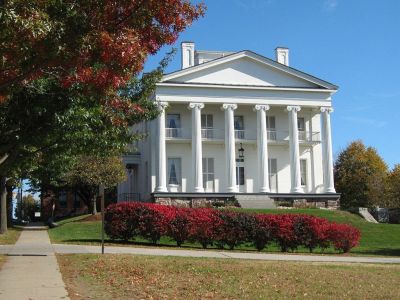
The Follett House stands as the city’s last surviving grand 19th-century lakeside mansion, a reminder of a time when the waterfront was lined with elegant private residences. Built in 1840 for businessman and later railroad executive Timothy Follett, the house reflects both personal ambition and the broader economic optimism of the era.
Designed by Ammi B. Young—also known for the Vermont State House—it remains one of the finest examples of Greek Revival architecture in Vermont. Despite Follett’s financial downfall in the 1850s, the property continued to pass through prominent hands before transitioning to institutional use from 1885 onward. Its historical and architectural significance was formally recognized with its listing on the National Register of Historic Places in 1972.
The Follett House faces Lake Champlain and features a terraced lawn. This 2½-story brick structure with a clapboard exterior is distinguished by its Greek Revival façade, including six Doric columns, a pediment, tall windows, and a second-floor balcony. Additional elements include a side portico and a cupola added in the 1880s, making it a rare surviving example of Burlington’s historic lakeside architecture.
Designed by Ammi B. Young—also known for the Vermont State House—it remains one of the finest examples of Greek Revival architecture in Vermont. Despite Follett’s financial downfall in the 1850s, the property continued to pass through prominent hands before transitioning to institutional use from 1885 onward. Its historical and architectural significance was formally recognized with its listing on the National Register of Historic Places in 1972.
The Follett House faces Lake Champlain and features a terraced lawn. This 2½-story brick structure with a clapboard exterior is distinguished by its Greek Revival façade, including six Doric columns, a pediment, tall windows, and a second-floor balcony. Additional elements include a side portico and a cupola added in the 1880s, making it a rare surviving example of Burlington’s historic lakeside architecture.
8) ECHO, Leahy Center for Lake Champlain
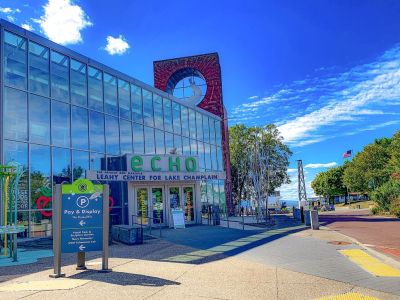
ECHO, Leahy Center for Lake Champlain, is a science and nature museum located on Burlington’s waterfront in northern Vermont. Opened in 2003, it focuses on the ecology and heritage of the Lake Champlain Basin through hands-on, accessible exhibits. Inside, visitors encounter interactive displays such as Engineer It! and Awesome Forces, a 30-foot 3D model of Champ—the lake’s legendary creature—and live exhibits featuring more than 70 species of fish, amphibians, reptiles, and invertebrates. A 3D theater and rotating traveling exhibitions add further variety, while daily animal encounters make the experience especially engaging for families.
The centre forms part of the 2.2-acre Leahy Center campus, named in recognition of Senator Patrick Leahy’s support for environmental stewardship in the region. It also hosts educational and research partners, including the University of Vermont’s Rubenstein School of Environment and Natural Resources and the Lake Champlain Basin Program Resource Room.
Designed with sustainability in mind, the building was Vermont’s first LEED-certified green building and remains the only lake aquarium in the United States with this distinction. A large solar canopy, added in 2018, further underscores its environmental focus. The name ECHO reflects its broader mission: to educate and inspire people of all ages about the ecology, culture, history, and stewardship of Lake Champlain.
The centre forms part of the 2.2-acre Leahy Center campus, named in recognition of Senator Patrick Leahy’s support for environmental stewardship in the region. It also hosts educational and research partners, including the University of Vermont’s Rubenstein School of Environment and Natural Resources and the Lake Champlain Basin Program Resource Room.
Designed with sustainability in mind, the building was Vermont’s first LEED-certified green building and remains the only lake aquarium in the United States with this distinction. A large solar canopy, added in 2018, further underscores its environmental focus. The name ECHO reflects its broader mission: to educate and inspire people of all ages about the ecology, culture, history, and stewardship of Lake Champlain.
9) Waterfront Park
Waterfront Park traces the arc of Burlington’s transformation from an industrial shoreline into one of its most inviting public spaces. Once lined with factories and loading docks, this stretch along Lake Champlain now opens onto wide lawns, walking paths, and clear views toward the Adirondack Mountains. The Burlington Bike Path runs along the water’s edge, while warmer months bring a steady rhythm of cyclists, picnickers, casual games, and students from nearby colleges. Among its more distinctive features are the swinging loveseats set to face the lake, offering a simple way to pause and take in the setting, along with nearby attractions such as the ECHO, Leahy Center for Lake Champlain.
During summer, the park becomes a hub of activity on both land and water. Sightseeing cruises depart regularly, including narrated trips and dining experiences aboard the Spirit of Ethan Allen, as well as sailing excursions with the Whistling Man Schooner Co.
The open waterfront also serves as a gathering place for seasonal events, from the large Independence Day fireworks display in early July to the Vermont Brewers Festival and the Lake Champlain Dragon Boat Festival later in the season. Easily accessible and located within walking distance of Church Street Marketplace, Waterfront Park remains a central point for both everyday leisure and larger community celebrations.
During summer, the park becomes a hub of activity on both land and water. Sightseeing cruises depart regularly, including narrated trips and dining experiences aboard the Spirit of Ethan Allen, as well as sailing excursions with the Whistling Man Schooner Co.
The open waterfront also serves as a gathering place for seasonal events, from the large Independence Day fireworks display in early July to the Vermont Brewers Festival and the Lake Champlain Dragon Boat Festival later in the season. Easily accessible and located within walking distance of Church Street Marketplace, Waterfront Park remains a central point for both everyday leisure and larger community celebrations.
The Most Popular Cities
/ view all