

Zwinger (Palatial Complex), Dresden (must see)
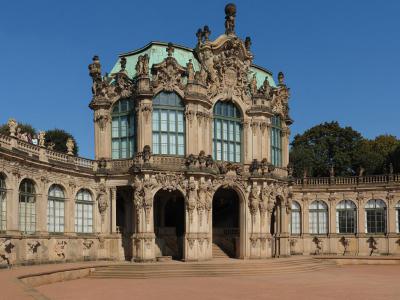
The Zwinger is one of Germany’s most impressive Baroque complexes and one of Dresden’s essential sights. Augustus the Strong, Elector of Saxony and King of Poland, commissioned it after being inspired by Louis XIV’s Versailles. Designed by architect Matthäus Daniel Pöppelmann and sculptor Balthasar Permoser, the complex was built between 1710 and 1728 as an orangery, garden, and spectacular setting for royal festivities.
The name Zwinger refers to the area between defensive walls. Dresden had an earlier Zwinger garden in the 15th century, where fresh produce was grown for the royal court. Although the present complex stands elsewhere, it retained the historic name.
The Zwinger was primarily a venue for royal entertainment. Its ornate portals, galleries, sculptures, and fountains were designed to impress, with Permoser’s magnificent Nymph’s Bath being one of the highlights. To find it, approach the complex’s Marble Hall at the northern end. Pass through the building, and you’ll be ready to enjoy the view of Nymph’s Bath.
Look for the Atlas sculpture crowning the western pavilion and the 40 porcelain bells of the carillon, which play every 15 minutes. The melodies change with the seasons and include works by Vivaldi, Mozart, Bach, Wagner, and Weber.
The complex hosted one of Dresden’s grandest celebrations in 1719, when Augustus the Strong’s son, Friedrich August, married Maria Josepha, daughter of the Habsburg emperor Joseph I. The courtyard garden and pond were added in the 1820s, while the gallery wing housing the Old Masters Picture Gallery was completed in 1855.
For tourists, the Zwinger offers much more than its architecture. Its museums include the Old Masters Picture Gallery, the Porcelain Collection, and the Mathematical and Physical Instruments Collection. The gardens and courtyard are also open to the public and are ideal for a leisurely stroll.
For the final highlight, kill two birds with one stone and get closer to the Crown Gate. Located on the complex’s southwestern wall, the ornate gate allows you to climb up to the roof-level terrace gallery for an elevated view across the entire courtyard.
The Zwinger was heavily damaged during the 1945 bombing of Dresden and reconstructed during the 1950s. Following a comprehensive four-year restoration, the inner courtyard was completely reopened to the public. Today, its combination of Baroque architecture, sculpture, beautiful gardens, and world-class museums makes it one of Dresden’s most rewarding attractions.
The name Zwinger refers to the area between defensive walls. Dresden had an earlier Zwinger garden in the 15th century, where fresh produce was grown for the royal court. Although the present complex stands elsewhere, it retained the historic name.
The Zwinger was primarily a venue for royal entertainment. Its ornate portals, galleries, sculptures, and fountains were designed to impress, with Permoser’s magnificent Nymph’s Bath being one of the highlights. To find it, approach the complex’s Marble Hall at the northern end. Pass through the building, and you’ll be ready to enjoy the view of Nymph’s Bath.
Look for the Atlas sculpture crowning the western pavilion and the 40 porcelain bells of the carillon, which play every 15 minutes. The melodies change with the seasons and include works by Vivaldi, Mozart, Bach, Wagner, and Weber.
The complex hosted one of Dresden’s grandest celebrations in 1719, when Augustus the Strong’s son, Friedrich August, married Maria Josepha, daughter of the Habsburg emperor Joseph I. The courtyard garden and pond were added in the 1820s, while the gallery wing housing the Old Masters Picture Gallery was completed in 1855.
For tourists, the Zwinger offers much more than its architecture. Its museums include the Old Masters Picture Gallery, the Porcelain Collection, and the Mathematical and Physical Instruments Collection. The gardens and courtyard are also open to the public and are ideal for a leisurely stroll.
For the final highlight, kill two birds with one stone and get closer to the Crown Gate. Located on the complex’s southwestern wall, the ornate gate allows you to climb up to the roof-level terrace gallery for an elevated view across the entire courtyard.
The Zwinger was heavily damaged during the 1945 bombing of Dresden and reconstructed during the 1950s. Following a comprehensive four-year restoration, the inner courtyard was completely reopened to the public. Today, its combination of Baroque architecture, sculpture, beautiful gardens, and world-class museums makes it one of Dresden’s most rewarding attractions.
Want to visit this sight? Check out these Self-Guided Walking Tours in Dresden. Alternatively, you can download the mobile app "GPSmyCity: Walks in 1K+ Cities" from Apple App Store or Google Play Store. The app turns your mobile device to a personal tour guide and it works offline, so no data plan is needed when traveling abroad.
Download The GPSmyCity App



Zwinger (Palatial Complex) on Map
Sight Name: Zwinger (Palatial Complex)
Sight Location: Dresden, Germany (See walking tours in Dresden)
Sight Type: Attraction/Landmark
Guide(s) Containing This Sight:
Sight Location: Dresden, Germany (See walking tours in Dresden)
Sight Type: Attraction/Landmark
Guide(s) Containing This Sight:
Nearby Sights
Walking Tours in Dresden, Germany

Create Your Own Walk in Dresden
Creating your own self-guided walk in Dresden is easy and fun. Choose the city attractions that you want to see and a walk route map will be created just for you. You can even set your hotel as the start point of the walk.
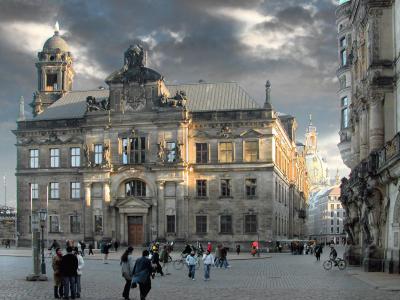
Dresden's Architectural Jewels
If there is one thing Dresden is particularly famous for, it is the magnificent architecture. Although known primarily for its Baroque buildings, the city has several other architectural styles present too, such as Renaissance, Historicism, Modernism and Post-modernism.
Much of downtown Dresden was destroyed in February 1945 by Allied bombing, which in turn prompted the rebuilding of the... view more
Tour Duration: 1 Hour
Travel Distance: 1.9 Km or 1.2 Miles
Much of downtown Dresden was destroyed in February 1945 by Allied bombing, which in turn prompted the rebuilding of the... view more
Tour Duration: 1 Hour
Travel Distance: 1.9 Km or 1.2 Miles
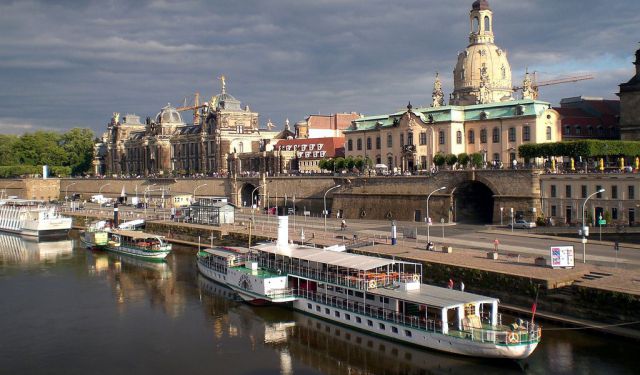
A Walk Through Dresden's Historic Old Town
Dresden’s reputation as a city of art and architecture has earned it the nickname “Florence on the Elbe.”
Dresden, the capital of Saxony, lies on the banks of the River Elbe in eastern Germany. The area may have been settled by Neolithic communities as early as 7500 BC, but Dresden’s documented history begins much later. The city developed within the Margraviate of Meissen, a territory... view more
Tour Duration: 2 Hours
Travel Distance: 2.5 Km or 1.6 Miles
Dresden, the capital of Saxony, lies on the banks of the River Elbe in eastern Germany. The area may have been settled by Neolithic communities as early as 7500 BC, but Dresden’s documented history begins much later. The city developed within the Margraviate of Meissen, a territory... view more
Tour Duration: 2 Hours
Travel Distance: 2.5 Km or 1.6 Miles
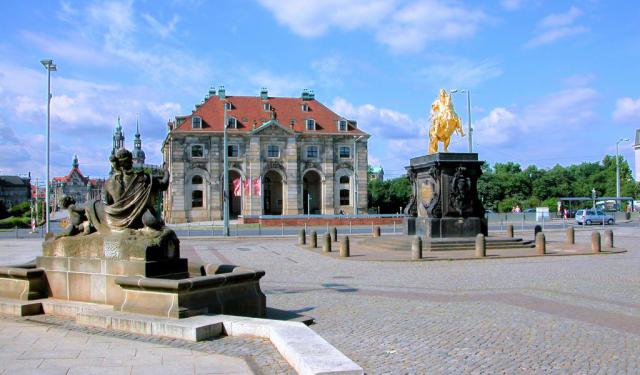
Exploring Dresden New Town on Foot
Dresden’s New Town occupies the northern bank of the Elbe, directly opposite the historic Old Town. Despite its name, it is far from new. The area was settled in the Middle Ages and was historically known as Old Dresden. It was incorporated into Dresden in 1549 under Elector Moritz but remained a relatively modest settlement for centuries compared with the more prestigious city on the opposite... view more
Tour Duration: 1 Hour
Travel Distance: 2.2 Km or 1.4 Miles
Tour Duration: 1 Hour
Travel Distance: 2.2 Km or 1.4 Miles