Custom Walk in Sorrento, Italy by sally-bear_9ed99 created on 2023-09-15
Guide Location: Italy » Sorrento
Guide Type: Custom Walk
# of Sights: 6
Tour Duration: 1 Hour(s)
Travel Distance: 1.4 Km or 0.9 Miles
Share Key: 2ELKR
Guide Type: Custom Walk
# of Sights: 6
Tour Duration: 1 Hour(s)
Travel Distance: 1.4 Km or 0.9 Miles
Share Key: 2ELKR
How It Works
Please retrieve this walk in the GPSmyCity app. Once done, the app will guide you from one tour stop to the next as if you had a personal tour guide. If you created the walk on this website or come to the page via a link, please follow the instructions below to retrieve the walk in the app.
Retrieve This Walk in App
Step 1. Download the app "GPSmyCity: Walks in 1K+ Cities" on Apple App Store or Google Play Store.



Step 2. In the GPSmyCity app, download(or launch) the guide "Sorrento Map and Walking Tours".
Step 3. Tap the menu button located at upper right corner of the "Walks" screen and select "Retrieve custom walk". Enter the share key: 2ELKR
1) Piazza Tasso (Tasso Square) (must see)
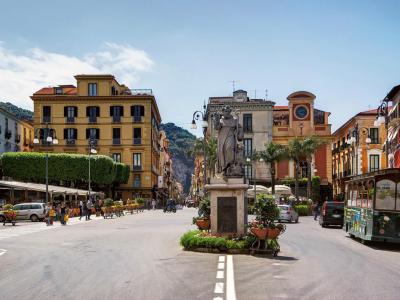
Torquato Tasso, born in 1544, stands on a granite pedestal in the square named for him. Tasso was the greatest poet of his era. He died in 1595, days before being crowned King of Poets by Pope Clement VIII. His statue shares the square with that of Saint Antonino, who sought asylum in Sorrento during the Lombard invasions of the 6th century.
The square was initially called Castle Square. Where the statue of Saint Antonino stands today was once the location of the 15th-century castle of Ferdinand of Aragon, demolished in 1843. The monument of Torquato Tasso was dedicated in 1870. The square sits astride the deep gorge that divides the center of Sorrento.
Surrounding the square are several notable historical buildings. In the southwestern part, you will find the Correale Palace, with its tiled courtyard, rebuilt in 1768. On the northern side of the square stands the Church of Santa Maria del Carmine. Inside, don’t miss the 1710 ceiling painting by Onofrio Avellino depicting the Virgin with Saint Simon, as well as the 16th-century gilded reliquaries containing saints’ bones.
Tasso Square is the entry point to the historic old town. Shops, restaurants, and bars line the square, creating a lively atmosphere. The Fauno Bar, located near the statue of Torquato Tasso, is a popular spot for cappuccino and pastries. Corso Italia, the main shopping street, branches off from the square, while smaller side streets offer additional boutiques and local shops to explore.
Cross over the forbidding gorge to find access to Sorrento Big Marina. It is where one may catch the water bus to the Isla of Capri, Tiberius's exotic playground. There are tour trolleys and hop-on, hop-off open-top sight-seeing busses from the square. Did we mention horse carriages as well? Yes, we did, just now.
As inviting as it is, Tasso Square stays busy throughout the day, so keep an eye out for scooters and traffic as you explore.
The square was initially called Castle Square. Where the statue of Saint Antonino stands today was once the location of the 15th-century castle of Ferdinand of Aragon, demolished in 1843. The monument of Torquato Tasso was dedicated in 1870. The square sits astride the deep gorge that divides the center of Sorrento.
Surrounding the square are several notable historical buildings. In the southwestern part, you will find the Correale Palace, with its tiled courtyard, rebuilt in 1768. On the northern side of the square stands the Church of Santa Maria del Carmine. Inside, don’t miss the 1710 ceiling painting by Onofrio Avellino depicting the Virgin with Saint Simon, as well as the 16th-century gilded reliquaries containing saints’ bones.
Tasso Square is the entry point to the historic old town. Shops, restaurants, and bars line the square, creating a lively atmosphere. The Fauno Bar, located near the statue of Torquato Tasso, is a popular spot for cappuccino and pastries. Corso Italia, the main shopping street, branches off from the square, while smaller side streets offer additional boutiques and local shops to explore.
Cross over the forbidding gorge to find access to Sorrento Big Marina. It is where one may catch the water bus to the Isla of Capri, Tiberius's exotic playground. There are tour trolleys and hop-on, hop-off open-top sight-seeing busses from the square. Did we mention horse carriages as well? Yes, we did, just now.
As inviting as it is, Tasso Square stays busy throughout the day, so keep an eye out for scooters and traffic as you explore.
2) Palazzo Correale (Correale Palace)
Correale Palace (Palazzo Correale), situated in the picturesque town of Sorrento, is a remarkable symbol of the diverse architectural and cultural influences that have shaped the region over many centuries. Dating back to the 14th century, this historic building showcases a blend of styles reflecting its long history.
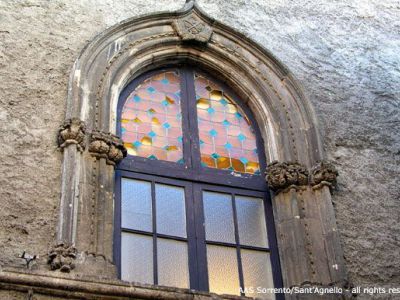
The exterior of the Correale Palace is immediately captivating, featuring a variety of small arched windows adorned with different shapes and designs, each representing a unique aspect of artistic expression and stylistic evolution. One notable feature is a striking Gothic-style window, reminiscent of the medieval origins of the palace. Additionally, the Neapolitan arched portal, decorated with Durazzo-Catalan ornaments, adds to the facade's charm and offers insight into the architectural trends of the palace's time.
Situated near Tasso Square's southeast corner, the palace transformed the Rococo era, best exemplified by its Majolica Courtyard, dating back to 1772. This beautifully crafted courtyard highlights the region's expertise in majolica and faience ware, echoing the grandeur of similar artworks found in Naples.
The history of the Correale Palace is as rich as its architecture. Originally serving as the refuge of Santa Maria della Pietà in 1610, it has been in private ownership since then. Nonetheless, visitors can still admire its beauty, including the architectural fantasia on the courtyard's back wall, entirely made of majolica tiles.
Upon leaving the palace, one is reminded of its unique place in Sorrento's architectural landscape by the distinctive arched windows on the facade, reminiscent of those found in nearby Veniero Palace, a 13th-century structure influenced by Byzantine and Arab styles.
The exterior of the Correale Palace is immediately captivating, featuring a variety of small arched windows adorned with different shapes and designs, each representing a unique aspect of artistic expression and stylistic evolution. One notable feature is a striking Gothic-style window, reminiscent of the medieval origins of the palace. Additionally, the Neapolitan arched portal, decorated with Durazzo-Catalan ornaments, adds to the facade's charm and offers insight into the architectural trends of the palace's time.
Situated near Tasso Square's southeast corner, the palace transformed the Rococo era, best exemplified by its Majolica Courtyard, dating back to 1772. This beautifully crafted courtyard highlights the region's expertise in majolica and faience ware, echoing the grandeur of similar artworks found in Naples.
The history of the Correale Palace is as rich as its architecture. Originally serving as the refuge of Santa Maria della Pietà in 1610, it has been in private ownership since then. Nonetheless, visitors can still admire its beauty, including the architectural fantasia on the courtyard's back wall, entirely made of majolica tiles.
Upon leaving the palace, one is reminded of its unique place in Sorrento's architectural landscape by the distinctive arched windows on the facade, reminiscent of those found in nearby Veniero Palace, a 13th-century structure influenced by Byzantine and Arab styles.
3) Cattedrale di Sorrento (Sorrento Cathedral)
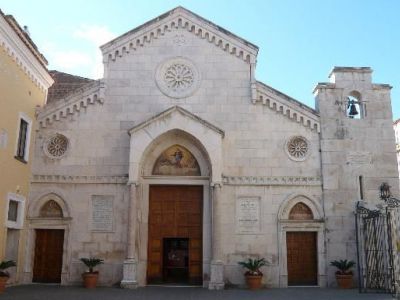
The Sorrento Cathedral, dedicated to the Virgin of the Assumption and the Apostles Philip and James, stands at the heart of the town. Consecrated in 1113, the cathedral has undergone several transformations, particularly between 1450 and 1573. Its current facade, completed in 1924, reflects a neo-Gothic style, while the church itself was originally built in Baroque fashion on the site of an ancient Greek temple, thought to have been dedicated to Zeus.
As you approach, notice the three entrances. The 16th-century central doorway, framed by antique marble columns, is topped with an ogival arch. Each entrance features a lunette: the larger central one honors the Virgin Mary, while the smaller ones depict Saints Philip and James. Above, the facade rises with battlements and a blind rose window, adding an unusual but charming character to the building.
Step inside, and you will see a Latin-cross layout with three naves, separated by fourteen sturdy pillars. The ceiling is flat, adorned with paintings of 2nd-century martyrs, and the dome, frescoed in 1902 by Pietro Barone and Augusto Moriani, adds a soft luminosity to the interior. On the right side of the altar, don’t miss the small chapel where the poet Torquato Tasso was baptized, linking the cathedral to one of Sorrento’s most celebrated historical figures.
Almost 200 feet away, the bell tower stands slightly apart from the main structure. Its 11th-century Romanesque base supports four square sections featuring arches, niches, cornices, ceramic tiles, and a clock, giving visitors a glimpse of architectural layers spanning centuries.
As you approach, notice the three entrances. The 16th-century central doorway, framed by antique marble columns, is topped with an ogival arch. Each entrance features a lunette: the larger central one honors the Virgin Mary, while the smaller ones depict Saints Philip and James. Above, the facade rises with battlements and a blind rose window, adding an unusual but charming character to the building.
Step inside, and you will see a Latin-cross layout with three naves, separated by fourteen sturdy pillars. The ceiling is flat, adorned with paintings of 2nd-century martyrs, and the dome, frescoed in 1902 by Pietro Barone and Augusto Moriani, adds a soft luminosity to the interior. On the right side of the altar, don’t miss the small chapel where the poet Torquato Tasso was baptized, linking the cathedral to one of Sorrento’s most celebrated historical figures.
Almost 200 feet away, the bell tower stands slightly apart from the main structure. Its 11th-century Romanesque base supports four square sections featuring arches, niches, cornices, ceramic tiles, and a clock, giving visitors a glimpse of architectural layers spanning centuries.
4) Sedile Dominova (Dominova Seat)
Dominova Seat (Sedile Dominova) is a historic architectural gem in the heart of Sorrento. Originally a gathering place for political discussions among nobles, this building has witnessed centuries of administrative affairs and political debates. Its location near the Sorrento coast adds to its charm, making it an attractive destination right from its elaborately decorated entrance.
Upon entering this 14th-century structure, visitors are welcomed by a meticulously painted depiction of the town, recounting its illustrious past. Moving further inside, the 16th-century atrium unfolds, supported by imposing pillars and arches, each adorned with majestic designs that narrate tales of the past.
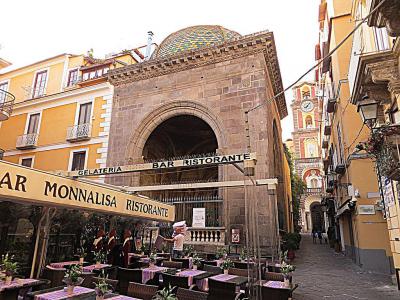
One of the most notable features of the building is its dome, decorated with Majolica tiles in vibrant shades of yellow and green. These tiles not only enhance its visual appeal but also bear the heraldic symbols of the noble families who once frequented Sedile Dominova for political gatherings. Although the passage of time has led to the deterioration of some original decorations, the 18th-century frescoes remain a testament to the artistic prowess of the era, preserved in their original splendor.
Today, Dominova Seat serves as a bustling tourist hub, attracting visitors from around the world with its historical significance and architectural beauty. While the influx of tourists can be overwhelming, nearby dining establishments such as La Pizza del Poeta, Le Colline di Sorrento, and Pub America offer delightful culinary experiences. The surrounding area buzzes with activities, promising a dynamic experience for visitors.
Upon entering this 14th-century structure, visitors are welcomed by a meticulously painted depiction of the town, recounting its illustrious past. Moving further inside, the 16th-century atrium unfolds, supported by imposing pillars and arches, each adorned with majestic designs that narrate tales of the past.
One of the most notable features of the building is its dome, decorated with Majolica tiles in vibrant shades of yellow and green. These tiles not only enhance its visual appeal but also bear the heraldic symbols of the noble families who once frequented Sedile Dominova for political gatherings. Although the passage of time has led to the deterioration of some original decorations, the 18th-century frescoes remain a testament to the artistic prowess of the era, preserved in their original splendor.
Today, Dominova Seat serves as a bustling tourist hub, attracting visitors from around the world with its historical significance and architectural beauty. While the influx of tourists can be overwhelming, nearby dining establishments such as La Pizza del Poeta, Le Colline di Sorrento, and Pub America offer delightful culinary experiences. The surrounding area buzzes with activities, promising a dynamic experience for visitors.
5) Villa Comunale Park (must see)
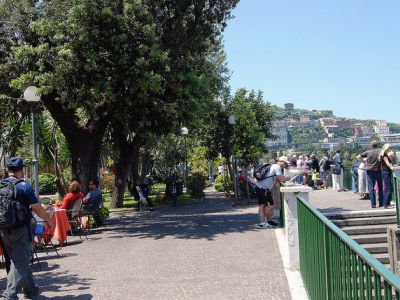
Villa Comunale Park in Sorrento is a beautiful and historically significant location that attracts visitors with its natural charm. Positioned near the Saint Francis Church and Cloister, this small park is a lush haven filled with palm trees, oaks, holm oaks, and ancient pines. Perched on the cliffs of Sorrento, it offers stunning views of Marina Grande and the coastline, making it more famous for its panoramic vistas than its greenery.
One distinctive feature of the park is its elevators, which provide access to Marina Piccola ferry and the San Francisco swim towers, offering a convenient route to the sea. Elevated above the bay and Mount Vesuvius, the park boasts well-maintained flower beds, manicured lawns, and tall palm trees. A cozy café within the park serves espresso, pastries, and ice cream, with sunset being the ideal time to enjoy its tranquil atmosphere.
Located a short walk from Tasso Square in the city center, the path to Villa Comunale Park passes by the historic 11th-century Church of Saint Antonino, adding a touch of history to the journey. Established between 1877 and 1879 on the former gardens of Franciscan friars, the park reflects the region's cultural heritage. Visitors can relax in the shade, stroll through well-kept gardens, and admire centuries-old olive trees.
The park also features two notable busts from the early twentieth century, honoring historian Bartolomeo Capasso and magistrate Francesco Saverio Gargiulo, contributing to its cultural ambiance. Additionally, it houses a museum displaying archaeological discoveries from Sorrento and a precious mosaic depicting a nymphaeum, adding to the historical appeal.
Villa Comunale Park serves not only as a natural oasis but also as a cultural center. Its terrace often hosts musical and theatrical performances, and during the Christmas season, it is adorned with festive lights. For those interested in exploring the beach below, the park offers access to the sea and an elevator for convenience, ensuring that all visitors can enjoy Sorrento's beauty and the majestic Gulf of Naples, with Vesuvius in the background.
One distinctive feature of the park is its elevators, which provide access to Marina Piccola ferry and the San Francisco swim towers, offering a convenient route to the sea. Elevated above the bay and Mount Vesuvius, the park boasts well-maintained flower beds, manicured lawns, and tall palm trees. A cozy café within the park serves espresso, pastries, and ice cream, with sunset being the ideal time to enjoy its tranquil atmosphere.
Located a short walk from Tasso Square in the city center, the path to Villa Comunale Park passes by the historic 11th-century Church of Saint Antonino, adding a touch of history to the journey. Established between 1877 and 1879 on the former gardens of Franciscan friars, the park reflects the region's cultural heritage. Visitors can relax in the shade, stroll through well-kept gardens, and admire centuries-old olive trees.
The park also features two notable busts from the early twentieth century, honoring historian Bartolomeo Capasso and magistrate Francesco Saverio Gargiulo, contributing to its cultural ambiance. Additionally, it houses a museum displaying archaeological discoveries from Sorrento and a precious mosaic depicting a nymphaeum, adding to the historical appeal.
Villa Comunale Park serves not only as a natural oasis but also as a cultural center. Its terrace often hosts musical and theatrical performances, and during the Christmas season, it is adorned with festive lights. For those interested in exploring the beach below, the park offers access to the sea and an elevator for convenience, ensuring that all visitors can enjoy Sorrento's beauty and the majestic Gulf of Naples, with Vesuvius in the background.
6) Marina Grande (Big Marina) (must see)
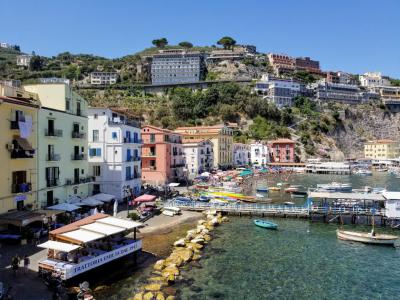
Despite its name, Marina Grande, or “Big Marina,” is actually smaller than Marina Piccola. Rather than being a transport hub, it is a fishing village and a destination in itself. As you walk through the marina, you will find restaurants and bars serving fresh seafood, small hotels, and even a local church. The area has preserved a sense of rustic charm, making it feel like a little world tucked away from the bustle of Sorrento’s main streets.
The marina lies in a protected nook of the Amalfi Coast, secluded by a rocky promontory. Local tradition says this was once the site of a Roman villa belonging to Marcellus, the nephew of Emperor Augustus. As you stroll along the waterfront, notice the small details that reflect its pre-industrial life. At sunset, fishermen pull in their nets, prepare their boats for the next day, and go about daily routines that have changed little over the centuries. Watching this is a way to experience the rhythms of a Sorrento that existed long before tourism became the town’s main industry.
Walking through Big Marina, you will see how it maintains a balance between community life and hospitality for visitors. Small shops and trattorias line narrow streets, while paths along the water offer calm places to pause and enjoy the view. This is a living village, not just a scenic stop, so take time to absorb the sounds, smells, and everyday life that give Big Marina its distinctive character. By the time you leave, you will understand why many visitors feel it is one of Sorrento’s most authentic corners.
The marina lies in a protected nook of the Amalfi Coast, secluded by a rocky promontory. Local tradition says this was once the site of a Roman villa belonging to Marcellus, the nephew of Emperor Augustus. As you stroll along the waterfront, notice the small details that reflect its pre-industrial life. At sunset, fishermen pull in their nets, prepare their boats for the next day, and go about daily routines that have changed little over the centuries. Watching this is a way to experience the rhythms of a Sorrento that existed long before tourism became the town’s main industry.
Walking through Big Marina, you will see how it maintains a balance between community life and hospitality for visitors. Small shops and trattorias line narrow streets, while paths along the water offer calm places to pause and enjoy the view. This is a living village, not just a scenic stop, so take time to absorb the sounds, smells, and everyday life that give Big Marina its distinctive character. By the time you leave, you will understand why many visitors feel it is one of Sorrento’s most authentic corners.
