Custom Walk in Dubai, United Arab Emirates by christian_64f9a created on 2025-03-24
Guide Location: United Arab Emirates » Dubai
Guide Type: Custom Walk
# of Sights: 6
Tour Duration: 3 Hour(s)
Travel Distance: 8.9 Km or 5.5 Miles
Share Key: GVNDJ
Guide Type: Custom Walk
# of Sights: 6
Tour Duration: 3 Hour(s)
Travel Distance: 8.9 Km or 5.5 Miles
Share Key: GVNDJ
How It Works
Please retrieve this walk in the GPSmyCity app. Once done, the app will guide you from one tour stop to the next as if you had a personal tour guide. If you created the walk on this website or come to the page via a link, please follow the instructions below to retrieve the walk in the app.
Retrieve This Walk in App
Step 1. Download the app "GPSmyCity: Walks in 1K+ Cities" on Apple App Store or Google Play Store.



Step 2. In the GPSmyCity app, download(or launch) the guide "Dubai Map and Walking Tours".
Step 3. Tap the menu button located at upper right corner of the "Walks" screen and select "Retrieve custom walk". Enter the share key: GVNDJ
1) Al Bastakiya
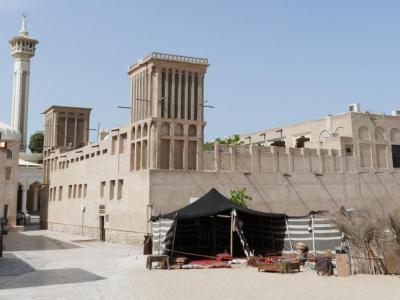
If you would like to get in touch with the past and see how Dubai was before the skyscrapers dominated the Emirate, go to Al Bastakiya along Dubai Creek.
This is an historic district and the oldest residential area in Dubai. It was built in the eighteen nineties with 60 houses, narrow lanes and marvelous wind towers. The unique thing about the area is that the people living there judged the wealth of their neighbors by the number of wind towers they possessed. It was once a residential area for rich merchants until the discovery of oil. The rich merchants moved away and the houses were taken over by expatriate workers.
In the nineteen seventies, half of the buildings were demolished to make room for an office complex and the rest became dilapidated, except for the Majlis Arts and Crafts Centre. The wind towers were used as warehouses. In 1989 the rest of the buildings were going to be demolished, but the timely intervention of Prince Charles, the Prince of Wales, saved them.
He asked for them to be preserved, pointing out that they would be a powerful tourist attraction. Restoration work was carried out by the Dubai Municipality, ending in 2005. Nowadays the buildings house art galleries of local and Persian art and cafés.
Shaikh Muhammad Center for Cultural Understanding, a non-profit organization is located in Al Bastakiya. The purpose of creating this organization was to establish a relationship of culture between the people of Dubai.
This is an historic district and the oldest residential area in Dubai. It was built in the eighteen nineties with 60 houses, narrow lanes and marvelous wind towers. The unique thing about the area is that the people living there judged the wealth of their neighbors by the number of wind towers they possessed. It was once a residential area for rich merchants until the discovery of oil. The rich merchants moved away and the houses were taken over by expatriate workers.
In the nineteen seventies, half of the buildings were demolished to make room for an office complex and the rest became dilapidated, except for the Majlis Arts and Crafts Centre. The wind towers were used as warehouses. In 1989 the rest of the buildings were going to be demolished, but the timely intervention of Prince Charles, the Prince of Wales, saved them.
He asked for them to be preserved, pointing out that they would be a powerful tourist attraction. Restoration work was carried out by the Dubai Municipality, ending in 2005. Nowadays the buildings house art galleries of local and Persian art and cafés.
Shaikh Muhammad Center for Cultural Understanding, a non-profit organization is located in Al Bastakiya. The purpose of creating this organization was to establish a relationship of culture between the people of Dubai.
2) Dubai Museum and Al Fahidi Fort (must see)
If you want to peel back Dubai’s glittering skyline and see what life looked like before oil changed everything, head straight—well, figuratively speaking—to the Dubai Museum. Think of it as a time capsule wrapped in palm fronds and cannon smoke.
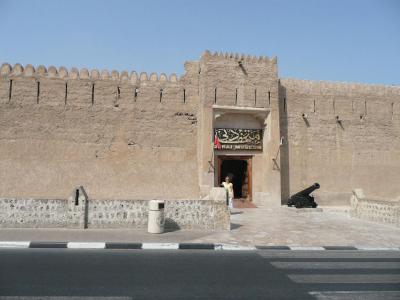
The museum sits inside Al Fahidi Fort, Dubai’s oldest surviving building, dating back to 1787—back when forts were built square, towers kept watch from three corners, and cannons weren’t just decorative. Step through the east entrance and you’re greeted by the UAE and Dubai flags flapping above two serious-looking cannons, as if still guarding the Creek from pirates. In the courtyard, there’s more artillery, plus an arish—a traditional summer house woven from palm fronds—complete with divans for lounging, a sleeping nook, and a kitchen where you can almost smell the old coffee.
Inside the fortress walls and underground galleries, history unfolds with flair. There’s a full display of weapons, a model of Dubai in 1820, and musical instruments paired with folk music that sounds like it’s drifting in from a village majlis (which is a special hall for receiving guests on formal occasions). One gallery features old maps and short films that rewind the city’s evolution—from pearl divers and dhow captains to skyscraper architects and metro lines.
Speaking of dhows (a lateen-rigged boat with one or two masts, used in the Arabian region), you’ll find one here—full-sized, naturally—alongside a recreated souk, complete with lifelike merchants selling goods as if they expect you to haggle. You’ll also come across a traditional mosque model, a family house, a Bedouin tent (camels included), and a celestial gallery where star maps explain how desert travelers once navigated by starlight rather than Google Maps...
The final stretch takes you into an archaeological diorama at Al Qusais, complete with ancient tombs and skeletons—as close to Indiana Jones as it possibly gets in Dubai.
Sound effects echo through every gallery, making it feel like the fort is alive again—market chatter, boat creaks, desert winds. And yes, there’s a gift shop that’s actually worth browsing.
Once you’ve soaked in the history, wander the nearby Al Fahidi district. Quiet lanes, coral-stone walls, and wind towers make the perfect contrast to the city’s steel and glass.
The museum sits inside Al Fahidi Fort, Dubai’s oldest surviving building, dating back to 1787—back when forts were built square, towers kept watch from three corners, and cannons weren’t just decorative. Step through the east entrance and you’re greeted by the UAE and Dubai flags flapping above two serious-looking cannons, as if still guarding the Creek from pirates. In the courtyard, there’s more artillery, plus an arish—a traditional summer house woven from palm fronds—complete with divans for lounging, a sleeping nook, and a kitchen where you can almost smell the old coffee.
Inside the fortress walls and underground galleries, history unfolds with flair. There’s a full display of weapons, a model of Dubai in 1820, and musical instruments paired with folk music that sounds like it’s drifting in from a village majlis (which is a special hall for receiving guests on formal occasions). One gallery features old maps and short films that rewind the city’s evolution—from pearl divers and dhow captains to skyscraper architects and metro lines.
Speaking of dhows (a lateen-rigged boat with one or two masts, used in the Arabian region), you’ll find one here—full-sized, naturally—alongside a recreated souk, complete with lifelike merchants selling goods as if they expect you to haggle. You’ll also come across a traditional mosque model, a family house, a Bedouin tent (camels included), and a celestial gallery where star maps explain how desert travelers once navigated by starlight rather than Google Maps...
The final stretch takes you into an archaeological diorama at Al Qusais, complete with ancient tombs and skeletons—as close to Indiana Jones as it possibly gets in Dubai.
Sound effects echo through every gallery, making it feel like the fort is alive again—market chatter, boat creaks, desert winds. And yes, there’s a gift shop that’s actually worth browsing.
Once you’ve soaked in the history, wander the nearby Al Fahidi district. Quiet lanes, coral-stone walls, and wind towers make the perfect contrast to the city’s steel and glass.
3) Dubai Textile Souk (Dubai Textile Market)
Now that you’re in Bur Dubai, the old soul of the city, check out the Dubai Textile Souk, stretching out like a woven tapestry of color, heritage, and very enthusiastic shopkeepers. This place — also known as the Old Souk or Bur Dubai Souk — sits right along Dubai Creek, with its equally famous siblings, the Gold Souk and Spice Souk, waiting across the water in Deira. To get there, you can just hop on an abra boat and glide over like a local...
The Textile Souk runs from 10 am to 10 pm, Saturday through Thursday, though some vendors disappear for a well-earned lunch siesta between 1 and 4. On Fridays, things kick off later, from 4 pm until closing. So, time it right and you’ll catch the buzz without melting.
Once upon a time, this place was the spot to buy fabrics for everything, from everyday clothing to wedding finery. The neighborhood didn’t grow in isolation — it was shaped by waves of traders from India and Pakistan who settled along the Creek. That’s how Hindi Lane was born, an alley bursting with bindis (a colored dot of religious or spiritual significance worn on the forehead), bangle bracelets, flowers, sari dresses, and devotional items — a pocket of Mumbai tucked into old Dubai.
Today, thanks to Dubai’s ambitious leap into the future, the souk leans more toward curious travelers than textile tycoons — which means you’re basically the star customer. Expect to be offered scarves in every color, fabric, and level of sparkle known to humankind...
Walk a little further and you’ll find fabrics, shoes, and jewelry that owe a clear nod to Delhi boutiques and Lahore bazaars. Pashmina fabrics and salwar kameez (traditional outfits of Pakistan) — they’re here, too, and yes, someone will try to convince you it’s “very special price, just for you.”
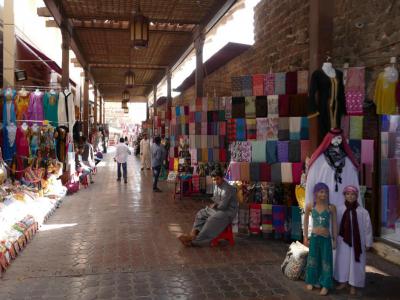
Architecturally, the souk is a time capsule with a few modern stitches. You’ll wander through shaded alleys — called “sikkas” — lined with tiny shops and draped in colorful textiles. Overhead, towering wooden arches funnel whatever breeze the desert allows, while traditional lanterns glow softly and make the whole place feel a bit like stepping into a story.
No skyscrapers. No glass. Just history, fabric, and a maze that smells faintly of incense and possibility.
The Textile Souk runs from 10 am to 10 pm, Saturday through Thursday, though some vendors disappear for a well-earned lunch siesta between 1 and 4. On Fridays, things kick off later, from 4 pm until closing. So, time it right and you’ll catch the buzz without melting.
Once upon a time, this place was the spot to buy fabrics for everything, from everyday clothing to wedding finery. The neighborhood didn’t grow in isolation — it was shaped by waves of traders from India and Pakistan who settled along the Creek. That’s how Hindi Lane was born, an alley bursting with bindis (a colored dot of religious or spiritual significance worn on the forehead), bangle bracelets, flowers, sari dresses, and devotional items — a pocket of Mumbai tucked into old Dubai.
Today, thanks to Dubai’s ambitious leap into the future, the souk leans more toward curious travelers than textile tycoons — which means you’re basically the star customer. Expect to be offered scarves in every color, fabric, and level of sparkle known to humankind...
Walk a little further and you’ll find fabrics, shoes, and jewelry that owe a clear nod to Delhi boutiques and Lahore bazaars. Pashmina fabrics and salwar kameez (traditional outfits of Pakistan) — they’re here, too, and yes, someone will try to convince you it’s “very special price, just for you.”
Architecturally, the souk is a time capsule with a few modern stitches. You’ll wander through shaded alleys — called “sikkas” — lined with tiny shops and draped in colorful textiles. Overhead, towering wooden arches funnel whatever breeze the desert allows, while traditional lanterns glow softly and make the whole place feel a bit like stepping into a story.
No skyscrapers. No glass. Just history, fabric, and a maze that smells faintly of incense and possibility.
4) Ali Bin Abi Taleb Mosque
The Ali Bin Abi Taleb Mosque, also known as the Iranian Mosque Hosainia, is a Shia mosque located in the Bur Dubai district of Dubai, near the old Textile Souk. This mosque is dedicated to Ali Ibn Abi Talib, a central figure in Shiism, and was built in 1979. It serves as a spiritual hub for the city's Iranian community.
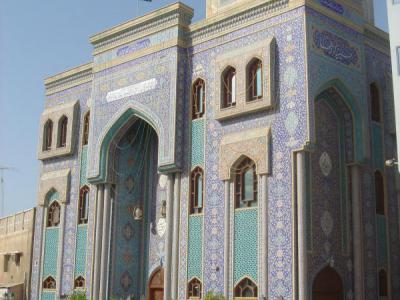
Architecturally, the mosque is a testament to the rich Persian influences in its design. The exterior and interior of the mosque are both vibrant and visually stunning, characterized by extensive Persian faience tilework. The mosque's façade and onion dome display a striking azure blue background, adorned with intricate floral patterns. This colorful scheme is complemented by Islamic calligraphy from the Quran, inscribed in rosettes amidst swirls of green, yellow, red, and white, adding to the mosque's aesthetic and spiritual allure.
Lonely Planet describes the Ali Bin Abi Taleb Mosque as a "simple yet striking" structure in the textile area of Bur Dubai Souq. The mosque is particularly noted for its sensuous, bulbous domes and a gently tapering minaret, which add to its distinctive silhouette against the Dubai skyline. Additionally, there is another Iranian Mosque in Satwa, a Shia mosque that also features similar architectural elements, showcasing the shared cultural and religious heritage within the region.
Architecturally, the mosque is a testament to the rich Persian influences in its design. The exterior and interior of the mosque are both vibrant and visually stunning, characterized by extensive Persian faience tilework. The mosque's façade and onion dome display a striking azure blue background, adorned with intricate floral patterns. This colorful scheme is complemented by Islamic calligraphy from the Quran, inscribed in rosettes amidst swirls of green, yellow, red, and white, adding to the mosque's aesthetic and spiritual allure.
Lonely Planet describes the Ali Bin Abi Taleb Mosque as a "simple yet striking" structure in the textile area of Bur Dubai Souq. The mosque is particularly noted for its sensuous, bulbous domes and a gently tapering minaret, which add to its distinctive silhouette against the Dubai skyline. Additionally, there is another Iranian Mosque in Satwa, a Shia mosque that also features similar architectural elements, showcasing the shared cultural and religious heritage within the region.
5) Spice Souq (Spice Market)
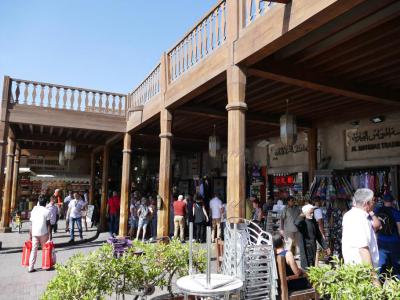
Welcome to the Spice Souk, Dubai’s aromatic time capsule tucked in the heart of the historic Deira district. Just a stone's throw from the creek, this market has been buzzing with life for over a century, serving both local residents and traders who sailed in from far-flung places like India, Iran, and East Africa.
In its heyday, the souk was where sea trade routes converged—think of it as the ancient version of a global marketplace. Spices, textiles, frankincense—you name it, it all passed through these narrow lanes. And while the souk’s open-roofed storefronts and winding paths might lack the shine of a modern mall, they’re a testament to a design forged by centuries of trade.
Today, the Spice Souk has evolved to cater to curious visitors, though it still has plenty of local flair. You'll encounter mountains of saffron, cinnamon, cumin, cardamom, and za’atar (which is a local aromatic herb blend) that’ll make you want to sprinkle it on everything. The air is thick with the smells of spices, incense, and bakhoor (the wood-chip fragrance used in Arab homes), and you can almost taste the history.
Beyond spices, the souk is a treasure trove of essential oils, rare herbal remedies, and dried goods that double as both gifts and souvenirs. Even if you’re not looking to buy, just wandering through the vibrant maze of colors and scents is an experience in itself.
For the best experience, beat the crowds by arriving early when the light’s just right and the stalls are fresh with their offerings. Don’t be afraid to haggle—it’s part of the charm. And remember, a smile goes a long way when negotiating for that perfect pinch of spice!
In its heyday, the souk was where sea trade routes converged—think of it as the ancient version of a global marketplace. Spices, textiles, frankincense—you name it, it all passed through these narrow lanes. And while the souk’s open-roofed storefronts and winding paths might lack the shine of a modern mall, they’re a testament to a design forged by centuries of trade.
Today, the Spice Souk has evolved to cater to curious visitors, though it still has plenty of local flair. You'll encounter mountains of saffron, cinnamon, cumin, cardamom, and za’atar (which is a local aromatic herb blend) that’ll make you want to sprinkle it on everything. The air is thick with the smells of spices, incense, and bakhoor (the wood-chip fragrance used in Arab homes), and you can almost taste the history.
Beyond spices, the souk is a treasure trove of essential oils, rare herbal remedies, and dried goods that double as both gifts and souvenirs. Even if you’re not looking to buy, just wandering through the vibrant maze of colors and scents is an experience in itself.
For the best experience, beat the crowds by arriving early when the light’s just right and the stalls are fresh with their offerings. Don’t be afraid to haggle—it’s part of the charm. And remember, a smile goes a long way when negotiating for that perfect pinch of spice!
6) Dubai Gold Souk (Dubai Gold Market) (must see)
Looking to bring home a shiny souvenir or maybe treat yourself to something special? Head over to the Dubai Gold Souk (also known as Deira Gold Souk).
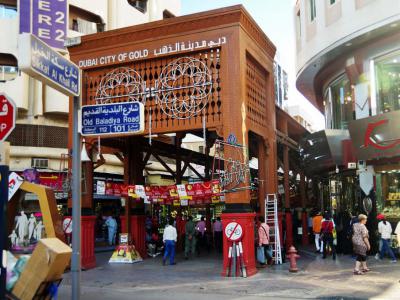
Step through the grand wooden gates, and you’ll find yourself in a treasure trove straight out of an Arabian Nights tale—only here, the gold is real (unlike those street sellers who might try to foist the fake on you). Inside, you’ll be greeted by over 300 shops offering a dazzling array of gold, platinum, diamonds, emeralds, and rubies. It's like walking into a glittering world of luxury.
Each shop has its own unique display, and the master craftsmen are ready to personalize any piece you fancy. Whether you’re after classic designs or modern flair, you’ll find something in every shade of gold—green, red, pink, white, yellow, and sometimes even platinum or silver.
Now, don’t be fooled by the absence of price tags. When you ask for the price, it might sound a little steep, but don’t fret—this is where the fun begins! Haggling is the name of the game, and if you’ve got the chops, you could knock the price down by half. New to the art of negotiation? No problem. Keep a straight face, pretend to walk away, if needed, and watch the prices drop. If you don’t get your deal in one shop, there’s always another around the corner—believe it, the merchants know this trick well!
Here’s a tip: Aim for at least a 15-20% discount on the making charges, since the price of gold by weight is usually fixed.
The souk’s open all year long, but it truly sparkles when the sun sets, with every corner twinkling and glittering—making it the perfect spot for an evening stroll...
Step through the grand wooden gates, and you’ll find yourself in a treasure trove straight out of an Arabian Nights tale—only here, the gold is real (unlike those street sellers who might try to foist the fake on you). Inside, you’ll be greeted by over 300 shops offering a dazzling array of gold, platinum, diamonds, emeralds, and rubies. It's like walking into a glittering world of luxury.
Each shop has its own unique display, and the master craftsmen are ready to personalize any piece you fancy. Whether you’re after classic designs or modern flair, you’ll find something in every shade of gold—green, red, pink, white, yellow, and sometimes even platinum or silver.
Now, don’t be fooled by the absence of price tags. When you ask for the price, it might sound a little steep, but don’t fret—this is where the fun begins! Haggling is the name of the game, and if you’ve got the chops, you could knock the price down by half. New to the art of negotiation? No problem. Keep a straight face, pretend to walk away, if needed, and watch the prices drop. If you don’t get your deal in one shop, there’s always another around the corner—believe it, the merchants know this trick well!
Here’s a tip: Aim for at least a 15-20% discount on the making charges, since the price of gold by weight is usually fixed.
The souk’s open all year long, but it truly sparkles when the sun sets, with every corner twinkling and glittering—making it the perfect spot for an evening stroll...
