Custom Walk in Reykjavik, Iceland by tfd_56ab7 created on 2025-03-27
Guide Location: Iceland » Reykjavik
Guide Type: Custom Walk
# of Sights: 7
Tour Duration: 2 Hour(s)
Travel Distance: 4.3 Km or 2.7 Miles
Share Key: 4FMLU
Guide Type: Custom Walk
# of Sights: 7
Tour Duration: 2 Hour(s)
Travel Distance: 4.3 Km or 2.7 Miles
Share Key: 4FMLU
How It Works
Please retrieve this walk in the GPSmyCity app. Once done, the app will guide you from one tour stop to the next as if you had a personal tour guide. If you created the walk on this website or come to the page via a link, please follow the instructions below to retrieve the walk in the app.
Retrieve This Walk in App
Step 1. Download the app "GPSmyCity: Walks in 1K+ Cities" on Apple App Store or Google Play Store.



Step 2. In the GPSmyCity app, download(or launch) the guide "Reykjavik Map and Walking Tours".
Step 3. Tap the menu button located at upper right corner of the "Walks" screen and select "Retrieve custom walk". Enter the share key: 4FMLU
1) Harpa Concert Hall and Conference Centre (must see)
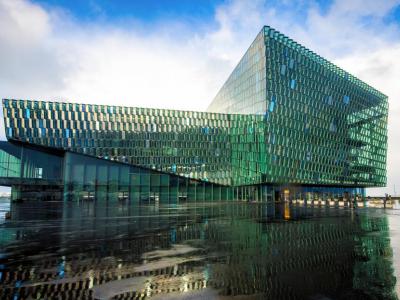
Harpa Concert Hall and Conference Centre is a modern complex completed in 2011. It is the first purpose-built concert hall in Reykjavik. Harpa is home to the Iceland Symphony Orchestra and the Icelandic Opera's offices.
The modern building features different colored geometric-shaped glass panels over a steel framework.
The 1970 The Musician sculpture is located in the water next to Harpa. Icelandic sculptor Olof Palsdottir created the sculpture which shows a cellist playing. The statue used to be located at the previous home of the Iceland Symphony Orchestra, but it moved with the Orchestra to its new home.
The concert hall also hosts performances by the Icelandic Opera and the Reykjavik Big Band.
The building won the European Union's Mies van der Rohe Award for contemporary architecture in 2013. In addition, Harpa won the MICE Report Award for the best conference center in Northern Europe.
Harpa has appeared in the series Black Mirror and in an episode of the Netflix series Sense8. It hosts several regular shows such as How to Become Icelandic in 60 Minutes, Pearls of Icelandic Songs, Reykjavik Classics,and Bowie: The Session.
Harpa features modern architecture and is stunning at night.
The modern building features different colored geometric-shaped glass panels over a steel framework.
The 1970 The Musician sculpture is located in the water next to Harpa. Icelandic sculptor Olof Palsdottir created the sculpture which shows a cellist playing. The statue used to be located at the previous home of the Iceland Symphony Orchestra, but it moved with the Orchestra to its new home.
The concert hall also hosts performances by the Icelandic Opera and the Reykjavik Big Band.
The building won the European Union's Mies van der Rohe Award for contemporary architecture in 2013. In addition, Harpa won the MICE Report Award for the best conference center in Northern Europe.
Harpa has appeared in the series Black Mirror and in an episode of the Netflix series Sense8. It hosts several regular shows such as How to Become Icelandic in 60 Minutes, Pearls of Icelandic Songs, Reykjavik Classics,and Bowie: The Session.
Harpa features modern architecture and is stunning at night.
2) Bæjarins beztu (The Town's Best Hot Dogs)
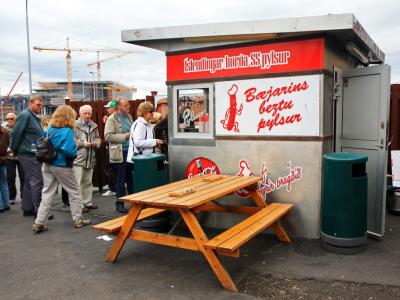
"The Town's Best Hot Dogs" (Bæjarins Beztu Pylsur) is a small chain of hot dog stands in Reykjavík. This chain has been in continuous operation since 1937 when it was originally established on Austurstræti street, right at the heart of the city. It was founded by the grandfather of the current owner, Guðrún Kristmundsdóttir. In the 1960s, the stand relocated a couple of streets north to Tryggvagata, right across from the Harpa Concert Hall, where the main flagship stand still operates today.
In August 2004, the stand gained widespread attention when it was visited by the former President of the United States, Bill Clinton, during his trip to Iceland for a UNICEF conference. This high-profile visit significantly boosted the stand's popularity, leading to its inclusion in various tourist guidebooks about Iceland. Just two years later, in August 2006, the renowned British newspaper, The Guardian, declared Bæjarins Beztu as the best hot dog stand in Europe.
Today, this chain is a favorite among both tourists and local residents alike. There are three more locations within the city, collectively selling over a thousand hot dogs on a bustling day.
The hot dogs offered by Bæjarins Beztu are primarily lamb-based but also contain pork and beef. They are served in a bun and come with a variety of condiment options, including ketchup, sweet mustard, remoulade, crispy fried onions, and raw onions. Customers who wish to have all the available toppings often use the Icelandic phrase "eina með öllu," which translates to "one with everything" in English.
In August 2004, the stand gained widespread attention when it was visited by the former President of the United States, Bill Clinton, during his trip to Iceland for a UNICEF conference. This high-profile visit significantly boosted the stand's popularity, leading to its inclusion in various tourist guidebooks about Iceland. Just two years later, in August 2006, the renowned British newspaper, The Guardian, declared Bæjarins Beztu as the best hot dog stand in Europe.
Today, this chain is a favorite among both tourists and local residents alike. There are three more locations within the city, collectively selling over a thousand hot dogs on a bustling day.
The hot dogs offered by Bæjarins Beztu are primarily lamb-based but also contain pork and beef. They are served in a bun and come with a variety of condiment options, including ketchup, sweet mustard, remoulade, crispy fried onions, and raw onions. Customers who wish to have all the available toppings often use the Icelandic phrase "eina með öllu," which translates to "one with everything" in English.
3) National Museum of Iceland (must see)
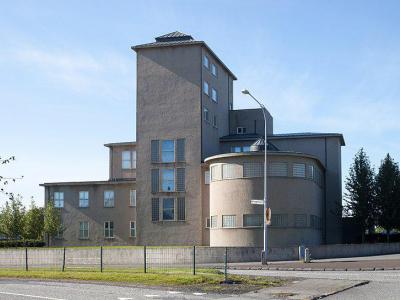
The National Museum of Iceland was founded on February 24, 1863, and its first curator was Jón Árnason. This museum housed the Icelandic collection, which had previously been kept in Danish museums. The second curator, Sigurður Guðmundsson, pushed for the establishment of an antiquarian collection. Initially, the museum was known as the Antiquarian Collection, but in 1911, its name was changed to the National Museum of Iceland. It didn't have a permanent location until 1950 when it moved to Suðurgata. Prior to that, it was located in various attics in Reykjavík, including the Culture House attic, where it stayed for 40 years.
The museum's permanent exhibition focuses on Icelandic history and boasts approximately 2,000 artifacts. One standout piece in this exhibition is the Valþjófsstaður door, which features a famous carving depicting a version of the Lion-Knight legend. In this legend, a knight defeats a dragon, ultimately freeing a lion that becomes his loyal companion.
The National Museum of Iceland provides a comprehensive look at Iceland's history, spanning from ancient times to the present day, presented in an engaging and visually appealing manner. The museum's collection includes Viking weaponry, sailing vessels, clothing, religious artifacts, and even a recreated Icelandic house. For those interested in more recent history, there is a collection of modern items, including a copy of Bjork's very first album, recorded when she was just 11 years old. Visitors can also have some fun in the costume room, where they can try on clothing from different periods in Icelandic history.
Tip:
Free entry included with Reykjavik City Card; there are free lockers; set aside 1.5-2.5 hours here.
There are free guided tours at 11am each Saturday, and it is recommended that you join one of these tours to gain a better understanding.
The museum's permanent exhibition focuses on Icelandic history and boasts approximately 2,000 artifacts. One standout piece in this exhibition is the Valþjófsstaður door, which features a famous carving depicting a version of the Lion-Knight legend. In this legend, a knight defeats a dragon, ultimately freeing a lion that becomes his loyal companion.
The National Museum of Iceland provides a comprehensive look at Iceland's history, spanning from ancient times to the present day, presented in an engaging and visually appealing manner. The museum's collection includes Viking weaponry, sailing vessels, clothing, religious artifacts, and even a recreated Icelandic house. For those interested in more recent history, there is a collection of modern items, including a copy of Bjork's very first album, recorded when she was just 11 years old. Visitors can also have some fun in the costume room, where they can try on clothing from different periods in Icelandic history.
Tip:
Free entry included with Reykjavik City Card; there are free lockers; set aside 1.5-2.5 hours here.
There are free guided tours at 11am each Saturday, and it is recommended that you join one of these tours to gain a better understanding.
4) National Gallery of Iceland
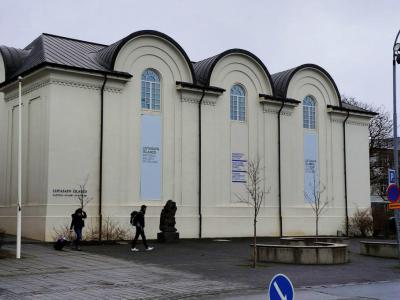
The National Gallery of Iceland, located in Reykjavík, is a prominent art museum showcasing a vast array of Icelandic art. This gallery is well-known for presenting works by renowned Icelandic artists and pieces that vividly illustrate Iceland's traditional culture.
Established in 1884 in Copenhagen, Denmark, by Björn Bjarnarson, the gallery initially featured a collection predominantly composed of artworks donated by Danish artists.
From its founding until 1916, the museum operated independently. However, in 1916, Iceland's Parliament transformed it into a branch of the National Museum of Iceland. The National Gallery was placed under council oversight in 1928.
The museum's collection was initially exhibited at the House of Parliament from 1885. In 1950, it was moved to the premises of the National Museum of Iceland in Reykjavík, where it was officially opened to the public in 1951. A 1961 legislation granted the museum full independence.
The National Gallery of Iceland regularly hosts various exhibitions that either highlight selections from its own collection or showcase works by both Icelandic and international artists. Notably, pieces from the National Gallery's collection are part of the first stage of the "Millennium" exhibition at the Culture House.
The Gallery's facility includes multiple exhibition halls across three floors, an art store, and a café. Additionally, it houses a specialized research library focusing on the conservation and dissemination of resources related to Icelandic art.
Why You Should Visit:
Over 200 years of Iceland-inspired art with great names like Münch and Vasarely and also more local artists. The museum building itself is a work of art.
Tip:
The entry fee comes with tickets for the two companion museums; ask the staff to indicate where those are on your map. Also, ask if you can take photographs – sometimes you can.
Established in 1884 in Copenhagen, Denmark, by Björn Bjarnarson, the gallery initially featured a collection predominantly composed of artworks donated by Danish artists.
From its founding until 1916, the museum operated independently. However, in 1916, Iceland's Parliament transformed it into a branch of the National Museum of Iceland. The National Gallery was placed under council oversight in 1928.
The museum's collection was initially exhibited at the House of Parliament from 1885. In 1950, it was moved to the premises of the National Museum of Iceland in Reykjavík, where it was officially opened to the public in 1951. A 1961 legislation granted the museum full independence.
The National Gallery of Iceland regularly hosts various exhibitions that either highlight selections from its own collection or showcase works by both Icelandic and international artists. Notably, pieces from the National Gallery's collection are part of the first stage of the "Millennium" exhibition at the Culture House.
The Gallery's facility includes multiple exhibition halls across three floors, an art store, and a café. Additionally, it houses a specialized research library focusing on the conservation and dissemination of resources related to Icelandic art.
Why You Should Visit:
Over 200 years of Iceland-inspired art with great names like Münch and Vasarely and also more local artists. The museum building itself is a work of art.
Tip:
The entry fee comes with tickets for the two companion museums; ask the staff to indicate where those are on your map. Also, ask if you can take photographs – sometimes you can.
5) Hallgrímskirkja (Church of Hallgrímur) (must see)
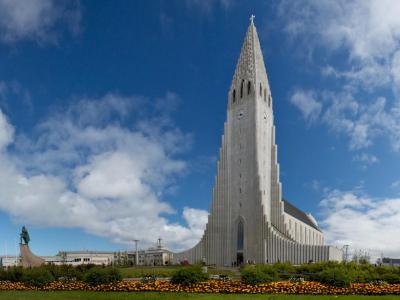
Standing at 74 meters (244 feet) tall, the striking Church of Hallgrímur is Iceland's tallest church. Architect Guojon Samuelsson began drawing the church in 1937. Construction began in 1945 and was completed in 1986.
Iceland's unique geography inspired the design of the church. Volcanic action created lava flows which cooled into grey, hexagonal columns. The dramatic, cool, jagged columns inspired the design of the Church of Hallgrímur.
The church was named after 17th-century clergyman and poet Hallgrimur Petursson. Hallgrimur Petursson was best known for his work Hymns of the Passion.
This iconic building is visible from many parts of Reykjavík. The Church of Hallgrímur is a Lutheran, or Church of Iceland establishment. Its impressive height was in part to compete with Landakot's Church, the Catholic Cathedral.
During the summer, visitors can enjoy concerts which run four days a week. Don't miss the incredible pipe organ that stands 15 meters (49 feet) tall. The pipe organ has electronic action; the pipes are remote from the pedal console. The organ has 5,275 pipes and has been featured in several recording albums.
Outside the entrance, visitors will find a statue of Leif Eriksson, a famed explorer. The United States gave the statue to Iceland in the 1930s to commemorate the 1,000th anniversary of the Icelandic Parliament. The Icelandic Parliament was first convened in the year 930 AD.
The large clock on the tower is often wrong, as strong Icelandic wind gusts often blow the hands about.
Why You Should Visit:
The Church of Hallgrímur is a dramatic church that wonderfully emulates Iceland's landscape. You will see the church's tower from all over the city and find the church even more impressive up close. The interior is surprisingly austere with clean lines.
Tips:
Admission is free, but a small fee provides access to a lift to the top of the building, where visitors can enjoy panoramic views of Reykjavik and the surrounding mountains.
Iceland's unique geography inspired the design of the church. Volcanic action created lava flows which cooled into grey, hexagonal columns. The dramatic, cool, jagged columns inspired the design of the Church of Hallgrímur.
The church was named after 17th-century clergyman and poet Hallgrimur Petursson. Hallgrimur Petursson was best known for his work Hymns of the Passion.
This iconic building is visible from many parts of Reykjavík. The Church of Hallgrímur is a Lutheran, or Church of Iceland establishment. Its impressive height was in part to compete with Landakot's Church, the Catholic Cathedral.
During the summer, visitors can enjoy concerts which run four days a week. Don't miss the incredible pipe organ that stands 15 meters (49 feet) tall. The pipe organ has electronic action; the pipes are remote from the pedal console. The organ has 5,275 pipes and has been featured in several recording albums.
Outside the entrance, visitors will find a statue of Leif Eriksson, a famed explorer. The United States gave the statue to Iceland in the 1930s to commemorate the 1,000th anniversary of the Icelandic Parliament. The Icelandic Parliament was first convened in the year 930 AD.
The large clock on the tower is often wrong, as strong Icelandic wind gusts often blow the hands about.
Why You Should Visit:
The Church of Hallgrímur is a dramatic church that wonderfully emulates Iceland's landscape. You will see the church's tower from all over the city and find the church even more impressive up close. The interior is surprisingly austere with clean lines.
Tips:
Admission is free, but a small fee provides access to a lift to the top of the building, where visitors can enjoy panoramic views of Reykjavik and the surrounding mountains.
6) Laugavegur Street (must see)
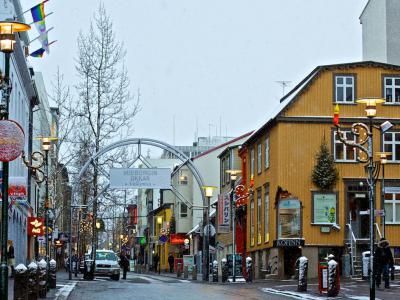
Laugavegur Street is Reykjavik's main shopping street. Visitors will find restaurants, bars, cafes, and boutique shops.
Laugavegur is one of the oldest streets in Reykjavík. The name can be translated as the Water Road. Here, women would bring their laundry to be washed in hot pools.
Laugavegur is just over a mile or two kilometers long. The shopping stretch starts at the city's busy bus center, Hlemmur, and continues to Bankastraeti.
There are two museums on Laugavegur. First, the Phallological Museum is the world's only museum dedicated to the male genitals, with specimens from the animal kingdom. The second museum is a small punk museum.
Most of the shops feature Icelandic designs and brands. Visitors will find high-end products, as well as shops with souvenirs such as books, fridge magnets, and stuffed animals.
Visitors can also find a variety of vintage shops and second-hand goods along Laugavegur.
Foodies will be delighted with the variety of options. Try traditional Icelandic menus or international cuisines. Visitors can also find vegan restaurants.
Several bars feature live music. Movie fans will love the Lebowski Bar, with food and "wheel of fortune" rounds.
Laugavegur is a diverse street with something for everyone.
Laugavegur is one of the oldest streets in Reykjavík. The name can be translated as the Water Road. Here, women would bring their laundry to be washed in hot pools.
Laugavegur is just over a mile or two kilometers long. The shopping stretch starts at the city's busy bus center, Hlemmur, and continues to Bankastraeti.
There are two museums on Laugavegur. First, the Phallological Museum is the world's only museum dedicated to the male genitals, with specimens from the animal kingdom. The second museum is a small punk museum.
Most of the shops feature Icelandic designs and brands. Visitors will find high-end products, as well as shops with souvenirs such as books, fridge magnets, and stuffed animals.
Visitors can also find a variety of vintage shops and second-hand goods along Laugavegur.
Foodies will be delighted with the variety of options. Try traditional Icelandic menus or international cuisines. Visitors can also find vegan restaurants.
Several bars feature live music. Movie fans will love the Lebowski Bar, with food and "wheel of fortune" rounds.
Laugavegur is a diverse street with something for everyone.
7) Sólfar (Sun Voyager) (must see)
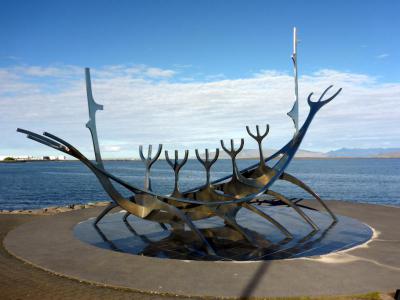
Sun Voyager is a sculpture crafted by the artist Jón Gunnar Árnason (1931-1989) and is situated alongside the Sæbraut road in Reykjavík. This artistic creation is often characterized as a representation of either a dreamboat or an homage to the sun. Jón Gunnar Árnason's intention behind this sculpture was to convey a sense of promise associated with uncharted territories, a dream symbolizing hope, progress, and freedom.
In 1986, the west district association of Reykjavík decided to sponsor a competition to commission a new outdoor sculpture in commemoration of the 200th anniversary of the city. Jón Gunnar's Sun Voyager emerged as the winning design in the competition, leading to the creation of a scaled-up aluminum model, which was later presented to the city for enlargement. The full-sized Sun Voyager was officially unveiled on Sæbraut, coinciding with the birthday of Reykjavík on August 18, 1990.
The sculpture is crafted from high-quality stainless steel and is positioned upon a circle formed by granite slabs, encircled by a material known as "town-hall concrete." Its construction meticulously followed Jón Gunnar Árnason's detailed full-scale drawing of the Sun Voyager and was supervised by the artist Kristinn E. Hrafnsson, who served as Jón Gunnar's assistant.
Why You Should Visit:
Great subject for photographs as it provides a nice vantage point to look out into the waters and think of very deep things.
In 1986, the west district association of Reykjavík decided to sponsor a competition to commission a new outdoor sculpture in commemoration of the 200th anniversary of the city. Jón Gunnar's Sun Voyager emerged as the winning design in the competition, leading to the creation of a scaled-up aluminum model, which was later presented to the city for enlargement. The full-sized Sun Voyager was officially unveiled on Sæbraut, coinciding with the birthday of Reykjavík on August 18, 1990.
The sculpture is crafted from high-quality stainless steel and is positioned upon a circle formed by granite slabs, encircled by a material known as "town-hall concrete." Its construction meticulously followed Jón Gunnar Árnason's detailed full-scale drawing of the Sun Voyager and was supervised by the artist Kristinn E. Hrafnsson, who served as Jón Gunnar's assistant.
Why You Should Visit:
Great subject for photographs as it provides a nice vantage point to look out into the waters and think of very deep things.
