Custom Walk in Girona, Spain by jhaarbosch_c66ac created on 2025-04-16
Guide Location: Spain » Girona
Guide Type: Custom Walk
# of Sights: 12
Tour Duration: 2 Hour(s)
Travel Distance: 2.7 Km or 1.7 Miles
Share Key: B37M5
Guide Type: Custom Walk
# of Sights: 12
Tour Duration: 2 Hour(s)
Travel Distance: 2.7 Km or 1.7 Miles
Share Key: B37M5
How It Works
Please retrieve this walk in the GPSmyCity app. Once done, the app will guide you from one tour stop to the next as if you had a personal tour guide. If you created the walk on this website or come to the page via a link, please follow the instructions below to retrieve the walk in the app.
Retrieve This Walk in App
Step 1. Download the app "GPSmyCity: Walks in 1K+ Cities" on Apple App Store or Google Play Store.



Step 2. In the GPSmyCity app, download(or launch) the guide "Girona Map and Walking Tours".
Step 3. Tap the menu button located at upper right corner of the "Walks" screen and select "Retrieve custom walk". Enter the share key: B37M5
1) Ascent of San Domenec - Braavos Market
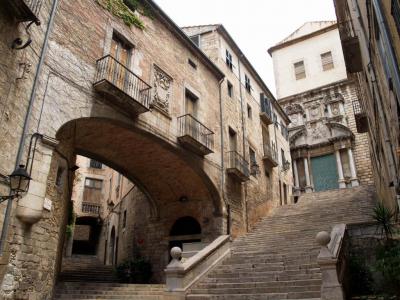
The Ascent of Saint Domènec is one of Girona’s most photogenic stairways-and not just because of its Game of Thrones cameo. This stepped street took shape between the 14th and 17th centuries and still feels like a stage set, flanked by Renaissance palaces, the Agullana Palace, and crowned by the imposing baroque front of the Church of Saint Martí Sacosta. Its roots go back even further: the Dominicans planted a convent here in the 13th century, turning the area into both a religious hub and a neighborhood crossroads. Later renovations matched the drama of the church above, leaving us with the elegant, balanced stairway you see today.
Climbing it is a workout, but one softened by the setting. Locals claim it’s impossible to pass without pausing-whether that’s to snap a photo, claim a table at Le Bistrot, whose terrace hides under the arch, or peek into the Ensesa workshop, a favorite during Girona’s annual Temps de Flors festival when flowers spill across the steps.
Then there’s its screen career. Perfume: The Story of a Murderer filmed here back in 2006, but it was HBO’s Game of Thrones that catapulted the stairway into global stardom. Season 6 dressed the steps as a bustling Braavosi marketplace, complete with awnings, baskets, and extras. It’s where Arya Stark, blind and desperate, was chased down by the Waif. The moment that sticks into the fans' minds is her tumble that sent orange-filled baskets flying on the stairs.
Today, the Ascent of Saint Domènec works double duty: a slice of Girona’s architectural story and a pop-culture landmark, equally good for a quiet climb or a re-enactment.
Climbing it is a workout, but one softened by the setting. Locals claim it’s impossible to pass without pausing-whether that’s to snap a photo, claim a table at Le Bistrot, whose terrace hides under the arch, or peek into the Ensesa workshop, a favorite during Girona’s annual Temps de Flors festival when flowers spill across the steps.
Then there’s its screen career. Perfume: The Story of a Murderer filmed here back in 2006, but it was HBO’s Game of Thrones that catapulted the stairway into global stardom. Season 6 dressed the steps as a bustling Braavosi marketplace, complete with awnings, baskets, and extras. It’s where Arya Stark, blind and desperate, was chased down by the Waif. The moment that sticks into the fans' minds is her tumble that sent orange-filled baskets flying on the stairs.
Today, the Ascent of Saint Domènec works double duty: a slice of Girona’s architectural story and a pop-culture landmark, equally good for a quiet climb or a re-enactment.
2) Ayuntamiento de Gerona (Girona City Hall)
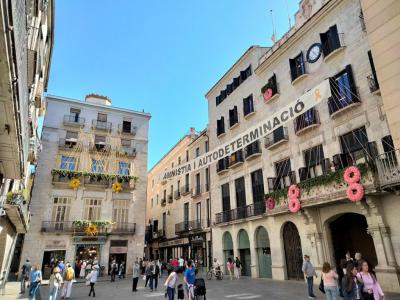
Welcome to Girona’s historic heartbeat-its City Hall (Ayuntamiento de Gerona), located in the charming Plaza del Vi. This striking building graces part of Catalonia’s protected architectural heritage and captivates visitors with its layered history and evolving style.
Built around an engaging interior courtyard, the City Hall features a façade accentuated by three grand portals leading into a vaulted vestibule. The ground floor opens into this welcoming space, while the upper stories carry repeating balconies-some modern, others simpler-reflecting various restoration phases. The courtyard contains a vaulted door and decorative dust guard, with the city’s coat of arms etched in stone beneath. Key interior renovations include the main meeting room, refreshed in 1917, the staircase added in 1901, and the restored mayor’s office completed around 1904.
Visually, the building blooms into an eclectic fusion of styles and eras. At the start of the 20th century, parts of the older façade were demolished and replaced with a new, more monumental face, crowned by a large balcony. The site has long held civic importance-earlier serving as the 16th‑century exchange table, and in 1830, the city’s official measuring standards were installed in its courtyard.
For tourists exploring Girona’s Old Town, the City Hall serves not only as a picturesque landmark but also as a tangible chronicle of the city’s administrative and architectural evolution, from medieval roots to modern renovations. Its proximity to other highlights like the Cathedral, the Jewish Quarter, and historic city walls makes it a perfect and enriching stop on any walking tour.
Built around an engaging interior courtyard, the City Hall features a façade accentuated by three grand portals leading into a vaulted vestibule. The ground floor opens into this welcoming space, while the upper stories carry repeating balconies-some modern, others simpler-reflecting various restoration phases. The courtyard contains a vaulted door and decorative dust guard, with the city’s coat of arms etched in stone beneath. Key interior renovations include the main meeting room, refreshed in 1917, the staircase added in 1901, and the restored mayor’s office completed around 1904.
Visually, the building blooms into an eclectic fusion of styles and eras. At the start of the 20th century, parts of the older façade were demolished and replaced with a new, more monumental face, crowned by a large balcony. The site has long held civic importance-earlier serving as the 16th‑century exchange table, and in 1830, the city’s official measuring standards were installed in its courtyard.
For tourists exploring Girona’s Old Town, the City Hall serves not only as a picturesque landmark but also as a tangible chronicle of the city’s administrative and architectural evolution, from medieval roots to modern renovations. Its proximity to other highlights like the Cathedral, the Jewish Quarter, and historic city walls makes it a perfect and enriching stop on any walking tour.
3) Rambla de la Libertad (Freedom Boulevard)
Freedom Boulevard cuts through Girona with the kind of energy that has kept it busy for centuries. Laid out in the 13th century as the town’s market street, it quickly became the economic and social heart of the city. Fast forward to 1869 and a revolutionary gesture changed its name forever: the “Tree of Freedom” was planted here during Spain’s turbulent Six Democratic Years, and the street inherited its present title, swapping old monarchical ties for the spirit of liberal ideals.
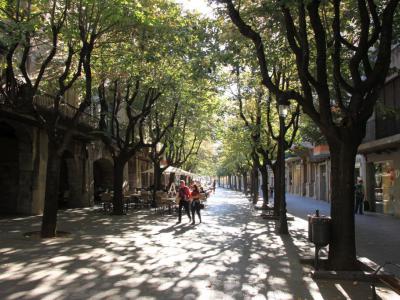
The boulevard’s arcaded colonnades still recall the medieval past, when guilds and traders sold their wares beneath the arches. Today those same arcades host shops, restaurants, and cafés, humming with voices and movement. A line of trees and benches runs through the centre, softening the bustle and inviting a catch-a-breath session. Seasonal markets and flower fairs carry on the centuries-old tradition of trade, just with fewer horses and more phone calls.
Along the walk, a few landmarks catch the eye. Norat House, built in 1912, flaunts its Art Nouveau curves, while near the Stone Bridge the Bòlit Contemporary Art Centre brings modern exhibitions into the mix and doubles as the city’s tourist information hub. At the Argenteria Street end, the Trobada Point sculpture places three bronze fingerprints into the pavement-a reminder that this has always been a meeting ground.
This is Girona in shorthand-arches, markets, whispers of the past, and the rhythm of everyday life. Freedom Boulevard may look like a straight line, but it carries centuries in its stride.
The boulevard’s arcaded colonnades still recall the medieval past, when guilds and traders sold their wares beneath the arches. Today those same arcades host shops, restaurants, and cafés, humming with voices and movement. A line of trees and benches runs through the centre, softening the bustle and inviting a catch-a-breath session. Seasonal markets and flower fairs carry on the centuries-old tradition of trade, just with fewer horses and more phone calls.
Along the walk, a few landmarks catch the eye. Norat House, built in 1912, flaunts its Art Nouveau curves, while near the Stone Bridge the Bòlit Contemporary Art Centre brings modern exhibitions into the mix and doubles as the city’s tourist information hub. At the Argenteria Street end, the Trobada Point sculpture places three bronze fingerprints into the pavement-a reminder that this has always been a meeting ground.
This is Girona in shorthand-arches, markets, whispers of the past, and the rhythm of everyday life. Freedom Boulevard may look like a straight line, but it carries centuries in its stride.
4) Monumento a los Defensores de Girona (Monument to the Defenders of Girona)
The Monument to the Defenders of Girona) stands as a solemn reminder of the city’s resilience during the Peninsular War. Located in the heart of Girona, it commemorates the citizens and soldiers who defended the city during the sieges of 1808 and 1809 against Napoleonic forces. These sieges, marked by extreme hardship, disease, and famine, became a defining chapter in Girona’s history, symbolizing unity and sacrifice. The monument, inaugurated in 1894, was designed to honor that collective bravery and to serve as a lasting tribute for future generations.
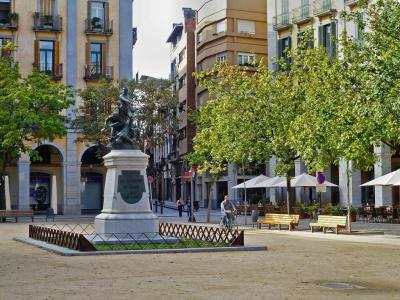
The monument’s design features a prominent stone pedestal topped with a bronze figure representing a defiant Girona fighter, weapon in hand, facing outward as if still guarding the city. Around its base are reliefs depicting scenes from the sieges, showing the human cost and determination of the defenders. Inscriptions further evoke the memory of those who perished, blending artistic detail with historical storytelling. The work captures not only the military struggle but also the spirit of civic resistance that defined Girona’s wartime endurance.
Today, the Monument to the Defenders of Girona is both a historical landmark and a place of reflection. Visitors often pause here to learn about the city’s role in the Peninsular War before exploring the surrounding streets and the old city walls, many of which also bear marks from that turbulent period. The site stands as a quiet counterpoint to Girona’s vibrant present, linking its medieval charm and modern life with the courage and sacrifice of its past.
The monument’s design features a prominent stone pedestal topped with a bronze figure representing a defiant Girona fighter, weapon in hand, facing outward as if still guarding the city. Around its base are reliefs depicting scenes from the sieges, showing the human cost and determination of the defenders. Inscriptions further evoke the memory of those who perished, blending artistic detail with historical storytelling. The work captures not only the military struggle but also the spirit of civic resistance that defined Girona’s wartime endurance.
Today, the Monument to the Defenders of Girona is both a historical landmark and a place of reflection. Visitors often pause here to learn about the city’s role in the Peninsular War before exploring the surrounding streets and the old city walls, many of which also bear marks from that turbulent period. The site stands as a quiet counterpoint to Girona’s vibrant present, linking its medieval charm and modern life with the courage and sacrifice of its past.
5) Onyar River Colored Houses (must see)
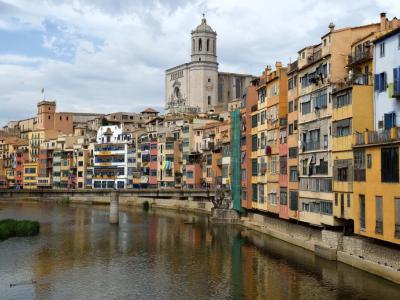
The Onyar River does more than split Girona in two-it frames one of its most photographed scenes. Lining its banks are the famous colored houses, stacked in ochres, pinks, yellows, and reds, their reflections doubling the spectacle in the water below. They weren’t designed as postcard material; in the Middle Ages, people simply built where space allowed-right on the river’s edge. Their facelift came much later, when architect Rafael Masó and a handful of local artists chose a palette that turned practicality into one of Girona’s defining images.
Locals sometimes call them the “Hanging Houses,” as if the buildings were daring you to notice how they cling to the riverbank. Among them sits the Masó House, the birthplace of Masó himself, now preserved as a museum that pulls visitors into his vision of Catalan modernism.
The river doesn’t just separate buildings; it has long marked a boundary between Girona’s medieval Old Town on one side and its modern growth on the other. Crossing one of its bridges is a literal step between eras, and few crossings are more famous than the Eiffel Bridge-built in 1877 by the same workshop that later sent an iron tower into the Paris sky.
If you’re looking for the best view, sunrise and sunset are the golden hours. From the bridges, the houses glow and ripple in the water, and even the most casual stroller turns into a photographer. But these façades aren’t only a backdrop; they’re an introduction. They welcome you into a city where centuries of history cling to the stones as tightly as the houses hug the river.
Locals sometimes call them the “Hanging Houses,” as if the buildings were daring you to notice how they cling to the riverbank. Among them sits the Masó House, the birthplace of Masó himself, now preserved as a museum that pulls visitors into his vision of Catalan modernism.
The river doesn’t just separate buildings; it has long marked a boundary between Girona’s medieval Old Town on one side and its modern growth on the other. Crossing one of its bridges is a literal step between eras, and few crossings are more famous than the Eiffel Bridge-built in 1877 by the same workshop that later sent an iron tower into the Paris sky.
If you’re looking for the best view, sunrise and sunset are the golden hours. From the bridges, the houses glow and ripple in the water, and even the most casual stroller turns into a photographer. But these façades aren’t only a backdrop; they’re an introduction. They welcome you into a city where centuries of history cling to the stones as tightly as the houses hug the river.
6) Casa Maso (Maso House)
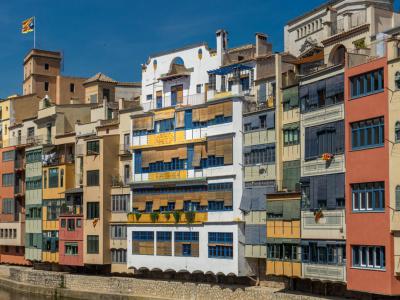
Masó House, perched along Crossbow Street beside the Onyar River, looks like just another of Girona’s riverside façades-until you realize it was the birthplace of Rafael Masó, one of Catalonia’s sharpest architectural minds of the early 20th century. Masó championed Noucentism, a movement that ditched the excesses of Modernism for cleaner lines, Mediterranean calm, and classical balance. His own home became both laboratory and showcase, and today it’s as much a museum as a family residence.
Between 1911 and 1919, Masó stitched together four adjoining houses into one flowing space. From the riverfront you see its distinctive exterior; step inside and you’re dropped straight into the daily life of a well-heeled Catalan household circa 1915. Stained glass, custom woodwork, ceramics, and textiles weren’t mere decoration here-they were Masó’s way of proving art and life should share the same roof. The rooms also display his drawings, models, and personal objects, sketching out a portrait of a man intent on reshaping his city one detail at a time.
Guided tours thread visitors through everything from the dining room and kitchen to the library and bedrooms. Along the way you notice the finer touches-mosaic floors, stained glass windows catching the light, and furnishings designed down to the last curve. Paintings and sculptures from the family’s collection widen the frame, placing Masó’s vision in conversation with the artistic world he inhabited.
For visitors, Masó House isn’t a static museum but a lived-in argument for Noucentism. It ties Girona’s medieval backdrop to its early 20th-century ambitions, while its place among the famous colored houses makes it a landmark in every sense. Step inside, and you’re not just seeing Masó’s work-you’re inhabiting his ideas.
Between 1911 and 1919, Masó stitched together four adjoining houses into one flowing space. From the riverfront you see its distinctive exterior; step inside and you’re dropped straight into the daily life of a well-heeled Catalan household circa 1915. Stained glass, custom woodwork, ceramics, and textiles weren’t mere decoration here-they were Masó’s way of proving art and life should share the same roof. The rooms also display his drawings, models, and personal objects, sketching out a portrait of a man intent on reshaping his city one detail at a time.
Guided tours thread visitors through everything from the dining room and kitchen to the library and bedrooms. Along the way you notice the finer touches-mosaic floors, stained glass windows catching the light, and furnishings designed down to the last curve. Paintings and sculptures from the family’s collection widen the frame, placing Masó’s vision in conversation with the artistic world he inhabited.
For visitors, Masó House isn’t a static museum but a lived-in argument for Noucentism. It ties Girona’s medieval backdrop to its early 20th-century ambitions, while its place among the famous colored houses makes it a landmark in every sense. Step inside, and you’re not just seeing Masó’s work-you’re inhabiting his ideas.
7) Puente de Sant Feliu (Sant Feliu Pedestrian Bridge)
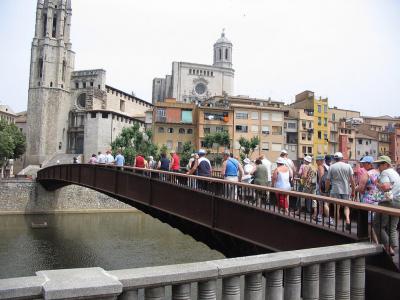
The Sant Feliu Pedestrian Bridge is a modern yet elegantly understated crossing over the Onyar River in Girona, Catalonia, Spain. Designed by Pedelta Structural Engineers and opened in 1998, this slender footbridge offers a graceful connection between the verdant Devesa Park and the historic Sant Feliu Square, situated just in front of the striking Saint Feliu church.
Crafted with minimalist precision, the bridge spans an impressive 58.4 meters in a single uninterrupted span, proudly showcasing a weathering‑steel box girder that gracefully varies in depth, from just 0.6 meters at mid‑span to 1.7 meters at each support. Its 3.5-meter-wide deck and integrated steel handrail blend functionality with elegance, making the structure both a feat of civil engineering and an aesthetically pleasing element within Girona’s urban landscape.
Since its unveiling, the bridge has been the recipient of several prestigious awards: a Civil Engineering mention (2nd Prize) at the 2000 Construmat Exhibition, plus selections for the FAD Awards in 1997 and the Eduardo Torroja Awards in 1999, attesting to its design excellence.
For visitors, the bridge serves as a peaceful and picturesque gateway into Girona’s old town. Whether arriving from Devesa Park or heading toward the Gothic charm of Saint Feliu church, it offers a moment of serene transition-and a spot for a memorable photo overlooking the river’s banks, especially as the city’s rich architectural tapestry unfolds around you.
Crafted with minimalist precision, the bridge spans an impressive 58.4 meters in a single uninterrupted span, proudly showcasing a weathering‑steel box girder that gracefully varies in depth, from just 0.6 meters at mid‑span to 1.7 meters at each support. Its 3.5-meter-wide deck and integrated steel handrail blend functionality with elegance, making the structure both a feat of civil engineering and an aesthetically pleasing element within Girona’s urban landscape.
Since its unveiling, the bridge has been the recipient of several prestigious awards: a Civil Engineering mention (2nd Prize) at the 2000 Construmat Exhibition, plus selections for the FAD Awards in 1997 and the Eduardo Torroja Awards in 1999, attesting to its design excellence.
For visitors, the bridge serves as a peaceful and picturesque gateway into Girona’s old town. Whether arriving from Devesa Park or heading toward the Gothic charm of Saint Feliu church, it offers a moment of serene transition-and a spot for a memorable photo overlooking the river’s banks, especially as the city’s rich architectural tapestry unfolds around you.
8) Basilica de Sant Feliu (Church of St. Felix)
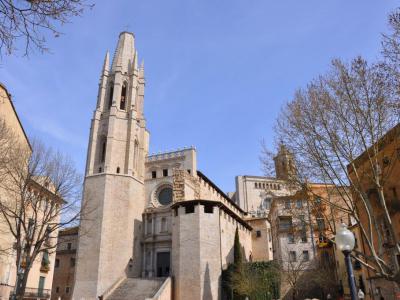
The Church of Saint Felix in Girona has been keeping watch over the city since long before the cathedral stole the limelight. Dedicated to Saint Felix, a Christian martyr who died here in the year 304 A.D., it grew stone by stone across five centuries, leaving behind a patchwork of Romanesque, Gothic, and Baroque details that read like an architectural timeline carved in limestone.
Its silhouette is unmistakable: a Gothic spire that cuts into Girona’s skyline, a Baroque outer wall that claims your attention easily, and a Romanesque apse still anchoring the structure to its earliest days. A sweeping staircase leads you up to the west portal, while inside, the gilded high altar and chapels create a sense of ceremony that has outlived kings and kingdoms alike.
But the real show-stealers lie along the side walls: eight sarcophagi dating from the 3rd and 4th centuries. These early Christian and Roman tombs, etched with biblical and allegorical scenes, make the church feel part sanctuary, part time capsule. Add in stained glass windows, carved details, and the echo of five bells from its tower, and you have a place where every corner reminds you that faith and civic pride have always walked hand in hand here.
The Church of Saint Felix isn’t a stop to tick off-it’s an encounter with Girona’s oldest layers, where ancient sarcophagi, medieval naves, and Baroque flourishes all argue their case. It’s less about one saint or one style, and more about how a city builds, rebuilds, and remembers.
Its silhouette is unmistakable: a Gothic spire that cuts into Girona’s skyline, a Baroque outer wall that claims your attention easily, and a Romanesque apse still anchoring the structure to its earliest days. A sweeping staircase leads you up to the west portal, while inside, the gilded high altar and chapels create a sense of ceremony that has outlived kings and kingdoms alike.
But the real show-stealers lie along the side walls: eight sarcophagi dating from the 3rd and 4th centuries. These early Christian and Roman tombs, etched with biblical and allegorical scenes, make the church feel part sanctuary, part time capsule. Add in stained glass windows, carved details, and the echo of five bells from its tower, and you have a place where every corner reminds you that faith and civic pride have always walked hand in hand here.
The Church of Saint Felix isn’t a stop to tick off-it’s an encounter with Girona’s oldest layers, where ancient sarcophagi, medieval naves, and Baroque flourishes all argue their case. It’s less about one saint or one style, and more about how a city builds, rebuilds, and remembers.
9) Ferran el Catòlic Street and Archaeological Walk - Braavos Port Market
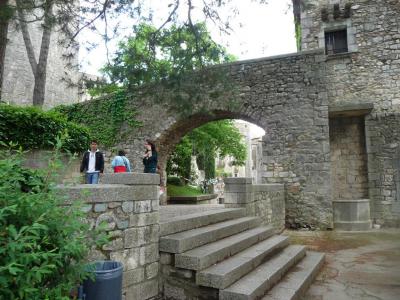
Ferran the Catholic Street borrows its name from Ferdinand II of Aragon, the same Ferdinand history books file under “the Catholic.” Today, this narrow stretch of Girona’s Old Town stitches together two heavyweights: the Archaeological Walk and Cathedral Square. The Walk itself is a time-layered path, first Roman, then Carolingian, later medieval-rebuilt in the 20th century after centuries of decline. Cypress shade, garden walls, watchtowers, and broad city views make it feel like Girona’s open-air scrapbook.
On Ferran the Catholic Street, you see the contrast straight away: stone remnants of those ancient walls leaning against later buildings, history literally jammed up against modern life. The Church of Saint Luke adds another note, reminding passersby that this isn’t just a shortcut between landmarks but a corridor with its own chapters.
And then comes the television twist. Game of Thrones fans know this part of town as Braavos. Arya Stark, hood up and wary, drifts through a market filmed right along the Archaeological Walk and nearby King Street. Jury Square, a few steps away, doubled as the Braavosi theater where Arya spied on the Lannister play. In Girona, though, the square has long served a more grounded role: concerts, performances, public gatherings. Its stone stairways, flanking walls, and the Galligants River give it the same natural backdrop that once lured HBO’s cameras.
With the Monastery of Saint Peter of Galligants only a short stroll away, this corner of Girona packs centuries of cultural weight, or pop-culture, the choice is yours.
On Ferran the Catholic Street, you see the contrast straight away: stone remnants of those ancient walls leaning against later buildings, history literally jammed up against modern life. The Church of Saint Luke adds another note, reminding passersby that this isn’t just a shortcut between landmarks but a corridor with its own chapters.
And then comes the television twist. Game of Thrones fans know this part of town as Braavos. Arya Stark, hood up and wary, drifts through a market filmed right along the Archaeological Walk and nearby King Street. Jury Square, a few steps away, doubled as the Braavosi theater where Arya spied on the Lannister play. In Girona, though, the square has long served a more grounded role: concerts, performances, public gatherings. Its stone stairways, flanking walls, and the Galligants River give it the same natural backdrop that once lured HBO’s cameras.
With the Monastery of Saint Peter of Galligants only a short stroll away, this corner of Girona packs centuries of cultural weight, or pop-culture, the choice is yours.
10) Catedral de Girona (Girona Cathedral) (must see)
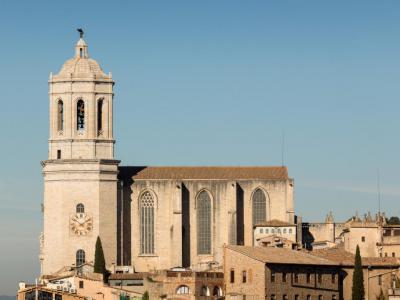
Resting on one of Girona’s high points, the Girona Cathedral doesn’t so much sit in the skyline as command it. The climb begins with that wide baroque staircase-grand enough to feel ceremonial before you’ve even crossed the threshold.
The story of this cathedral stretches across seven centuries of construction, from the 11th to the 18th, leaving behind an architectural mixture of Romanesque, Gothic, and Baroque. The earliest layer survives in the cloister and Charlemagne Tower, but the main piece arrived in the 14th century: a single Gothic nave, seventy-five feet across. It’s the widest Gothic nave in the world, and second only to St. Peter’s in Rome for sheer span-an audacious feat of stone engineering. By the 18th century, the baroque façade sealed the building’s imposing look.
Step inside, and the contrasts play out in stained glass light, a silver-and-gem altarpiece, and side chapels that balance solemnity with flourish. The bell tower rises with clock and belfry, while the Romanesque cloister to the north, with its trapezoid plan and double columns, gives you a glimpse into an older, quieter rhythm of devotion.
The real treasures sit in the cathedral’s museum: the Tapestry of Creation, a masterpiece of embroidery from the 11th or 12th century; the illuminated Gerona Beatus manuscript from the 10th; and a silver casket crafted for the Caliph Hisham II. Together, they weave a timeline of faith, artistry, and power.
And if the staircase looks familiar-it’s because HBO’s Game of Thrones turned it into the Great Sept of Baelor. Girona Cathedral has been playing host to drama for a thousand years; the cameras were just a bit late to the party.
The story of this cathedral stretches across seven centuries of construction, from the 11th to the 18th, leaving behind an architectural mixture of Romanesque, Gothic, and Baroque. The earliest layer survives in the cloister and Charlemagne Tower, but the main piece arrived in the 14th century: a single Gothic nave, seventy-five feet across. It’s the widest Gothic nave in the world, and second only to St. Peter’s in Rome for sheer span-an audacious feat of stone engineering. By the 18th century, the baroque façade sealed the building’s imposing look.
Step inside, and the contrasts play out in stained glass light, a silver-and-gem altarpiece, and side chapels that balance solemnity with flourish. The bell tower rises with clock and belfry, while the Romanesque cloister to the north, with its trapezoid plan and double columns, gives you a glimpse into an older, quieter rhythm of devotion.
The real treasures sit in the cathedral’s museum: the Tapestry of Creation, a masterpiece of embroidery from the 11th or 12th century; the illuminated Gerona Beatus manuscript from the 10th; and a silver casket crafted for the Caliph Hisham II. Together, they weave a timeline of faith, artistry, and power.
And if the staircase looks familiar-it’s because HBO’s Game of Thrones turned it into the Great Sept of Baelor. Girona Cathedral has been playing host to drama for a thousand years; the cameras were just a bit late to the party.
11) Bishop José Cartañà Street - Streets of Braavos
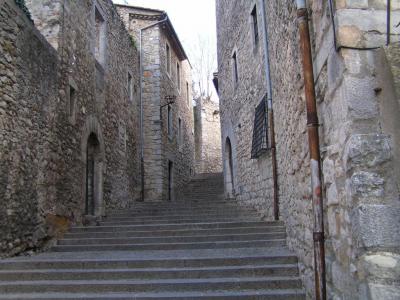
Slip around the back of Girona’s cathedral and you’ll stumble onto Bishop Josep Cartañà Street-a lane that once belonged mostly to locals and pigeons but now doubles as prime Braavos territory. In Game of Thrones Season 6, this is where Arya Stark, blinded and desperate, staggered along the cobbles, begging for alms. The producers hardly touched a thing; the uneven stones, the narrow squeeze of walls, and those shadowy corners were ready-made for Braavos grit.
The street itself begins under an arch beside Apostols’ Square and winds down toward Saint Cristòfol Street. Its name honors Bishop Josep Cartañà, who left his mark on Girona in the 20th century and now rests eternally in the cathedral towering above. Beneath your feet lie Roman foundations, while the walls tell tales of medieval expansions. On paper, it’s a modest side street; in practice, it’s a timeline compressed into a few dozen meters.
For locals, it’s another thread in Girona’s historic fabric. For “Thronies,” it’s Arya’s training ground. The stone steps behind the cathedral gardens have become a pilgrimage site where fans perch, squint into imaginary sunlight, and play the part of a blind girl with more grit than coins. It’s one of the most reenacted moments in town-and perhaps the only spot where you’ll see tourists queuing up to pretend to beg.
That’s the charm of Bishop Cartañà Street: history layered with pop culture, a lane that’s both lived-in and cinematic, where Girona’s past meets fantasy.
The street itself begins under an arch beside Apostols’ Square and winds down toward Saint Cristòfol Street. Its name honors Bishop Josep Cartañà, who left his mark on Girona in the 20th century and now rests eternally in the cathedral towering above. Beneath your feet lie Roman foundations, while the walls tell tales of medieval expansions. On paper, it’s a modest side street; in practice, it’s a timeline compressed into a few dozen meters.
For locals, it’s another thread in Girona’s historic fabric. For “Thronies,” it’s Arya’s training ground. The stone steps behind the cathedral gardens have become a pilgrimage site where fans perch, squint into imaginary sunlight, and play the part of a blind girl with more grit than coins. It’s one of the most reenacted moments in town-and perhaps the only spot where you’ll see tourists queuing up to pretend to beg.
That’s the charm of Bishop Cartañà Street: history layered with pop culture, a lane that’s both lived-in and cinematic, where Girona’s past meets fantasy.

12) Torre Gironella (Gironella Tower)
Nestled in the heart of Girona’s historic quarter, Gironella Tower stands as a silent sentinel at the highest point of the ancient Roman walls-known as the Força Vella-just behind the majestic Cathedral and beside the Bishop’s Palace. This evocative ruin, officially recognized as a Cultural Asset of National Interest since April 22, 1949, offers visitors both historical depth and architectural intrigue.
Architecturally, Gironella Tower is a fascinating patchwork of eras: its visible remains include a robust Roman square tower lying partly beneath an embankment, a barrel-vault supporting structure, medieval walls, and later reinforcements. Visitors can still climb the stone stairs into the access courtyard, where the historic “Joana Enríquez Gate” marks one of its most striking features.
Tracing its storied past, the tower’s existence is recorded as early as 994 AD. Around the year 1000, Count Ramon Borrell III incorporated the Roman structure into the new Castle of Gironella, which by 1190 had become officially recognized as such. Over the centuries, it served various roles-including a prison in the 13th century-and was rebuilt after collapsing in 1404, only to be reinforced again in 1462 by Joana Enríquez. Tragically, the tower met its ruin at the hands of Napoleonic forces in 1814.
Today, Gironella Tower remains an evocative waypoint on Girona’s Archaeological Walk. It offers not just sweeping vistas over the Old Quarter, but also an intimate window into a layered past where Roman foundations, medieval fortifications, and modern memory converge. A visit here is both scenic and scholarly-a must for history lovers and curious travelers alike.
Architecturally, Gironella Tower is a fascinating patchwork of eras: its visible remains include a robust Roman square tower lying partly beneath an embankment, a barrel-vault supporting structure, medieval walls, and later reinforcements. Visitors can still climb the stone stairs into the access courtyard, where the historic “Joana Enríquez Gate” marks one of its most striking features.
Tracing its storied past, the tower’s existence is recorded as early as 994 AD. Around the year 1000, Count Ramon Borrell III incorporated the Roman structure into the new Castle of Gironella, which by 1190 had become officially recognized as such. Over the centuries, it served various roles-including a prison in the 13th century-and was rebuilt after collapsing in 1404, only to be reinforced again in 1462 by Joana Enríquez. Tragically, the tower met its ruin at the hands of Napoleonic forces in 1814.
Today, Gironella Tower remains an evocative waypoint on Girona’s Archaeological Walk. It offers not just sweeping vistas over the Old Quarter, but also an intimate window into a layered past where Roman foundations, medieval fortifications, and modern memory converge. A visit here is both scenic and scholarly-a must for history lovers and curious travelers alike.
