Custom Walk in Corfu, Greece by davewaters1_886c8 created on 2025-04-17
Guide Location: Greece » Corfu
Guide Type: Custom Walk
# of Sights: 9
Tour Duration: 1 Hour(s)
Travel Distance: 1.6 Km or 1 Miles
Share Key: MSQ2U
Guide Type: Custom Walk
# of Sights: 9
Tour Duration: 1 Hour(s)
Travel Distance: 1.6 Km or 1 Miles
Share Key: MSQ2U
How It Works
Please retrieve this walk in the GPSmyCity app. Once done, the app will guide you from one tour stop to the next as if you had a personal tour guide. If you created the walk on this website or come to the page via a link, please follow the instructions below to retrieve the walk in the app.
Retrieve This Walk in App
Step 1. Download the app "GPSmyCity: Walks in 1K+ Cities" on Apple App Store or Google Play Store.



Step 2. In the GPSmyCity app, download(or launch) the guide "Corfu Map and Walking Tours".
Step 3. Tap the menu button located at upper right corner of the "Walks" screen and select "Retrieve custom walk". Enter the share key: MSQ2U
1) Old Fortress (must see)
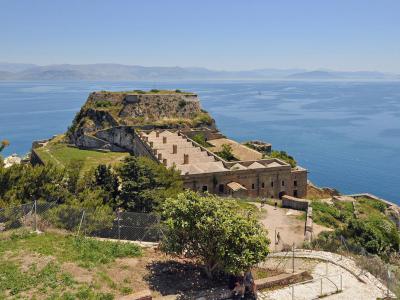
A jagged rock rising from the sea, crowned with walls that have seen more as many cannons as boats floating in the sea. That’s Corfu’s Old Fortress, first fortified back in the 6th century AD when locals, tired of getting knocked around by Ostrogoth raids, hauled themselves onto this peninsula for safety. The Byzantines took over the project in the 12th century, adding towers on two peaks and giving the place its dual identity as Old Castle and New Castle.
Then came the Venetians, and with them, big ideas. From 1386 to 1797, they carved the Contrafossa canal, severing the fortress from the town and turning it into a floating citadel. They stacked on bastions, underground passages, and towers robust enough to stare down three separate Ottoman sieges. The last, in 1716, dragged on for seven weeks until Count von der Schulenburg and his defenders forced the Ottomans packing. But the fortress wasn’t invincible-two years later, a lightning strike hit the powder magazine and blew the place sky-high, Venetian commander included.
Roll forward to the British in the 19th century, who added their own flair with a lighthouse and military barracks. Later chapters got grim: Italian bombs in 1923, and under Nazi occupation, the fortress became a holding prison for Corfu’s Jews before deportation-a story that ended in tragedy for most.
And yet, the fortress endures. Today it’s home to the Public Library of Corfu and the Ionian University’s Music Research Lab, and its courtyards double as stages for concerts and exhibitions. Wander the bastions, slip through shadowy tunnels, or just climb high for sweeping views over Corfu Town’s terracotta rooftops, the Ionian shimmer, and Albania’s distant peaks. Part monument, part cultural playground, the Old Fortress is history with a pulse.
Then came the Venetians, and with them, big ideas. From 1386 to 1797, they carved the Contrafossa canal, severing the fortress from the town and turning it into a floating citadel. They stacked on bastions, underground passages, and towers robust enough to stare down three separate Ottoman sieges. The last, in 1716, dragged on for seven weeks until Count von der Schulenburg and his defenders forced the Ottomans packing. But the fortress wasn’t invincible-two years later, a lightning strike hit the powder magazine and blew the place sky-high, Venetian commander included.
Roll forward to the British in the 19th century, who added their own flair with a lighthouse and military barracks. Later chapters got grim: Italian bombs in 1923, and under Nazi occupation, the fortress became a holding prison for Corfu’s Jews before deportation-a story that ended in tragedy for most.
And yet, the fortress endures. Today it’s home to the Public Library of Corfu and the Ionian University’s Music Research Lab, and its courtyards double as stages for concerts and exhibitions. Wander the bastions, slip through shadowy tunnels, or just climb high for sweeping views over Corfu Town’s terracotta rooftops, the Ionian shimmer, and Albania’s distant peaks. Part monument, part cultural playground, the Old Fortress is history with a pulse.
2) Spianada Square
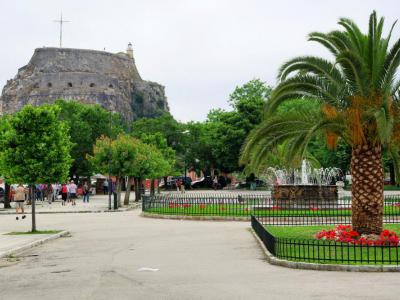
Spianada Square in Corfu, whose name comes from the Italian spianare, meaning “to flatten,” lives up to its name-though not in spirit. It spreads out as the largest square in the Balkans, a broad stage where centuries of history have left their mark. The Venetians began the story in the 16th century, clearing away houses to create an open zone of defense for the Old Fortress. Later came the French, with their taste for order and neat urban planning, followed by the British, who sprinkled in their own additions. The result is a patchwork of empires, still visible in stone, gardens, and arcades.
At the heart of the square stands the Peristyle of Maitland, a circle of twenty Ionic columns raised in 1817 by General George Whitmore. It rests on top of what was once a water cistern, though the locals still call it the “Sterna.” Monuments dot the area like footnotes in marble-among them the statue of Count von der Schulenburg, remembered for repelling the Turks in 1716. In the “Boschetto” garden, fountains and busts of figures such as poet Konstantinos Theotokis and author Gerald Durrell soften the grandeur with quieter, more personal notes.
One side of Spianada is framed by the Liston Arcade, a French-era creation from 1807 inspired by Paris’s Rivoli street. Today its arcades shelter cafés whose tables are among the most coveted in Corfu. Not far off rises the Palace of Saint Michael and Saint George, a British-built neoclassical landmark from 1824, now housing the Museum of Asian Art. Together, they turn the square into a living open-air gallery of European design.
But Spianada is no museum piece. Cricket matches-an odd British legacy-still play out on its lawn, while Easter parades, concerts, and festivals keep the square buzzing with life. It is Corfu’s civic heart, where military history, imperial flair, and everyday social life continue to mingle in the open air.
At the heart of the square stands the Peristyle of Maitland, a circle of twenty Ionic columns raised in 1817 by General George Whitmore. It rests on top of what was once a water cistern, though the locals still call it the “Sterna.” Monuments dot the area like footnotes in marble-among them the statue of Count von der Schulenburg, remembered for repelling the Turks in 1716. In the “Boschetto” garden, fountains and busts of figures such as poet Konstantinos Theotokis and author Gerald Durrell soften the grandeur with quieter, more personal notes.
One side of Spianada is framed by the Liston Arcade, a French-era creation from 1807 inspired by Paris’s Rivoli street. Today its arcades shelter cafés whose tables are among the most coveted in Corfu. Not far off rises the Palace of Saint Michael and Saint George, a British-built neoclassical landmark from 1824, now housing the Museum of Asian Art. Together, they turn the square into a living open-air gallery of European design.
But Spianada is no museum piece. Cricket matches-an odd British legacy-still play out on its lawn, while Easter parades, concerts, and festivals keep the square buzzing with life. It is Corfu’s civic heart, where military history, imperial flair, and everyday social life continue to mingle in the open air.
3) Liston (must see)
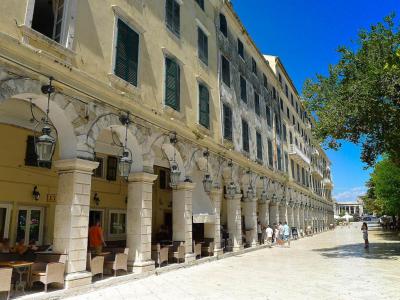
Liston's name is up for debate. Depends who you ask. Scholars will point to the Venetian lista-a term for a grand promenade. Locals with a taste for legend prefer the tale of a literal “list” of aristocrats who alone were allowed to strut along here before Corfu joined Greece in 1864. Whichever story you choose, the walkway has been Corfu’s living room ever since.
The French put their stamp on the place between 1807 and 1814, shaping the arcades to mirror Paris’s Rivoli street. With its neoclassical arches stretched along the edge of the Spianada, the Liston gave Corfu a dose of cosmopolitan flair. Today, those same arches frame cafés that never seem to empty, their terraces packed with conversations and clinking cups.
Geography keeps the Liston at the heart of it all. It links Spianada Square to the Old Town, just steps from the Old Fortress, the Palace of Saint Michael and Saint George, and Saint Spyridon’s Church. At Easter, the arcades glow purple with lanterns, processions wind past, and locals toss clay pots from balconies in a thunderous ritual that rattles the air. On quieter days, you might hear folk music, watch a cricket match on the lawn, or stumble into a street exhibition.
And then there’s the simple pleasure: sipping coffee under the shade, nibbling kumquat sweets, or raising an eyebrow at the polished chaos of traffic and cricket sharing the same square. The Liston is a performance that never ends, starring whoever happens to be passing through, which today, happens to include you.
The French put their stamp on the place between 1807 and 1814, shaping the arcades to mirror Paris’s Rivoli street. With its neoclassical arches stretched along the edge of the Spianada, the Liston gave Corfu a dose of cosmopolitan flair. Today, those same arches frame cafés that never seem to empty, their terraces packed with conversations and clinking cups.
Geography keeps the Liston at the heart of it all. It links Spianada Square to the Old Town, just steps from the Old Fortress, the Palace of Saint Michael and Saint George, and Saint Spyridon’s Church. At Easter, the arcades glow purple with lanterns, processions wind past, and locals toss clay pots from balconies in a thunderous ritual that rattles the air. On quieter days, you might hear folk music, watch a cricket match on the lawn, or stumble into a street exhibition.
And then there’s the simple pleasure: sipping coffee under the shade, nibbling kumquat sweets, or raising an eyebrow at the polished chaos of traffic and cricket sharing the same square. The Liston is a performance that never ends, starring whoever happens to be passing through, which today, happens to include you.
4) Casa Parlante (must see)
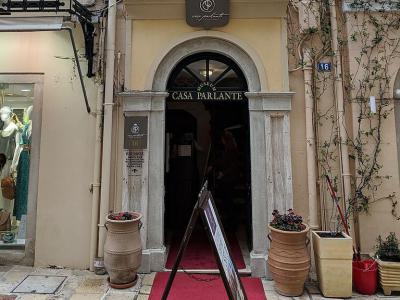
Imagine stepping into a 19th-century Corfiot mansion where the walls quite literally have something to say-that’s Casa Parlante. This Venetian-style house museum sits in the Old Town, not far from Liston and Spianada Square, and it whisks you straight into the refined world of Corfu’s aristocracy during the British protectorate. Furniture, portraits, and heirlooms set the scene, but the twist is how the place “talks.” With animatronics, sounds, and even scents, the mansion feels less like a static exhibit and more like a home mid-conversation.
As you move through the rooms, you’ll cross paths with the count and countess, their children, and the staff, all frozen in moments of daily routine yet curiously alive. You might hear a waltz seeping through the walls, smell dishes simmering in the kitchen, or find yourself in the middle of an afternoon tea that looks convincingly underway. Every chamber doubles as a slice of noble life, complete with rocking chairs that creak, music that lingers, and details that give the sense you’ve caught the household by surprise.
The Talking House doesn’t feel like a typical museum; it’s closer to walking through a living play where history is staged with a wink. It turns the aristocratic past into something tangible, not only to observe but to experience, making a centuries-old lifestyle both memorable and oddly familiar.
As you move through the rooms, you’ll cross paths with the count and countess, their children, and the staff, all frozen in moments of daily routine yet curiously alive. You might hear a waltz seeping through the walls, smell dishes simmering in the kitchen, or find yourself in the middle of an afternoon tea that looks convincingly underway. Every chamber doubles as a slice of noble life, complete with rocking chairs that creak, music that lingers, and details that give the sense you’ve caught the household by surprise.
The Talking House doesn’t feel like a typical museum; it’s closer to walking through a living play where history is staged with a wink. It turns the aristocratic past into something tangible, not only to observe but to experience, making a centuries-old lifestyle both memorable and oddly familiar.
5) Banknote Museum of Alpha Bank
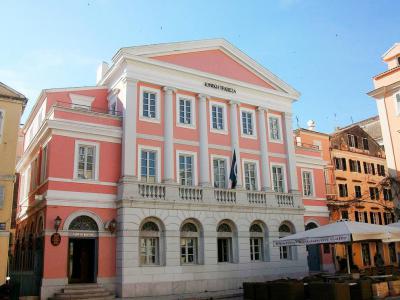
Nestled in the historic heart of Corfu, the Banknote Museum of Alpha Bank occupies a beautifully preserved neoclassical edifice originally built for the Ionian Bank in the mid‑19th century. Designed by Corfiot architect Ioannis Chronis around 1840, this distinguished building once housed the first branch of the Ionian Bank. Since 2000, following the bank's merger with Alpha Bank, the site has carried forward its legacy with renewed purpose and care.
Established in 1981, the museum opened a window into Greek numismatic history, and after a careful renovation in the early 2000s, it reopened to the public in 2005. This transformation was guided by historian Aris Rapidis and included input from John Keyworth of the Bank of England, ensuring international museum standards in presentation and curation.
Inside, visitors embark on a chronological journey through nearly two centuries of Greece’s monetary evolution-from the revolutionary bonds issued in 1822 by the fledgling Greek State, through the iconic phoenix banknotes of Governor Kapodistrias, to the final drachma banknotes phased out in favor of the euro in 2002. Alongside around 2,000 banknotes, the displays showcase printing plates, essays, rare specimens like the 1860 “colonata,” and even a remarkable Byzantine‑inspired note depicting Hagia Sophia from 1920 that was never circulated.
Free to all visitors and thoughtfully interpreted in both Greek and English, the museum packs a rich, engaging experience into a manageable visit, typically around 30 to 45 minutes.
Established in 1981, the museum opened a window into Greek numismatic history, and after a careful renovation in the early 2000s, it reopened to the public in 2005. This transformation was guided by historian Aris Rapidis and included input from John Keyworth of the Bank of England, ensuring international museum standards in presentation and curation.
Inside, visitors embark on a chronological journey through nearly two centuries of Greece’s monetary evolution-from the revolutionary bonds issued in 1822 by the fledgling Greek State, through the iconic phoenix banknotes of Governor Kapodistrias, to the final drachma banknotes phased out in favor of the euro in 2002. Alongside around 2,000 banknotes, the displays showcase printing plates, essays, rare specimens like the 1860 “colonata,” and even a remarkable Byzantine‑inspired note depicting Hagia Sophia from 1920 that was never circulated.
Free to all visitors and thoughtfully interpreted in both Greek and English, the museum packs a rich, engaging experience into a manageable visit, typically around 30 to 45 minutes.
6) Town Hall
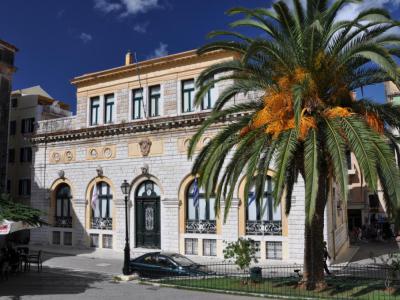
Picture yourself standing in the heart of Corfu’s Old Town, where the Town Hall claims pride of place on its namesake square. At first glance, it looks like something Venice might have misplaced, with its marble arches, sculpted masks, and a façade that seems far too elegant to be just another civic building. And in truth, it wasn’t built for that purpose at all. Between 1663 and 1693, this was the Lodge of the Noblemen-an exclusive Venetian-era club where Corfu’s elite gathered to talk politics, throw parties, and remind everyone else of their status.
The Venetians left their fingerprints all over the place, quite literally in the stonework. Step closer, and you’ll spot the masks, engraved emblems, and intricate flourishes decorating the walls. Standing guard on the eastern wall is a bust of Admiral Francesco Morosini, the Venetian naval commander whose résumé included campaigns across the Mediterranean. He’s not alone up there: four small figures representing his virtues keep him company, in case anyone forgot he was meant to be admired.
As the centuries rolled on, the building reinvented itself. In 1720, it became the Noble Theatre of Saint Giacomo, where aristocrats would be just spectators. Then, in 1903, it swapped curtains for council meetings and officially became Corfu’s Town Hall. The archives of the theatre were tragically lost in 1943 during a German bombing, with only the main stage curtain surviving-today it’s preserved in the New Municipal Theatre as a rare fragment of that era.
For visitors today, the Town Hall is less about bureaucracy and more about standing in front of one of Corfu’s finest Venetian legacies. Its Renaissance style and central location make it a natural stop for anyone exploring the Old Town. The building still carries the air of a stage-only now, the players are tourists, locals, and the daily life of Corfu itself.
The Venetians left their fingerprints all over the place, quite literally in the stonework. Step closer, and you’ll spot the masks, engraved emblems, and intricate flourishes decorating the walls. Standing guard on the eastern wall is a bust of Admiral Francesco Morosini, the Venetian naval commander whose résumé included campaigns across the Mediterranean. He’s not alone up there: four small figures representing his virtues keep him company, in case anyone forgot he was meant to be admired.
As the centuries rolled on, the building reinvented itself. In 1720, it became the Noble Theatre of Saint Giacomo, where aristocrats would be just spectators. Then, in 1903, it swapped curtains for council meetings and officially became Corfu’s Town Hall. The archives of the theatre were tragically lost in 1943 during a German bombing, with only the main stage curtain surviving-today it’s preserved in the New Municipal Theatre as a rare fragment of that era.
For visitors today, the Town Hall is less about bureaucracy and more about standing in front of one of Corfu’s finest Venetian legacies. Its Renaissance style and central location make it a natural stop for anyone exploring the Old Town. The building still carries the air of a stage-only now, the players are tourists, locals, and the daily life of Corfu itself.
7) Saint Spyridon Church (must see)
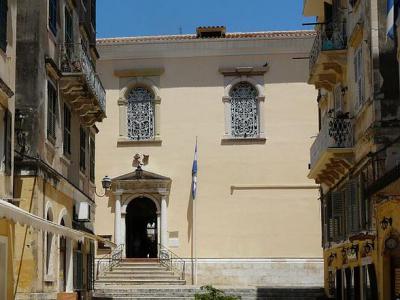
Saint Spyridon Church in Corfu isn’t just a building you pass by-it’s a 16th-century heavyweight in both history and faith. Raised in 1589, it honours Corfu’s patron saint, Spyridon, a 4th-century figure celebrated for his miracles and steadfast belief. After his death, his relics were safeguarded in Constantinople until the city fell, then ferried to Corfu, where they eventually found a permanent home in this church within the old city walls.
Its Venetian stamp is hard to miss. The red-domed bell tower-tall enough to make its presence known across the Ionian Islands-dominates Corfu Town’s skyline. Inside, it’s all about detail and devotion: golden flourishes, a painted ceiling narrating episodes from the saint’s life, and at the heart, the silver casket holding his relics. These remains are central to Corfu’s identity, carried through the streets in processions that mark the island’s brushes with sieges, plagues, and survival against the odds.
The crypt adds its own intrigue, with a double sarcophagus encasing the saint’s body, surrounded by 53 incense burners-18 fashioned in gold, the rest in silver. Even the Romanov coat of arms above the west door tells a story of connections that looks hard to believe at first glance.
Step inside today, and you’ll find a place where Orthodox devotion meets Venetian elegance, where pilgrims kneel in reverence and curious visitors look upward in awe. The church and island are in good hands, as Saint Spyridon had centuries to master his craft. Even though not always in physical form.
Its Venetian stamp is hard to miss. The red-domed bell tower-tall enough to make its presence known across the Ionian Islands-dominates Corfu Town’s skyline. Inside, it’s all about detail and devotion: golden flourishes, a painted ceiling narrating episodes from the saint’s life, and at the heart, the silver casket holding his relics. These remains are central to Corfu’s identity, carried through the streets in processions that mark the island’s brushes with sieges, plagues, and survival against the odds.
The crypt adds its own intrigue, with a double sarcophagus encasing the saint’s body, surrounded by 53 incense burners-18 fashioned in gold, the rest in silver. Even the Romanov coat of arms above the west door tells a story of connections that looks hard to believe at first glance.
Step inside today, and you’ll find a place where Orthodox devotion meets Venetian elegance, where pilgrims kneel in reverence and curious visitors look upward in awe. The church and island are in good hands, as Saint Spyridon had centuries to master his craft. Even though not always in physical form.
8) Holocaust Memorial of Corfu
The Holocaust Memorial of Corfu is a poignant tribute to the 2000 Jewish citizens of Corfu who perished in the Auschwitz and Birkenau concentration camps during World War II. The monument was erected in 2001 in memory of the tragic events that took place in June 1944 when the German troops deported 1800 Jews from the island to the concentration camps.
The monument is located in a small square in the north of the old town of Kerkyra, where the center of the Jewish community of the island used to be before the war. The Jewish community of Corfu was the strongest in Greece before the war, but tragically, only a handful of survivors returned to the island after the war ended.
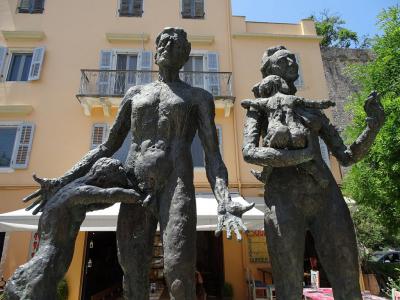
The bronze sculpture by Georgios Karahalios depicts a naked family of four, symbolizing the vulnerability and helplessness of the Jewish victims of the Holocaust. The text on the plaque reads, "Never again for any nation," reminding us of the importance of preserving the memory of the Holocaust and ensuring that such atrocities never happen again.
The monument is a joint effort by the municipality and the Jewish community of Corfu, a testament to the importance of remembering the past and honoring the memory of those who lost their lives. It serves as a powerful reminder of the horrors of the Holocaust and the need to promote tolerance, understanding, and respect for all people regardless of their religion, race, or ethnicity.
The monument is located in a small square in the north of the old town of Kerkyra, where the center of the Jewish community of the island used to be before the war. The Jewish community of Corfu was the strongest in Greece before the war, but tragically, only a handful of survivors returned to the island after the war ended.
The bronze sculpture by Georgios Karahalios depicts a naked family of four, symbolizing the vulnerability and helplessness of the Jewish victims of the Holocaust. The text on the plaque reads, "Never again for any nation," reminding us of the importance of preserving the memory of the Holocaust and ensuring that such atrocities never happen again.
The monument is a joint effort by the municipality and the Jewish community of Corfu, a testament to the importance of remembering the past and honoring the memory of those who lost their lives. It serves as a powerful reminder of the horrors of the Holocaust and the need to promote tolerance, understanding, and respect for all people regardless of their religion, race, or ethnicity.
9) New Fortress (must see)
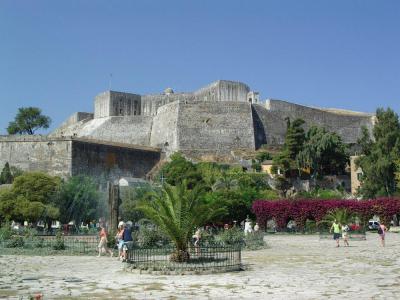
High above the old harbor, the New Fortress of Corfu looms like a stony reminder that Venice never did anything halfway when it came to defense. After the Ottomans came knocking in 1537, it became clear that the Old Fortress wasn’t enough. So in 1577, the Venetians rolled up their sleeves, flattened entire neighborhoods, and raised this new citadel on the hill of Saint Mark. By 1645, the work was largely done, and what emerged was a masterclass in military engineering-bastions, moats, and underground passages all stitched into the fabric of Corfu’s skyline.
The fortress is built on two levels, each with its own perks. The lower level holds a three-story building and a pentagonal bastion, strung together with arched halls, staircases, and labyrinth-like ramps. Baroque gates and a long, dry moat added extra muscle. Higher up, the bastions of Skarponas and Epta Anemoi command the town and sea, reached by way of the aptly named Bell Castle. Later centuries left their fingerprints too-the 18th-century Venetians fortified the western hills, the French shored up Vidos Islet, and the British, practical as ever, added their barracks.
For adventurers, the payoff is layered. You can wander through its shadowy tunnels, touch the thick stone walls, and read the Venetian lion carved in relief since 1728, all while imagining the fortress as the shield it once was. Or, climb to the higher bastions and let the view unfold-the tiled rooftops of Corfu Town, the sweep of the sea, and the Old Fortress standing watch in the distance.
Today, the former barracks host art exhibitions and cultural events. The New Fortress, in its mix of grit, history, and unexpected beauty, shows how Corfu has always been more crossroads than outpost.
The fortress is built on two levels, each with its own perks. The lower level holds a three-story building and a pentagonal bastion, strung together with arched halls, staircases, and labyrinth-like ramps. Baroque gates and a long, dry moat added extra muscle. Higher up, the bastions of Skarponas and Epta Anemoi command the town and sea, reached by way of the aptly named Bell Castle. Later centuries left their fingerprints too-the 18th-century Venetians fortified the western hills, the French shored up Vidos Islet, and the British, practical as ever, added their barracks.
For adventurers, the payoff is layered. You can wander through its shadowy tunnels, touch the thick stone walls, and read the Venetian lion carved in relief since 1728, all while imagining the fortress as the shield it once was. Or, climb to the higher bastions and let the view unfold-the tiled rooftops of Corfu Town, the sweep of the sea, and the Old Fortress standing watch in the distance.
Today, the former barracks host art exhibitions and cultural events. The New Fortress, in its mix of grit, history, and unexpected beauty, shows how Corfu has always been more crossroads than outpost.
