Custom Walk in Valletta, Malta by dantonow_eb7b9 created on 2025-05-06
Guide Location: Malta » Valletta
Guide Type: Custom Walk
# of Sights: 8
Tour Duration: 2 Hour(s)
Travel Distance: 3.7 Km or 2.3 Miles
Share Key: ASTFH
Guide Type: Custom Walk
# of Sights: 8
Tour Duration: 2 Hour(s)
Travel Distance: 3.7 Km or 2.3 Miles
Share Key: ASTFH
How It Works
Please retrieve this walk in the GPSmyCity app. Once done, the app will guide you from one tour stop to the next as if you had a personal tour guide. If you created the walk on this website or come to the page via a link, please follow the instructions below to retrieve the walk in the app.
Retrieve This Walk in App
Step 1. Download the app "GPSmyCity: Walks in 1K+ Cities" on Apple App Store or Google Play Store.



Step 2. In the GPSmyCity app, download(or launch) the guide "Valletta Map and Walking Tours".
Step 3. Tap the menu button located at upper right corner of the "Walks" screen and select "Retrieve custom walk". Enter the share key: ASTFH
1) City Gate
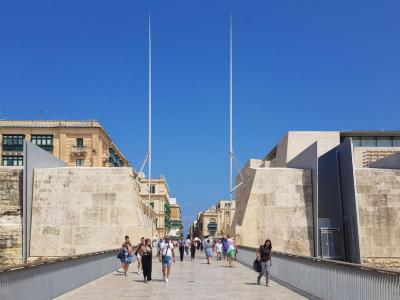
City Gate serves as the main entrance to Valletta. Often referred to as the “Door to the City,” it marks the point where visitors step from the modern world into the historic grid of streets planned in the 16th century.
The first gate on this site, known as San Giorgio Gate, was built between 1566 and 1569 by military engineer Francesco Laparelli, following the Great Siege. It was a fortified opening in the city walls, designed very much with defense in mind. In 1632, it was replaced by a more decorative gate by Maltese architect Tommaso Dingli, reflecting the city’s growing confidence and stability.
Under British rule, a new gate was built in 1853, designed by Colonel Thompson of the Royal Engineers. Featuring two large central arches and two smaller side arches, it became known as the Reale Gate and stood throughout the colonial period. In 1964, a fourth gate was inaugurated as part of a redevelopment plan for the entrance and the nearby Royal Opera House, although the full project was never completed.
As you approach today, you will see the fifth and current City Gate, completed in 2014 and designed by Italian architect Renzo Piano. Walking through it, you will find a clean, modern opening that intentionally contrasts with the historic stone walls. Don’t miss the way the gate frames Republic Street—the city’s main axis—drawing your eye straight into Valletta’s orderly layout.
The first gate on this site, known as San Giorgio Gate, was built between 1566 and 1569 by military engineer Francesco Laparelli, following the Great Siege. It was a fortified opening in the city walls, designed very much with defense in mind. In 1632, it was replaced by a more decorative gate by Maltese architect Tommaso Dingli, reflecting the city’s growing confidence and stability.
Under British rule, a new gate was built in 1853, designed by Colonel Thompson of the Royal Engineers. Featuring two large central arches and two smaller side arches, it became known as the Reale Gate and stood throughout the colonial period. In 1964, a fourth gate was inaugurated as part of a redevelopment plan for the entrance and the nearby Royal Opera House, although the full project was never completed.
As you approach today, you will see the fifth and current City Gate, completed in 2014 and designed by Italian architect Renzo Piano. Walking through it, you will find a clean, modern opening that intentionally contrasts with the historic stone walls. Don’t miss the way the gate frames Republic Street—the city’s main axis—drawing your eye straight into Valletta’s orderly layout.
2) Triton Fountain (must see)
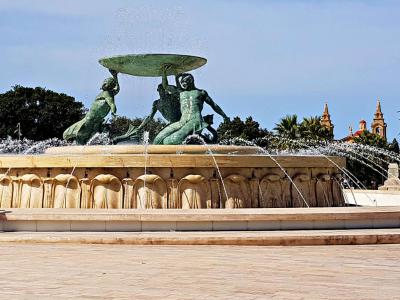
Just outside Valletta’s City Gate stands the Triton Fountain, a familiar sight for anyone arriving in Malta’s capital. Completed in the late 1950s and inaugurated in 1959, it was created by sculptor Chevalier Vincent Apap with draftsman Victor Anastasi. Today it serves not only as a monument but also as a kind of entry point, giving visitors their first impression of Valletta’s blend of Mediterranean heritage and modern life.
The fountain is composed of three bronze Tritons, figures from Greek mythology known for their ties to the sea. They raise a broad circular basin above their heads, supported by a round platform finished in travertine. Each figure carries the weight differently: two Tritons balance on one knee, while the third kneels fully. Viewed from City Gate, their faces all come into view, giving the composition a sense of unity and rhythm. The arrangement was influenced by Rome’s Fontana delle Tartarughe, a fountain admired for the interaction among its sculptures.
Here, the Tritons are portrayed with strong, expressive bodies, their muscles defined as if caught mid-motion. Their poses create a sense of cooperation, as though they are working together to lift the basin above them. The travertine platform beneath them adds texture and warmth, especially under Malta’s bright sunlight, which brings out the greenish tones of the bronze. The water that spills from the basin softens the monumental forms, adding movement and sound to the open square.
The fountain is composed of three bronze Tritons, figures from Greek mythology known for their ties to the sea. They raise a broad circular basin above their heads, supported by a round platform finished in travertine. Each figure carries the weight differently: two Tritons balance on one knee, while the third kneels fully. Viewed from City Gate, their faces all come into view, giving the composition a sense of unity and rhythm. The arrangement was influenced by Rome’s Fontana delle Tartarughe, a fountain admired for the interaction among its sculptures.
Here, the Tritons are portrayed with strong, expressive bodies, their muscles defined as if caught mid-motion. Their poses create a sense of cooperation, as though they are working together to lift the basin above them. The travertine platform beneath them adds texture and warmth, especially under Malta’s bright sunlight, which brings out the greenish tones of the bronze. The water that spills from the basin softens the monumental forms, adding movement and sound to the open square.
3) Valletta Waterfront (must see)
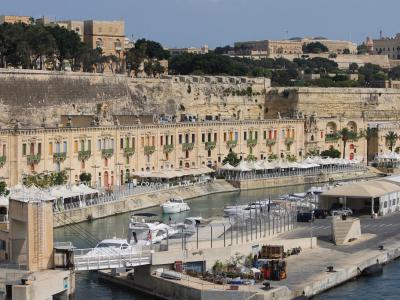
The Valletta Waterfront, located in Floriana, is a picturesque promenade distinguished by three notable buildings: a centrally positioned Church of the Flight into Egypt, the Pinto Stores (also known as the Pinto Wharf) to the left, and the Forni Stores (or Forni Shopping Complex) to the right.
Originally established in July 1727 by Grand Master Anton Manuel de Vilhena, the Valletta Marina underwent subsequent development in 1752 under the direction of Grandmaster Manuel Pinto de Fonseca. This expansion saw the addition of 19 impressive stores and a church, all designed in the Baroque style attributed to Andrea Belli.
During World War II, the area suffered significant damage from aerial bombardment due to its proximity to the Malta Dockyard and British naval forces in Grand Harbour. However, extensive restoration efforts were undertaken post-war to revive and enhance the waterfront.
Today, management of the Valletta Waterfront falls under a private consortium, overseeing Malta's cruise liner operations. The waterfront boasts approximately twelve restaurants, several bars, and retail outlets. It serves as a venue for various events, including the Malta Jazz Festival and the Malta Fireworks Festival.
The Church of the Flight into Egypt, constructed in 1752 alongside the stores, endured bombing during World War II. However, damaged portions were faithfully reconstructed to match the original design, with restored original elements. Mass is conducted at the church every Saturday evening. Additionally, a bronze image of Jesus's face, originally affixed to the church, now adorns the facade of the Co-Cathedral of Saint John in Valletta.
Recognized for their historical significance, the Pinto Stores were designated as a grade 1 national monument and listed on the National Inventory of the Cultural Property of the Maltese Islands (NICPMI), having been included on the Antiquities List of 1925.
Originally established in July 1727 by Grand Master Anton Manuel de Vilhena, the Valletta Marina underwent subsequent development in 1752 under the direction of Grandmaster Manuel Pinto de Fonseca. This expansion saw the addition of 19 impressive stores and a church, all designed in the Baroque style attributed to Andrea Belli.
During World War II, the area suffered significant damage from aerial bombardment due to its proximity to the Malta Dockyard and British naval forces in Grand Harbour. However, extensive restoration efforts were undertaken post-war to revive and enhance the waterfront.
Today, management of the Valletta Waterfront falls under a private consortium, overseeing Malta's cruise liner operations. The waterfront boasts approximately twelve restaurants, several bars, and retail outlets. It serves as a venue for various events, including the Malta Jazz Festival and the Malta Fireworks Festival.
The Church of the Flight into Egypt, constructed in 1752 alongside the stores, endured bombing during World War II. However, damaged portions were faithfully reconstructed to match the original design, with restored original elements. Mass is conducted at the church every Saturday evening. Additionally, a bronze image of Jesus's face, originally affixed to the church, now adorns the facade of the Co-Cathedral of Saint John in Valletta.
Recognized for their historical significance, the Pinto Stores were designated as a grade 1 national monument and listed on the National Inventory of the Cultural Property of the Maltese Islands (NICPMI), having been included on the Antiquities List of 1925.
4) Church of St. Paul's Shipwreck (must see)
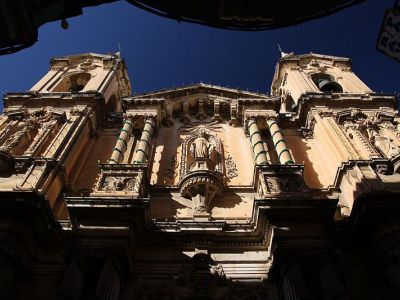
One of Valletta’s oldest churches is the Collegiate Parish Church of Saint Paul’s Shipwreck, dedicated to the Apostle Paul, who is regarded as the father of the Maltese. According to the New Testament, Paul was being taken to Rome as a prisoner in 60 AD when his ship encountered a severe storm in the Mediterranean. After days of drifting, the vessel was wrecked on Malta. During his three-month stay, he healed the father of the island and later many other sick people. The church was built to commemorate this event.
Designed by Girolamo Cassar, the church was completed in 1582. As you step inside, you will encounter artworks spanning several centuries.
The main highlights of the church are the relics connected to Saint Paul. To see them, head to the right-hand side chapels along the nave. The first side chapel on your right typically houses the reliquary containing a piece of Saint Paul’s right wrist bone, displayed in a small glass case with a descriptive plaque. Return to the nave and continue toward the rear of the church. In another side chapel on the opposite side, you will find a fragment of the column from the Three Fountains in Rome, where Saint Paul was martyred, also presented in a labeled reliquary.
After visiting both relics, circle back to the main altar to admire the high altar and the altarpiece by Matteo Pérez d’Aleccio, an Italian painter known for his large-scale altarpieces and frescoes. The church also houses paintings by Attilio Palmobi and Giuseppe Calì, two important Maltese artists of the late 19th and early 20th centuries.
The Feast of the Shipwreck of St. Paul, held on February 10th, is one of Malta’s major religious celebrations. Throughout the day, the church hosts special Masses, and the 1659 statue of St. Paul by Melchiorre Cafà is carried in a procession through the streets of Valletta. As bells ring, the area around the church fills with activity, drawing both locals and visitors into the festivities.
Designed by Girolamo Cassar, the church was completed in 1582. As you step inside, you will encounter artworks spanning several centuries.
The main highlights of the church are the relics connected to Saint Paul. To see them, head to the right-hand side chapels along the nave. The first side chapel on your right typically houses the reliquary containing a piece of Saint Paul’s right wrist bone, displayed in a small glass case with a descriptive plaque. Return to the nave and continue toward the rear of the church. In another side chapel on the opposite side, you will find a fragment of the column from the Three Fountains in Rome, where Saint Paul was martyred, also presented in a labeled reliquary.
After visiting both relics, circle back to the main altar to admire the high altar and the altarpiece by Matteo Pérez d’Aleccio, an Italian painter known for his large-scale altarpieces and frescoes. The church also houses paintings by Attilio Palmobi and Giuseppe Calì, two important Maltese artists of the late 19th and early 20th centuries.
The Feast of the Shipwreck of St. Paul, held on February 10th, is one of Malta’s major religious celebrations. Throughout the day, the church hosts special Masses, and the 1659 statue of St. Paul by Melchiorre Cafà is carried in a procession through the streets of Valletta. As bells ring, the area around the church fills with activity, drawing both locals and visitors into the festivities.
5) Palace Square (St. George's Square)
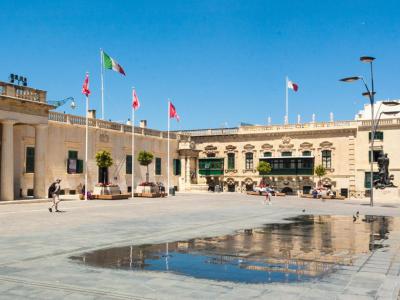
Saint George's Square, also known as Palace Square, stands as the vibrant heart of Valletta. This grand square dates back to the 17th century and has been the backdrop to some of the island's most significant events, including royal visits, grand victory celebrations, and the historic presentation of the George Cross in 1942. Situated in front of the splendid Grandmaster’s Palace, the square is adorned with notable buildings such as the Casa Dei Conti, which served as the treasury of the Order of Saint John, the Main Guard Building, and the Hostel de Verdelin, now repurposed as a police station.
Over the centuries, while its appearance has evolved, Saint George’s Square has continuously served as the epicenter of city life in Valletta. Today, it is celebrated as a 'people’s square,' bustling with activity and life. It regularly hosts exhibitions, festivals, and the enchanting monthly Changing of the Guard ceremony, making it a dynamic hub for both locals and visitors. The square also features a captivating dancing water spectacle that occurs hourly, adding to its allure.
Positioned at the core of Valletta, approximately halfway down the city's main thoroughfare, Republic Street, and bordered by Old Theatre Street and Archbishop Street, Saint George’s Square is not just a testament to Malta’s rich and colorful history but also a lively venue for concerts, performances, and various events. This charming square is undeniably a must-visit location for anyone exploring the historic city of Valletta, offering a unique glimpse into the heart and soul of the Maltese capital.
Over the centuries, while its appearance has evolved, Saint George’s Square has continuously served as the epicenter of city life in Valletta. Today, it is celebrated as a 'people’s square,' bustling with activity and life. It regularly hosts exhibitions, festivals, and the enchanting monthly Changing of the Guard ceremony, making it a dynamic hub for both locals and visitors. The square also features a captivating dancing water spectacle that occurs hourly, adding to its allure.
Positioned at the core of Valletta, approximately halfway down the city's main thoroughfare, Republic Street, and bordered by Old Theatre Street and Archbishop Street, Saint George’s Square is not just a testament to Malta’s rich and colorful history but also a lively venue for concerts, performances, and various events. This charming square is undeniably a must-visit location for anyone exploring the historic city of Valletta, offering a unique glimpse into the heart and soul of the Maltese capital.
6) Republic Square
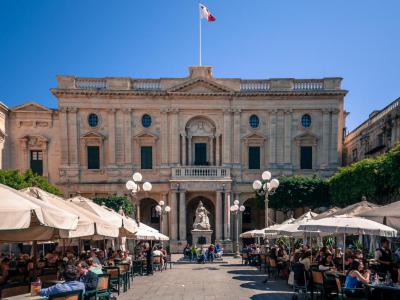
Initially known as Treasury Square due to its hosting of the Order of Saint John's treasury, this area was later renamed Queen's Square after a statue of Queen Victoria was placed there during the British era. Nowadays, it's officially called Republic Square, but many people still refer to it as Queen's Square.
On the northwest side, you'll find a significant building, the Common Treasure House, which stored important documents and financial records for the Order of Saint John. Over time, this building has served various purposes, including government offices, a hotel, and a cinema. It suffered damage during World War II but was repaired and is now the Casino Maltese, with cafes and shops occupying the ground level. One notable spot here is Cafe Cordina - one of Malta’s most historic cafés and a longtime gathering place for locals, artists, writers, and politicians.
The southeast side faces the National Library of Malta, a necessity for more space for the Order's growing collection of books. Designed by Stefano Ittar, a Polish-Italian architect, the library was completed in 1796.
The square's northeast side is next to the Grandmaster's Palace, the official residence of Malta's ruler, while the southwest side features a shopping arcade. Today, the square is a lively area with outdoor cafes and restaurants.
On the northwest side, you'll find a significant building, the Common Treasure House, which stored important documents and financial records for the Order of Saint John. Over time, this building has served various purposes, including government offices, a hotel, and a cinema. It suffered damage during World War II but was repaired and is now the Casino Maltese, with cafes and shops occupying the ground level. One notable spot here is Cafe Cordina - one of Malta’s most historic cafés and a longtime gathering place for locals, artists, writers, and politicians.
The southeast side faces the National Library of Malta, a necessity for more space for the Order's growing collection of books. Designed by Stefano Ittar, a Polish-Italian architect, the library was completed in 1796.
The square's northeast side is next to the Grandmaster's Palace, the official residence of Malta's ruler, while the southwest side features a shopping arcade. Today, the square is a lively area with outdoor cafes and restaurants.
7) Republic Street
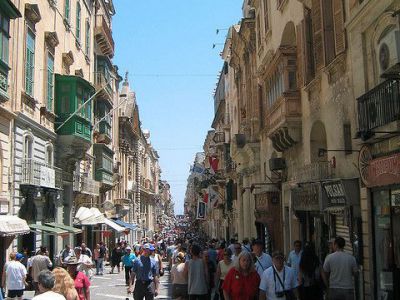
Republic Street is the main artery of Valletta and the center of the capital’s administrative life. Stretching for just one kilometer, it runs straight from City Gate to the granaries beside Fort Saint Elmo, forming the backbone of the city’s grid. Today it is primarily pedestrian, making it an easy and enjoyable place to explore on foot.
As you walk along Republic Street, you will see many of Malta’s key institutions and landmarks. You will pass the modern Parliament of Malta near the entrance, followed by the Courts of Justice and the Grand Master’s Palace further along. The street also intersects several important squares, each offering different views of Valletta’s government buildings, churches, cafés, and small museums.
Down the street, you will find yourself moving through centuries of Maltese history. Don’t miss the traditional shopfronts and the contrast between older limestone facades and recent restorations. This is one of the best places to watch daily life unfold—office workers, shoppers, and visitors all sharing the same historic path.
Republic Street has carried many names. Laid out soon after the Great Siege of 1565, it was originally called San Giorgio Street. Under French rule it became National Street, followed by Royal Road during the early British period. In 1936 it was renamed Kingsway, a name many older residents still remember. After independence, it received its present name: Republic Street.
Bombed during World War II and later rebuilt, the street remains the heart of Valletta—busy, historic, and central to understanding the city.
As you walk along Republic Street, you will see many of Malta’s key institutions and landmarks. You will pass the modern Parliament of Malta near the entrance, followed by the Courts of Justice and the Grand Master’s Palace further along. The street also intersects several important squares, each offering different views of Valletta’s government buildings, churches, cafés, and small museums.
Down the street, you will find yourself moving through centuries of Maltese history. Don’t miss the traditional shopfronts and the contrast between older limestone facades and recent restorations. This is one of the best places to watch daily life unfold—office workers, shoppers, and visitors all sharing the same historic path.
Republic Street has carried many names. Laid out soon after the Great Siege of 1565, it was originally called San Giorgio Street. Under French rule it became National Street, followed by Royal Road during the early British period. In 1936 it was renamed Kingsway, a name many older residents still remember. After independence, it received its present name: Republic Street.
Bombed during World War II and later rebuilt, the street remains the heart of Valletta—busy, historic, and central to understanding the city.

8) St. Catherine's Church
The Church of Saint Catherine of Alexandria, more commonly known as the Church of Saint Catherine of Italy, stands as a historic emblem of faith and cultural heritage in Valletta. Founded by the Hospitaller Langue of Italy, this Roman Catholic church was initially constructed in 1576 to cater to the spiritual needs of the Italian Knights of Saint John. Strategically positioned adjacent to the Auberge d'Italie, the church was a product of the architectural ingenuity of Girolamo Cassar, who was commissioned to design the building.
Throughout the 17th century, the church underwent significant enhancements, including the addition of an octagonal structure to complement the pre-existing chapel, which was subsequently transformed into the sanctuary. These modifications not only expanded the church's capacity but also enriched its architectural complexity.
The Church of Saint Catherine has witnessed extensive restoration efforts, particularly from 2001 to 2011, ensuring its preservation and continuous service to the Italian community in Malta as their parish church. This enduring role underscores the church's pivotal place within the local Italian community, offering a spiritual haven and a touchstone of cultural identity.
Notably, the church is recognized on the National Inventory of the Cultural Property of the Maltese Islands, highlighting its significance in Malta's rich cultural landscape. The interior of the church houses a remarkable titular painting by Mattia Preti, depicting the martyrdom of Saint Catherine of Alexandria. This masterpiece, a generous donation by Preti himself, along with the cupola adorned with painted stucco decorations and ornamental patterns in grey and gold, showcases Preti's artistic brilliance and contributes to the church's aesthetic and spiritual allure.
Throughout the 17th century, the church underwent significant enhancements, including the addition of an octagonal structure to complement the pre-existing chapel, which was subsequently transformed into the sanctuary. These modifications not only expanded the church's capacity but also enriched its architectural complexity.
The Church of Saint Catherine has witnessed extensive restoration efforts, particularly from 2001 to 2011, ensuring its preservation and continuous service to the Italian community in Malta as their parish church. This enduring role underscores the church's pivotal place within the local Italian community, offering a spiritual haven and a touchstone of cultural identity.
Notably, the church is recognized on the National Inventory of the Cultural Property of the Maltese Islands, highlighting its significance in Malta's rich cultural landscape. The interior of the church houses a remarkable titular painting by Mattia Preti, depicting the martyrdom of Saint Catherine of Alexandria. This masterpiece, a generous donation by Preti himself, along with the cupola adorned with painted stucco decorations and ornamental patterns in grey and gold, showcases Preti's artistic brilliance and contributes to the church's aesthetic and spiritual allure.
