Custom Walk in Taormina, Italy by kathyroy_f4ac2 created on 2025-06-08
Guide Location: Italy » Taormina
Guide Type: Custom Walk
# of Sights: 9
Tour Duration: 2 Hour(s)
Travel Distance: 3.2 Km or 2 Miles
Share Key: 2XFX7
Guide Type: Custom Walk
# of Sights: 9
Tour Duration: 2 Hour(s)
Travel Distance: 3.2 Km or 2 Miles
Share Key: 2XFX7
How It Works
Please retrieve this walk in the GPSmyCity app. Once done, the app will guide you from one tour stop to the next as if you had a personal tour guide. If you created the walk on this website or come to the page via a link, please follow the instructions below to retrieve the walk in the app.
Retrieve This Walk in App
Step 1. Download the app "GPSmyCity: Walks in 1K+ Cities" on Apple App Store or Google Play Store.



Step 2. In the GPSmyCity app, download(or launch) the guide "Taormina Map and Walking Tours".
Step 3. Tap the menu button located at upper right corner of the "Walks" screen and select "Retrieve custom walk". Enter the share key: 2XFX7
1) Porta Catania (Catania Gate)
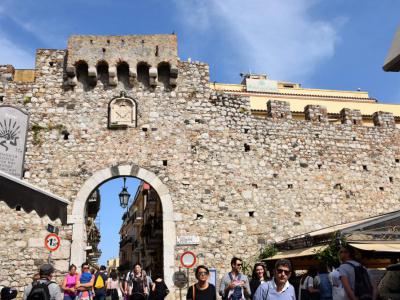
Catania Gate has been standing guard at the southern end of Taormina since 1440, when the Kingdom of Aragon decided the hilltop town needed a proper gateway toward the road to Catania. Solid stonework and the Aragonese coat of arms still stare down from the arch, reminders that this was once a serious checkpoint, not just a photo stop. Back then, the gate formed part of a triple wall system that kept the medieval town secure while funneling merchants, travelers, and locals through a single controlled passage.
Just outside lies Giuseppe Buciuni Square, a place with more layers than it lets on. In Norman times, it was the site of official meetings held precisely at one in the afternoon, an oddly specific schedule that gave the gate its other name, the “Gate of the Touch.” Centuries later, the square was renamed to honor Buciuni, a local hero of World War II. Around it, the patchwork of architectural styles-Arab flourishes, Norman solidity, Gothic lines, and Spanish touches-tells its own story of Sicily’s revolving door of rulers.
Walking through the arch is still a ritual of sorts. One moment you’re outside the medieval boundary, the next you’re on Umberto street, Taormina’s showcase of cafés, palazzi, and shops that winds its way to Messina Gate on the far end. Flanking Catania Gate is the Palace of the Dukes of Santo Stefano, a 14th-century Gothic and Arab-Norman hybrid that makes the gate’s plain strength look even more austere.
Today, Catania Gate is less about defense and more about continuity. Every traveler who steps under its arch becomes part of the long procession of centuries, entering Taormina the same way countless others have since the 15th century.
Just outside lies Giuseppe Buciuni Square, a place with more layers than it lets on. In Norman times, it was the site of official meetings held precisely at one in the afternoon, an oddly specific schedule that gave the gate its other name, the “Gate of the Touch.” Centuries later, the square was renamed to honor Buciuni, a local hero of World War II. Around it, the patchwork of architectural styles-Arab flourishes, Norman solidity, Gothic lines, and Spanish touches-tells its own story of Sicily’s revolving door of rulers.
Walking through the arch is still a ritual of sorts. One moment you’re outside the medieval boundary, the next you’re on Umberto street, Taormina’s showcase of cafés, palazzi, and shops that winds its way to Messina Gate on the far end. Flanking Catania Gate is the Palace of the Dukes of Santo Stefano, a 14th-century Gothic and Arab-Norman hybrid that makes the gate’s plain strength look even more austere.
Today, Catania Gate is less about defense and more about continuity. Every traveler who steps under its arch becomes part of the long procession of centuries, entering Taormina the same way countless others have since the 15th century.

2) Corso Umberto (Umberto Street) (must see)
Umberto Street may carry the name of a 19th-century king, but its roots run much deeper than royal vanity projects. It follows the line of the old Greco-Roman road, the Consular Valeria road, stretching neatly between Catania Gate on one side and Messina Gate on the other. For centuries it has served as Taormina’s backbone, first for soldiers and merchants, later for nobles and pilgrims, and now for anyone with a camera or an appetite for gelato.
In medieval times, this was the town’s central spine, with alleys leading to monasteries, chapels, and palaces that announced Taormina’s status under whichever ruler happened to hold Sicily. Its architecture still reads like a roll call of conquerors: Norman arches, Gothic tracery, Renaissance refinements, and Baroque flourishes. The Palace of the Corvaja family, a 15th-century residence that mixes Arab and Norman motifs, is a standout along the route. Look closer and you’ll spot the layers of antiquity as well-the Temple of Jupiter Serapis replaced by the Church of Saint Pancras, or the Roman Odeon now lying hidden beneath the Church of Saint Catherine.
Midway along, April 9th Square opens like a stage set, complete with checkerboard paving and a terrace that frames the Ionian Sea and Mount Etna as though they were painted backdrops. Overlooking it all is the Clock Tower, or Middle Gate, linking the Greco-Roman quarter to the medieval heart of the town.
Today, Umberto Street is equal parts history book and shop window. Designer stores rub shoulders with artisan workshops, while cafés and wine bars spill out onto the flagstones. From dawn until late, the street hums with life, reminding visitors that Taormina has always known how to turn a simple road into the grandest of stages.
In medieval times, this was the town’s central spine, with alleys leading to monasteries, chapels, and palaces that announced Taormina’s status under whichever ruler happened to hold Sicily. Its architecture still reads like a roll call of conquerors: Norman arches, Gothic tracery, Renaissance refinements, and Baroque flourishes. The Palace of the Corvaja family, a 15th-century residence that mixes Arab and Norman motifs, is a standout along the route. Look closer and you’ll spot the layers of antiquity as well-the Temple of Jupiter Serapis replaced by the Church of Saint Pancras, or the Roman Odeon now lying hidden beneath the Church of Saint Catherine.
Midway along, April 9th Square opens like a stage set, complete with checkerboard paving and a terrace that frames the Ionian Sea and Mount Etna as though they were painted backdrops. Overlooking it all is the Clock Tower, or Middle Gate, linking the Greco-Roman quarter to the medieval heart of the town.
Today, Umberto Street is equal parts history book and shop window. Designer stores rub shoulders with artisan workshops, while cafés and wine bars spill out onto the flagstones. From dawn until late, the street hums with life, reminding visitors that Taormina has always known how to turn a simple road into the grandest of stages.
3) Chiesa della Visitazione (Church of the Visitation)
Just past the iconic Clock Tower, stands the Church of the Visitation-a small but richly storied church whose origins trace back centuries, possibly replacing a Romanesque predecessor. Inside, a hidden crypt hints at even earlier Christian roots, when clandestine worship found refuge beneath the streets of Taormina.
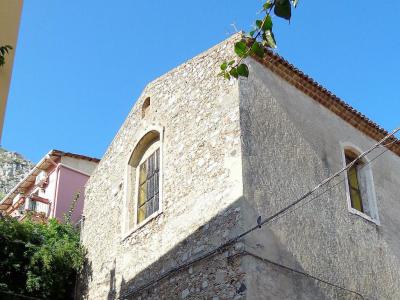
Externally, the church presents a sober medieval profile, with a portal crafted from rugged Taormina stone and accented by a window framed in Syracuse stone-an understated facade that contrasts with its surprisingly ornate interior. Rising modestly behind is the diminutive bell tower, elegantly integrated into the northeast corner of the structure, supported by twin arches-visual testimony to centuries of careful adaptation.
Stepping inside, visitors encounter a single nave lined with intricately decorated stucco altars. Each minor altar echoes the next, featuring twisted columns with finely sculpted reliefs, Corinthian capitals, split-arched tympanums adorned with cherubic finials, and richly patterned fabric antependia-collectively creating an interior screen-like effect of delicate artistry. The sense of refinement continues in the elevated presbytery, separated by a marble balustrade and dominated by a 1699 fresco titled “Triumph of the Cross” by Vincenzo Tuccari, surrounded by lush stucco work, cherubs, and volute motifs.
It is deeply embedded in Taormina’s religious traditions-especially during Holy Week, when the congregation of the Madonna Addolorata, gathers here to begin one of the town’s most evocative processions. Young women, in ceremonial black, carry the statue of the Madonna Addolorata, setting out in silence through torch‑lit streets.
Externally, the church presents a sober medieval profile, with a portal crafted from rugged Taormina stone and accented by a window framed in Syracuse stone-an understated facade that contrasts with its surprisingly ornate interior. Rising modestly behind is the diminutive bell tower, elegantly integrated into the northeast corner of the structure, supported by twin arches-visual testimony to centuries of careful adaptation.
Stepping inside, visitors encounter a single nave lined with intricately decorated stucco altars. Each minor altar echoes the next, featuring twisted columns with finely sculpted reliefs, Corinthian capitals, split-arched tympanums adorned with cherubic finials, and richly patterned fabric antependia-collectively creating an interior screen-like effect of delicate artistry. The sense of refinement continues in the elevated presbytery, separated by a marble balustrade and dominated by a 1699 fresco titled “Triumph of the Cross” by Vincenzo Tuccari, surrounded by lush stucco work, cherubs, and volute motifs.
It is deeply embedded in Taormina’s religious traditions-especially during Holy Week, when the congregation of the Madonna Addolorata, gathers here to begin one of the town’s most evocative processions. Young women, in ceremonial black, carry the statue of the Madonna Addolorata, setting out in silence through torch‑lit streets.
4) Chiesa Madonna della Rocca (Madonna della Rocca Church)
Chiesa Madonna della Rocca (Madonna della Rocca Church) is a small church located on a steep mountain overlooking the town of Taormina. The church was built using the natural cave shape of the existing rock, and part of its ceiling is made up of living rock, known as Taormina stone. The church was founded by Abbot Francesco Raineri in 1640, with the help of the archbishop of Messina, Geronimo Venero.
Francesco Raineri was a Taormina priest who had a great love for his hometown, and he demonstrated this by embellishing the Chapel of the Church of S. Domenico, to which he donated a beautiful golden brass sphere with coral inlays. After his death in 1647, he was buried in the Madonna della Rocca Church, which he had built.
Next to the sanctuary, there was a small monastery where the religious retired to pray and do penance in hermitage, like the ancient anchorites or hermits. The hermitage had a view facing the Peloritani mountains, Castelmola, and Etna. The origin of the church of Madonna della Rocca can be traced back to the 12th century, during the Norman domination, when King Roger II ruled Sicily.
Legend has it that a young shepherd boy from the nearby village of Mola was grazing his flock on the mountain when a sudden storm forced him to take refuge with the sheep in the nearby cave. While the storm was raging outside the cave, the shepherd boy saw a beautiful woman all illuminated and shining, holding a blond child in her arms. The child smiled at him with maternal sweetness. The shepherd boy fled scared, abandoned his sheep in the cave, and ran to tell what had happened to his parents. When his parents went to the cave, they found a painting in which the woman was depicted, but the child's head was missing.
Francesco Raineri was a Taormina priest who had a great love for his hometown, and he demonstrated this by embellishing the Chapel of the Church of S. Domenico, to which he donated a beautiful golden brass sphere with coral inlays. After his death in 1647, he was buried in the Madonna della Rocca Church, which he had built.
Next to the sanctuary, there was a small monastery where the religious retired to pray and do penance in hermitage, like the ancient anchorites or hermits. The hermitage had a view facing the Peloritani mountains, Castelmola, and Etna. The origin of the church of Madonna della Rocca can be traced back to the 12th century, during the Norman domination, when King Roger II ruled Sicily.
Legend has it that a young shepherd boy from the nearby village of Mola was grazing his flock on the mountain when a sudden storm forced him to take refuge with the sheep in the nearby cave. While the storm was raging outside the cave, the shepherd boy saw a beautiful woman all illuminated and shining, holding a blond child in her arms. The child smiled at him with maternal sweetness. The shepherd boy fled scared, abandoned his sheep in the cave, and ran to tell what had happened to his parents. When his parents went to the cave, they found a painting in which the woman was depicted, but the child's head was missing.

5) Villa Comunale (Taormina Public Gardens) (must see)
Lady Florence Trevelyan, born in New Castle on Tyne, England, a gardener by profession, was in love. Unfortunately, she was in love with the future King Edward VII of England. This could not be. Queen Victoria sent Florence packing. She settled in Taormina in 1884. She married the Mayor, Salvatore Cacciola, and planted a garden.
Lady Florence Trevelyan was no ordinary gardener. Once she settled in Taormina, she began shaping the town’s landscape with the same flair others reserved for writing novels. Her first venture was the small “Beautiful Island” offshore, where she built a retreat and filled it with exotic species collected on her travels. From there she moved inland, buying hillside plots between Bagnoli Croce and Giardini, laying out gardens that married Mediterranean plants with specimens brought from far-flung corners of the world. To crown her efforts, she scattered the grounds with eccentric “Victorian follies” she dubbed “hives”-brick towers and fanciful structures that borrowed freely from Gothic and Moorish design. Their playful oddity still distinguishes the gardens from more predictable landscapes.
When Florence died in 1907, the municipality inherited her creations and opened them to the public. True to the English landscape tradition, the Villa Comunale was arranged with winding paths, manicured beds, fountains, and shaded corners. Visitors today still wander past palms, cypresses, oleanders, and blooms that shift with the seasons, while the follies stand like whimsical punctuation marks among the greenery. Yet the real showstopper comes from the terraces: sweeping panoramas that take in the Bay of Naxos, the Ionian Sea, and the silhouette of Mount Etna.
More than a century on, the Public Gardens remain a favorite gathering spot. Families stroll, children play, and concerts animate the lawns, all within a setting that balances nature with a dash of eccentric history. In shaping these grounds, Lady Florence left Taormina a gift that feels as alive and unconventional as the woman herself.
Lady Florence Trevelyan was no ordinary gardener. Once she settled in Taormina, she began shaping the town’s landscape with the same flair others reserved for writing novels. Her first venture was the small “Beautiful Island” offshore, where she built a retreat and filled it with exotic species collected on her travels. From there she moved inland, buying hillside plots between Bagnoli Croce and Giardini, laying out gardens that married Mediterranean plants with specimens brought from far-flung corners of the world. To crown her efforts, she scattered the grounds with eccentric “Victorian follies” she dubbed “hives”-brick towers and fanciful structures that borrowed freely from Gothic and Moorish design. Their playful oddity still distinguishes the gardens from more predictable landscapes.
When Florence died in 1907, the municipality inherited her creations and opened them to the public. True to the English landscape tradition, the Villa Comunale was arranged with winding paths, manicured beds, fountains, and shaded corners. Visitors today still wander past palms, cypresses, oleanders, and blooms that shift with the seasons, while the follies stand like whimsical punctuation marks among the greenery. Yet the real showstopper comes from the terraces: sweeping panoramas that take in the Bay of Naxos, the Ionian Sea, and the silhouette of Mount Etna.
More than a century on, the Public Gardens remain a favorite gathering spot. Families stroll, children play, and concerts animate the lawns, all within a setting that balances nature with a dash of eccentric history. In shaping these grounds, Lady Florence left Taormina a gift that feels as alive and unconventional as the woman herself.
6) Piazza IX Aprile (April 9th Square) (must see)
April 9th Square comes with a story that is part history, part blunder. On April 9, 1860, the congregation at Taormina’s Cathedral was told that Giuseppe Garibaldi had landed at Marsala to liberate Sicily from Bourbon rule. The preacher’s announcement sparked jubilation, even though it was completely wrong-Garibaldi would not arrive for another month. The error was so memorable that when Italy’s unification was complete, the square was renamed after the date, preserving the echo of that mistaken cheer.
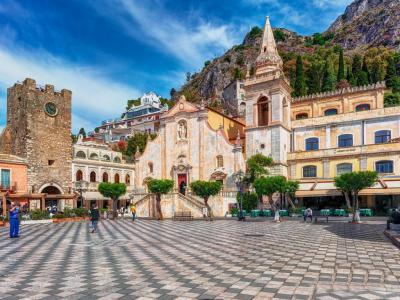
Before the renaming, it was known as Sant’Agostino Square, after the small Church of Saint Augustine built in 1448. That church still stands, though today it holds books instead of worshippers, serving as the town’s public library. Across the square rises the Church of San Giuseppe, a Baroque confection from the 17th century with a staircase as theatrical as its façade. Completing the ensemble is the medieval Clock Tower, rebuilt in the 1600s after French troops leveled it, once marking the dividing line between Taormina’s Greco-Roman foundations and its medieval quarter.
The square unfolds directly off Umberto Street, halfway between the town’s two historic gates, and has always been a gathering place. Cafés and shops crowd its edges, with artists ready to sketch a visitor’s likeness for the price of a cappuccino. Yet the highlight is the terrace itself: its checkerboard paving leads to a panorama stretching from the Ionian Sea across the Bay of Naxos to Mount Etna’s volcanic peak. Few places capture Taormina’s mix of drama, history, and spectacle as vividly as this plaza.
Before the renaming, it was known as Sant’Agostino Square, after the small Church of Saint Augustine built in 1448. That church still stands, though today it holds books instead of worshippers, serving as the town’s public library. Across the square rises the Church of San Giuseppe, a Baroque confection from the 17th century with a staircase as theatrical as its façade. Completing the ensemble is the medieval Clock Tower, rebuilt in the 1600s after French troops leveled it, once marking the dividing line between Taormina’s Greco-Roman foundations and its medieval quarter.
The square unfolds directly off Umberto Street, halfway between the town’s two historic gates, and has always been a gathering place. Cafés and shops crowd its edges, with artists ready to sketch a visitor’s likeness for the price of a cappuccino. Yet the highlight is the terrace itself: its checkerboard paving leads to a panorama stretching from the Ionian Sea across the Bay of Naxos to Mount Etna’s volcanic peak. Few places capture Taormina’s mix of drama, history, and spectacle as vividly as this plaza.
7) Chiesa di San Giuseppe (Church of Saint Joseph)
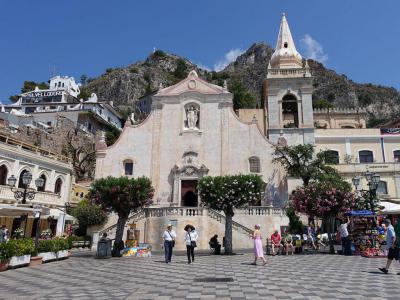
The Church of Saint Joseph, set right next to the Clock Tower on April 9th Square, makes no effort to hide its Baroque flair. Raised between the late 1600s and early 1700s as the home of the Confraternity of Souls in Purgatory, it was Taormina’s way of showing that devotion could come with a theatrical touch. Dedicated to Saint Joseph, the patron of workers and families, it quickly became a stage for processions and celebrations that spilled into the piazza, blending religious fervor with civic pride.
Its façade is pure Sicilian Baroque flair. A sweeping double staircase leads up as if summoning visitors onto the set. Scrolls and curves abound, twin towers frame the entrance, and the central portal is decked out with carved stonework capped by a triangular pediment. Above it all, Christ the King keeps watch from a marble niche. Side doors open to the sacristy on one hand and a hall often turned into exhibition space on the other, giving the building a role that has stretched beyond the strictly liturgical. The Salesian Order took charge in 1919, adding more decoration, and after a closure in 2015 for repairs, the church was restored to its full Baroque vigor.
Inside, restraint meets richness: a single nave lined with marble altars, frescoes of prophets, and Gospel scenes. A dome supported by marble columns crowns the tabernacle, while the main altar, in colorful Taormina marble, pulls the eye forward. Alongside the Church of Saint Augustine and the Clock Tower, Saint Joseph’s church completes the square’s ensemble-a trio that makes April 9th Square one of Taormina’s most theatrical corners.
Its façade is pure Sicilian Baroque flair. A sweeping double staircase leads up as if summoning visitors onto the set. Scrolls and curves abound, twin towers frame the entrance, and the central portal is decked out with carved stonework capped by a triangular pediment. Above it all, Christ the King keeps watch from a marble niche. Side doors open to the sacristy on one hand and a hall often turned into exhibition space on the other, giving the building a role that has stretched beyond the strictly liturgical. The Salesian Order took charge in 1919, adding more decoration, and after a closure in 2015 for repairs, the church was restored to its full Baroque vigor.
Inside, restraint meets richness: a single nave lined with marble altars, frescoes of prophets, and Gospel scenes. A dome supported by marble columns crowns the tabernacle, while the main altar, in colorful Taormina marble, pulls the eye forward. Alongside the Church of Saint Augustine and the Clock Tower, Saint Joseph’s church completes the square’s ensemble-a trio that makes April 9th Square one of Taormina’s most theatrical corners.
8) Torre dell’Orologio (Clock Tower)
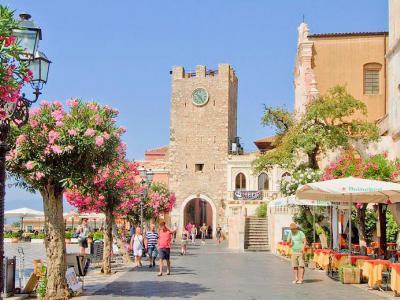
The Clock Tower of Taormina, standing on Umberto Street, is less a simple landmark and more a time capsule of the town’s turbulent past. Once called the Middle Tower, it was planted on the remains of Taormina’s earliest defenses from the 4th century BC. The tower itself first rose in the 7th century AD, was rebuilt in the 12th, and later folded into the third ring of medieval walls protecting the Borgo quarter by the 15th century. As one of three gateways, it drew a line between Taormina’s Greco-Roman foundations and its medieval growth.
The tower’s life has been anything but calm. Its darkest moment came in 1676, when the forces of Louis XIV battered Taormina during a siege and left the structure in ruins. Locals, unwilling to let the gap stand, rebuilt it just three years later with some extra demands. They insisted on adding a clock and a carillon of bells, ensuring the tower no longer just guarded the town but also told it when to gather, worship, or celebrate. From mayoral elections to the July 9th feast of Saint Pancras, the bells marked out civic rhythms as clearly as any decree.
Visually, the tower is an exercise in layered strength and ceremony. Its square stone base supports a midsection with four rounded arches that hold the bells, all topped by a neat conical dome with windows looking out over the town. Flanking April 9th Square and close to the church of Saint Joseph, the tower anchors Taormina’s old center. Crossing its arch today still feels like a small act of arrival-into the bustle of Corso Umberto, framed by history and with Mount Etna waiting in the distance.
The tower’s life has been anything but calm. Its darkest moment came in 1676, when the forces of Louis XIV battered Taormina during a siege and left the structure in ruins. Locals, unwilling to let the gap stand, rebuilt it just three years later with some extra demands. They insisted on adding a clock and a carillon of bells, ensuring the tower no longer just guarded the town but also told it when to gather, worship, or celebrate. From mayoral elections to the July 9th feast of Saint Pancras, the bells marked out civic rhythms as clearly as any decree.
Visually, the tower is an exercise in layered strength and ceremony. Its square stone base supports a midsection with four rounded arches that hold the bells, all topped by a neat conical dome with windows looking out over the town. Flanking April 9th Square and close to the church of Saint Joseph, the tower anchors Taormina’s old center. Crossing its arch today still feels like a small act of arrival-into the bustle of Corso Umberto, framed by history and with Mount Etna waiting in the distance.

9) Duomo di Taormina (Cathedral of Taormina)
The Cathedral of Saint Nicholas of Bari, also known as the Cathedral of Taormina, stands in Cathedral Square just off Corso Umberto and has been one of the town’s defining monuments since the 13th century. Built during the Norman period on the site of an earlier church, it earned the nickname “fortress cathedral” because of its thick stone walls and battlements, which reflected both its religious and defensive roles in a time when coastal towns were vulnerable to raids.
The façade presents layers of history. A large Renaissance rose window crowns the center above the main portal, flanked by Baroque Corinthian columns from the 17th century, while side entrances were added in the 15th and 16th centuries. The square bell tower, rebuilt several times, rises beside it. Inside, the cathedral follows a Latin cross plan with three naves ending in three apses. Pink marble columns divide the space, their capitals decorated with carved motifs of leaves and fish. The high altar of polychrome marble dominates the interior, while doorjambs feature carved symbols of the evangelists and apostles, adding to the rich iconography.
The chapels hold treasures of Sicilian art and devotion. In the right nave are works by Antonio Giuffrè and Antonello de Saliba, including depictions of the Visitation, Madonna, and the Last Supper, as well as a Byzantine Madonna covered in silver and jewels. The left nave contains lunettes by Alfonso Franco. In 1980, Pope John Paul II elevated the church to the status of Minor Basilica.
Outside, the Four Fountains of Taormina complete the setting, making the square and cathedral together a vibrant center of history, faith, and civic pride.
The façade presents layers of history. A large Renaissance rose window crowns the center above the main portal, flanked by Baroque Corinthian columns from the 17th century, while side entrances were added in the 15th and 16th centuries. The square bell tower, rebuilt several times, rises beside it. Inside, the cathedral follows a Latin cross plan with three naves ending in three apses. Pink marble columns divide the space, their capitals decorated with carved motifs of leaves and fish. The high altar of polychrome marble dominates the interior, while doorjambs feature carved symbols of the evangelists and apostles, adding to the rich iconography.
The chapels hold treasures of Sicilian art and devotion. In the right nave are works by Antonio Giuffrè and Antonello de Saliba, including depictions of the Visitation, Madonna, and the Last Supper, as well as a Byzantine Madonna covered in silver and jewels. The left nave contains lunettes by Alfonso Franco. In 1980, Pope John Paul II elevated the church to the status of Minor Basilica.
Outside, the Four Fountains of Taormina complete the setting, making the square and cathedral together a vibrant center of history, faith, and civic pride.
