Custom Walk in Oslo, Norway by chloe_stoyanovski_556f4 created on 2025-06-17
Guide Location: Norway » Oslo
Guide Type: Custom Walk
# of Sights: 6
Tour Duration: 3 Hour(s)
Travel Distance: 6.7 Km or 4.2 Miles
Share Key: 96QW3
Guide Type: Custom Walk
# of Sights: 6
Tour Duration: 3 Hour(s)
Travel Distance: 6.7 Km or 4.2 Miles
Share Key: 96QW3
How It Works
Please retrieve this walk in the GPSmyCity app. Once done, the app will guide you from one tour stop to the next as if you had a personal tour guide. If you created the walk on this website or come to the page via a link, please follow the instructions below to retrieve the walk in the app.
Retrieve This Walk in App
Step 1. Download the app "GPSmyCity: Walks in 1K+ Cities" on Apple App Store or Google Play Store.



Step 2. In the GPSmyCity app, download(or launch) the guide "Oslo Map and Walking Tours".
Step 3. Tap the menu button located at upper right corner of the "Walks" screen and select "Retrieve custom walk". Enter the share key: 96QW3
1) Honnorbrygga Cruise Port
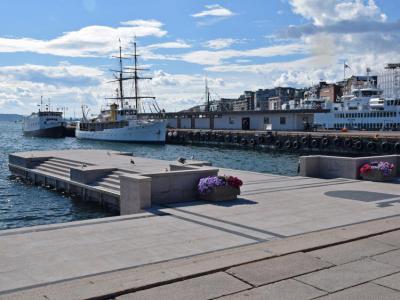
Oslo Cruise Port serves as a vital gateway for cruise passengers eager to explore the cultural richness and natural beauty of Norway. Nestled at the end of the breathtaking Oslofjord, the cruise terminal offers travelers a spectacular introduction to the country's stunning landscapes even before they set foot on shore.
Upon arrival at Oslo Cruise Port, passengers typically dock at one of the four piers located on the Akershus Fortress side. The cruise terminal building at Akershus offers essential facilities such as a coffee shop, tourist information, currency exchange, Wi-Fi, souvenir shops, and taxis, ensuring passengers have everything they need for a comfortable and convenient visit. Additionally, the close proximity of the terminal piers to the city center allows travelers easy access to Oslo's main attractions, whether by foot, public transport, or guided excursions.
Oslo Cruise Port's strategic location makes it effortless for passengers to explore the city's vibrant culture, historic landmarks, and scenic waterfront promenades. Within a short walking distance from the port, visitors can immerse themselves in Oslo's bustling city center or opt for a leisurely stroll along the picturesque Harbour Promenade, which offers captivating views of the surrounding area. With an array of public transportation options available, including sightseeing buses and trams, exploring Oslo's attractions from the cruise port is convenient and hassle-free, allowing passengers to make the most of their time ashore.
Upon arrival at Oslo Cruise Port, passengers typically dock at one of the four piers located on the Akershus Fortress side. The cruise terminal building at Akershus offers essential facilities such as a coffee shop, tourist information, currency exchange, Wi-Fi, souvenir shops, and taxis, ensuring passengers have everything they need for a comfortable and convenient visit. Additionally, the close proximity of the terminal piers to the city center allows travelers easy access to Oslo's main attractions, whether by foot, public transport, or guided excursions.
Oslo Cruise Port's strategic location makes it effortless for passengers to explore the city's vibrant culture, historic landmarks, and scenic waterfront promenades. Within a short walking distance from the port, visitors can immerse themselves in Oslo's bustling city center or opt for a leisurely stroll along the picturesque Harbour Promenade, which offers captivating views of the surrounding area. With an array of public transportation options available, including sightseeing buses and trams, exploring Oslo's attractions from the cruise port is convenient and hassle-free, allowing passengers to make the most of their time ashore.
2) Aker Brygge Wharf (must see)
Aker Brygge in Oslo is a vibrant neighborhood known for its shopping, dining, and entertainment options. Once an industrial area with a shipyard that operated until 1982, it underwent significant redevelopment starting in the mid-1980s, transforming into a commercial and residential hub.
This redevelopment involved a mix of demolishing old industrial buildings and repurposing workshop halls into shopping areas, culminating in a modern district completed in 1998. The area now features shops, restaurants, a cinema, offices, residential apartments, a small boat harbor, and a ferry terminal. Further reorganization between 2010 and 2014 enhanced public spaces and added a new district.
Today, Aker Brygge attracts around 12 million visitors annually and is a leader in waterfront development in Norway. It combines public areas with cultural sites, such as the Astrup Fearnley Museum of Modern Art, and various artworks like the 'Sundial for Spatial Echoes' by Tomás Saraceno and the 'South Oslo' sculpture by Jacqueline Donachie.
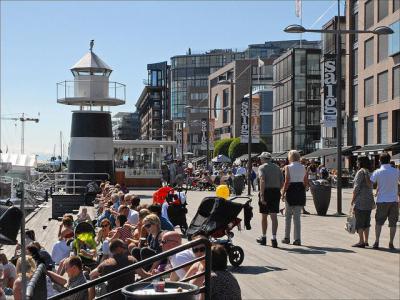
The local pier is a popular spot for people-watching, dining at food trucks, and relaxing. The Aker Brygge Marina offers boat rentals, kayaking, and saunas, making it a great place to experience the Oslo Fjord.
Still, the most popular activity at Aker Brygge is strolling along the promenade, which offers abundant outdoor seating-estimated at around 2,500 seats-allowing visitors to enjoy the blend of old-world and modern architecture. The wharf frequently hosts pop-up shops, fashion shows, concerts, and art exhibits, ensuring a lively atmosphere. Aker Brygge provides enough entertainment for a visitor to easily spend an entire day enjoying the sights and activities.
This redevelopment involved a mix of demolishing old industrial buildings and repurposing workshop halls into shopping areas, culminating in a modern district completed in 1998. The area now features shops, restaurants, a cinema, offices, residential apartments, a small boat harbor, and a ferry terminal. Further reorganization between 2010 and 2014 enhanced public spaces and added a new district.
Today, Aker Brygge attracts around 12 million visitors annually and is a leader in waterfront development in Norway. It combines public areas with cultural sites, such as the Astrup Fearnley Museum of Modern Art, and various artworks like the 'Sundial for Spatial Echoes' by Tomás Saraceno and the 'South Oslo' sculpture by Jacqueline Donachie.
The local pier is a popular spot for people-watching, dining at food trucks, and relaxing. The Aker Brygge Marina offers boat rentals, kayaking, and saunas, making it a great place to experience the Oslo Fjord.
Still, the most popular activity at Aker Brygge is strolling along the promenade, which offers abundant outdoor seating-estimated at around 2,500 seats-allowing visitors to enjoy the blend of old-world and modern architecture. The wharf frequently hosts pop-up shops, fashion shows, concerts, and art exhibits, ensuring a lively atmosphere. Aker Brygge provides enough entertainment for a visitor to easily spend an entire day enjoying the sights and activities.
3) Karl Johans Gate (must see)
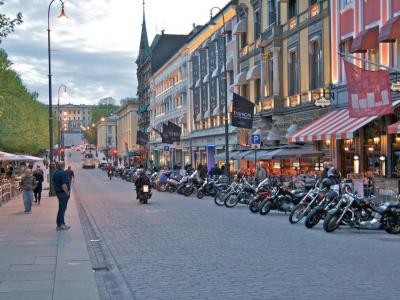
Karl Johans Gate, or simply "Karl Johan" (as the locals colloquially refer to it), is named after King Karl III Johan and is considered the main street in Oslo. Popular with tourists, it gets particularly vibrant on Norway's Constitution Day, May 17, with parades and royal appearances. Street performers, including jugglers and musicians, add to the lively atmosphere from May to October, making it a cultural hub in the city.
Karl Johans Gate stretches 1,415 meters from Oslo Central Station to the Royal Palace. A section between the station and the Storting building is fully pedestrian. Lining the street are a number of landmarks such as the Oslo Cathedral, the Bazaars, the Fire Brigade, the National Theater, the Hotel Continental, and the University of Oslo.
Palace Park (Slottsparken) at the east end of Karl Johans Gate is home to the Royal Palace (Slottet). Originally built for King Karl III Johan, the palace continues to function as a residence for the present King of Norway, Harald V.
The street is made up of two distinct sections with unique histories. The eastern section, between Egertorget to Jernbanetorget squares, was originally part of King Christian IV's old city, near the ramparts. It wasn't fully developed until the 1690s when the Oslo Cathedral was built. The western section was developed in the late 1830s, as part of an urban expansion. Designed as a parade route, it was named Karl Johans Gate in 1852 after King Karl Johan’s death. The distinctively wide western and narrow eastern sections were merged in 1860.
In 2005, to mark the centenary of the dissolution of the Union between Sweden and Norway, the western part of Karl Johans Gate was narrowed and the pavements extended, aligning with the midpoint of the Royal Palace’s facade. New lampposts (modeled after 1920s designs) were installed, and the street was repaved with large stones. Also, to honor the 100th anniversary of Henrik Ibsen’s death in 2006, quotes from his works were embedded in the pavement between Frederiks Gate and the Grand Hotel, replicating the famous writer's daily route from the 1890s.
Karl Johans Gate stretches 1,415 meters from Oslo Central Station to the Royal Palace. A section between the station and the Storting building is fully pedestrian. Lining the street are a number of landmarks such as the Oslo Cathedral, the Bazaars, the Fire Brigade, the National Theater, the Hotel Continental, and the University of Oslo.
Palace Park (Slottsparken) at the east end of Karl Johans Gate is home to the Royal Palace (Slottet). Originally built for King Karl III Johan, the palace continues to function as a residence for the present King of Norway, Harald V.
The street is made up of two distinct sections with unique histories. The eastern section, between Egertorget to Jernbanetorget squares, was originally part of King Christian IV's old city, near the ramparts. It wasn't fully developed until the 1690s when the Oslo Cathedral was built. The western section was developed in the late 1830s, as part of an urban expansion. Designed as a parade route, it was named Karl Johans Gate in 1852 after King Karl Johan’s death. The distinctively wide western and narrow eastern sections were merged in 1860.
In 2005, to mark the centenary of the dissolution of the Union between Sweden and Norway, the western part of Karl Johans Gate was narrowed and the pavements extended, aligning with the midpoint of the Royal Palace’s facade. New lampposts (modeled after 1920s designs) were installed, and the street was repaved with large stones. Also, to honor the 100th anniversary of Henrik Ibsen’s death in 2006, quotes from his works were embedded in the pavement between Frederiks Gate and the Grand Hotel, replicating the famous writer's daily route from the 1890s.
4) Oslo Opera House
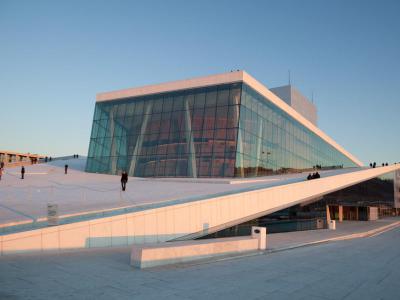
The Oslo Opera House is a notable building that hosts the Norwegian National Ballet, the Opera Orchestra, and the Ballet School. Situated right by the harbour, its unique angled, white exterior looks as if it rises from the water, allowing visitors to climb the roof for stunning views of Oslo and the fjord throughout the year.
At street level, large windows offer a peek into rehearsals and workshop activities inside. The interior features mainly oak, and the main hall has a horseshoe shape, similar to traditional theatres. Designed by the Norwegian architecture firm Snøhetta, the building has won several prestigious awards.
The Norwegian National Opera & Ballet offers a diverse program from three stages: The Main House with 1369 seats, the Second House with 400 seats, and the Studio with 200 seats. Additionally, the opera roof and foyer are used for concerts. Guided tours are available in both Norwegian and English.
At street level, large windows offer a peek into rehearsals and workshop activities inside. The interior features mainly oak, and the main hall has a horseshoe shape, similar to traditional theatres. Designed by the Norwegian architecture firm Snøhetta, the building has won several prestigious awards.
The Norwegian National Opera & Ballet offers a diverse program from three stages: The Main House with 1369 seats, the Second House with 400 seats, and the Studio with 200 seats. Additionally, the opera roof and foyer are used for concerts. Guided tours are available in both Norwegian and English.
5) Grünerløkka
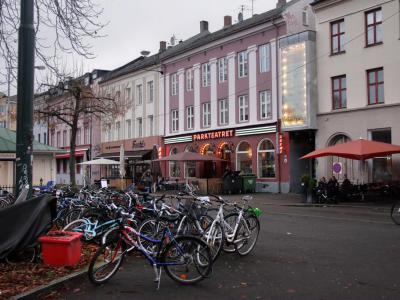
Grünerløkka, situated within the city of Oslo, was incorporated into the city (then known as Christiania) in 1858. Historically, Grünerløkka was recognized as a working-class enclave; however, since the latter part of the 20th century, it has been progressively undergoing gentrification. Despite its location in the East End, Grünerløkka boasts higher property values compared to other neighborhoods in that vicinity. The name Grünerløkka honors Friedrich Grüner (1628-1674), who held the positions of chief administrator and master of the mint in Christiania.
In 1861, Norwegian businessman Thorvald Meyer acquired portions of the Grünerløkka region. He was responsible for the construction of Grünerløkka's primary thoroughfare, now called Thorvald Meyers gate. Over the 19th century, Grünerløkka transformed into a hub for the working class, attracting numerous factories due to its advantageous proximity to the Akerselva River.
Grünerløkka is situated within the vicinity of Paulus Church (Paulus kirke). By 1866, the population of the Paulus parish stood at 13,600, a figure that surged to 22,000 by the year 1900. Interestingly, at that time, only five streets in Oslo could boast populations exceeding 3,000, three of which were located within Grünerløkka: Markveien, Thorvald Meyers gate, and Toftes gate.
Grünerløkka also features Olaf Ryes Plass, a park square named after Norwegian-Danish General Olaf Rye (1791–1849). Initially an open field, it remained so until the 1880s. In 1883, Oslo kommune acquired the property from members of the Grüner family. Subsequently, a narrow diagonal street was constructed, connecting Markveien to Thorvald Meyers gate, with a midway stop for horses and carriages. Today, this area has transformed into a pedestrian park square.
In 1861, Norwegian businessman Thorvald Meyer acquired portions of the Grünerløkka region. He was responsible for the construction of Grünerløkka's primary thoroughfare, now called Thorvald Meyers gate. Over the 19th century, Grünerløkka transformed into a hub for the working class, attracting numerous factories due to its advantageous proximity to the Akerselva River.
Grünerløkka is situated within the vicinity of Paulus Church (Paulus kirke). By 1866, the population of the Paulus parish stood at 13,600, a figure that surged to 22,000 by the year 1900. Interestingly, at that time, only five streets in Oslo could boast populations exceeding 3,000, three of which were located within Grünerløkka: Markveien, Thorvald Meyers gate, and Toftes gate.
Grünerløkka also features Olaf Ryes Plass, a park square named after Norwegian-Danish General Olaf Rye (1791–1849). Initially an open field, it remained so until the 1880s. In 1883, Oslo kommune acquired the property from members of the Grüner family. Subsequently, a narrow diagonal street was constructed, connecting Markveien to Thorvald Meyers gate, with a midway stop for horses and carriages. Today, this area has transformed into a pedestrian park square.
6) University Botanical Garden and Natural History Museum
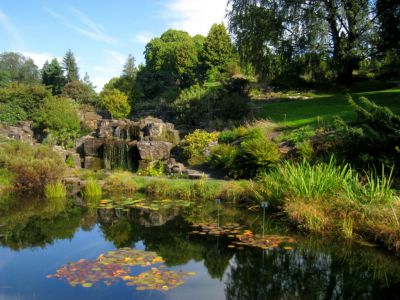
Oslo’s leafy brainchild, the University Botanical Garden, was founded back in 1814 by the University of Oslo-because, indeed, a “serious academic institution” sounds better if fitted with 7,500 plants... All these specimens aren’t just for show-they’re enlisted in the noble missions of science, conservation, and giving visitors an excuse to say words like “gymnosperm” in public.
Wandering the grounds, you’ll bump into Toyen Manor, a stately wooden relic with serious seniority-it’s the oldest building in the university’s care and quite possibly the oldest timber structure in Oslo. Inside, you’ll find rotating exhibits and a cozy café, perfect for contemplating your place in the ecosystem over a cinnamon bun.
Sharing the spotlight is the Natural History Museum, Norway’s largest of its kind, where prehistoric skeletons, glittering minerals, and climate education await. Don’t miss the world’s oldest complete primate skeleton-or as we like to call it, your ancient cousin with excellent posture...
The whole ensemble is tucked into Toyen Park, just west of the Edvard Munch Museum. The best part is that the garden's entry is free all week. And if you time your visit for Thursday, all the indoor exhibits are free too. So, go on-embrace your inner botanist, climate warrior, or curious mammal and enjoy yourself.
Wandering the grounds, you’ll bump into Toyen Manor, a stately wooden relic with serious seniority-it’s the oldest building in the university’s care and quite possibly the oldest timber structure in Oslo. Inside, you’ll find rotating exhibits and a cozy café, perfect for contemplating your place in the ecosystem over a cinnamon bun.
Sharing the spotlight is the Natural History Museum, Norway’s largest of its kind, where prehistoric skeletons, glittering minerals, and climate education await. Don’t miss the world’s oldest complete primate skeleton-or as we like to call it, your ancient cousin with excellent posture...
The whole ensemble is tucked into Toyen Park, just west of the Edvard Munch Museum. The best part is that the garden's entry is free all week. And if you time your visit for Thursday, all the indoor exhibits are free too. So, go on-embrace your inner botanist, climate warrior, or curious mammal and enjoy yourself.
