Custom Walk in Malmo, Sweden by drpqt6482 created on 2025-06-25
Guide Location: Sweden » Malmo
Guide Type: Custom Walk
# of Sights: 5
Tour Duration: 1 Hour(s)
Travel Distance: 0.5 Km or 0.3 Miles
Share Key: JKZYQ
Guide Type: Custom Walk
# of Sights: 5
Tour Duration: 1 Hour(s)
Travel Distance: 0.5 Km or 0.3 Miles
Share Key: JKZYQ
How It Works
Please retrieve this walk in the GPSmyCity app. Once done, the app will guide you from one tour stop to the next as if you had a personal tour guide. If you created the walk on this website or come to the page via a link, please follow the instructions below to retrieve the walk in the app.
Retrieve This Walk in App
Step 1. Download the app "GPSmyCity: Walks in 1K+ Cities" on Apple App Store or Google Play Store.



Step 2. In the GPSmyCity app, download(or launch) the guide "Malmo Map and Walking Tours".
Step 3. Tap the menu button located at upper right corner of the "Walks" screen and select "Retrieve custom walk". Enter the share key: JKZYQ
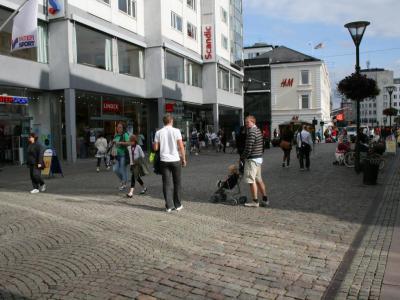
1) Sodergatan Street (must see)
Sodergatan is Malmo's main shopping street. The pedestrian-only street is home to a large variety of stores.
Visitors will find budget-friendly brands, high-end fashion, and vintage clothing. In addition, the cobblestone street is also home to many cafes, restaurants, and bars.
Sodergatan is also one of Malmo's oldest streets. It was first known as Sönnergatan in 1462. Over the years, the street has had many name changes until it was finally named Södergatan in 1842.
The buildings along Sodergatan feature architecture from the 16th century up to the present day. Flensburgska Huset was constructed on Sodergatan Street in the late 16th century. Flensburgska Huset is the oldest building in Malmo and features layers of white stone and red brick. Baltzar City is one of the street's newest buildings, dedicated in 2002.
Visitors to Sodergatan Street can also find the famous Optimistorkestern sculpture. This charming artwork shows a marching band led by a drummer.
Visitors will find budget-friendly brands, high-end fashion, and vintage clothing. In addition, the cobblestone street is also home to many cafes, restaurants, and bars.
Sodergatan is also one of Malmo's oldest streets. It was first known as Sönnergatan in 1462. Over the years, the street has had many name changes until it was finally named Södergatan in 1842.
The buildings along Sodergatan feature architecture from the 16th century up to the present day. Flensburgska Huset was constructed on Sodergatan Street in the late 16th century. Flensburgska Huset is the oldest building in Malmo and features layers of white stone and red brick. Baltzar City is one of the street's newest buildings, dedicated in 2002.
Visitors to Sodergatan Street can also find the famous Optimistorkestern sculpture. This charming artwork shows a marching band led by a drummer.
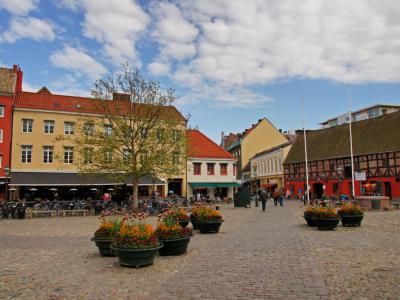
2) Lilla Torg (Little Square) (must see)
As its name suggests, Little Square is a small but charming square. The square was created in 1590 as a marketplace square. Shoppers would visit the square to buy daily household goods. Local maids would shop for meat, freshly baked bread, fish, and general groceries.
The square is paved with natural stones and invites locals and tourists to stay and enjoy the cozy atmosphere.
Little Square features old houses, boutique shops, outdoor cafes, friendly restaurants, and intimate bars. Visitors will enjoy shopping at the Swedish shops and exploring Scandi style fashion, and admire the centuries old houses in the surrounding area.
Little Square is known for its nightlife. Check out Drumbar, Malmo's only Scottish pub. Moosehead Bar often shows international sports. Mello Yello has a yellow outdoor seating area and is one of Malmo's most popular spots for eating, drinking, and people-watching.
Hedmanska Garden is located on the south side of the square. This half-timbered house dates to the 1590s. The house's courtyard is home to the Form/Design Center, which features a gallery and exhibitions.
The square is paved with natural stones and invites locals and tourists to stay and enjoy the cozy atmosphere.
Little Square features old houses, boutique shops, outdoor cafes, friendly restaurants, and intimate bars. Visitors will enjoy shopping at the Swedish shops and exploring Scandi style fashion, and admire the centuries old houses in the surrounding area.
Little Square is known for its nightlife. Check out Drumbar, Malmo's only Scottish pub. Moosehead Bar often shows international sports. Mello Yello has a yellow outdoor seating area and is one of Malmo's most popular spots for eating, drinking, and people-watching.
Hedmanska Garden is located on the south side of the square. This half-timbered house dates to the 1590s. The house's courtyard is home to the Form/Design Center, which features a gallery and exhibitions.
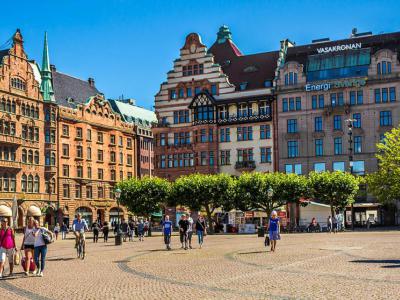
3) Stortorget (Main Square) (must see)
Main Square was first created in 1540 and is the largest and oldest square in Malmo. In its heyday, it was also the largest market square in Northern Europe. Mayor Jörgen Kock created the square by demolishing the old Catholic Church and monastery after the Reformation.
An impressive equestrian statue depicting King Karl X Gustav stands at the center of the square. King Karl X Gustav conquered former Danish provinces and united them with the Swedish Empire in 1658.
From the 16th to the 19th century, the square was home to a central city fountain. This fountain provided drinking water to many city businesses and homes through wooden pipes. Today, an ornamental fountain is in its place.
The square is home to many historical buildings, including Malmo City Hall, the Kocksa Huset, and the Lion Pharmacy.
Main Square frequently hosts large events such as the popular week-long Malmo Festival in the summer. The festival features culture, art, and music and hosts over one million visitors each year.
An impressive equestrian statue depicting King Karl X Gustav stands at the center of the square. King Karl X Gustav conquered former Danish provinces and united them with the Swedish Empire in 1658.
From the 16th to the 19th century, the square was home to a central city fountain. This fountain provided drinking water to many city businesses and homes through wooden pipes. Today, an ornamental fountain is in its place.
The square is home to many historical buildings, including Malmo City Hall, the Kocksa Huset, and the Lion Pharmacy.
Main Square frequently hosts large events such as the popular week-long Malmo Festival in the summer. The festival features culture, art, and music and hosts over one million visitors each year.
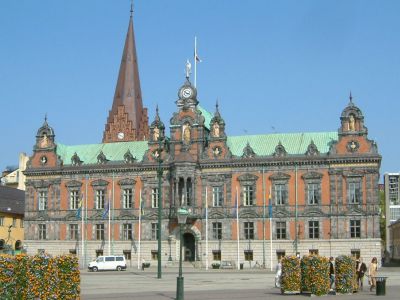
4) Malmo Radhus (Malmo City Hall) (must see)
Located in the historical heart of Malmo on the expansive Stortorget Square, the Malmo City Hall (Rådhuset) is a striking testament to the architectural evolution of this Swedish city. Originally built between 1544 and 1547 under the direction of Jörgen Kock, this grand building has played a central role in Malmo's administrative history and is noted as one of the largest town halls from the 16th century.
Through centuries, the structure has undergone significant transformations. The most notable came around 1860 when it was bestowed with an ornate Dutch Renaissance facade, as part of extensive restoration efforts to revive its medieval grandeur. This period also saw the addition of elaborate stucco work on the upper floor ceilings, enhancing its aesthetic appeal.
One of the building's historical elements, the vaulted cellars, retains its medieval ambiance and now houses the Rådhuskällaren, a highly regarded restaurant that offers a unique dining experience beneath the city hall. Above, the Knut Hall, inspired by the Hall of Mirrors in Versailles Palace, and the luxurious Bernadotte Room, reserved for royal and diplomatic engagements, continue to add to the building’s prestige and functionality.
Today, Malmo City Hall stands not only as a beacon of the city's rich history but also as a vibrant venue for balls, special events, and culinary enjoyment, making it a focal point of civic pride and cultural heritage in Malmo.
Through centuries, the structure has undergone significant transformations. The most notable came around 1860 when it was bestowed with an ornate Dutch Renaissance facade, as part of extensive restoration efforts to revive its medieval grandeur. This period also saw the addition of elaborate stucco work on the upper floor ceilings, enhancing its aesthetic appeal.
One of the building's historical elements, the vaulted cellars, retains its medieval ambiance and now houses the Rådhuskällaren, a highly regarded restaurant that offers a unique dining experience beneath the city hall. Above, the Knut Hall, inspired by the Hall of Mirrors in Versailles Palace, and the luxurious Bernadotte Room, reserved for royal and diplomatic engagements, continue to add to the building’s prestige and functionality.
Today, Malmo City Hall stands not only as a beacon of the city's rich history but also as a vibrant venue for balls, special events, and culinary enjoyment, making it a focal point of civic pride and cultural heritage in Malmo.
5) Sankt Petri Kyrka (St. Peter's Church) (must see)
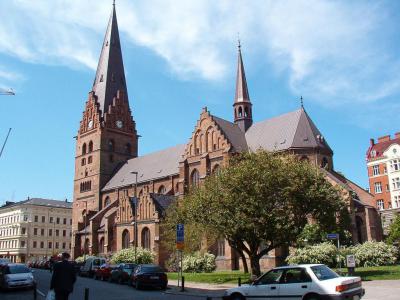
Saint Peter's Church is Malmo's oldest church and the city's oldest preserved brick building. Originally, it was Malmo's only parish church. Saint Peter's Church was constructed on the site of an earlier church between 1319 and 1380. The church features Brick Gothic architecture and was constructed with red brick.
After the original tower collapsed in 1420, a new tower was built. The tower was renovated in 1442 and 1890. The imposing tower is 98 meters (322 feet) tall. During the 15th and 16th centuries, five side chapels were built. Three of the side chapels survive today. The church porch was built in the 15th century.
Swedish scholar and architect Carl Georg Brunius renovated the church in the 1800s. The roof was replaced with a copper roof, and many bricks were replaced. In addition, the church was renovated several times in the 1900s.
The interior is dominated by its 25-meter tall (82 foot) nave. The whitewashed interior features beautiful medieval murals from the 15th and 16th centuries.
Saint Peter's oak altarpiece is impressively large, reaching 15 meters (49 feet) tall. The altarpiece dates to 1611 and features four levels depicting various Biblical scenes.
The pulpit was inaugurated in 1599. It was crafted with black limestone, light sandstone, and gilt and features scenes from Christ's life.
Similar to the pulpit, the baptismal font was crafted from black limestone and dedicated in 1601. The octagonal font features Biblical scenes.
Saint Peter's has a 1951 organ with an older facade. The church's small library houses books from the 16th century.
After the original tower collapsed in 1420, a new tower was built. The tower was renovated in 1442 and 1890. The imposing tower is 98 meters (322 feet) tall. During the 15th and 16th centuries, five side chapels were built. Three of the side chapels survive today. The church porch was built in the 15th century.
Swedish scholar and architect Carl Georg Brunius renovated the church in the 1800s. The roof was replaced with a copper roof, and many bricks were replaced. In addition, the church was renovated several times in the 1900s.
The interior is dominated by its 25-meter tall (82 foot) nave. The whitewashed interior features beautiful medieval murals from the 15th and 16th centuries.
Saint Peter's oak altarpiece is impressively large, reaching 15 meters (49 feet) tall. The altarpiece dates to 1611 and features four levels depicting various Biblical scenes.
The pulpit was inaugurated in 1599. It was crafted with black limestone, light sandstone, and gilt and features scenes from Christ's life.
Similar to the pulpit, the baptismal font was crafted from black limestone and dedicated in 1601. The octagonal font features Biblical scenes.
Saint Peter's has a 1951 organ with an older facade. The church's small library houses books from the 16th century.
