Custom Walk in Nice, France by cpmorris_8ebb8 created on 2025-07-20
Guide Location: France » Nice
Guide Type: Custom Walk
# of Sights: 14
Tour Duration: 4 Hour(s)
Travel Distance: 7.4 Km or 4.6 Miles
Share Key: QC7UD
Guide Type: Custom Walk
# of Sights: 14
Tour Duration: 4 Hour(s)
Travel Distance: 7.4 Km or 4.6 Miles
Share Key: QC7UD
How It Works
Please retrieve this walk in the GPSmyCity app. Once done, the app will guide you from one tour stop to the next as if you had a personal tour guide. If you created the walk on this website or come to the page via a link, please follow the instructions below to retrieve the walk in the app.
Retrieve This Walk in App
Step 1. Download the app "GPSmyCity: Walks in 1K+ Cities" on Apple App Store or Google Play Store.



Step 2. In the GPSmyCity app, download(or launch) the guide "Nice Map and Walking Tours".
Step 3. Tap the menu button located at upper right corner of the "Walks" screen and select "Retrieve custom walk". Enter the share key: QC7UD
1) Cathédrale Saint-Nicolas (Russian Orthodox Cathedral) (must see)
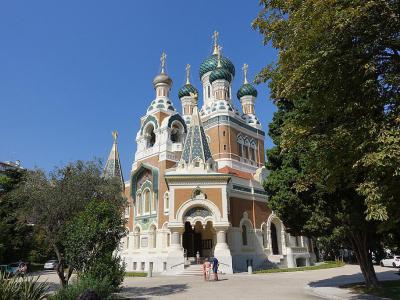
The Cathedrale Saint-Nicolas, an Eastern Orthodox cathedral in Nice, is a possession of the Russian Federation. Nevertheless, it is also a national monument of France. It is in the Moscow Patriarchate and it's the largest Eastern Orthodox church in Western Europe. In 1864 Tsar Alexander II took the first train to Nice and fell in love with the climate.
Since the visit of Alexander II the Riviera has been very popular with the Russians. The Cathedral was consecrated in 1912 in memory of Tsarevich Nicholas Alexandrovich, who had died in Nice. Funding for the Cathedral was provided by Tsar Nicholas II of unhappy memory. In 2013 the Court of Cassation ruled the building and land to be Russian.
Although the Cathedral is located in Nice, one glance at the exterior would give it away. It is Russian, inside and out. No other architecture in Nice approaches it. It makes one think of a Fabrage egg. The onion-shaped domes and bright colors, the vast collection of icons leave no doubt.
Admission to sightseers is free but no photographs inside are allowed and telephones should be turned off. There is a dress code for those who wish to go inside. Men must not wear shorts. Women may not show bare shoulders and heads should be covered.
Since the visit of Alexander II the Riviera has been very popular with the Russians. The Cathedral was consecrated in 1912 in memory of Tsarevich Nicholas Alexandrovich, who had died in Nice. Funding for the Cathedral was provided by Tsar Nicholas II of unhappy memory. In 2013 the Court of Cassation ruled the building and land to be Russian.
Although the Cathedral is located in Nice, one glance at the exterior would give it away. It is Russian, inside and out. No other architecture in Nice approaches it. It makes one think of a Fabrage egg. The onion-shaped domes and bright colors, the vast collection of icons leave no doubt.
Admission to sightseers is free but no photographs inside are allowed and telephones should be turned off. There is a dress code for those who wish to go inside. Men must not wear shorts. Women may not show bare shoulders and heads should be covered.
2) Promenade des Anglais (English Promenade) (must see)
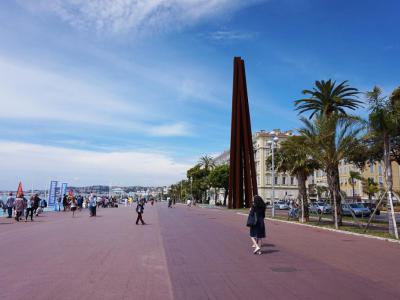
In the late 1700s, English aristocrats developed a fondness for the city of Nice, spending their winters along the shore. During the harsh winter of 1820, English visitors found themselves surrounded by a wave of beggars. The solution? Build a walkway along the seashore—funded by the Anglican Church. A brilliant idea that benefited everyone.
The city leaders took the plan further, greatly expanding its scope. After Nice was annexed by France in 1860, the “Promenade Path” became known as the English Promenade. Today, locals simply call it La Prom, and it remains a favourite spot for walkers, families, skateboarders, and cyclists.
The Promenade stretches for about four miles around the Bay of Angels”. On the seaside, private and public beaches stand side by side, often crowded during summer months. Don’t be surprised if you have to share your patch of sand. Above the coastline, in the hills of Nice, former aristocratic villas have been transformed into grand hotels and museums.
Tip:
Restaurants along the seafront tend to be more expensive. For a more authentic experience, try the traditional eateries a little farther inland. One of the most vibrant stretches lies between Boulevard Gambetta and the Old Town, where you’ll find the grand Belle Époque hotels, elegant residences, and plenty to explore.
The city leaders took the plan further, greatly expanding its scope. After Nice was annexed by France in 1860, the “Promenade Path” became known as the English Promenade. Today, locals simply call it La Prom, and it remains a favourite spot for walkers, families, skateboarders, and cyclists.
The Promenade stretches for about four miles around the Bay of Angels”. On the seaside, private and public beaches stand side by side, often crowded during summer months. Don’t be surprised if you have to share your patch of sand. Above the coastline, in the hills of Nice, former aristocratic villas have been transformed into grand hotels and museums.
Tip:
Restaurants along the seafront tend to be more expensive. For a more authentic experience, try the traditional eateries a little farther inland. One of the most vibrant stretches lies between Boulevard Gambetta and the Old Town, where you’ll find the grand Belle Époque hotels, elegant residences, and plenty to explore.
3) Fontaine du Soleil
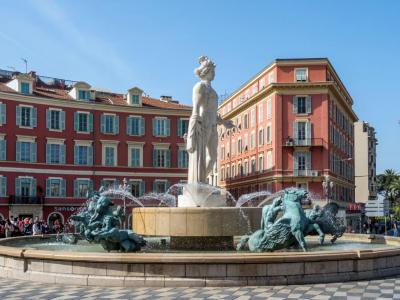
The Fountain of the Sun (Fontaine du Soleil) is undoubtedly one of the most iconic landmarks in Nice. Located at the heart of Massena Square, the fountain is a popular tourist spot and a must-visit for anyone who finds themselves in the vicinity.
This impressive fountain features a magnificent statue of Apollo, the god of the sun, who stands tall and proud at the center of the sculpture. The statue of Apollo is completely naked, symbolizing the strength and beauty of the sun. The statue of Apollo was originally installed in 1956, the same year that the fountain was inaugurated. It was removed in 1970, but has since been restored and can be seen in its entirety today.
The fountain also features five bronze statues that represent planets - Earth, Mars, Mercury, Venus, and Saturn. These statues were created by French sculptor Alfred Janniot and are positioned around the statue of Apollo in a circular formation, symbolizing the solar system.
The Fountain of the Sun is a truly breathtaking work of art, and its location in Massena Square only adds to its beauty. The square is a bustling hub of activity, with street performers, vendors, and locals all coming together to create a lively and vibrant atmosphere.
This impressive fountain features a magnificent statue of Apollo, the god of the sun, who stands tall and proud at the center of the sculpture. The statue of Apollo is completely naked, symbolizing the strength and beauty of the sun. The statue of Apollo was originally installed in 1956, the same year that the fountain was inaugurated. It was removed in 1970, but has since been restored and can be seen in its entirety today.
The fountain also features five bronze statues that represent planets - Earth, Mars, Mercury, Venus, and Saturn. These statues were created by French sculptor Alfred Janniot and are positioned around the statue of Apollo in a circular formation, symbolizing the solar system.
The Fountain of the Sun is a truly breathtaking work of art, and its location in Massena Square only adds to its beauty. The square is a bustling hub of activity, with street performers, vendors, and locals all coming together to create a lively and vibrant atmosphere.
4) Cours Saleya Markets (must see)
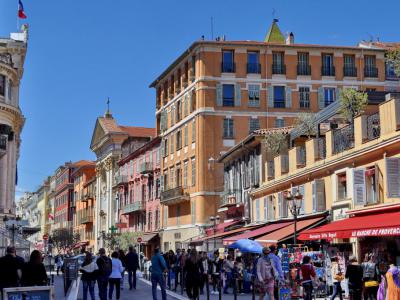
A trip to Nice absolutely must include a stroll around the Cours Saleya Markets. This lively stretch once served as the city’s main square, but today it’s an open-air market bursting with colour, fragrance, and energy. The sights, sounds, smells, and friendly bustle make it one of the highlights of any visit.
Every Monday morning, the area transforms into an antique market where you can hunt for the perfect piece of Art Deco design or a one-of-a-kind souvenir. From Tuesday through Sunday, the market is devoted to flowers and seasonal produce. The selection changes with the time of year, but everything sold here is fresh and full of Mediterranean flavour.
If your accommodation includes a kitchen, don’t miss the fresh fish stalls — the taste of fish caught just hours before is incomparable, especially when paired with local herbs, bread, and wine.
During summer evenings, the Cours Saleya becomes a craft market. You can shop for flowers, fruit, cheese, olives, and bread in the morning, then return after sunset to browse handmade jewellery, art, and souvenirs. The surrounding cafés and restaurants make it easy to linger — the perfect way to spend a summer day in Nice.
For early birds, this market is a delight. Bring reusable bags for your purchases, along with small bills and coins — the vendors are busy and often prefer quick transactions.
Tip: Be there around noon. You’ll hear the daily cannon fired — a long-standing tradition that began with the Duke of Nizza, who used it as a reminder for his shop-loving wife to come home for lunch.
Every Monday morning, the area transforms into an antique market where you can hunt for the perfect piece of Art Deco design or a one-of-a-kind souvenir. From Tuesday through Sunday, the market is devoted to flowers and seasonal produce. The selection changes with the time of year, but everything sold here is fresh and full of Mediterranean flavour.
If your accommodation includes a kitchen, don’t miss the fresh fish stalls — the taste of fish caught just hours before is incomparable, especially when paired with local herbs, bread, and wine.
During summer evenings, the Cours Saleya becomes a craft market. You can shop for flowers, fruit, cheese, olives, and bread in the morning, then return after sunset to browse handmade jewellery, art, and souvenirs. The surrounding cafés and restaurants make it easy to linger — the perfect way to spend a summer day in Nice.
For early birds, this market is a delight. Bring reusable bags for your purchases, along with small bills and coins — the vendors are busy and often prefer quick transactions.
Tip: Be there around noon. You’ll hear the daily cannon fired — a long-standing tradition that began with the Duke of Nizza, who used it as a reminder for his shop-loving wife to come home for lunch.
5) Colline du Chateau (Castle Hill) (must see)
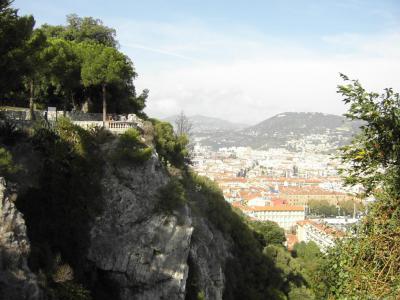
Castle Hill is a must see with its breathtaking views of the city and the Mediterranean Sea. This area is where Nice was founded in the third century BCE. From high on the hill a trading post was established and then a defensive post was maintained. A large wall was built around the city only to be torn down in the early 1700s.
Don’t go to the hill expecting to see the “Castle”, as a few ruins still remain but that is all. The area is still intriguing nonetheless. Aside from the exquisite views, there is a beautiful park, the Naval Museum, stepping stones that depict the Odyssey by Homer and a beautiful old cemetery filled with gorgeous headstones.
There is also a man-made waterfall along the way, which sometimes gets shutoff in the late afternoon, so be sure to visit early if you want to see it. There are plenty of benches around the area so take a few minutes to revel in the Mediterranean splendor of the park. This is a great place to pack a picnic lunch and spend the afternoon. There is a small cafe in the area too.
Getting to the hill can be accomplished several different ways depending upon time constraints and fitness. For those who like to walk, take the steps up to the observation platform. There are 213 steps but the view is spectacular along the way. For a fee, there is also an elevator or a motorized train. The train does not really allow for any wandering, so for those who like to stroll and look on their own schedule, take the steps or the elevator or a combination of the two.
Don’t go to the hill expecting to see the “Castle”, as a few ruins still remain but that is all. The area is still intriguing nonetheless. Aside from the exquisite views, there is a beautiful park, the Naval Museum, stepping stones that depict the Odyssey by Homer and a beautiful old cemetery filled with gorgeous headstones.
There is also a man-made waterfall along the way, which sometimes gets shutoff in the late afternoon, so be sure to visit early if you want to see it. There are plenty of benches around the area so take a few minutes to revel in the Mediterranean splendor of the park. This is a great place to pack a picnic lunch and spend the afternoon. There is a small cafe in the area too.
Getting to the hill can be accomplished several different ways depending upon time constraints and fitness. For those who like to walk, take the steps up to the observation platform. There are 213 steps but the view is spectacular along the way. For a fee, there is also an elevator or a motorized train. The train does not really allow for any wandering, so for those who like to stroll and look on their own schedule, take the steps or the elevator or a combination of the two.
6) Monument aux Morts
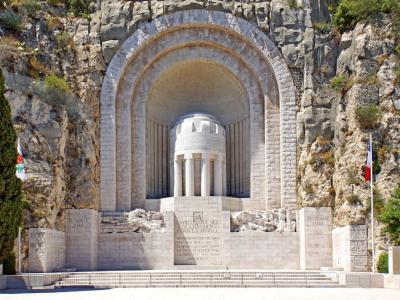
The Monument aux Morts is a very striking memorial to the people who passed away during World War I. It was erected in 1919, and was the brain child of the Mayor of Nice at that time. That was Goiran Francis. In terms of pure size, it is one of the largest tributes to the fallen to be found anywhere in the country.
The location of the memorial is set so that it faces out to the ocean. It is built into the beautiful Castle Hill in town. During the daytime, the light plays off the white stone that was used to build the structure, making the whole thing look a bit surrealistic. It is dome shaped, and has an urn in the middle. If you take time to go up to the display, you will be able to read the names of the three thousand six hundred and fifty five lost souls that are honored here. It is a great spot to stop for a moment of contemplation.
The design was done by Roger Seasal. Some of the additional work, namely the bas-reliefs was added closer to 1928 by Alfred Janniot.
The location of the memorial is set so that it faces out to the ocean. It is built into the beautiful Castle Hill in town. During the daytime, the light plays off the white stone that was used to build the structure, making the whole thing look a bit surrealistic. It is dome shaped, and has an urn in the middle. If you take time to go up to the display, you will be able to read the names of the three thousand six hundred and fifty five lost souls that are honored here. It is a great spot to stop for a moment of contemplation.
The design was done by Roger Seasal. Some of the additional work, namely the bas-reliefs was added closer to 1928 by Alfred Janniot.
7) Place Garibaldi (Garibaldi Square) (must see)
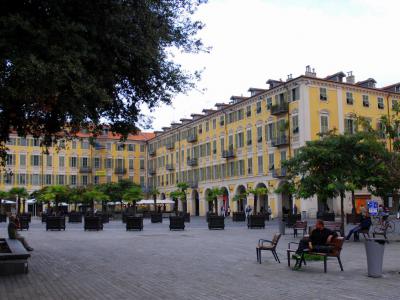
Place Garibaldi, designed by architect Antoine Spinelli and completed in 1773, is one of the oldest and most distinguished squares in Nice. Conceived while the city was still under Sardinian rule, it served as the royal gateway along the route connecting Nice to Turin. Its harmonious proportions and classical layout make it a fine example of 18th-century urban design on the French Riviera.
The square is framed by elegant Baroque-style buildings, three storeys high, painted in warm shades of ochre and terracotta. Their graceful arcades and trompe-l’œil frescoes evoke both the Mediterranean light and the Italian influence of the House of Savoy. At its centre rises the monument to Giuseppe Garibaldi, the celebrated general and native of Nice, who played a defining role in the unification of Italy. The statue, installed in 1891, shows Garibaldi standing proudly atop a pedestal adorned with coats of arms and lions.
Place Garibaldi is intersected by Jean Jaurès Boulevard, Republic Avenue, and Cassini Street, placing it at a crossroads between the old town and the modern city. Around the square stand several landmarks, including the Chapel of the Holy Sepulcher, the historic Turin Café, and the National Theater of Nice, each adding to the square’s rich architectural and cultural landscape.
Beneath the southern end of the square lie traces of Nice’s layered past. An archaeological crypt, accessible from Jean Jaurès Boulevard, reveals remnants of the 16th-century fortifications — including sections of the Pairoliere Tower, the Saint Sebastian Bastion, and the Augustins Suburb. These remains remind visitors that this elegant square once stood at the heart of the city’s defensive walls.
The square is framed by elegant Baroque-style buildings, three storeys high, painted in warm shades of ochre and terracotta. Their graceful arcades and trompe-l’œil frescoes evoke both the Mediterranean light and the Italian influence of the House of Savoy. At its centre rises the monument to Giuseppe Garibaldi, the celebrated general and native of Nice, who played a defining role in the unification of Italy. The statue, installed in 1891, shows Garibaldi standing proudly atop a pedestal adorned with coats of arms and lions.
Place Garibaldi is intersected by Jean Jaurès Boulevard, Republic Avenue, and Cassini Street, placing it at a crossroads between the old town and the modern city. Around the square stand several landmarks, including the Chapel of the Holy Sepulcher, the historic Turin Café, and the National Theater of Nice, each adding to the square’s rich architectural and cultural landscape.
Beneath the southern end of the square lie traces of Nice’s layered past. An archaeological crypt, accessible from Jean Jaurès Boulevard, reveals remnants of the 16th-century fortifications — including sections of the Pairoliere Tower, the Saint Sebastian Bastion, and the Augustins Suburb. These remains remind visitors that this elegant square once stood at the heart of the city’s defensive walls.
8) Place Saint Francois
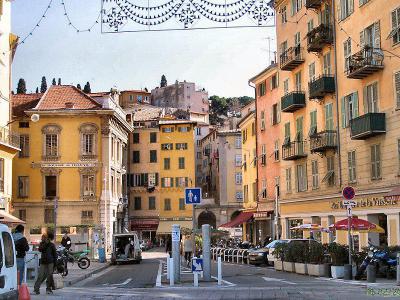
The Place Saint François used to be the home of the town hall which was built in the 16th century in Baroque style. The square is smaller than some in Nice, but it is still a beautiful place to visit. There is a wonderful fountain in the middle of the square that was built in the 1930s a gift from François Aragon that depicts dolphins.
There is a bell tower on the square that was built by the Franciscan monks who gave the name to the square- Saint Francis. This area used to house a large Franciscan convent, but only the bell tower and some of the cloister remain today. Still, it is easy to imagine how busy this little spot was in its heyday when the town hall was here.
The square hosts a fish market every morning with the exception of Monday. Some of the finest and freshest catch from the Mediterranean may be purchased here, so it can still be a busy bundle of activity. It is a nice spot to check out the architecture and people watch.
There is a bell tower on the square that was built by the Franciscan monks who gave the name to the square- Saint Francis. This area used to house a large Franciscan convent, but only the bell tower and some of the cloister remain today. Still, it is easy to imagine how busy this little spot was in its heyday when the town hall was here.
The square hosts a fish market every morning with the exception of Monday. Some of the finest and freshest catch from the Mediterranean may be purchased here, so it can still be a busy bundle of activity. It is a nice spot to check out the architecture and people watch.
9) Place Rossetti (Rossetti Square)
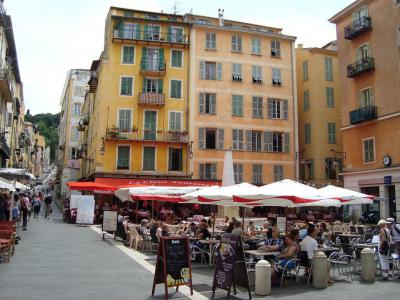
If you’re looking for a place to spend a leisurely day simply watching the world go by, head to the famous Rossetti Square. This charming public square is reached by several winding streets of the Old Town, each leading into a lively open space centred around a beautiful Baroque-style fountain.
The surrounding buildings are centuries old, their façades slightly tilted with age, giving the square its distinctive old-world charm. Look up and you’ll often see laundry strung across balconies — a touch of everyday life that adds to the atmosphere.
While you’re here, be sure to treat yourself to a scoop of artisanal ice cream from Fenocchio, a beloved local institution. And when it’s time to sit down for a meal, take your pick from one of the inviting cafés or restaurants bordering the square. Bon appétit!
The surrounding buildings are centuries old, their façades slightly tilted with age, giving the square its distinctive old-world charm. Look up and you’ll often see laundry strung across balconies — a touch of everyday life that adds to the atmosphere.
While you’re here, be sure to treat yourself to a scoop of artisanal ice cream from Fenocchio, a beloved local institution. And when it’s time to sit down for a meal, take your pick from one of the inviting cafés or restaurants bordering the square. Bon appétit!
10) Cathédrale Sainte-Réparate (Saint Reparate Cathedral) (must see)
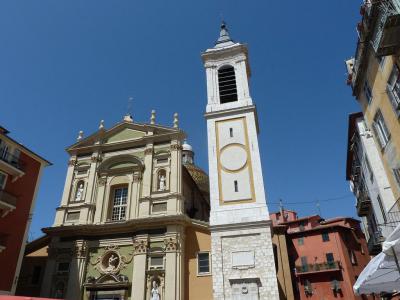
The Saint Reparate Cathedral is one of the most interesting and beautiful cathedrals in Nice. It sits on the site of a small church called Saint Mary of the Castle that dates back circa 1049. The current structure was built in the middle 17th century, and dedicated in 1699. The building is magnificent and contains 10 chapels maintained by private families, and three organs.
The name comes from a young Palestinian boy who was martyred for his Christian faith. Saint Reparate was 15 when he was beheaded and his body set adrift in a small vessel. According to legend, the boat floated up to the shores of Nice and he is now buried at the cathedral.
There have been additions over the years; the Baroque facade was added in the early 1800s. This hides the original cupola which is still there, but a bit hard to see. However, the cupola is covered in colored tiles and is beautiful standing guard over the transept.
The inside also carries on the Baroque theme with plentiful use of marble and gold. The barrel ceilings only add to the huge splendor of the cathedral which is built in the style of the Latin cross. This is definitely a must see when in Nice.
The name comes from a young Palestinian boy who was martyred for his Christian faith. Saint Reparate was 15 when he was beheaded and his body set adrift in a small vessel. According to legend, the boat floated up to the shores of Nice and he is now buried at the cathedral.
There have been additions over the years; the Baroque facade was added in the early 1800s. This hides the original cupola which is still there, but a bit hard to see. However, the cupola is covered in colored tiles and is beautiful standing guard over the transept.
The inside also carries on the Baroque theme with plentiful use of marble and gold. The barrel ceilings only add to the huge splendor of the cathedral which is built in the style of the Latin cross. This is definitely a must see when in Nice.
11) Promenade du Paillon
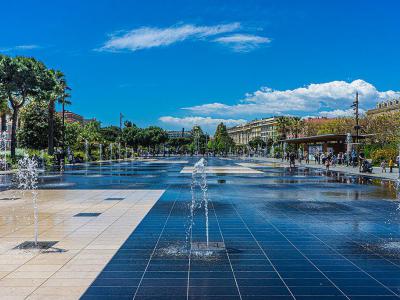
The Paillon Promenade (Promenade du Paillon) in Nice is a picturesque green corridor that connects the Walkway of the English (Promenade des Anglais) to the National Theater along the Avenue des Phocéens, the Boulevard Jean-Jaurès, the Avenue de Verdun, and the Avenue Félix-Faure. The promenade spans 1.2 km and follows the course of the Paillon-covered river. Designed by the landscaper Michel Péna, it features 1,600 trees, 6,000 shrubs, and 50,000 perennials.
The project to create the promenade began in 2010 with the demolition of the Nice bus station and its hanging gardens. It was inaugurated on October 26, 2013, and has since become a popular destination for locals and tourists, especially children who enjoy playing on the various attractions.
The Paillon Promenade includes a 3,000 square meters water mirror equipped with 128 jets and a 1,400 square meters mist plateau. It offers several scenarios to the spectators and is a sight to behold. Park regulations prohibit sitting on the lawns.
The Paillon Promenade is a part of the Green Belt (Coulée Verte), and in January 2020, the mayor of Nice presented a project to extend it. This extension will lead to the demolition of the National Theater of Nice and the Acropolis Congress Center (Palais des Congrès Acropolis) and will cover an area of just under 8 hectares. The extension is set to be completed by 2025.
The project to create the promenade began in 2010 with the demolition of the Nice bus station and its hanging gardens. It was inaugurated on October 26, 2013, and has since become a popular destination for locals and tourists, especially children who enjoy playing on the various attractions.
The Paillon Promenade includes a 3,000 square meters water mirror equipped with 128 jets and a 1,400 square meters mist plateau. It offers several scenarios to the spectators and is a sight to behold. Park regulations prohibit sitting on the lawns.
The Paillon Promenade is a part of the Green Belt (Coulée Verte), and in January 2020, the mayor of Nice presented a project to extend it. This extension will lead to the demolition of the National Theater of Nice and the Acropolis Congress Center (Palais des Congrès Acropolis) and will cover an area of just under 8 hectares. The extension is set to be completed by 2025.
12) Place Massena (Massena Square) (must see)
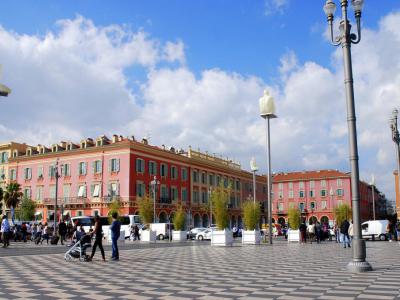
Masséna Square, named in the honour of André Masséna, a Marshal of France during the French Revolutionary and Napoleonic Wars, was designed by Joseph Vernier in 1844. It is spacious and bordered by ochre-coloured Italianate buildings, palm trees, and stone pines.
It is a popular venue for concerts, public events, and festivals. The Carnival Parade, Bastille Day celebrations, and other traditional festivities are often held here. One of the square’s most distinctive features is the Open Sky Museum — seven sculpted Buddhist figures perched on high stilts above the square. At night, they glow in shifting colours, adding a dreamlike atmosphere.
The Open Sky Museum also includes a display of blue-green “fairy” lights arranged in a kind of poetic Morse code. Opposite the lights stands “Nine Oblique Lines”, a monumental sculpture created to mark the 150th anniversary of Nice’s annexation to France. Nearby, in the Sun Fountain, the god Apollo stands proudly, watching over the city — and the city, in turn, seems to watch him.
Beside the square lies the Paillon Promenade, a lush green park lined with palms and flowering shrubs. Its Mirror Fountain features jets of water that spray in rhythmic bursts from the ground, creating reflections on a polished stone base. Children — and often adults — delight in running through the misty water clouds.
Facing the Paillon Promenade is the Albert I Garden, a public park dating back to the 1880s. Stretching from Masséna Square toward the English Promenade and Old Nice, it hosts summer festivals, including the renowned Nice Jazz Festival. With its fountains, exotic flowers, and shaded paths, it offers a calm, green retreat.
It is a popular venue for concerts, public events, and festivals. The Carnival Parade, Bastille Day celebrations, and other traditional festivities are often held here. One of the square’s most distinctive features is the Open Sky Museum — seven sculpted Buddhist figures perched on high stilts above the square. At night, they glow in shifting colours, adding a dreamlike atmosphere.
The Open Sky Museum also includes a display of blue-green “fairy” lights arranged in a kind of poetic Morse code. Opposite the lights stands “Nine Oblique Lines”, a monumental sculpture created to mark the 150th anniversary of Nice’s annexation to France. Nearby, in the Sun Fountain, the god Apollo stands proudly, watching over the city — and the city, in turn, seems to watch him.
Beside the square lies the Paillon Promenade, a lush green park lined with palms and flowering shrubs. Its Mirror Fountain features jets of water that spray in rhythmic bursts from the ground, creating reflections on a polished stone base. Children — and often adults — delight in running through the misty water clouds.
Facing the Paillon Promenade is the Albert I Garden, a public park dating back to the 1880s. Stretching from Masséna Square toward the English Promenade and Old Nice, it hosts summer festivals, including the renowned Nice Jazz Festival. With its fountains, exotic flowers, and shaded paths, it offers a calm, green retreat.
13) Avenue Jean-Medecin
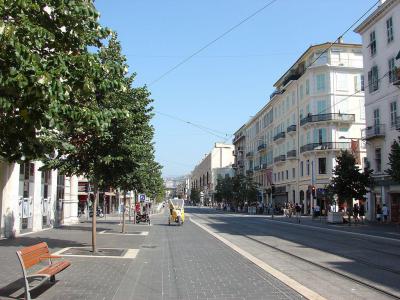
If you want to get in a leisurely stroll through one of the most popular streets of Nice, you will want to take a walk along the famous Avenue Jean Medicin. This famous part of town was named for one of the former city mayors. He was the head of the town for over 50 years. There has been a lot of care in the overall design, and the tour of the famous promenade is simply marvelous.
The best shopping in town can be found here, but be prepared to spend a little money in these shops. The streets are great for pedestrians, and have a lot of room for walking. The stores are also designed for people to be able to just pop in and out for a visit.
The Basilique Notre Dame is not very far away, so you will want to go while there. The whole trip down the famous avenue will take you around 30 minutes from the furthest end (which is by the train station or the Place Massena, depending on which end you start at.) If you need a rest along the way, stop in the famous Nice Etoile Mall. It has some of the best shopping along the way also.
The best shopping in town can be found here, but be prepared to spend a little money in these shops. The streets are great for pedestrians, and have a lot of room for walking. The stores are also designed for people to be able to just pop in and out for a visit.
The Basilique Notre Dame is not very far away, so you will want to go while there. The whole trip down the famous avenue will take you around 30 minutes from the furthest end (which is by the train station or the Place Massena, depending on which end you start at.) If you need a rest along the way, stop in the famous Nice Etoile Mall. It has some of the best shopping along the way also.
14) Basilique Notre-Dame (must see)
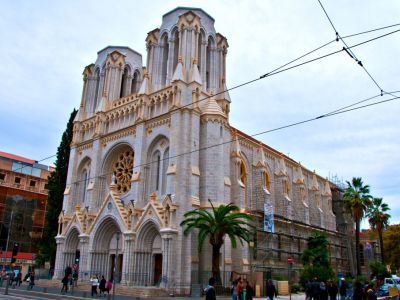
The Notre Dame Church of Nice is the largest of the churches located in the city. It is also one of the main Old Town attractions, representing the first of the churches built in the area in a more modern architectural style. You can find the building on Avenue Jean Medecin, in the very heart of that part of Nice.
By far, most of the religious buildings in Nice have been designed in an Italian Baroque manner. So, in 1848, when the Basiliquee Notre-Dame was built, its very Gothic style represented something totally new. The design was created by the well known architect C. Lenormand. The style lends an old and majestic kind of look to this house of worship that transcends the building's actual age.
The Avenue Jean Medecin is a very busy street in old Nice; therefore, it shouldn't be too difficult for anyone to find things to do along its whole length, making a stop at the famous church a must-do for your trip.
Why You Should Visit:
The architecture is impressive, especially when the exterior is lit up at night and reflects in the glass windows next door and across the street. Serene, with beautiful rose windows and stained glass on the inside, it offers a peaceful escape from the hustle and bustle of downtown Nice.
By far, most of the religious buildings in Nice have been designed in an Italian Baroque manner. So, in 1848, when the Basiliquee Notre-Dame was built, its very Gothic style represented something totally new. The design was created by the well known architect C. Lenormand. The style lends an old and majestic kind of look to this house of worship that transcends the building's actual age.
The Avenue Jean Medecin is a very busy street in old Nice; therefore, it shouldn't be too difficult for anyone to find things to do along its whole length, making a stop at the famous church a must-do for your trip.
Why You Should Visit:
The architecture is impressive, especially when the exterior is lit up at night and reflects in the glass windows next door and across the street. Serene, with beautiful rose windows and stained glass on the inside, it offers a peaceful escape from the hustle and bustle of downtown Nice.
