Custom Walk in Charleston, South Carolina by kathykilman_b848f created on 2025-08-07
Guide Location: USA » Charleston
Guide Type: Custom Walk
# of Sights: 5
Tour Duration: 2 Hour(s)
Travel Distance: 3.6 Km or 2.2 Miles
Share Key: 2FVQR
Guide Type: Custom Walk
# of Sights: 5
Tour Duration: 2 Hour(s)
Travel Distance: 3.6 Km or 2.2 Miles
Share Key: 2FVQR
How It Works
Please retrieve this walk in the GPSmyCity app. Once done, the app will guide you from one tour stop to the next as if you had a personal tour guide. If you created the walk on this website or come to the page via a link, please follow the instructions below to retrieve the walk in the app.
Retrieve This Walk in App
Step 1. Download the app "GPSmyCity: Walks in 1K+ Cities" on Apple App Store or Google Play Store.



Step 2. In the GPSmyCity app, download(or launch) the guide "Charleston Map and Walking Tours".
Step 3. Tap the menu button located at upper right corner of the "Walks" screen and select "Retrieve custom walk". Enter the share key: 2FVQR
1) Historic City Market (must see)
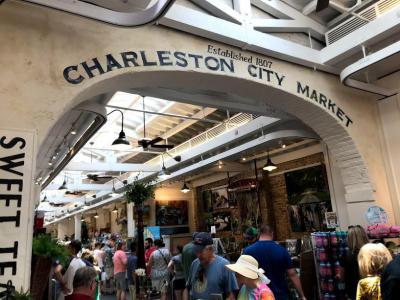
A visit to Charleston would be incomplete without exploring the Historic City Market. Established in the 1790s, it spans four city blocks, covering a vast 33-acre area, starting from the temple-like Market Hall, which now houses the Confederate Museum.
Back in its prime during the early 20th century, the market provided a livelihood for thousands of African-American entrepreneurs and vendors. Today, it remains operational with dozens of vendors offering a wide range of souvenirs and goods, including clothing, jewelry, chocolates, artwork, Gullah sweetgrass baskets, and regional keepsakes.
Places of note include Callie's Hot Little Biscuit, Carolina Rice, Carolina Tea, and other eateries within the market. The surrounding area also has numerous shops, ice cream parlors, and restaurants, making it worthwhile to plan for several hours of exploration and enjoyment.
An excellent option for a rainy day visit (since it offers shelter), the market allows you to browse comfortably, stay dry, and hopefully discover some great deals. While credit cards are accepted, it's advisable to carry some cash as you might receive discounts for cash payments. Additionally, from April through December, the Night Market hosts local artists and food vendors on weekends.
The entire market complex was declared a National Historic Landmark and added to the National Register of Historic Places in 1973.
Back in its prime during the early 20th century, the market provided a livelihood for thousands of African-American entrepreneurs and vendors. Today, it remains operational with dozens of vendors offering a wide range of souvenirs and goods, including clothing, jewelry, chocolates, artwork, Gullah sweetgrass baskets, and regional keepsakes.
Places of note include Callie's Hot Little Biscuit, Carolina Rice, Carolina Tea, and other eateries within the market. The surrounding area also has numerous shops, ice cream parlors, and restaurants, making it worthwhile to plan for several hours of exploration and enjoyment.
An excellent option for a rainy day visit (since it offers shelter), the market allows you to browse comfortably, stay dry, and hopefully discover some great deals. While credit cards are accepted, it's advisable to carry some cash as you might receive discounts for cash payments. Additionally, from April through December, the Night Market hosts local artists and food vendors on weekends.
The entire market complex was declared a National Historic Landmark and added to the National Register of Historic Places in 1973.
2) King Street
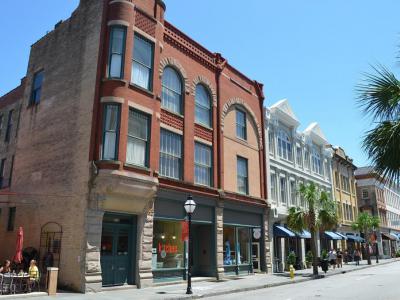
King Street and its surroundings are, perhaps, the most happening areas in Charleston. It is also the second most historically and architecturally significant downtown lane, (after Meeting Street), where the city's past and present converge. With a history spanning more than three centuries, this thoroughfare was named for King Charles II of England and soon thrived as a retail corridor, commercial center, and a major shopping district, hosting a diverse array of high-end specialty shops.
Do you like it upscale? Even if not for shopping, a leisurely stroll down this street's pedestrian-friendly sidewalks impresses with stores offering unique and handmade jewelry, antiques, gifts, shoes, and fine clothing; as well as galleries showcasing the work of local artists and artisans. Peculiar enough, many local stores still "dress" their windows as they did back in the old days. There's also no shortage of trendy restaurants and cool little coffee and dessert shops here either, worth stopping by and taking a break.
With such an abundance of options, you may find yourself wondering where to begin your exploration. As you plan your visit, it's worth noting that King Street can be divided into three sections: the lower section, known for its top-notch antiques and jewelry boutiques; the middle section, home to upscale brand-name stores and some exceptional shoe shops; and the upper section, characterized by more cutting-edge boutiques and housewares stores (often locally owned and with a personal touch), along with a vibrant restaurant scene. Feel free to explore at your own pace and delight in the offerings of each section.
Tip:
Keep an eye out for "Second Sundays on King," an event where the street is closed to cars throughout the afternoon, spanning from Calhoun Street to Queen Street. Plus, don't miss the Saturday farmers' market in Marion Square during the spring and summer months.
Do you like it upscale? Even if not for shopping, a leisurely stroll down this street's pedestrian-friendly sidewalks impresses with stores offering unique and handmade jewelry, antiques, gifts, shoes, and fine clothing; as well as galleries showcasing the work of local artists and artisans. Peculiar enough, many local stores still "dress" their windows as they did back in the old days. There's also no shortage of trendy restaurants and cool little coffee and dessert shops here either, worth stopping by and taking a break.
With such an abundance of options, you may find yourself wondering where to begin your exploration. As you plan your visit, it's worth noting that King Street can be divided into three sections: the lower section, known for its top-notch antiques and jewelry boutiques; the middle section, home to upscale brand-name stores and some exceptional shoe shops; and the upper section, characterized by more cutting-edge boutiques and housewares stores (often locally owned and with a personal touch), along with a vibrant restaurant scene. Feel free to explore at your own pace and delight in the offerings of each section.
Tip:
Keep an eye out for "Second Sundays on King," an event where the street is closed to cars throughout the afternoon, spanning from Calhoun Street to Queen Street. Plus, don't miss the Saturday farmers' market in Marion Square during the spring and summer months.
3) The Battery (must see)
Charleston's White Point Garden, commonly known as the Battery, may not fit the traditional definition of an "attraction" like a museum or a fort, but it holds a unique place in the hearts of visitors and residents alike. While it's not an official attraction, it's almost a rite of passage for first-time visitors to stroll through this historic site. In a city where nearly every building and street holds historical significance, few places offer a more comprehensive glimpse into Charleston's 300-year history.
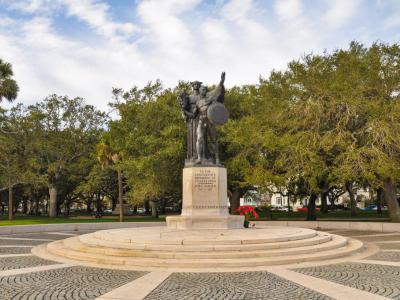
This picturesque spot at the eastern end of East Bay Street is now a serene park adorned with statues, monuments, ancient cannons, and majestic live oak trees-though the ambiance has not always been so tranquil. This site has been a prominent feature in Charleston since the early days of English settlement when it was known as Oyster Point due to its marshy beach covered in white oyster shells. Initially, it mainly served as a navigational aid for ships entering and leaving the harbor and only gained notoriety in the 1720s when infamous pirate Stede Bonnet and his crew were hanged here from makeshift gallows. These executions effectively put an end to pirate activities that had plagued the Carolina coast. Then, during the War of 1812, a fort was built in the area, giving rise to the popular name "the Battery".
The site was officially designated as a park in 1837 when the city reconfigured certain streets to create White Point Garden. It was from this vantage point that Charlestonians witnessed the opening shots of the Civil War on April 12, 1861, as Confederate fortifications across the river exchanged fire with Union troops stationed in Fort Sumter. Once the war started, this peaceful garden was dramatically transformed into two massive earthwork batteries as part of Charleston's inner defense line. While the end of the Civil War marked the conclusion of the Battery's military role, poignant reminders of subsequent wars remain in the form of cannons and monuments, each accompanied by informative plaques or markers.
As a tourist destination, the Battery is also famous for its collection of elegant, predominantly antebellum homes.
This picturesque spot at the eastern end of East Bay Street is now a serene park adorned with statues, monuments, ancient cannons, and majestic live oak trees-though the ambiance has not always been so tranquil. This site has been a prominent feature in Charleston since the early days of English settlement when it was known as Oyster Point due to its marshy beach covered in white oyster shells. Initially, it mainly served as a navigational aid for ships entering and leaving the harbor and only gained notoriety in the 1720s when infamous pirate Stede Bonnet and his crew were hanged here from makeshift gallows. These executions effectively put an end to pirate activities that had plagued the Carolina coast. Then, during the War of 1812, a fort was built in the area, giving rise to the popular name "the Battery".
The site was officially designated as a park in 1837 when the city reconfigured certain streets to create White Point Garden. It was from this vantage point that Charlestonians witnessed the opening shots of the Civil War on April 12, 1861, as Confederate fortifications across the river exchanged fire with Union troops stationed in Fort Sumter. Once the war started, this peaceful garden was dramatically transformed into two massive earthwork batteries as part of Charleston's inner defense line. While the end of the Civil War marked the conclusion of the Battery's military role, poignant reminders of subsequent wars remain in the form of cannons and monuments, each accompanied by informative plaques or markers.
As a tourist destination, the Battery is also famous for its collection of elegant, predominantly antebellum homes.
4) Rainbow Row (must see)
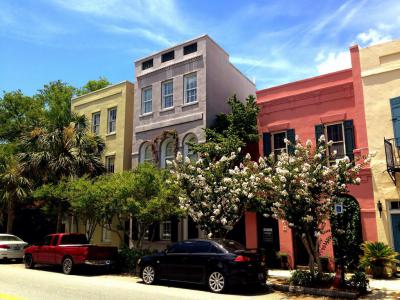
Rainbow Row, a series of thirteen pastel-colored mansions facing the Cooper River, is one of the most iconic and photographed sights in the United States. The vibrant, historically accurate colors are a testament to Charleston's Caribbean heritage, a legacy of the English settlers from Barbados who were among the city's earliest residents.
These homes are exceptionally old, considering Charleston's history of fires, hurricanes, and earthquakes. Most of them were built between 1730 and 1750 when they were located right along the Cooper River, serving as storefronts on the wharf. Later, the street was built on top of landfill, creating the current landscape.
Various myths surround the choice of colors. Some claim that intoxicated sailors returning from the port could remember their lodgings based on color, while others suggest that the colors were chosen to indicate the buildings' purpose as stores, making it easier for illiterate slaves to identify where they could shop.
One way or another, each of these houses has a fascinating story to tell about its origin and inhabitants. Despite facing natural calamities and the Civil War, they have remarkably remained intact and have weathered the test of time. If you examine them closely, you can see signs of renovations, including earthquake rods reinforcing the structures to ensure their stability.
Rainbow Row also holds significant importance in American historic preservation. These were the first Charleston homes to undergo restoration and recovery from early-20th-century deterioration. The restoration efforts on Rainbow Row directly inspired the creation of the Preservation Society of Charleston, the first organization of its kind in the United States.
These homes are exceptionally old, considering Charleston's history of fires, hurricanes, and earthquakes. Most of them were built between 1730 and 1750 when they were located right along the Cooper River, serving as storefronts on the wharf. Later, the street was built on top of landfill, creating the current landscape.
Various myths surround the choice of colors. Some claim that intoxicated sailors returning from the port could remember their lodgings based on color, while others suggest that the colors were chosen to indicate the buildings' purpose as stores, making it easier for illiterate slaves to identify where they could shop.
One way or another, each of these houses has a fascinating story to tell about its origin and inhabitants. Despite facing natural calamities and the Civil War, they have remarkably remained intact and have weathered the test of time. If you examine them closely, you can see signs of renovations, including earthquake rods reinforcing the structures to ensure their stability.
Rainbow Row also holds significant importance in American historic preservation. These were the first Charleston homes to undergo restoration and recovery from early-20th-century deterioration. The restoration efforts on Rainbow Row directly inspired the creation of the Preservation Society of Charleston, the first organization of its kind in the United States.
5) Joe Riley Waterfront Park (must see)
Historically, the waterfront area of Charleston, just off the Cooper River, has been a center of maritime traffic, housing wharves and shipping terminals. Refurbished in 1990, it has received numerous accolades, including the Landmark Award from the American Society of Landscape Architects and the National Trust for Historic Preservation.
Waterfront Park is split into sections. At the northern entrance, near the base of Vendue Range, you'll encounter a large fountain that serves as a prominent focal point. From there, Venue Wharf, a wide wooden pier with sheltered swings, extends into the Cooper River.
The park's largest portion consists of two prominent features: a lush canopy of oak trees lining Concord and Prioleau streets for about a quarter-mile; and a 1,200-foot palmetto-lined esplanade that gracefully follows the natural waterline, ensuring public access to the water's edge.
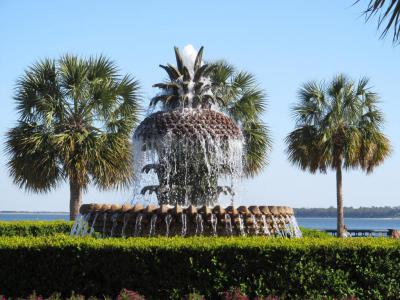
Nestled within the expansive grassy lawn is the famous Pineapple Fountain, located directly in front of the City Gallery and surrounded by trees and benches.
You can pack a picnic lunch, relax on the benches, witness the cruise ships come and go, marvel at the colossal cargo vessels entering one of the nation's busiest ports, and savor the breathtaking sunsets while catching a refreshing breeze on a sunny day.
Why You Should Visit:
Beautifully landscaped areas for picnics; spectacular unobstructed views of Charleston Harbor, the Ravenel Bridge, Patriots Point, and Fort Sumter; a magnificent fountain, a dense oak tree canopy, and numerous benches to engage in the art of people-watching. Sunrises and sunsets here are consistently stunning, and you might even spot dolphins here. There is no admission fee.
Waterfront Park is split into sections. At the northern entrance, near the base of Vendue Range, you'll encounter a large fountain that serves as a prominent focal point. From there, Venue Wharf, a wide wooden pier with sheltered swings, extends into the Cooper River.
The park's largest portion consists of two prominent features: a lush canopy of oak trees lining Concord and Prioleau streets for about a quarter-mile; and a 1,200-foot palmetto-lined esplanade that gracefully follows the natural waterline, ensuring public access to the water's edge.
Nestled within the expansive grassy lawn is the famous Pineapple Fountain, located directly in front of the City Gallery and surrounded by trees and benches.
You can pack a picnic lunch, relax on the benches, witness the cruise ships come and go, marvel at the colossal cargo vessels entering one of the nation's busiest ports, and savor the breathtaking sunsets while catching a refreshing breeze on a sunny day.
Why You Should Visit:
Beautifully landscaped areas for picnics; spectacular unobstructed views of Charleston Harbor, the Ravenel Bridge, Patriots Point, and Fort Sumter; a magnificent fountain, a dense oak tree canopy, and numerous benches to engage in the art of people-watching. Sunrises and sunsets here are consistently stunning, and you might even spot dolphins here. There is no admission fee.
