Custom Walk in Livorno, Italy by al_puzzuoli_ed6ea created on 2025-08-28
Guide Location: Italy » Livorno
Guide Type: Custom Walk
# of Sights: 10
Tour Duration: 3 Hour(s)
Travel Distance: 6.8 Km or 4.2 Miles
Share Key: ZKGFK
Guide Type: Custom Walk
# of Sights: 10
Tour Duration: 3 Hour(s)
Travel Distance: 6.8 Km or 4.2 Miles
Share Key: ZKGFK
How It Works
Please retrieve this walk in the GPSmyCity app. Once done, the app will guide you from one tour stop to the next as if you had a personal tour guide. If you created the walk on this website or come to the page via a link, please follow the instructions below to retrieve the walk in the app.
Retrieve This Walk in App
Step 1. Download the app "GPSmyCity: Walks in 1K+ Cities" on Apple App Store or Google Play Store.



Step 2. In the GPSmyCity app, download(or launch) the guide "Livorno Map and Walking Tours".
Step 3. Tap the menu button located at upper right corner of the "Walks" screen and select "Retrieve custom walk". Enter the share key: ZKGFK
1) Porto Mediceo (Mediceo Port)
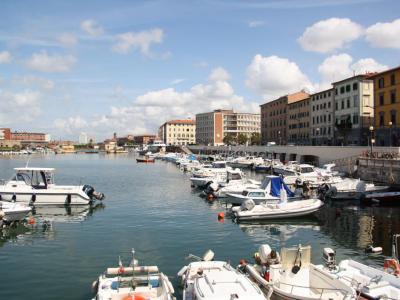
The Mediceo Port is Livorno’s maritime core and the reason the city exists in its present form. Created in the late 16th century under the Medici, the port was conceived as a purpose-built harbor, designed to serve trade, naval defense, and controlled access to the city. Unlike medieval ports that grew organically over centuries, the Mediceo Port was planned from the outset as part of Livorno’s transformation into a modern seaport, engineered to compete on the Mediterranean stage.
A decisive turning point came with the Livornine Laws of 1591 and 1593, which granted Livorno its status as a free port. These laws offered tax exemptions, legal protections, and freedom of worship to foreign merchants. The port developed in close coordination with Livorno’s defensive system. One of the most iconic structures of this era is the Molo Mediceo, the long curved pier built under Grand Duke Ferdinando I de’ Medici. Considered an engineering marvel at the time, it was laid out to protect the harbor from the strong southwest wind, making year-round navigation and safe anchorage possible.
Over the centuries, the Mediceo Port adapted to changing political and economic realities, remaining active through Medici rule, the Habsburg-Lorraine period, and Italian unification, while retaining its original strategic layout. Today, it remains a working harbor rather than a decorative waterfront. Walking along its edges, visitors can see ships, cranes, and fortifications coexisting in the same space where Renaissance planners once envisioned a controlled gateway to an open city.
A decisive turning point came with the Livornine Laws of 1591 and 1593, which granted Livorno its status as a free port. These laws offered tax exemptions, legal protections, and freedom of worship to foreign merchants. The port developed in close coordination with Livorno’s defensive system. One of the most iconic structures of this era is the Molo Mediceo, the long curved pier built under Grand Duke Ferdinando I de’ Medici. Considered an engineering marvel at the time, it was laid out to protect the harbor from the strong southwest wind, making year-round navigation and safe anchorage possible.
Over the centuries, the Mediceo Port adapted to changing political and economic realities, remaining active through Medici rule, the Habsburg-Lorraine period, and Italian unification, while retaining its original strategic layout. Today, it remains a working harbor rather than a decorative waterfront. Walking along its edges, visitors can see ships, cranes, and fortifications coexisting in the same space where Renaissance planners once envisioned a controlled gateway to an open city.
2) Terrazza Mascagni (Mascagni Terrace) (must see)
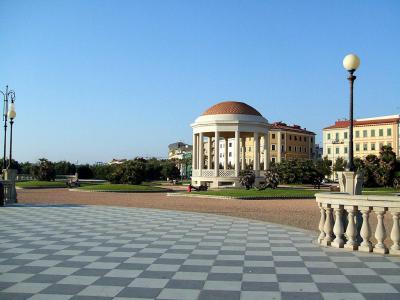
Terrazza Mascagni, known in English as Mascagni Terrace, is a piazza that overlooks the Ligurian Sea. The breathtaking square has a stunning black-and-white checkered floor that provides ample room for walking along the arm of the Mediterranean. There are a total of 34,000 tiles over 8,700 square meters (just over two acres).
The area was turned into a square in 1925 using a design by engineer Enrico Salvais. It was named afer composer Pietro Mascagni. Prior to this, Mascagni Terrace was the location for the Cavalleggeri Fort.
There are many notable spots within Mascagni Terrace. One of the most historically significant is the gazebo located in the southernmost portion of the square. The original gazebo was built by Ghino Venturi in the 1930s. It was destroyed during World War II but painstakingly rebuilt to look exactly like it did when it was new.
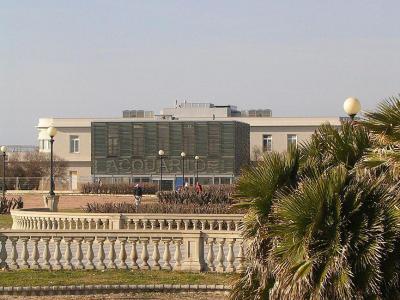
The Mascagni Terrace is home to the Livorno Aquarium, which allows patrons to learn more about the sea life of the Mediterranean. A swimming pool in the square is open to the public. It has a large slide with a stunning view of the sea.
Those wanting to take a break from sightseeing can rest on a sun bed. Each sun bed is equipped with a foldable umbrella to offer either sun or shade. There are several restaurants in and near the square and a large number of tables that are ideal for a quick bite while enjoying the atmosphere.
Other amenities at the Mascagni Terrace include walking paths, public restrooms and a playground for young children.
The area was turned into a square in 1925 using a design by engineer Enrico Salvais. It was named afer composer Pietro Mascagni. Prior to this, Mascagni Terrace was the location for the Cavalleggeri Fort.
There are many notable spots within Mascagni Terrace. One of the most historically significant is the gazebo located in the southernmost portion of the square. The original gazebo was built by Ghino Venturi in the 1930s. It was destroyed during World War II but painstakingly rebuilt to look exactly like it did when it was new.
The Mascagni Terrace is home to the Livorno Aquarium, which allows patrons to learn more about the sea life of the Mediterranean. A swimming pool in the square is open to the public. It has a large slide with a stunning view of the sea.
Those wanting to take a break from sightseeing can rest on a sun bed. Each sun bed is equipped with a foldable umbrella to offer either sun or shade. There are several restaurants in and near the square and a large number of tables that are ideal for a quick bite while enjoying the atmosphere.
Other amenities at the Mascagni Terrace include walking paths, public restrooms and a playground for young children.
3) Acquario di Livorno (Livorno Aquarium) (must see)
The Livorno Aquarium (Acquario di Livorno), situated on the scenic Terrazza Mascagni, offers visitors a deep dive into the wonders of marine life and beyond. Located near the Cetacean Sanctuary, this aquarium is home to an impressive range of aquatic species, amphibians, reptiles, and insects from all over the world.
As you begin your visit, the first room is dedicated to Diacinto Cestoni and introduces the vibrant biodiversity of the Mediterranean Sea. You’ll explore themed exhibition tanks like “The Crustaceans of the Mediterranean” and “The Colors of the Mediterranean,” where you’ll discover the rich underwater landscapes of this region.
Among the aquarium's many highlights are the Indo-Pacific tank, where Ari and Cuba, the star turtles, swim alongside zebra sharks, Napoleon fish, and blacktip reef sharks. Another crowd favorite is the tactile tank, offering visitors the unique chance to get up close and touch rays as they glide gracefully through the water. The jellyfish exhibit serves as both a visual spectacle and a gentle reminder of environmental conservation, raising awareness about the threat plastic waste poses to sea turtles and other marine creatures.
The aquarium also boasts a mesmerizing reproduction of a Greek-Roman shipwreck in its Mediterranean tank, where species like great sea bass and rockfish swim around the ruins. Moving through the exhibits, visitors encounter the vibrant world of the Caribbean Sea, home to colorful creatures such as the green moray eel, surgeonfish, and fire angel fish.
A visit to the panoramic terrace provides sweeping views of Livorno's coastline and an opportunity to reflect on the aquarium’s incredible displays. For those fascinated by land creatures, the tour concludes with a diverse range of amphibians and reptiles, including chameleons, iguanas, dart frogs, and leafcutting ants.
Ideal for families and travelers alike, the Livorno Aquarium blends education with an engaging, immersive experience, making it a must-see attraction on any visit to Livorno.
As you begin your visit, the first room is dedicated to Diacinto Cestoni and introduces the vibrant biodiversity of the Mediterranean Sea. You’ll explore themed exhibition tanks like “The Crustaceans of the Mediterranean” and “The Colors of the Mediterranean,” where you’ll discover the rich underwater landscapes of this region.
Among the aquarium's many highlights are the Indo-Pacific tank, where Ari and Cuba, the star turtles, swim alongside zebra sharks, Napoleon fish, and blacktip reef sharks. Another crowd favorite is the tactile tank, offering visitors the unique chance to get up close and touch rays as they glide gracefully through the water. The jellyfish exhibit serves as both a visual spectacle and a gentle reminder of environmental conservation, raising awareness about the threat plastic waste poses to sea turtles and other marine creatures.
The aquarium also boasts a mesmerizing reproduction of a Greek-Roman shipwreck in its Mediterranean tank, where species like great sea bass and rockfish swim around the ruins. Moving through the exhibits, visitors encounter the vibrant world of the Caribbean Sea, home to colorful creatures such as the green moray eel, surgeonfish, and fire angel fish.
A visit to the panoramic terrace provides sweeping views of Livorno's coastline and an opportunity to reflect on the aquarium’s incredible displays. For those fascinated by land creatures, the tour concludes with a diverse range of amphibians and reptiles, including chameleons, iguanas, dart frogs, and leafcutting ants.
Ideal for families and travelers alike, the Livorno Aquarium blends education with an engaging, immersive experience, making it a must-see attraction on any visit to Livorno.
4) Viale Italia (Italy Avenue)
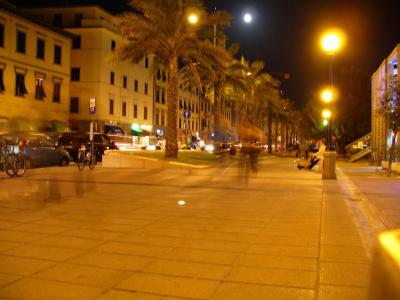
Viale Italia, or Italy Avenue, is a promenade that snakes along the seafront from the southernmost point of La Rotunda to the Piazza Luigi Orlando. Visitors to Livorno will find themselves on Italy Avenue often as it provides access to many of the city's most notable sites. However, it is worth the time to appreciate the street itself.
Most visitors can begin their visit of Italy Avenue at Regina Margherita Barrier. This is where the street offers excellent walking paths that are unencumbered by traffic. From there, visitors will pass such spots as the Italian Naval Academy, the Church of San Jacopo in Acquaviva, the Queen's Rock, the Gazebo Terrazza on Mascagni and the Livorno Aquarium, among many others.
The street is also known for shopping and dining. There are numerous dining options for those who want to try authentic Tuscan cuisine or enjoy a gelato. Visitors should also plan to buy souvenirs at one of the many shops along the street.
Most visitors can begin their visit of Italy Avenue at Regina Margherita Barrier. This is where the street offers excellent walking paths that are unencumbered by traffic. From there, visitors will pass such spots as the Italian Naval Academy, the Church of San Jacopo in Acquaviva, the Queen's Rock, the Gazebo Terrazza on Mascagni and the Livorno Aquarium, among many others.
The street is also known for shopping and dining. There are numerous dining options for those who want to try authentic Tuscan cuisine or enjoy a gelato. Visitors should also plan to buy souvenirs at one of the many shops along the street.
5) Monumento Dei Quattro Mori (Monument of the Four Moors)
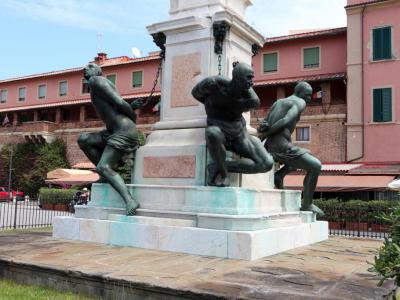
The Monument of the Four Moors is Livorno’s most recognizable public sculpture. Erected in the early 17th century, it reflects both the artistic taste of the period and the political ambitions of the Medici. The monument was commissioned in 1617 by Cosimo II de’ Medici, the Grand Duke of Tuscany from 1609 to 1621, in honor of his father, Grand Duke Ferdinando I, and completed in 1626.
At the center of the monument is a marble statue of Ferdinando I, dressed as a Knight of the Order of Saint Stephen, the naval order founded by the Medici to combat piracy and assert control over the Tyrrhenian Sea. The figure stands atop a high pedestal, gazing toward the harbor. Surrounding the base are four bronze figures, sculpted by Pietro Tacca, a leading Mannerist and early Baroque sculptor. These figures represent defeated corsairs, bound in chains at each corner of the pedestal.
The four bronze statues belong to a wider 17th-century sculptural trend in Italy that favored expressive depictions of prisoners, captives, and enslaved figures. Each Moor is physically distinct, suggesting different geographic origins within the Mediterranean world and beyond; one figure is clearly African, while others reflect North African or Middle Eastern features. Tradition holds that Tacca used real prisoners as models.
The monument projects Medici maritime power and authority, while also unintentionally revealing darker realities of the period, including slavery and forced captivity, in which Tuscan interests were not innocent observers.
At the center of the monument is a marble statue of Ferdinando I, dressed as a Knight of the Order of Saint Stephen, the naval order founded by the Medici to combat piracy and assert control over the Tyrrhenian Sea. The figure stands atop a high pedestal, gazing toward the harbor. Surrounding the base are four bronze figures, sculpted by Pietro Tacca, a leading Mannerist and early Baroque sculptor. These figures represent defeated corsairs, bound in chains at each corner of the pedestal.
The four bronze statues belong to a wider 17th-century sculptural trend in Italy that favored expressive depictions of prisoners, captives, and enslaved figures. Each Moor is physically distinct, suggesting different geographic origins within the Mediterranean world and beyond; one figure is clearly African, while others reflect North African or Middle Eastern features. Tradition holds that Tacca used real prisoners as models.
The monument projects Medici maritime power and authority, while also unintentionally revealing darker realities of the period, including slavery and forced captivity, in which Tuscan interests were not innocent observers.
6) Via Grande (Main Street)
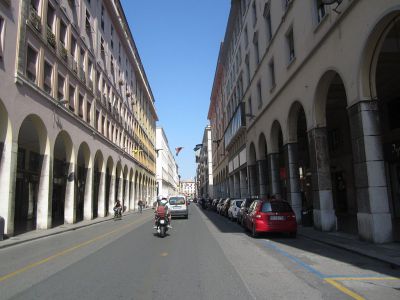
The Main Street is Livorno’s main commercial artery, stretching from the Mediceo Port toward Republic Square and forming a direct link between the harbor and the city center. Laid out as part of Livorno’s original Medici planning, the street was designed to handle movement of people, goods, and daily life. Today, it remains one of the busiest and most recognizable routes in the city, especially for visitors arriving by sea.
The street functions as Livorno’s primary shopping corridor, lined with a mix of international fashion brands, shoe stores, jewelry and perfume shops, alongside cafes and smaller local businesses. The postwar reconstruction of the 1950s reshaped the street with modernist buildings and a simplified layout. While this altered its appearance, the street retained its original role as Livorno’s commercial backbone.
Offering insight into Livorno’s everyday rhythm, you pass through Grande Square, the city’s central civic space, rebuilt after the war and anchored by the Livorno Cathedral. On the northern edge of the square, facing the Cathedral, you see the Gran Guardia Loggia, connected to civic order and public authority.
Walking east, the route reaches Guerrazzi Square. Here stands the Monument to Francesco Domenico Guerrazzi, a writer and political figure of the Risorgimento, whose presence reflects Livorno’s strong republican and revolutionary tradition. Nearby, the Poccianti Cistern recalls the city’s 19th-century water infrastructure, while the Picchetto Palace marks the site of a former military checkpoint controlling movement along the street. The walk concludes at the historic Pisa Gate, once a main entrance to the city, now demolished, just before Main Street meets Republic Square.
The street functions as Livorno’s primary shopping corridor, lined with a mix of international fashion brands, shoe stores, jewelry and perfume shops, alongside cafes and smaller local businesses. The postwar reconstruction of the 1950s reshaped the street with modernist buildings and a simplified layout. While this altered its appearance, the street retained its original role as Livorno’s commercial backbone.
Offering insight into Livorno’s everyday rhythm, you pass through Grande Square, the city’s central civic space, rebuilt after the war and anchored by the Livorno Cathedral. On the northern edge of the square, facing the Cathedral, you see the Gran Guardia Loggia, connected to civic order and public authority.
Walking east, the route reaches Guerrazzi Square. Here stands the Monument to Francesco Domenico Guerrazzi, a writer and political figure of the Risorgimento, whose presence reflects Livorno’s strong republican and revolutionary tradition. Nearby, the Poccianti Cistern recalls the city’s 19th-century water infrastructure, while the Picchetto Palace marks the site of a former military checkpoint controlling movement along the street. The walk concludes at the historic Pisa Gate, once a main entrance to the city, now demolished, just before Main Street meets Republic Square.
7) Piazza Della Repubblica (Republic Square)
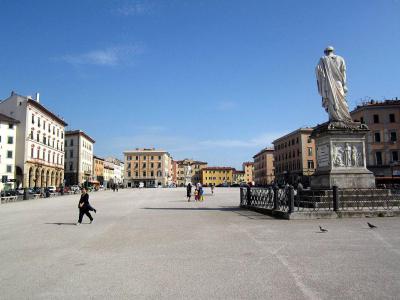
Republic Square was designed as a monumental structure built over water. Created in the 19th century by covering part of the Royal Canal system, the square is famously known to locals as Bridge Square. Beneath its surface lies the Great Vault, a vast elliptical vaulted structure that continues to carry canal water below.
This immense masonry vault is considered a notable achievement of 19th-century engineering, allowing the city to expand its civic space without abandoning its canal-based layout. Seen from above, Republic Square takes on a distinct oblong, elliptical shape, intentionally modeled on the grand urban “place” tradition popular in contemporary Parisian planning. Broad facades and continuous building lines frame the square.
At the south end of the oval stands the statue of Grand Duke Ferdinand III and at the north end stands Leopold II, both being rulers of the Lorraine dynasty under whom Livorno underwent major transformation. Their presence reflects the period when Livorno was strengthened as a free port, attracting merchants, artisans, and foreign communities. Just nearby, the New Fort, a 16th-century Medici defensive fortress, lies north-west of the square, across the canal.
This immense masonry vault is considered a notable achievement of 19th-century engineering, allowing the city to expand its civic space without abandoning its canal-based layout. Seen from above, Republic Square takes on a distinct oblong, elliptical shape, intentionally modeled on the grand urban “place” tradition popular in contemporary Parisian planning. Broad facades and continuous building lines frame the square.
At the south end of the oval stands the statue of Grand Duke Ferdinand III and at the north end stands Leopold II, both being rulers of the Lorraine dynasty under whom Livorno underwent major transformation. Their presence reflects the period when Livorno was strengthened as a free port, attracting merchants, artisans, and foreign communities. Just nearby, the New Fort, a 16th-century Medici defensive fortress, lies north-west of the square, across the canal.
8) Fortezza Nuova (New Fort) (must see)
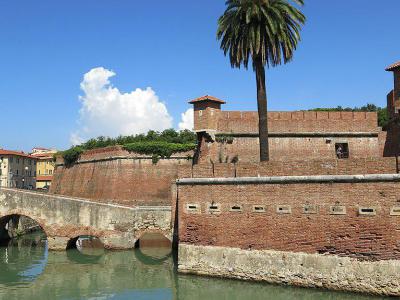
The New Fort was built in the late 16th century, shortly after the Old Fort, forming part of an ambitious Medici strategy to secure Livorno’s harbor and control access to the port. Unlike medieval fortresses that evolved gradually, the New Fort was conceived as a modern military structure, shaped by Renaissance engineering and a clear vision of Livorno’s future as a major Mediterranean port.
The fort’s design is closely linked to Bernardo Buontalenti, a Florentine polymath. In 1576, Buontalenti proposed the "Buontalenti Pentagon", a comprehensive defensive system enclosing the settlement. The New Fort itself was built on a canal-surrounded island within this defensive network, and even today the structure appears almost like a fortress rising directly out of the water. As Livorno expanded, parts of the fortifications were modified to allow the growth of commercial districts.
For centuries, the New Fort remained an active military installation and later served additional roles, including use as a prison. Heavily damaged during the Second World War, it was restored by 1972 and reimagined for civilian use. Today, the New Fort functions as a public park and cultural venue. Inside the walls, visitors can walk across grassy lawns and along gently rising ramparts, where the fort’s angular bastions and thick masonry remain clearly visible. Traces of embrasures, walls, and defensive geometry survive throughout the site, while the broad interior space is now used for quiet walks, informal gatherings, and occasional cultural events.
The fort’s design is closely linked to Bernardo Buontalenti, a Florentine polymath. In 1576, Buontalenti proposed the "Buontalenti Pentagon", a comprehensive defensive system enclosing the settlement. The New Fort itself was built on a canal-surrounded island within this defensive network, and even today the structure appears almost like a fortress rising directly out of the water. As Livorno expanded, parts of the fortifications were modified to allow the growth of commercial districts.
For centuries, the New Fort remained an active military installation and later served additional roles, including use as a prison. Heavily damaged during the Second World War, it was restored by 1972 and reimagined for civilian use. Today, the New Fort functions as a public park and cultural venue. Inside the walls, visitors can walk across grassy lawns and along gently rising ramparts, where the fort’s angular bastions and thick masonry remain clearly visible. Traces of embrasures, walls, and defensive geometry survive throughout the site, while the broad interior space is now used for quiet walks, informal gatherings, and occasional cultural events.
9) Venezia Nuova (New Venice)
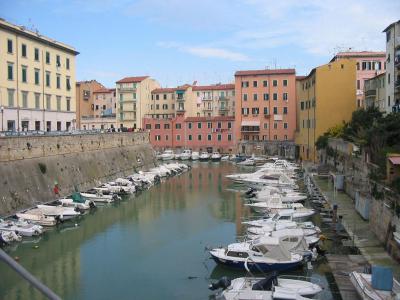
New Venice (Venezia Nuova) is a historic district in Livorno, known for being one of the few areas in the city center that largely retained its architectural heritage despite the destruction of World War II and subsequent reconstruction. While not the original Medici Livorno nucleus, it has become the city's true historic center, preserving its essence and charm.
The district was developed between 1629 and 1645 to accommodate Livorno’s burgeoning merchant class, which flourished thanks to the abolition of customs duties and inclusive policies initiated by the Medici Grand Dukes. These policies attracted merchants and traders from all over the world, transforming Livorno into a thriving commercial hub. The neighborhood's construction drew inspiration from Venice, with the use of advanced techniques imported from the Venetian lagoon to build over what was once a partially submerged area.
New Venice is characterized by its tall houses, distinguished by their blond plaster facades in shades of pink and green, catching the sun's light in golden and verdigris reflections reminiscent of the oil-slicked canal waters. These homes, with their pale, dusty shutters, convey a mix of faded nobility and popular freedom in their open architecture, embodying the Mediterranean's architectural beauty.
The district is home to two significant religious landmarks: the Church of San Ferdinando Re, associated with the Trinitarian order, and the octagonal Church of Santa Caterina, built by the Dominicans. Both churches reflect the artistic and spiritual vibrancy of the district during its peak in the 18th century.
Every summer, New Venice becomes the vibrant stage for "Venice Effect," a folkloristic event where the streets are filled with stalls, shows, and cultural celebrations, breathing life into the historic canals. Additionally, the district hosts a winery that actively participates in Livorno’s traditional rowing competitions, adding to its rich cultural fabric.
The district was developed between 1629 and 1645 to accommodate Livorno’s burgeoning merchant class, which flourished thanks to the abolition of customs duties and inclusive policies initiated by the Medici Grand Dukes. These policies attracted merchants and traders from all over the world, transforming Livorno into a thriving commercial hub. The neighborhood's construction drew inspiration from Venice, with the use of advanced techniques imported from the Venetian lagoon to build over what was once a partially submerged area.
New Venice is characterized by its tall houses, distinguished by their blond plaster facades in shades of pink and green, catching the sun's light in golden and verdigris reflections reminiscent of the oil-slicked canal waters. These homes, with their pale, dusty shutters, convey a mix of faded nobility and popular freedom in their open architecture, embodying the Mediterranean's architectural beauty.
The district is home to two significant religious landmarks: the Church of San Ferdinando Re, associated with the Trinitarian order, and the octagonal Church of Santa Caterina, built by the Dominicans. Both churches reflect the artistic and spiritual vibrancy of the district during its peak in the 18th century.
Every summer, New Venice becomes the vibrant stage for "Venice Effect," a folkloristic event where the streets are filled with stalls, shows, and cultural celebrations, breathing life into the historic canals. Additionally, the district hosts a winery that actively participates in Livorno’s traditional rowing competitions, adding to its rich cultural fabric.
10) Fortezza Vecchia (Old Fort) (must see)
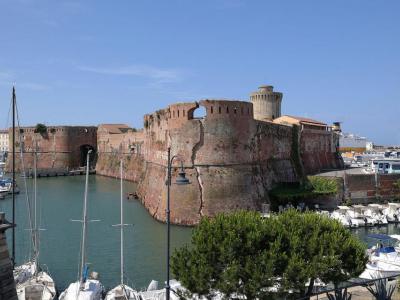
The Old Fort stands at the entrance to Livorno’s harbor and represents the city’s earliest phase as a strategic port. Long before Livorno was conceived as a planned Medici city, this site already controlled access to the coast and shipping routes. Over several centuries, it evolved from a medieval stronghold into a Renaissance fortress.
The fortress assumed its present form beginning in 1519, when a new defensive complex was commissioned by Cardinal Giulio de’ Medici, the future Pope Clement VII, and designed by Antonio da Sangallo the Elder, one of the leading military architects of the Renaissance. Completed in 1534, the fort integrated earlier structures into a modern artillery-resistant design. Its layout is defined by three major bastions, Ampolletta on the landward side, Canaviglia facing the port, and Capitana to the northeast.
Beneath this Medici construction lie much older elements. The oldest surviving part in the Old Fort is the Keep of Countess Matilda, which is also the oldest surviving structure in Livorno. The keep is traditionally linked to Matilda of Canossa and dated to the early 11th century. In 1377, the Republic of Pisa incorporated the tower into a larger fortress known as the Quadrature of the Pisans, establishing the site’s long-standing defensive role. Within the Medici fortress stands the Church of Saint Francis of Assisi, built in 1530, where in 1606 the ceremony officially proclaiming Livorno a city took place.
The fortress assumed its present form beginning in 1519, when a new defensive complex was commissioned by Cardinal Giulio de’ Medici, the future Pope Clement VII, and designed by Antonio da Sangallo the Elder, one of the leading military architects of the Renaissance. Completed in 1534, the fort integrated earlier structures into a modern artillery-resistant design. Its layout is defined by three major bastions, Ampolletta on the landward side, Canaviglia facing the port, and Capitana to the northeast.
Beneath this Medici construction lie much older elements. The oldest surviving part in the Old Fort is the Keep of Countess Matilda, which is also the oldest surviving structure in Livorno. The keep is traditionally linked to Matilda of Canossa and dated to the early 11th century. In 1377, the Republic of Pisa incorporated the tower into a larger fortress known as the Quadrature of the Pisans, establishing the site’s long-standing defensive role. Within the Medici fortress stands the Church of Saint Francis of Assisi, built in 1530, where in 1606 the ceremony officially proclaiming Livorno a city took place.
