Custom Walk in Bari, Italy by giuliasava_58db8 created on 2025-10-12
Guide Location: Italy » Bari
Guide Type: Custom Walk
# of Sights: 7
Tour Duration: 1 Hour(s)
Travel Distance: 1.5 Km or 0.9 Miles
Share Key: R7KT6
Guide Type: Custom Walk
# of Sights: 7
Tour Duration: 1 Hour(s)
Travel Distance: 1.5 Km or 0.9 Miles
Share Key: R7KT6
How It Works
Please retrieve this walk in the GPSmyCity app. Once done, the app will guide you from one tour stop to the next as if you had a personal tour guide. If you created the walk on this website or come to the page via a link, please follow the instructions below to retrieve the walk in the app.
Retrieve This Walk in App
Step 1. Download the app "GPSmyCity: Walks in 1K+ Cities" on Apple App Store or Google Play Store.



Step 2. In the GPSmyCity app, download(or launch) the guide "Bari Map and Walking Tours".
Step 3. Tap the menu button located at upper right corner of the "Walks" screen and select "Retrieve custom walk". Enter the share key: R7KT6
1) Castello Normanno-Svevo (Swabian Castle) (must see)
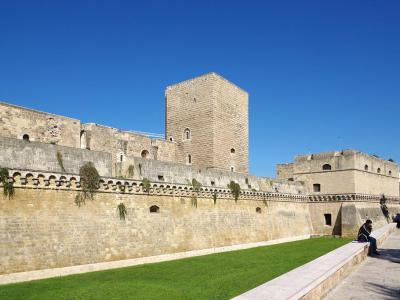
The Swabian Castle of Bari, sometimes called the Hohenstaufen Castle, has stood in one form or another for nearly nine centuries, its stones carrying the weight of both destruction and rebirth. Its origins go back to around 1132, when the Norman king Roger II ordered its construction to secure Bari’s harbor and surrounding lands. But in 1156, William I of Sicily-nicknamed “the Wicked”-swept through the city, razing much of it to the ground, including the fortress. What could have been its end became instead a turning point, for in 1233 Emperor Frederick II rebuilt the castle on a grander scale, transforming it into one of the strongest symbols of his reign in southern Italy.
The fortress was more than a military outpost. It doubled as a royal residence, a place where rulers held court and where alliances were forged. One of its most famous anecdotes comes from 1221, when St. Francis of Assisi is said to have stayed here as Frederick’s guest. According to legend, the emperor-skeptical of Francis’s holiness-sent a courtesan to tempt him. But when she approached his bed, she saw it engulfed in flames and fled in terror. Frederick, secretly watching, was so struck by what he saw that he never doubted Francis again. The story, half miracle and half morality play, still lingers in the castle’s lore.
Over the centuries, the castle passed through many hands-the Angevins, the Aragonese, and later rulers of Spain and Naples-all of whom modified it to suit their purposes. Its moat and towers reflect a history of defense, while its courtyards and hallways recall a time of ceremony and rule.
Nowadays, the Swabian Castle no longer bristles with cannons, but it remains a cornerstone of Bari’s identity. Visitors wander through its courtyards, exhibitions, and echoing halls, while its towers still command views toward the Adriatic. To walk here is to step into layers of history-Norman ambition, Frederick’s authority, Francis’s legend-all fused into one enduring monument. It is not only stone and battlements, but a living reminder of Bari’s resilience and place on the frontier between empires.
The fortress was more than a military outpost. It doubled as a royal residence, a place where rulers held court and where alliances were forged. One of its most famous anecdotes comes from 1221, when St. Francis of Assisi is said to have stayed here as Frederick’s guest. According to legend, the emperor-skeptical of Francis’s holiness-sent a courtesan to tempt him. But when she approached his bed, she saw it engulfed in flames and fled in terror. Frederick, secretly watching, was so struck by what he saw that he never doubted Francis again. The story, half miracle and half morality play, still lingers in the castle’s lore.
Over the centuries, the castle passed through many hands-the Angevins, the Aragonese, and later rulers of Spain and Naples-all of whom modified it to suit their purposes. Its moat and towers reflect a history of defense, while its courtyards and hallways recall a time of ceremony and rule.
Nowadays, the Swabian Castle no longer bristles with cannons, but it remains a cornerstone of Bari’s identity. Visitors wander through its courtyards, exhibitions, and echoing halls, while its towers still command views toward the Adriatic. To walk here is to step into layers of history-Norman ambition, Frederick’s authority, Francis’s legend-all fused into one enduring monument. It is not only stone and battlements, but a living reminder of Bari’s resilience and place on the frontier between empires.
2) Strada delle Orecchiette ("Ears" Pasta Street)
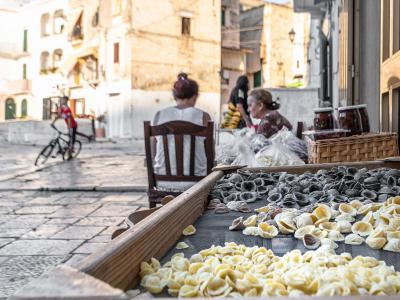
They say that to truly know Bari, you must pass through the Low Arch and find yourself on the Street of the “Little Ears.” This narrow stretch of Old Bari, hidden among twisting lanes, carries a timeless atmosphere where everyday life and tradition unfold openly before visitors’ eyes. Here, the “orecchiette” pasta-so named for its little ear shape-has been made for generations by women who set up wooden tables right outside their doorways. With nimble thumbs, they press and flick the dough into shape, chatting with neighbors, keeping an eye on children, and occasionally selling bags of fresh pasta to passersby. It is not performance, but routine, a tradition woven into family life that has endured for centuries.
The street’s location near the Basilica of Saint Nicholas is telling. For pilgrims who once walked through these alleys, the sight of women working pasta became part of the city’s rhythm-faith, food, and community inseparable. One anecdote often shared is how grandmothers teach their granddaughters the thumb-rolling technique by having them practice on tiny lumps of dough, reminding them that “orecchiette must hold the sauce like a cradle.” In this way, skill and culture are passed down at the kitchen table as naturally as conversation.
Pasta Street is less about sightseeing and more about immersion. The earthy scent of semolina drifts through the air, knives clatter on wooden boards, and the warmth of neighborhood life surrounds you. Buying a bag of fresh orecchiette, or even sitting down for a home-cooked meal, offers not just food but a taste of Bari’s enduring spirit-simple, generous, and alive in its oldest streets.
The street’s location near the Basilica of Saint Nicholas is telling. For pilgrims who once walked through these alleys, the sight of women working pasta became part of the city’s rhythm-faith, food, and community inseparable. One anecdote often shared is how grandmothers teach their granddaughters the thumb-rolling technique by having them practice on tiny lumps of dough, reminding them that “orecchiette must hold the sauce like a cradle.” In this way, skill and culture are passed down at the kitchen table as naturally as conversation.
Pasta Street is less about sightseeing and more about immersion. The earthy scent of semolina drifts through the air, knives clatter on wooden boards, and the warmth of neighborhood life surrounds you. Buying a bag of fresh orecchiette, or even sitting down for a home-cooked meal, offers not just food but a taste of Bari’s enduring spirit-simple, generous, and alive in its oldest streets.

3) Cattedrale di San Sabino (Bari Cathedral) (must see)
Bari Cathedral, formally dedicated to Saint Sabinus, carries the scars and resilience of a city that has been rebuilt more than once. Its story begins in the 6th century, when a basilica first rose on the site, tied to the memory of Bishop Sabinus of Canosa. That early church, however, would not survive the fury of King William I of Sicily-known as “Il Malo,” or “the Wicked.” In 1156, he stormed Bari and razed most of the city, sparing only the Basilica of Saint Nicholas. The cathedral was left in ruins, a victim of conquest and power struggles that defined southern Italy in the Middle Ages.
From that devastation, Bari slowly reclaimed its spirit. Over the following decades, a new cathedral was built in the Apulian Romanesque style, solid and restrained, a clear sign of determination rather than excess. When it was finally consecrated in 1292, the people of Bari had not only rebuilt their place of worship but also reaffirmed their faith and identity. Within its crypt, the relics of Saint Sabinus found a permanent home, making the cathedral an enduring focal point for local devotion. Pilgrims still come to pay respects, their prayers mingling with centuries of whispered hopes that have filled the space since the relics arrived in 844.
Through time, the cathedral bore the marks of change-frescoes added, baroque details layered, bomb damage during World War II repaired-but the core remained the same: a space where daily life unfolded. Baptisms, weddings, funerals, and festivals tied the community to its cathedral in ways that survived wars and rulers alike.
From the relics in the crypt to the steady presence of worshippers, Bari Cathedral embodies endurance. It reminds visitors that cities, like faith, can be shaken but still rise again.
From that devastation, Bari slowly reclaimed its spirit. Over the following decades, a new cathedral was built in the Apulian Romanesque style, solid and restrained, a clear sign of determination rather than excess. When it was finally consecrated in 1292, the people of Bari had not only rebuilt their place of worship but also reaffirmed their faith and identity. Within its crypt, the relics of Saint Sabinus found a permanent home, making the cathedral an enduring focal point for local devotion. Pilgrims still come to pay respects, their prayers mingling with centuries of whispered hopes that have filled the space since the relics arrived in 844.
Through time, the cathedral bore the marks of change-frescoes added, baroque details layered, bomb damage during World War II repaired-but the core remained the same: a space where daily life unfolded. Baptisms, weddings, funerals, and festivals tied the community to its cathedral in ways that survived wars and rulers alike.
From the relics in the crypt to the steady presence of worshippers, Bari Cathedral embodies endurance. It reminds visitors that cities, like faith, can be shaken but still rise again.
4) Basilica San Nicola (Basilica of Saint Nicholas) (must see)
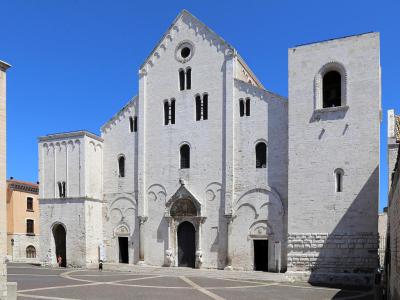
The Basilica of Saint Nicholas in Bari is more than a landmark; it is the story of how a city was transformed by faith, devotion, and legend. The tale begins in 1087, when sailors from Bari set sail for Myra, in present-day Turkey, and returned with the relics of Saint Nicholas, the miracle-working bishop whose reputation had spread across Christendom. Bringing his bones back to Bari was not just a daring act-it was a turning point that placed the city firmly on the map of Europe as a place of pilgrimage. Almost immediately, construction began on a church worthy of the saint, rising over the remains of the old Byzantine governor’s palace.
The man at the heart of all this, Nicholas himself, was born in the 3rd century. Known for his generosity and miracles, he became Bishop of Myra and endured persecution under Diocletian before his reputation as a protector of sailors, children, and the vulnerable took root. When Bari’s merchants brought his relics to Italy, they were greeted with both celebration and awe, and by 1197 the basilica was consecrated in the presence of Emperor Henry VI. From that moment, the city was not only a vital port but also a spiritual destination, visited by both Catholics and Orthodox pilgrims-a rare point of unity in a divided medieval world.
One of Bari’s most enduring traditions still recalls the sailors’ voyage: every May, during the Feast of Saint Nicholas, the saint’s statue is carried through the streets and taken out to sea before returning in a grand procession. The event blends faith and folklore, filling the city with music, fireworks, and prayers, and it remains one of Bari’s proudest celebrations.
Inside the basilica today, visitors find not just frescoes and stone columns but a crypt where pilgrims kneel at the saint’s marble tomb, often alongside curious travelers. Here, history and devotion mingle in a way that feels timeless. For Bari, the basilica was never only about architecture-it was about becoming more than a port, a city anchored in the enduring presence of its patron saint.
The man at the heart of all this, Nicholas himself, was born in the 3rd century. Known for his generosity and miracles, he became Bishop of Myra and endured persecution under Diocletian before his reputation as a protector of sailors, children, and the vulnerable took root. When Bari’s merchants brought his relics to Italy, they were greeted with both celebration and awe, and by 1197 the basilica was consecrated in the presence of Emperor Henry VI. From that moment, the city was not only a vital port but also a spiritual destination, visited by both Catholics and Orthodox pilgrims-a rare point of unity in a divided medieval world.
One of Bari’s most enduring traditions still recalls the sailors’ voyage: every May, during the Feast of Saint Nicholas, the saint’s statue is carried through the streets and taken out to sea before returning in a grand procession. The event blends faith and folklore, filling the city with music, fireworks, and prayers, and it remains one of Bari’s proudest celebrations.
Inside the basilica today, visitors find not just frescoes and stone columns but a crypt where pilgrims kneel at the saint’s marble tomb, often alongside curious travelers. Here, history and devotion mingle in a way that feels timeless. For Bari, the basilica was never only about architecture-it was about becoming more than a port, a city anchored in the enduring presence of its patron saint.
5) Museo Archeologico di Santa Scolastica (Archaeological Museum of Santa Scolastica)
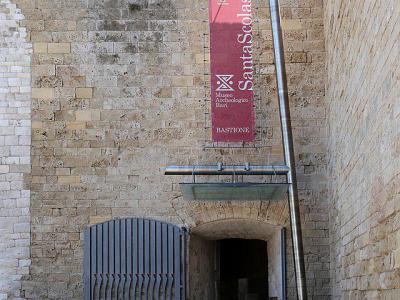
The Archaeological Museum of Santa Scolastica is a rich trove of Apulian history housed in the former Benedictine monastery of Santa Scolastica. This site retains layers of history through its architectural transformations-from its legendary founding around the 10th–11th centuries to the additions of a 16th‑century defensive bastion.
The museum’s origins trace back to 1875, when Professor Nitto De Rossi began assembling a collection that would lay the foundation for what opened to the public in 1890 at the Ateneo Square. It wasn’t until 2001 that the museum relocated into the restored monastic complex, and after extensive renovations, its new exhibition spaces finally opened around 2018.
Inside, visitors embark on a compelling chronological journey through Apulia’s past. The collections span from prehistoric tools and ceramics to Daunian, Peucetian, and Messapian geometric pottery, as well as Greek, Byzantine, Arab‑Norman, and medieval jewelry and artifacts. Reconstruction of the museum’s narration divides the exhibits into thematic sections such as Prehistory and Protohistory, Ancient Peoples of Apulia, Iapygians and Greeks, and Archaeology of Bari-plus a special display about life in the monastery itself.
Visitors are treated not only to artifacts but to the archaeological area of San Pietro, accessible directly from the monastery’s bastion, which offers real remnants of past settlements beneath its walls. Multimedia installations consciously enrich the experience, providing contextual depth to architectural and artistic heritage-particularly of Byzantine Bari and monastic life.
The museum’s origins trace back to 1875, when Professor Nitto De Rossi began assembling a collection that would lay the foundation for what opened to the public in 1890 at the Ateneo Square. It wasn’t until 2001 that the museum relocated into the restored monastic complex, and after extensive renovations, its new exhibition spaces finally opened around 2018.
Inside, visitors embark on a compelling chronological journey through Apulia’s past. The collections span from prehistoric tools and ceramics to Daunian, Peucetian, and Messapian geometric pottery, as well as Greek, Byzantine, Arab‑Norman, and medieval jewelry and artifacts. Reconstruction of the museum’s narration divides the exhibits into thematic sections such as Prehistory and Protohistory, Ancient Peoples of Apulia, Iapygians and Greeks, and Archaeology of Bari-plus a special display about life in the monastery itself.
Visitors are treated not only to artifacts but to the archaeological area of San Pietro, accessible directly from the monastery’s bastion, which offers real remnants of past settlements beneath its walls. Multimedia installations consciously enrich the experience, providing contextual depth to architectural and artistic heritage-particularly of Byzantine Bari and monastic life.
6) Piazza Mercantile (Merchant Square)
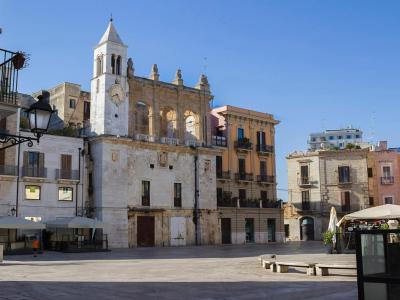
Merchant Square has been the stage for Bari’s public life for centuries, a place where power, trade, and daily routine came together in full view of the Adriatic. Established in the 13th century at the edge of the Old Town, it quickly grew into the city’s commercial heart. Merchants set up stalls, officials read out proclamations, and townspeople crowded the space to hear news or celebrate feast days. It was also the starting point of the Francigena street, the medieval pilgrims’ route leading to the Cathedral of Saint Nicholas, tying the square to both faith and commerce. Linked to the port by the fortified Tower of Sant’Antonio, the square was a gateway for traders and travelers alike.
The square also carried a darker side of justice. For centuries, the Pillar of Justice stood in plain sight, where bankrupt debtors were chained as a warning to others. This ritual of shame left an indelible mark on the memory of the place, a reminder that commerce in Bari was not only opportunity but also risk. Over time, the square took on layers of meaning-Palazzo del Sedile housed the city council, while its clock tower marked the hours of both labor and leisure.
Even catastrophe could not silence the square. After the fire and explosions of 1601, the ruling House of Sforza oversaw a renewal that gave Merchant Square new life, linking it directly to Ferrarese Square and reinforcing its role as the city’s business center.
The square no longer chains debtors, but it still chains people’s attention. Cafés and restaurants spill out onto the stones, and journalist Lino Patruno once compared it to a model that never stops winning hearts, “as if it were for the first time.” For visitors, Merchant Square remains what it always was: the beating civic and social heart of Bari.
The square also carried a darker side of justice. For centuries, the Pillar of Justice stood in plain sight, where bankrupt debtors were chained as a warning to others. This ritual of shame left an indelible mark on the memory of the place, a reminder that commerce in Bari was not only opportunity but also risk. Over time, the square took on layers of meaning-Palazzo del Sedile housed the city council, while its clock tower marked the hours of both labor and leisure.
Even catastrophe could not silence the square. After the fire and explosions of 1601, the ruling House of Sforza oversaw a renewal that gave Merchant Square new life, linking it directly to Ferrarese Square and reinforcing its role as the city’s business center.
The square no longer chains debtors, but it still chains people’s attention. Cafés and restaurants spill out onto the stones, and journalist Lino Patruno once compared it to a model that never stops winning hearts, “as if it were for the first time.” For visitors, Merchant Square remains what it always was: the beating civic and social heart of Bari.
7) Colonna Infame (Infamous Column)
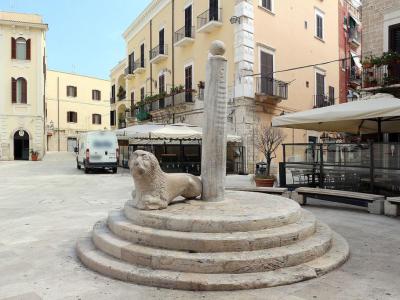
The Infamous Column, stands as a compelling relic of the city's judicial and civic past. Dating back to the mid-16th century, the column was commissioned by the Spanish Viceroy Pietro di Toledo and is widely associated with public shaming practices aimed at insolvent debtors.
Though concrete documentation is scarce, tradition holds that those unable to pay their debts were once displayed here-hands bound to the column and humiliation enforced. Today, it serves as a reminder of how communities once balanced justice and spectacle.
Architecturally, the monument features a white marble column rising from four concentric steps, crowned by a spherical finial. At its base reclines an ancient lion sculpted from Apulian limestone breccia-likely repurposed from a Roman tomb dating to between the 1st century B.C. and 1st century A.D. The inscription on its collar, “guardian of justice”, reinforces its symbolic role in watching over the city.
Originally placed near the Sea Gate by the old port, the Colonna Infame later found a home in its current location, aligning with the area’s historical role as Bari’s civic and commercial heart.
Though concrete documentation is scarce, tradition holds that those unable to pay their debts were once displayed here-hands bound to the column and humiliation enforced. Today, it serves as a reminder of how communities once balanced justice and spectacle.
Architecturally, the monument features a white marble column rising from four concentric steps, crowned by a spherical finial. At its base reclines an ancient lion sculpted from Apulian limestone breccia-likely repurposed from a Roman tomb dating to between the 1st century B.C. and 1st century A.D. The inscription on its collar, “guardian of justice”, reinforces its symbolic role in watching over the city.
Originally placed near the Sea Gate by the old port, the Colonna Infame later found a home in its current location, aligning with the area’s historical role as Bari’s civic and commercial heart.
