Custom Walk in Key West, Florida by mkn9823_fcc95 created on 2025-12-02
Guide Location: USA » Key West
Guide Type: Custom Walk
# of Sights: 8
Tour Duration: 3 Hour(s)
Travel Distance: 6.1 Km or 3.8 Miles
Share Key: 6UE9U
Guide Type: Custom Walk
# of Sights: 8
Tour Duration: 3 Hour(s)
Travel Distance: 6.1 Km or 3.8 Miles
Share Key: 6UE9U
How It Works
Please retrieve this walk in the GPSmyCity app. Once done, the app will guide you from one tour stop to the next as if you had a personal tour guide. If you created the walk on this website or come to the page via a link, please follow the instructions below to retrieve the walk in the app.
Retrieve This Walk in App
Step 1. Download the app "GPSmyCity: Walks in 1K+ Cities" on Apple App Store or Google Play Store.



Step 2. In the GPSmyCity app, download(or launch) the guide "Key West Map and Walking Tours".
Step 3. Tap the menu button located at upper right corner of the "Walks" screen and select "Retrieve custom walk". Enter the share key: 6UE9U

1) U.S. Coast Guard Cutter Ingham Maritime Museum (must see)
The U.S. Coast Guard Cutter Ingham Maritime Museum is a decommissioned ship museum docked in Key West at Truman Waterfront Park. It’s one of the most interesting historic sites on the island because it isn’t a recreated exhibit-you’re stepping onto a real working vessel with tight corridors, steep ladders, and rooms that still look like they did during service. The Ingham served for decades and is best known for its roles in World War II, the Cold War, and later drug interdiction operations.
Walking through the ship gives a clear sense of how demanding life on board was. Visitors can move through key areas like the bridge, crew quarters, and operational spaces, with signs explaining what each section was used for and how the crew lived day to day. The metal surfaces, narrow passageways, and low ceilings make the experience feel very different from a standard museum. It’s hands-on and detailed, with a lot to take in even without reading every panel.
The Ingham is also recognized as a National Historic Landmark, and many displays focus on the ship’s combat history, Coast Guard missions, and the people who served on it. Along the route, you’ll see original equipment, weapons, and ship systems that show how a cutter operated at sea. For anyone interested in military history or ships, it’s the kind of place where you end up stopping often just to look at how everything fits together.
The visit is done mostly at your own pace, and it can take longer than expected because there are so many levels and rooms to explore. Comfortable shoes are a good idea, and visitors should be prepared for steep steps and tight spaces in places. When you step back onto the dock, the harbor feels very different after spending time inside a ship built for hard conditions and serious missions.
Walking through the ship gives a clear sense of how demanding life on board was. Visitors can move through key areas like the bridge, crew quarters, and operational spaces, with signs explaining what each section was used for and how the crew lived day to day. The metal surfaces, narrow passageways, and low ceilings make the experience feel very different from a standard museum. It’s hands-on and detailed, with a lot to take in even without reading every panel.
The Ingham is also recognized as a National Historic Landmark, and many displays focus on the ship’s combat history, Coast Guard missions, and the people who served on it. Along the route, you’ll see original equipment, weapons, and ship systems that show how a cutter operated at sea. For anyone interested in military history or ships, it’s the kind of place where you end up stopping often just to look at how everything fits together.
The visit is done mostly at your own pace, and it can take longer than expected because there are so many levels and rooms to explore. Comfortable shoes are a good idea, and visitors should be prepared for steep steps and tight spaces in places. When you step back onto the dock, the harbor feels very different after spending time inside a ship built for hard conditions and serious missions.
2) Mallory Square (must see)
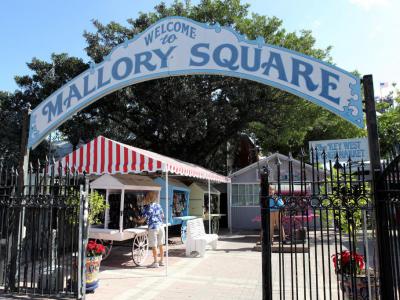
Mallory Square is one of the best-known waterfront spots in Key West, set right along the harbor at the western edge of Old Town. It’s famous for its nightly Sunset Celebration, when locals and visitors gather to watch the sky change color over the water. During the day, the area feels open and relaxed, with views of boats, palm-lined edges, and the gentle movement of the tide. In the evening, it turns lively and social, with music, snacks, and people filling the open space near the seawall.
Start near the waterline and face outward toward the Gulf. Take a slow look across the harbor, where you’ll often see sailboats, tour boats, and cruise ships in the distance. Then turn slightly and watch the crowd as the sun gets lower-street performers set up along the main walkway, and food carts start drawing lines. If you want the best view, come to the square early and choose a spot closer to the water with a clear horizon and away from tall masts or poles that might block the sunset.
For photos, the best moment usually comes just before the sun disappears-keep the camera ready, and look behind you too, because the fading light often makes the buildings and faces glow.
Mallory Square is simple to visit, easy to reach, and hard to forget. Whether you stop by for a quick look during the day or stay for the full sunset routine, it’s one of those Key West places that captures the island’s energy in a single spot.
Start near the waterline and face outward toward the Gulf. Take a slow look across the harbor, where you’ll often see sailboats, tour boats, and cruise ships in the distance. Then turn slightly and watch the crowd as the sun gets lower-street performers set up along the main walkway, and food carts start drawing lines. If you want the best view, come to the square early and choose a spot closer to the water with a clear horizon and away from tall masts or poles that might block the sunset.
For photos, the best moment usually comes just before the sun disappears-keep the camera ready, and look behind you too, because the fading light often makes the buildings and faces glow.
Mallory Square is simple to visit, easy to reach, and hard to forget. Whether you stop by for a quick look during the day or stay for the full sunset routine, it’s one of those Key West places that captures the island’s energy in a single spot.
3) St. Mary Star of the Sea (must see)
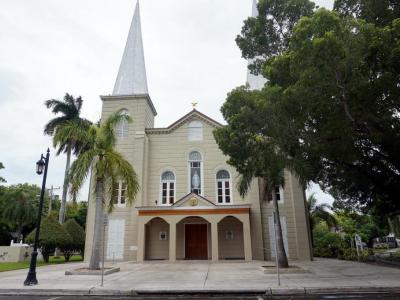
Saint Mary Star of the Sea is a very beautiful Catholic basilica; one of the oldest Catholic parishes in the state of Florida and the oldest parish in the Archdiocese of Miami. With local coral rock used as construction material, the exterior of the church reflects the eclectic period of American Victorian Architecture. It also shows elements of a modified, early Renaissance Revival style. This may be found in the rusticated walls, rounded arches and lunettes that are composed of transitional gothic arches, louvered shutters and colored glass. Many interior elements have both Romanesque and early Renaissance characteristics. Behind the altar is a stained glass window that depicts the church's patroness.
Once you exit the church building, you find yourself on the grounds. A cemetery, grotto, and a marker can be found there. As you walk toward each, you will notice that the stones underneath your feet come together to form the shape of a rosary. This Rosary Path is meant to make you pray the rosary as you walk from stone to stone. You will notice the lovely grotto at the end of the path, which contains statues of Lourdes and Bernadette. It is said that one of the members, named Sister Gabriel, remarked on its dedication day "Key West would never experience the full brunt of a hurricane". And as all residents can attest, there has not been a severe storm on the island since the erection of the Grotto in 1922.
Why You Should Visit:
Lovely, peaceful grounds! The basilica itself is inviting, with a sanctuary containing many Caribbean design features, and has opening doors all along the sides for cool airflow.
Tip:
Be sure to explore the Stations of the Cross garden adjacent to the grotto before heading inside to admire the beauty and tranquility of the basilica. If you go inside, please donate (a complex like this has ongoing needs) or stop by the well-stocked gift shop behind the building.
Once you exit the church building, you find yourself on the grounds. A cemetery, grotto, and a marker can be found there. As you walk toward each, you will notice that the stones underneath your feet come together to form the shape of a rosary. This Rosary Path is meant to make you pray the rosary as you walk from stone to stone. You will notice the lovely grotto at the end of the path, which contains statues of Lourdes and Bernadette. It is said that one of the members, named Sister Gabriel, remarked on its dedication day "Key West would never experience the full brunt of a hurricane". And as all residents can attest, there has not been a severe storm on the island since the erection of the Grotto in 1922.
Why You Should Visit:
Lovely, peaceful grounds! The basilica itself is inviting, with a sanctuary containing many Caribbean design features, and has opening doors all along the sides for cool airflow.
Tip:
Be sure to explore the Stations of the Cross garden adjacent to the grotto before heading inside to admire the beauty and tranquility of the basilica. If you go inside, please donate (a complex like this has ongoing needs) or stop by the well-stocked gift shop behind the building.
4) Duval Street (must see)
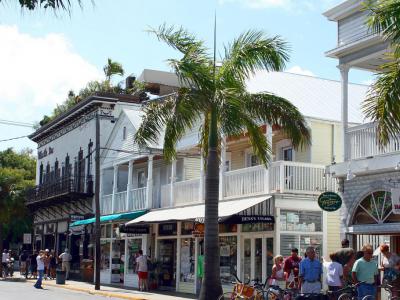
Duval Street is the main street in Key West, stretching across the island and acting as the city’s central strip for food, nightlife, shopping, and people-watching. It’s the place most visitors end up on at some point, because so many bars, restaurants, cafés, galleries, and small local shops are clustered here. The atmosphere is lively and casual, and it shifts depending on the time of day-quieter in the morning, busy by afternoon, and fully active once the evening starts.
As you walk along Duval, take a moment to look up as well as straight ahead. Many of the street’s best details are above eye level: wraparound balconies, old wooden trim, hanging plants, and faded signs that hint at how long some businesses have been around. Pay attention to the architecture too-some buildings look polished and updated, while others still have that weathered character that fits Key West. As you walk, also glance down the side streets, where the noise drops quickly and you can spot shady lanes, smaller historic homes, and tucked-away patios.
In the middle section of Duval Street, it’s worth slowing down and noticing how the blocks change. One area may feel like a restaurant row, while the next is all bars and music. Listen for live performances coming from open doors, watch the mix of locals and visitors, and notice how quickly crowds form around certain corners. If the sidewalks feel crowded, stepping into an open-air courtyard for a minute can make a big difference-many places have garden-style seating hidden behind the street-front entrance. This is also where you’ll see the widest range of “Key West energy,” from laid-back afternoon drinks to busier late-night scenes.
Duval Street isn’t a single attraction so much as a snapshot of the city’s personality. It’s social, loud in places, relaxed in others, and full of small moments that make the walk interesting-street performers, music spilling out, and the constant movement of people. Even without a plan, it’s easy to spend longer here than expected.
As you walk along Duval, take a moment to look up as well as straight ahead. Many of the street’s best details are above eye level: wraparound balconies, old wooden trim, hanging plants, and faded signs that hint at how long some businesses have been around. Pay attention to the architecture too-some buildings look polished and updated, while others still have that weathered character that fits Key West. As you walk, also glance down the side streets, where the noise drops quickly and you can spot shady lanes, smaller historic homes, and tucked-away patios.
In the middle section of Duval Street, it’s worth slowing down and noticing how the blocks change. One area may feel like a restaurant row, while the next is all bars and music. Listen for live performances coming from open doors, watch the mix of locals and visitors, and notice how quickly crowds form around certain corners. If the sidewalks feel crowded, stepping into an open-air courtyard for a minute can make a big difference-many places have garden-style seating hidden behind the street-front entrance. This is also where you’ll see the widest range of “Key West energy,” from laid-back afternoon drinks to busier late-night scenes.
Duval Street isn’t a single attraction so much as a snapshot of the city’s personality. It’s social, loud in places, relaxed in others, and full of small moments that make the walk interesting-street performers, music spilling out, and the constant movement of people. Even without a plan, it’s easy to spend longer here than expected.
5) Key West Butterfly & Nature Conservatory (must see)
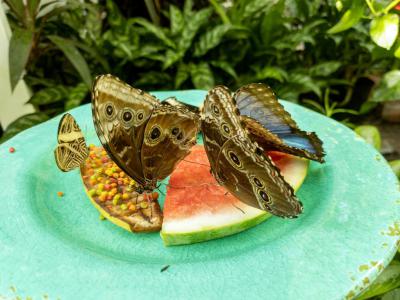
The Key West Butterfly & Nature Conservatory is a small indoor tropical habitat in Old Town where visitors can walk through a climate-controlled space filled with lush plants, waterfalls, and constant movement overhead. Inside, there are 50–60 varieties of butterflies from around the world, along with several species of free-flying, “butterfly-friendly” birds. It’s warm and humid, with simple paths that make it easy to explore at a slow pace.
As you step inside, take a few seconds to get used to the light and the motion around you. Butterflies are everywhere, but they’re easier to spot when you focus on flowering plants, leafy edges, and the brighter spots under the glass ceiling. Look closely at leaves and shaded corners too-some butterflies rest with their wings closed, blending in more than you’d expect. The birds add another layer to the experience, and you may spot American flamingoes, red-factor canaries, zebra finches, cordon-bleu finches, and even tiny “button” (also known as Chinese painted) quail moving through the greenery.
Keep walking slowly and watch where the butterflies gather. They often cluster near bright flowers, shallow water features, or sunny patches where they can warm up. If one lands nearby, staying still for a moment gives you a better chance to notice the patterns and colors up close. For photos, it helps to aim toward lighter backgrounds and keep your hands steady, since the butterflies rarely stay in place for long. Before leaving the main habitat, it’s also worth checking your shoulders and bag-sometimes a butterfly tags along without you noticing.
Outside the main conservatory, there’s usually a small museum-style area that explains butterfly life cycles and highlights different species. It’s a peaceful stop that feels completely different from the busy streets outside, and it’s easy to spend longer than expected just watching everything around you.
As you step inside, take a few seconds to get used to the light and the motion around you. Butterflies are everywhere, but they’re easier to spot when you focus on flowering plants, leafy edges, and the brighter spots under the glass ceiling. Look closely at leaves and shaded corners too-some butterflies rest with their wings closed, blending in more than you’d expect. The birds add another layer to the experience, and you may spot American flamingoes, red-factor canaries, zebra finches, cordon-bleu finches, and even tiny “button” (also known as Chinese painted) quail moving through the greenery.
Keep walking slowly and watch where the butterflies gather. They often cluster near bright flowers, shallow water features, or sunny patches where they can warm up. If one lands nearby, staying still for a moment gives you a better chance to notice the patterns and colors up close. For photos, it helps to aim toward lighter backgrounds and keep your hands steady, since the butterflies rarely stay in place for long. Before leaving the main habitat, it’s also worth checking your shoulders and bag-sometimes a butterfly tags along without you noticing.
Outside the main conservatory, there’s usually a small museum-style area that explains butterfly life cycles and highlights different species. It’s a peaceful stop that feels completely different from the busy streets outside, and it’s easy to spend longer than expected just watching everything around you.
6) The Southernmost Point (must see)
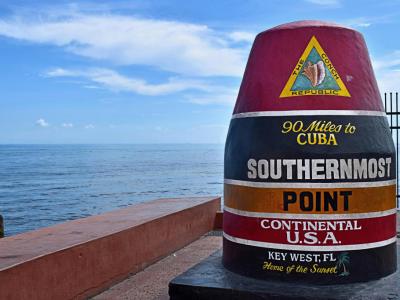
The Southernmost Point is one of the most photographed landmarks in Key West. Marked by a large painted concrete buoy, it’s known for the bold message claiming it as the “Southernmost Point Continental U.S.A.” and for the simple feeling of being at the edge of the island with open ocean nearby. It’s a quick stop, but it’s a classic Key West moment that almost everyone wants to see at least once.
As of September 2025, the original site at the corner of South Street and Whitehead Street is closed due to a major reconstruction project involving the seawall, roadway, and plaza (with completion expected in late 2026). In the meantime, visitors can still get the iconic photo at a full-scale replica buoy installed at Duval Street Pocket Park, 1400 Duval St, which serves as the temporary Southernmost Point photo spot.
Even though it’s called the “southernmost point,” it’s worth knowing that it’s more of a symbolic landmark than a precise geographic measurement, and it’s mainly famous because it’s easy to recognize and fun to visit. Many people also notice how close Cuba is listed on the buoy, which adds to the sense of how far south Key West really is.
Because it’s such a popular photo stop, it helps to expect crowds and a bit of waiting time, even at the temporary location. Early morning tends to be quieter, and later in the day the light can be better for pictures. After the photo, it’s easy to keep walking through the nearby streets, where you’ll find small homes, palm trees, and that relaxed end-of-the-island atmosphere.
As of September 2025, the original site at the corner of South Street and Whitehead Street is closed due to a major reconstruction project involving the seawall, roadway, and plaza (with completion expected in late 2026). In the meantime, visitors can still get the iconic photo at a full-scale replica buoy installed at Duval Street Pocket Park, 1400 Duval St, which serves as the temporary Southernmost Point photo spot.
Even though it’s called the “southernmost point,” it’s worth knowing that it’s more of a symbolic landmark than a precise geographic measurement, and it’s mainly famous because it’s easy to recognize and fun to visit. Many people also notice how close Cuba is listed on the buoy, which adds to the sense of how far south Key West really is.
Because it’s such a popular photo stop, it helps to expect crowds and a bit of waiting time, even at the temporary location. Early morning tends to be quieter, and later in the day the light can be better for pictures. After the photo, it’s easy to keep walking through the nearby streets, where you’ll find small homes, palm trees, and that relaxed end-of-the-island atmosphere.
7) Key West Lighthouse & Museum (must see)
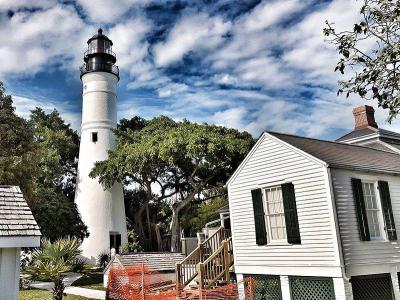
The Key West Lighthouse & Museum is a well-known historic site in Old Town, located just off Duval Street near the Ernest Hemingway Home. Built in 1848, the lighthouse helped guide ships through the reefs and narrow waters around the Florida Keys at a time when Key West was a busy port and maritime traffic was constant. Today, it remains one of the island’s most recognizable landmarks and a place where visitors can get a closer look at how navigation worked before modern systems took over.
The main highlight is the climb to the top of the lighthouse. Visitors walk up 88 steps to reach the upper level, where the view opens across Old Town’s rooftops, palm trees, and porches, with glimpses of water in the distance. The staircase is narrow and steep in places, but the climb is short, and the lookout at the top makes it worth the effort. Many people also enjoy seeing how the structure is built from the inside, since the lighthouse feels very different up close than it does from the street.
Next door, the museum is housed in the former Keeper’s Quarters and focuses on the daily work that kept the light operating year after year. Exhibits include photographs, maps, documents, and objects connected to lighthouse life, along with details about the equipment and routines used by the keepers.
One of the most well-known figures connected to this site is Barbara Mabrity, who continued maintaining the lighthouse in the mid-1800s after her husband, the keeper, died. Her story is often mentioned as an early example of a woman taking on the demanding role of lighthouse keeper.
The main highlight is the climb to the top of the lighthouse. Visitors walk up 88 steps to reach the upper level, where the view opens across Old Town’s rooftops, palm trees, and porches, with glimpses of water in the distance. The staircase is narrow and steep in places, but the climb is short, and the lookout at the top makes it worth the effort. Many people also enjoy seeing how the structure is built from the inside, since the lighthouse feels very different up close than it does from the street.
Next door, the museum is housed in the former Keeper’s Quarters and focuses on the daily work that kept the light operating year after year. Exhibits include photographs, maps, documents, and objects connected to lighthouse life, along with details about the equipment and routines used by the keepers.
One of the most well-known figures connected to this site is Barbara Mabrity, who continued maintaining the lighthouse in the mid-1800s after her husband, the keeper, died. Her story is often mentioned as an early example of a woman taking on the demanding role of lighthouse keeper.
8) Ernest Hemingway Home & Museum (must see)
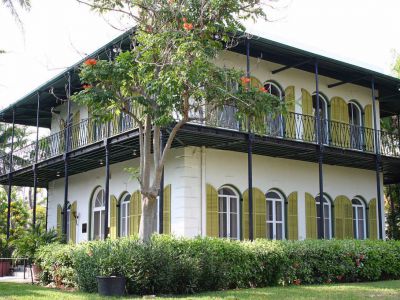
The Ernest Hemingway Home & Museum is one of Key West’s most popular historic attractions, located in Old Town just a short walk from Duval Street. Ernest Hemingway, the American novelist and journalist, lived here in the 1930s, and the house still feels personal and lived-in rather than staged. Visitors come for the literary connection, but the property itself-its rooms, gardens, and famous cats-makes it memorable even for people who haven’t read his books.
As you step inside, look at the layout of the home and the everyday details that have been preserved. Notice the dark wood furniture, the shelves, and the way the rooms open into each other, giving the house a solid, comfortable feel. Pay special attention to Hemingway’s writing studio, which sits slightly apart from the main house-this is where he worked, away from distractions, and it’s one of the places people linger the most.
Outside, take your time in the garden areas, because a lot of the charm is there. Watch for the famous polydactyl (or more specifically six-toed) cats, which are descendants of Hemingway’s original cats-there are nearly 60 of them living on the property. You’ll often spot them resting in shady corners, stretched out on porches, or walking along low walls. Many of the cats are quite sociable, but it’s best to let them come to you first and be patient rather than reaching for them right away. The grounds also include a pool, tropical plants, and paths that make it easy to wander without feeling rushed.
The visit combines literature, local history, and the simple feeling of being in a real Key West home from another era. It’s a place where small details matter, and a short tour can easily turn into a longer one once you start noticing everything around you.
As you step inside, look at the layout of the home and the everyday details that have been preserved. Notice the dark wood furniture, the shelves, and the way the rooms open into each other, giving the house a solid, comfortable feel. Pay special attention to Hemingway’s writing studio, which sits slightly apart from the main house-this is where he worked, away from distractions, and it’s one of the places people linger the most.
Outside, take your time in the garden areas, because a lot of the charm is there. Watch for the famous polydactyl (or more specifically six-toed) cats, which are descendants of Hemingway’s original cats-there are nearly 60 of them living on the property. You’ll often spot them resting in shady corners, stretched out on porches, or walking along low walls. Many of the cats are quite sociable, but it’s best to let them come to you first and be patient rather than reaching for them right away. The grounds also include a pool, tropical plants, and paths that make it easy to wander without feeling rushed.
The visit combines literature, local history, and the simple feeling of being in a real Key West home from another era. It’s a place where small details matter, and a short tour can easily turn into a longer one once you start noticing everything around you.
