Custom Walk in Assisi, Italy by tintinbelmonte_ec263 created on 2025-12-03
Guide Location: Italy » Assisi
Guide Type: Custom Walk
# of Sights: 6
Tour Duration: 3 Hour(s)
Travel Distance: 6.8 Km or 4.2 Miles
Share Key: RRC33
Guide Type: Custom Walk
# of Sights: 6
Tour Duration: 3 Hour(s)
Travel Distance: 6.8 Km or 4.2 Miles
Share Key: RRC33
How It Works
Please retrieve this walk in the GPSmyCity app. Once done, the app will guide you from one tour stop to the next as if you had a personal tour guide. If you created the walk on this website or come to the page via a link, please follow the instructions below to retrieve the walk in the app.
Retrieve This Walk in App
Step 1. Download the app "GPSmyCity: Walks in 1K+ Cities" on Apple App Store or Google Play Store.



Step 2. In the GPSmyCity app, download(or launch) the guide "Assisi Map and Walking Tours".
Step 3. Tap the menu button located at upper right corner of the "Walks" screen and select "Retrieve custom walk". Enter the share key: RRC33
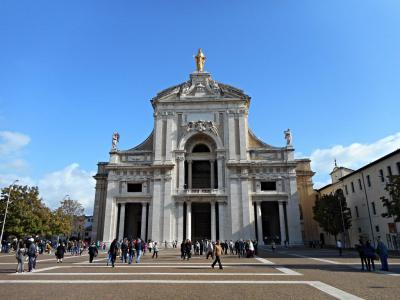
1) Basilica di Santa Maria degli Angeli (Papal Basilica of Saint Mary of the Angels) (must see)
Dominating the skyline of the Valley of Spoleto, the colossal domed basilica near Assisi train station is an imposing sight that can hardly be overlooked. Despite its grandeur, the structure itself lacks aesthetic appeal, having been constructed between 1569 and 1684 and later rebuilt following a devastating earthquake in 1832. Its primary purpose is to enshrine the "Porziuncola" (Little Portion), a humble hut-chapel that served as the focal point of the early Franciscan movement founded by Saint Francis.
Nestled incongruously within the church's austere Baroque interior, the Porziuncola is decorated with somewhat unfortunate 19th-century frescoes on its exterior. However, inside, visitors can view features believed to be remnants of Francis's simple stone dwelling, as well as well-preserved 14th-century frescoes depicting scenes from the saint's life. Beneath the main altar lies the excavated remnants of the old monastery, including the site where Francis breathed his last.
In the basilica's garden, pilgrims can encounter descendants of the rose bushes said to have been involved in a legendary episode from Francis's life. Legend holds that Francis, wrestling with a profound nocturnal temptation, threw himself into these rose bushes, which miraculously shed their thorns upon contact with his saintly flesh. Each May, these bushes bloom thornless, their leaves bearing the stains of the blood shed during that fateful night.
The basilica draws crowds of pilgrims on August 1st and 2nd for the Pardon of Saint Francis, during which visitors receive automatic absolution. This tradition harkens back to a vision experienced by Francis, in which Christ asked him what would best benefit the human soul. Francis replied that forgiveness should be granted to all who entered his chapel. In the 1920s, the influx of pilgrims swelled further following reports of the supposed movement of the 8-meter bronze Madonna on the facade.
Nestled incongruously within the church's austere Baroque interior, the Porziuncola is decorated with somewhat unfortunate 19th-century frescoes on its exterior. However, inside, visitors can view features believed to be remnants of Francis's simple stone dwelling, as well as well-preserved 14th-century frescoes depicting scenes from the saint's life. Beneath the main altar lies the excavated remnants of the old monastery, including the site where Francis breathed his last.
In the basilica's garden, pilgrims can encounter descendants of the rose bushes said to have been involved in a legendary episode from Francis's life. Legend holds that Francis, wrestling with a profound nocturnal temptation, threw himself into these rose bushes, which miraculously shed their thorns upon contact with his saintly flesh. Each May, these bushes bloom thornless, their leaves bearing the stains of the blood shed during that fateful night.
The basilica draws crowds of pilgrims on August 1st and 2nd for the Pardon of Saint Francis, during which visitors receive automatic absolution. This tradition harkens back to a vision experienced by Francis, in which Christ asked him what would best benefit the human soul. Francis replied that forgiveness should be granted to all who entered his chapel. In the 1920s, the influx of pilgrims swelled further following reports of the supposed movement of the 8-meter bronze Madonna on the facade.
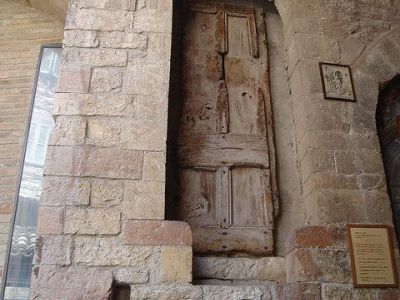
2) Casa natale di San Francesco (Birthplace of St. Francis)
This is believed to be the original site where the future Saint Francis of Assisi was born on July 5, 1182. Legend has it that his birthplace was once a stable, housing oxen and donkeys, where his mother sought refuge to give birth. The inscription above the pointed arch entry attests to this history, with the property being transformed into an oratory and first documented in 1286.
The façade is dominated by a Romanesque arch, with a Gothic entry portal. Stepping inside this place of worship, especially after visiting the larger churches bustling with tourists, one immediately notices the humble, minimalist interior: simple benches along the walls and traces of 13th-14th century frescoes above the raised altar.
Outside, in a charming, intimate square, stands a modern bronze sculpture depicting Francesco's parents: his father, Pietro di Bernardone dei Moriconi, and his French mother, Pica de Bourlemont. Overlooking the square is the imposing 17th-century Chiesa Nuova (New Church) with a grand Renaissance-style façade. This church was erected in 1615 on the presumed site of Saint Francis's paternal home.
Inside the church, near the first pillar on the left, visitors can see the room where Francesco's father, a prosperous silk merchant, allegedly chained his young rebellious son in an attempt to dissuade him from a life of penitence and devotion to the poor, hoping to steer him back to the family trade. Ultimately, Francesco was released by his mother, who understood her son's calling to higher values.
The façade is dominated by a Romanesque arch, with a Gothic entry portal. Stepping inside this place of worship, especially after visiting the larger churches bustling with tourists, one immediately notices the humble, minimalist interior: simple benches along the walls and traces of 13th-14th century frescoes above the raised altar.
Outside, in a charming, intimate square, stands a modern bronze sculpture depicting Francesco's parents: his father, Pietro di Bernardone dei Moriconi, and his French mother, Pica de Bourlemont. Overlooking the square is the imposing 17th-century Chiesa Nuova (New Church) with a grand Renaissance-style façade. This church was erected in 1615 on the presumed site of Saint Francis's paternal home.
Inside the church, near the first pillar on the left, visitors can see the room where Francesco's father, a prosperous silk merchant, allegedly chained his young rebellious son in an attempt to dissuade him from a life of penitence and devotion to the poor, hoping to steer him back to the family trade. Ultimately, Francesco was released by his mother, who understood her son's calling to higher values.
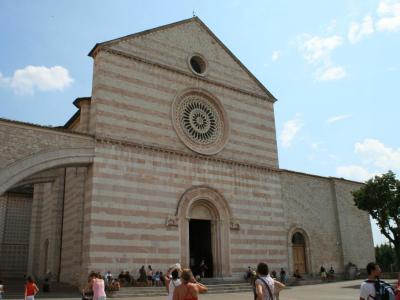
3) Basilica di Santa Chiara (Basilica of St. Clare) (must see)
Consecrated in 1265, this basilica is the final resting place of Saint Clare, Saint Francis's devoted companion and the founder of Franciscan nuns. Born into nobility in 1182, her deeply religious upbringing "backfired", leading her to forsake her family and two marriage proposals at the age of 17 in order to join Francis. In a symbolic gesture, the saint sheared off her blonde locks and replaced her finery with a simple cassock. Though she parted ways with Francis after a year, they remained spiritually connected until his death.
The basilica stands of the site of the former San Giorgio church, where Francis attended school and was later canonized. With a modest facade and a lavish rose window, it mirrors the Upper Church of the Basilica of Saint Francis; however, its engineering fell short, necessitating the addition of peculiar buttresses in 1351 to stave off collapse.
Inside, the atmosphere is dim and austere, a consequence of early censorship efforts. In the 17th century, Bishop Spader of Germany, fearing corruption, ordered the obliteration of its frescoes. Some fragments of earlier Sienese frescoes from the original San Giorgio have survived, mostly in the transepts and above the high altar.
Notable features include scenes from the "Apocalypse" and the "Life of Christ" in the south transept, likely the work of a collaborator of Giotto. Above the high altar, a large 13th-century Crucifix hangs, surrounded by scenes from the "Life of Saint Clare". Meanwhile, the north transept displays episodes from "Genesis".
The Oratorio del Crocifisso chapel houses the Byzantine Crucifix that allegedly spoke to Francis, telling him: "Repair my Church". It also contains relics belonging to Clare and Francis. Clare's body rests in the Baroque crypt hidden down a passageway.
The basilica stands of the site of the former San Giorgio church, where Francis attended school and was later canonized. With a modest facade and a lavish rose window, it mirrors the Upper Church of the Basilica of Saint Francis; however, its engineering fell short, necessitating the addition of peculiar buttresses in 1351 to stave off collapse.
Inside, the atmosphere is dim and austere, a consequence of early censorship efforts. In the 17th century, Bishop Spader of Germany, fearing corruption, ordered the obliteration of its frescoes. Some fragments of earlier Sienese frescoes from the original San Giorgio have survived, mostly in the transepts and above the high altar.
Notable features include scenes from the "Apocalypse" and the "Life of Christ" in the south transept, likely the work of a collaborator of Giotto. Above the high altar, a large 13th-century Crucifix hangs, surrounded by scenes from the "Life of Saint Clare". Meanwhile, the north transept displays episodes from "Genesis".
The Oratorio del Crocifisso chapel houses the Byzantine Crucifix that allegedly spoke to Francis, telling him: "Repair my Church". It also contains relics belonging to Clare and Francis. Clare's body rests in the Baroque crypt hidden down a passageway.
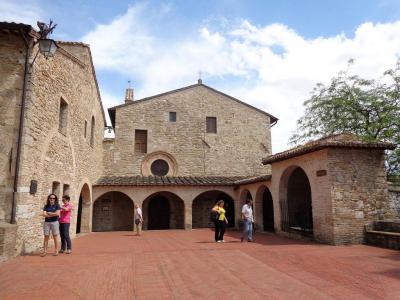
4) Chiesa di San Damiano (Church of St. Damian) (must see)
In 1205, it was in San Damiano that Francis of Assisi received his divine call to undertake repairs, and where he brought Saint Clare and her followers, "pouring the sweetness of Christ into her ears". Clare stayed here until her death, although the nuns departed seven years later. After establishing the Poor Clares, Francis visited San Damiano only once more, towards the end of his life. Suffering from illness and partial blindness, he composed the "Canticle of the Sun" here. His body was also briefly laid here after his death, fulfilling his promise to Clare that she would see him once more. The church was owned by Lord Lothian until 1983, after which it was transferred to the Friars Minor. They have maintained it as it was centuries ago, a stipulation set by Lothian in his bequest.
Uniquely among sites in Assisi with Franciscan ties, San Damiano preserves an ideal that is distinctly Franciscan – serene and rural, nestled among olive groves, cypresses, and wildflowers, overlooking the pastoral Spoleto Valley. A life-sized bronze statue of Saint Francis sits meditating, gazing out over the valley, sublimely absorbed in the divine presence in all things. Visitors are guided around the complex by signs, beginning outside with a fresco of Saint Roch, the saint called upon against infectious diseases, displaying a plague sore. Above the main entrance, a small balcony marks the spot from which Clare, brandishing the Sacrament, repelled a Saracen army threatening Assisi.
Inside, the church's nave, dating back to at least 1030, is simple and smoke-darkened, featuring a decayed wooden choir and lectern. To the right, there's a small window through which the priest of San Damiano threw the money Francis had given him for church repairs. Nearby, a tiny hole marks where Francis hid from his father’s anger for a month. Beyond some stairs leading to a terrace and small garden, there is a vestibule with a woodworm-infested choir and two frescoes, including a delicate "Madonna and Child" by an unidentified artist influenced by Giotto. Upstairs, there is an oratory and a small dormitory with a cross and flowers marking the place where Clare passed away. A door on the right opens to the cloisters, offering a peek at the refectory still furnished with its original table and oak benches.
Uniquely among sites in Assisi with Franciscan ties, San Damiano preserves an ideal that is distinctly Franciscan – serene and rural, nestled among olive groves, cypresses, and wildflowers, overlooking the pastoral Spoleto Valley. A life-sized bronze statue of Saint Francis sits meditating, gazing out over the valley, sublimely absorbed in the divine presence in all things. Visitors are guided around the complex by signs, beginning outside with a fresco of Saint Roch, the saint called upon against infectious diseases, displaying a plague sore. Above the main entrance, a small balcony marks the spot from which Clare, brandishing the Sacrament, repelled a Saracen army threatening Assisi.
Inside, the church's nave, dating back to at least 1030, is simple and smoke-darkened, featuring a decayed wooden choir and lectern. To the right, there's a small window through which the priest of San Damiano threw the money Francis had given him for church repairs. Nearby, a tiny hole marks where Francis hid from his father’s anger for a month. Beyond some stairs leading to a terrace and small garden, there is a vestibule with a woodworm-infested choir and two frescoes, including a delicate "Madonna and Child" by an unidentified artist influenced by Giotto. Upstairs, there is an oratory and a small dormitory with a cross and flowers marking the place where Clare passed away. A door on the right opens to the cloisters, offering a peek at the refectory still furnished with its original table and oak benches.
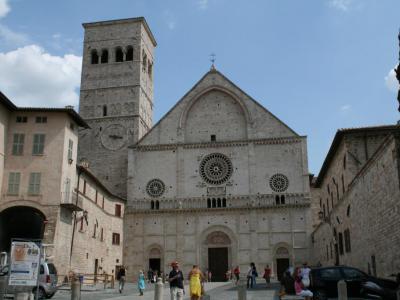
5) Cattedrale di San Rufino di Assisi (Assisi Cathedral) (must see)
As you step out from the narrow streets east of the Town Hall Square, the Cathedral, or "Duomo", presents itself with its characteristic three-tiered Umbrian facade. Tradition has it that the first church on this site was built around 412 to house the remains of Saint Rufinus, Assisi's first ever bishop, martyred about 170 years earlier. Another structure was erected around 1029, with the crypt and current bell tower surviving from that period. Yet another iteration of the church, closest to the present-day one, was consecrated in 1253.
Its Romanesque portal is a masterpiece of carving, flanked by two red marble lions and adorned with lilies, foliage, faces, birds, winged crocodiles, and a pair of griffins. Look closely at the lunette above the door to spot the child being nursed, with its stern-looking parents. Adjacent to the portal stands a massive, sturdy bell tower, somehow harmonizing with the church's overall design.
Inside, the highlight is the baptismal font used for Saint Francis, Saint Clare, and possibly the future Emperor Frederick II. Positioned at the near end of the church on the right, it is surrounded by Romanesque statues of a lion and a winged ox. Across from it, at the beginning of the left aisle, a small door leads to an impressive Roman cistern. Recent research suggests that the cathedral square, rather than Town Hall Square ("Piazza del Comune"), may have been the location of the town's original Roman Forum.
Saint Rufinus's remains still rest in the crypt beneath the altar, which visitors can access along with a small museum.
Its Romanesque portal is a masterpiece of carving, flanked by two red marble lions and adorned with lilies, foliage, faces, birds, winged crocodiles, and a pair of griffins. Look closely at the lunette above the door to spot the child being nursed, with its stern-looking parents. Adjacent to the portal stands a massive, sturdy bell tower, somehow harmonizing with the church's overall design.
Inside, the highlight is the baptismal font used for Saint Francis, Saint Clare, and possibly the future Emperor Frederick II. Positioned at the near end of the church on the right, it is surrounded by Romanesque statues of a lion and a winged ox. Across from it, at the beginning of the left aisle, a small door leads to an impressive Roman cistern. Recent research suggests that the cathedral square, rather than Town Hall Square ("Piazza del Comune"), may have been the location of the town's original Roman Forum.
Saint Rufinus's remains still rest in the crypt beneath the altar, which visitors can access along with a small museum.
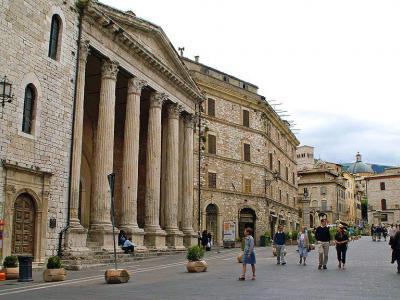
6) Piazza del Comune (Town Hall Square) (must see)
Assisi's beating heart, Piazza del Comune, sits atop what could be the Roman Forum or an ancient sacred site – opinions vary. In any case, it's a striking medieval square, teeming with eateries that might cost you an arm and a leg but offer prime spots for people-watching.
A chunk of the magnificent neo-Gothic former post office, decked out with frescoed walls and stunning vaulted ceilings, now houses the tourist office. Overlooking the square are some significant palaces, such as the 14th-century Palazzo dei Priori, but the star of the show remains the former Temple of Minerva, whose façade has been perfectly preserved.
Back in the day, feudal bigwigs flaunted their residential towers here, eventually making way for the rise of merchant-class buildings. By 1305, the Roman temple found itself flanked by the People's Tower, while the Town Hall held court on the south and western sides.
Tip:
Don't forget to check out the Zubboli bookshop, a local institution since 1870, and Bar Minerva, a favorite haunt for a drink.
A chunk of the magnificent neo-Gothic former post office, decked out with frescoed walls and stunning vaulted ceilings, now houses the tourist office. Overlooking the square are some significant palaces, such as the 14th-century Palazzo dei Priori, but the star of the show remains the former Temple of Minerva, whose façade has been perfectly preserved.
Back in the day, feudal bigwigs flaunted their residential towers here, eventually making way for the rise of merchant-class buildings. By 1305, the Roman temple found itself flanked by the People's Tower, while the Town Hall held court on the south and western sides.
Tip:
Don't forget to check out the Zubboli bookshop, a local institution since 1870, and Bar Minerva, a favorite haunt for a drink.
