Custom Walk in Montpellier, France by gdrmaq_57c4a created on 2025-12-09
Guide Location: France » Montpellier
Guide Type: Custom Walk
# of Sights: 9
Tour Duration: 1 Hour(s)
Travel Distance: 1.9 Km or 1.2 Miles
Share Key: 7NBBD
Guide Type: Custom Walk
# of Sights: 9
Tour Duration: 1 Hour(s)
Travel Distance: 1.9 Km or 1.2 Miles
Share Key: 7NBBD
How It Works
Please retrieve this walk in the GPSmyCity app. Once done, the app will guide you from one tour stop to the next as if you had a personal tour guide. If you created the walk on this website or come to the page via a link, please follow the instructions below to retrieve the walk in the app.
Retrieve This Walk in App
Step 1. Download the app "GPSmyCity: Walks in 1K+ Cities" on Apple App Store or Google Play Store.



Step 2. In the GPSmyCity app, download(or launch) the guide "Montpellier Map and Walking Tours".
Step 3. Tap the menu button located at upper right corner of the "Walks" screen and select "Retrieve custom walk". Enter the share key: 7NBBD

1) AL/MA Gallery
Galerie AL/MA, located in the heart of Montpellier’s historic center, has been a dedicated platform for contemporary art since its establishment in 2002 by a group of friends. Under the direction of Marie-Caroline Allaire-Matte, the gallery has become a vibrant space for showcasing both emerging and established artists, focusing on those with a strong connection to abstract art and its various forms. With a minimalist interior that allows the exhibited works to take center stage, AL/MA is known for its thought-provoking displays and curated events.
The gallery’s commitment to supporting artists extends beyond exhibitions. Marie-Caroline Allaire-Matte frequently engages in external curatorial projects and collaborates with other cultural institutions like MO.CO. and FRAC, making AL/MA a significant player in the local art scene. The gallery’s mezzanine level, home to a curated selection of artists’ books, adds another layer of discovery for visitors.
Whether you are a seasoned art enthusiast or a curious newcomer, a visit to Galerie AL/MA promises not just a visual experience but also an opportunity to engage in insightful discussions with the welcoming gallery owner.
The gallery’s commitment to supporting artists extends beyond exhibitions. Marie-Caroline Allaire-Matte frequently engages in external curatorial projects and collaborates with other cultural institutions like MO.CO. and FRAC, making AL/MA a significant player in the local art scene. The gallery’s mezzanine level, home to a curated selection of artists’ books, adds another layer of discovery for visitors.
Whether you are a seasoned art enthusiast or a curious newcomer, a visit to Galerie AL/MA promises not just a visual experience but also an opportunity to engage in insightful discussions with the welcoming gallery owner.
2) Palace of Justice
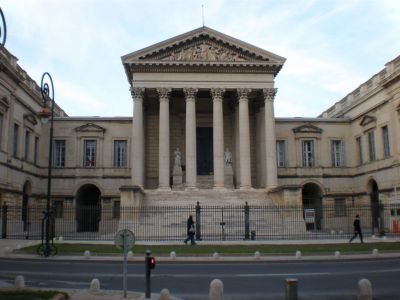
The Palace of Justice in Montpellier is a notable landmark that embodies the city's rich history and architectural heritage. Located on Rue Foch, this grand building was completed in 1853, but its origins trace back to the 12th century when Guilhem VI constructed his palace on this site. Over the centuries, the site evolved, housing various judicial institutions that reflected the changing governance and history of Montpellier.
The current Palace of Justice, designed in a Neo-classical style, showcases a prominent facade adorned with perfectly aligned Corinthian columns. The design was conceived by architect Charles Abric and construction took place between 1846 and 1853, replacing a deteriorating structure that once served as the Royal Court and Revolutionary Tribunal.
The Palace has been classified as a Historical Monument since 1994 and is known for its imposing presence. It currently serves as the seat of the Court of Assizes and the Court of Appeal, while other judicial functions have been relocated to the New Courthouse (Cité Judiciaire Méditerranée) since 1996.
In the Middle Ages, this site was home to the Guilhem family fortress, where civil and criminal cases were overseen by a bailiff. The fortress remained a central judicial location until it was demolished in 1577 during the Wars of Religion. The current building’s Neoclassical design symbolizes the judicial and administrative transformations of Montpellier, making it a key reference point in the city’s architectural landscape.
The current Palace of Justice, designed in a Neo-classical style, showcases a prominent facade adorned with perfectly aligned Corinthian columns. The design was conceived by architect Charles Abric and construction took place between 1846 and 1853, replacing a deteriorating structure that once served as the Royal Court and Revolutionary Tribunal.
The Palace has been classified as a Historical Monument since 1994 and is known for its imposing presence. It currently serves as the seat of the Court of Assizes and the Court of Appeal, while other judicial functions have been relocated to the New Courthouse (Cité Judiciaire Méditerranée) since 1996.
In the Middle Ages, this site was home to the Guilhem family fortress, where civil and criminal cases were overseen by a bailiff. The fortress remained a central judicial location until it was demolished in 1577 during the Wars of Religion. The current building’s Neoclassical design symbolizes the judicial and administrative transformations of Montpellier, making it a key reference point in the city’s architectural landscape.
3) Porte du Peyrou (Gate of Peyrou)
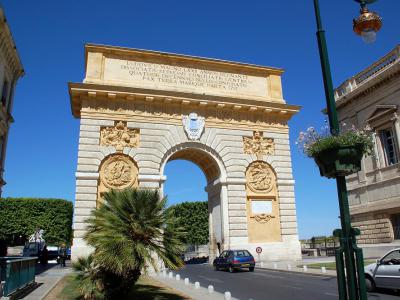
The Gate of Peyrou, also called Triumphal Arch, can be found at the east end of the Peyou Park gardens in the center of Montpellier. It is almost fifty feet high and 59 feet wide. It was built in 1693 and designed by Francois Dorbay. Dorbay was perhaps inspired by the Parisian arch, the Gate of Dionysius, or even the Gate of Saint-Martin.
The Gate of Peyrou was dedicated to King Louis XIV, the "Sun King" of France. The Gate marks the entrance to the Royal Palace of Peyrou. It is within walking distance of the Saint-Clement Aqueduct offering a great view of the eastern part of the city.
The different stations of progress in King Louis XIV's reign are set into the facade of the arch. The shield and badge of the city of Montpellier are fixed at the top of the arch. There is a climb of 88 steps to the top of the Triumphal Arch. Every Sunday there is a flea market in the nearby Peyrou Square. One can shop here and think of the King.
The Gate of Peyrou was dedicated to King Louis XIV, the "Sun King" of France. The Gate marks the entrance to the Royal Palace of Peyrou. It is within walking distance of the Saint-Clement Aqueduct offering a great view of the eastern part of the city.
The different stations of progress in King Louis XIV's reign are set into the facade of the arch. The shield and badge of the city of Montpellier are fixed at the top of the arch. There is a climb of 88 steps to the top of the Triumphal Arch. Every Sunday there is a flea market in the nearby Peyrou Square. One can shop here and think of the King.
4) Promenade du Peyrou (Peyrou Promenade) (must see)
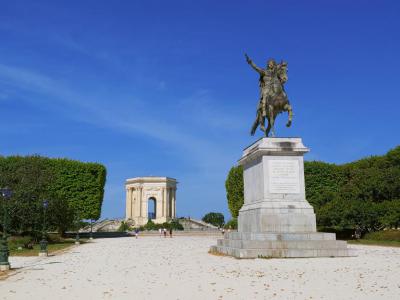
At the edge of the old town the city, is the Peyrou Promenade. The Triumph Arch honoring Louis XIV is here. There is also a statue of Louis on horseback erected in 1718. And close by is the neoclassical water tower and the 18th century aqueduct, reaching 14 kilometers to the Saint Clement spring.
The park dates from 1774, when Louis ascended the throne of France. It was designed and laid out by architect Jean Giral. Visitors to the park are rewarded with a panoramic view of the city and its surroundings. The Aqueduct of Saint Clement and its reservoir date from 1753. The cistern, called the Water Castle, was added in 1766.
There are the statues of children and a Lion by sculptor Injalbert of 1883. In 1927 a walk-in annualized sun dial was installed by Pierre Humbert. The promenade is 953 feet long and 529 feet in width. It has four entrances, three on the east side and one above the stairs on the west side. The main entrance is on the Francois Frank Street.
The park dates from 1774, when Louis ascended the throne of France. It was designed and laid out by architect Jean Giral. Visitors to the park are rewarded with a panoramic view of the city and its surroundings. The Aqueduct of Saint Clement and its reservoir date from 1753. The cistern, called the Water Castle, was added in 1766.
There are the statues of children and a Lion by sculptor Injalbert of 1883. In 1927 a walk-in annualized sun dial was installed by Pierre Humbert. The promenade is 953 feet long and 529 feet in width. It has four entrances, three on the east side and one above the stairs on the west side. The main entrance is on the Francois Frank Street.
5) Statue of Louis XIV
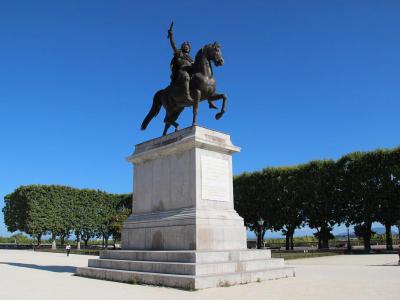
The equestrian statue of Louis XIV in Montpellier is a prominent monument in the heart of the Promenade du Peyrou. Erected in 1828, this bronze statue is a tribute to King Louis XIV, replacing an earlier version destroyed during the French Revolution. Sculpted by Jean Baptiste Joseph De Bay and cast by Auguste-Jean-Marie Carbonneaux, it was designed based on the vision of Jules Hardouin-Mansart. The statue is positioned on a marble pedestal, marking the highest point in Montpellier, and carries a Latin inscription that reads: “The States of Languedoc dedicated this monument to Louis the Great in his lifetime and have erected it after he died in 1718.”
Louis XIV, also known as the Sun King, ruled France from 1643 until he died in 1715, making his reign one of the longest in European history. The original statue, crafted by Pierre Mazeline de Rouen and Simon Hurtrelle de Béthune in 1692, was transported from Paris and unveiled in 1718. However, it was dismantled during the Revolution in 1792 and replaced by the guillotine. The current statue, half the size of the original, was transported from Paris to Montpellier in just 25 days and was unveiled in 1838.
Classified as a historical monument in 1954, this statue, alongside the site itself (classified in 1943), is one of the earliest representations of Louis XIV, following those on Victory Square (Place des Victoires) in Paris and Parade Ground (Place d'Armes) in Versailles. The statue’s positioning and design echo classical themes, with Louis XIV depicted in a style reminiscent of Marcus Aurelius, exuding regal authority and grandeur.
Louis XIV, also known as the Sun King, ruled France from 1643 until he died in 1715, making his reign one of the longest in European history. The original statue, crafted by Pierre Mazeline de Rouen and Simon Hurtrelle de Béthune in 1692, was transported from Paris and unveiled in 1718. However, it was dismantled during the Revolution in 1792 and replaced by the guillotine. The current statue, half the size of the original, was transported from Paris to Montpellier in just 25 days and was unveiled in 1838.
Classified as a historical monument in 1954, this statue, alongside the site itself (classified in 1943), is one of the earliest representations of Louis XIV, following those on Victory Square (Place des Victoires) in Paris and Parade Ground (Place d'Armes) in Versailles. The statue’s positioning and design echo classical themes, with Louis XIV depicted in a style reminiscent of Marcus Aurelius, exuding regal authority and grandeur.
6) Water Tower
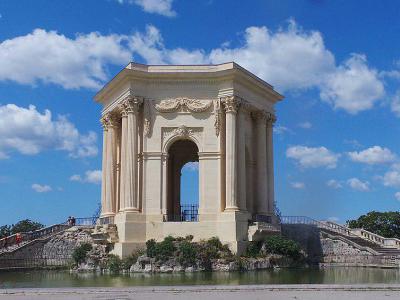
The Water Tower in Peyrou Park, Montpellier, stands as a striking example of neo-Classical architecture. Located at the terminus of the Montpellier Aqueduct, this hexagonal tower served as a reservoir for the freshwater transported from the Lez spring, carried by the 14-kilometer-long Saint-Clément aqueduct designed by Henri Pitot. The water tower, completed in 1774 by architect Jean Giral, is adorned with Corinthian columns and arches, adding a touch of grandeur to its functional purpose.
Rising to a height of approximately 50 feet, the pale ochre structure is flanked by ornate stone staircases, accentuating its elegance. At night, the tower illuminates beautifully, creating a mesmerizing focal point for the Peyrou promenade. Originally constructed in 1766 to support a pre-existing reservoir built in 1753, the Water Tower has since become an iconic feature of the park, along with the triumphal arch, the statue of Louis XIV, and the ancient arches of the Roman aqueduct, Les Arceaux.
Beyond its architectural significance, the Water Tower is linked to a historical anecdote: a rare portrait of Jean Moulin, a key figure in the French Resistance during World War II, was taken at the foot of the aqueduct in 1939. Captured by his childhood friend Marcel Bernard, the photograph shows Moulin during his time as prefect of Eure-et-Loir.
Today, the Water Tower and its surrounding ensemble are recognized as Historic Monuments, offering visitors panoramic views of Montpellier’s historic center, known as the Ecusson, and the surrounding landscapes. The tower stands as a testament to Montpellier’s rich heritage and classical beauty.
Rising to a height of approximately 50 feet, the pale ochre structure is flanked by ornate stone staircases, accentuating its elegance. At night, the tower illuminates beautifully, creating a mesmerizing focal point for the Peyrou promenade. Originally constructed in 1766 to support a pre-existing reservoir built in 1753, the Water Tower has since become an iconic feature of the park, along with the triumphal arch, the statue of Louis XIV, and the ancient arches of the Roman aqueduct, Les Arceaux.
Beyond its architectural significance, the Water Tower is linked to a historical anecdote: a rare portrait of Jean Moulin, a key figure in the French Resistance during World War II, was taken at the foot of the aqueduct in 1939. Captured by his childhood friend Marcel Bernard, the photograph shows Moulin during his time as prefect of Eure-et-Loir.
Today, the Water Tower and its surrounding ensemble are recognized as Historic Monuments, offering visitors panoramic views of Montpellier’s historic center, known as the Ecusson, and the surrounding landscapes. The tower stands as a testament to Montpellier’s rich heritage and classical beauty.
7) Montpellier Aqueduct
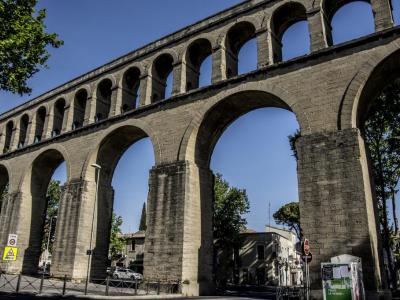
The Montpellier Aqueduct, also known as the Saint-Clément or Arceaux Aqueduct, is a monumental structure that stands as a testament to 18th-century engineering ingenuity. Constructed between 1753 and 1765, the aqueduct was designed to transport water from the Saint-Clément spring, located 14 kilometers (8.7 miles) away, to the water tower in Peyrou Park, a key landmark at the western end of Montpellier’s city center.
The aqueduct’s most striking feature is its double layer of arches in the middle section, inspired by traditional Roman aqueducts. With 53 arches stretching over 800 meters (2,600 feet), the structure showcases a harmonious blend of practicality and aesthetics, making it an iconic piece of Montpellier’s urban landscape.
Built using local Castries stone, the aqueduct’s channels were lined with lead to prevent freezing during winter months, ensuring a consistent water supply year-round. The completion of this ambitious project silenced skeptics who had doubted its feasibility, and it became one of the largest private hydraulic projects ever undertaken in France.
Today, visitors can walk beneath the arches and marvel at the aqueduct’s intricate design. A popular time to visit is on Sundays, when the area around the Les Arceaux tram stop transforms into a bustling flea market, providing a lively backdrop to the historic structure. Nearby attractions such as the Montpellier Plant Garden, the Atger Museum, and the Fabre Museum make this part of the city a vibrant hub for history and culture enthusiasts.
The Montpellier Aqueduct not only served a crucial role in providing water to the city but also stands as a symbol of the vision and perseverance of the people who built it, bringing a piece of history into the heart of modern-day Montpellier.
The aqueduct’s most striking feature is its double layer of arches in the middle section, inspired by traditional Roman aqueducts. With 53 arches stretching over 800 meters (2,600 feet), the structure showcases a harmonious blend of practicality and aesthetics, making it an iconic piece of Montpellier’s urban landscape.
Built using local Castries stone, the aqueduct’s channels were lined with lead to prevent freezing during winter months, ensuring a consistent water supply year-round. The completion of this ambitious project silenced skeptics who had doubted its feasibility, and it became one of the largest private hydraulic projects ever undertaken in France.
Today, visitors can walk beneath the arches and marvel at the aqueduct’s intricate design. A popular time to visit is on Sundays, when the area around the Les Arceaux tram stop transforms into a bustling flea market, providing a lively backdrop to the historic structure. Nearby attractions such as the Montpellier Plant Garden, the Atger Museum, and the Fabre Museum make this part of the city a vibrant hub for history and culture enthusiasts.
The Montpellier Aqueduct not only served a crucial role in providing water to the city but also stands as a symbol of the vision and perseverance of the people who built it, bringing a piece of history into the heart of modern-day Montpellier.
8) Théâtre de la Plume (Feather Theater)
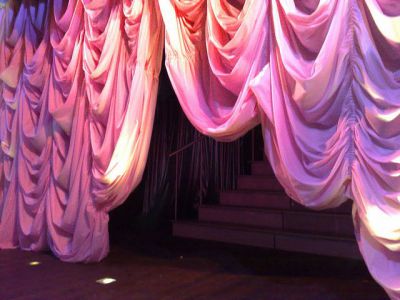
Nestled in the vibrant city of Montpellier, the Théâtre de la Plume (Feather Theater) is a beloved venue known for its unique focus on children’s entertainment. This local favorite is more than just a theater-it’s a dynamic cultural space that offers a delightful introduction to the world of performing arts for audiences of all ages.
The Théâtre de la Plume’s varied programming includes national and international fairy tales brought to life by talented and professional actors, puppetry, and even musical storytelling. These engaging performances are not only entertaining but also serve as an excellent opportunity for foreign children to immerse themselves in the French language and culture. Beyond theater, the venue regularly hosts parties, festivals, and themed events, making it a lively destination for families throughout the year.
While the theater’s primary focus is on young audiences, it also transforms into a versatile cultural hub during the weekends, offering café-theater evenings, music performances, and a rich variety of shows catering to a broader audience. The venue’s creativity and inventiveness shine through, especially as it operates with limited resources, relying on local talent to present original productions, clown shows, and much more.
For over 20 years, the theater has welcomed local companies to showcase their work, creating a platform for the community to enjoy quality entertainment during school holidays, Wednesdays, and weekends. The venue’s commitment to accessibility and excellence extends to its acclaimed ballet production company, which brings classical and contemporary dance performances to the stage.
The Théâtre de la Plume’s varied programming includes national and international fairy tales brought to life by talented and professional actors, puppetry, and even musical storytelling. These engaging performances are not only entertaining but also serve as an excellent opportunity for foreign children to immerse themselves in the French language and culture. Beyond theater, the venue regularly hosts parties, festivals, and themed events, making it a lively destination for families throughout the year.
While the theater’s primary focus is on young audiences, it also transforms into a versatile cultural hub during the weekends, offering café-theater evenings, music performances, and a rich variety of shows catering to a broader audience. The venue’s creativity and inventiveness shine through, especially as it operates with limited resources, relying on local talent to present original productions, clown shows, and much more.
For over 20 years, the theater has welcomed local companies to showcase their work, creating a platform for the community to enjoy quality entertainment during school holidays, Wednesdays, and weekends. The venue’s commitment to accessibility and excellence extends to its acclaimed ballet production company, which brings classical and contemporary dance performances to the stage.

9) Park of the Guirlande
The Park of the Guirlande, located in the Figuerolles district of Montpellier, is a serene public space with a storied past. Initially a private garden established in the 18th century, the park was acquired by the city in 1978 to provide a peaceful retreat for residents and visitors alike. Spanning roughly one hectare, it features a harmonious blend of English and French garden styles, making it an ideal escape from the urban hustle.
The park's tranquil atmosphere is complemented by a unique collection of attractions, including a shell-encrusted water fountain, a pond adorned with rocks and shellfish, and several charming sculptures. Shaded paths, lined with majestic chestnut, linden, and mulberry trees, lead visitors to picturesque spots perfect for relaxation or reading. A sophisticated playground area provides entertainment for children, while adults can unwind on one of the many benches scattered throughout the park.
One of the park’s distinctive features is its historical architecture. Canon Giraud, who oversaw the park’s redesign in the 18th century, possibly collaborated with the renowned architect Jean-Antoine Giral. The garden's layout follows a classic pattern with intersecting axes and French-style flowerbeds, creating a visual experience reminiscent of traditional formal gardens. The park’s artistic significance and beautifully preserved landscape have earned it a place on the Inventory of Picturesque Sites of the Hérault region.
Today, the Park of the Guirlande remains a cherished local gem, offering a perfect environment for a quiet stroll or family outing amidst Montpellier’s rich botanical and cultural heritage.
The park's tranquil atmosphere is complemented by a unique collection of attractions, including a shell-encrusted water fountain, a pond adorned with rocks and shellfish, and several charming sculptures. Shaded paths, lined with majestic chestnut, linden, and mulberry trees, lead visitors to picturesque spots perfect for relaxation or reading. A sophisticated playground area provides entertainment for children, while adults can unwind on one of the many benches scattered throughout the park.
One of the park’s distinctive features is its historical architecture. Canon Giraud, who oversaw the park’s redesign in the 18th century, possibly collaborated with the renowned architect Jean-Antoine Giral. The garden's layout follows a classic pattern with intersecting axes and French-style flowerbeds, creating a visual experience reminiscent of traditional formal gardens. The park’s artistic significance and beautifully preserved landscape have earned it a place on the Inventory of Picturesque Sites of the Hérault region.
Today, the Park of the Guirlande remains a cherished local gem, offering a perfect environment for a quiet stroll or family outing amidst Montpellier’s rich botanical and cultural heritage.
