Custom Walk in Livorno, Italy by gafairlie_6d9675 created on 2026-01-01
Guide Location: Italy » Livorno
Guide Type: Custom Walk
# of Sights: 7
Tour Duration: 3 Hour(s)
Travel Distance: 7.4 Km or 4.6 Miles
Share Key: V75QX
Guide Type: Custom Walk
# of Sights: 7
Tour Duration: 3 Hour(s)
Travel Distance: 7.4 Km or 4.6 Miles
Share Key: V75QX
How It Works
Please retrieve this walk in the GPSmyCity app. Once done, the app will guide you from one tour stop to the next as if you had a personal tour guide. If you created the walk on this website or come to the page via a link, please follow the instructions below to retrieve the walk in the app.
Retrieve This Walk in App
Step 1. Download the app "GPSmyCity: Walks in 1K+ Cities" on Apple App Store or Google Play Store.



Step 2. In the GPSmyCity app, download(or launch) the guide "Livorno Map and Walking Tours".
Step 3. Tap the menu button located at upper right corner of the "Walks" screen and select "Retrieve custom walk". Enter the share key: V75QX
1) Fortezza Vecchia (Old Fort) (must see)
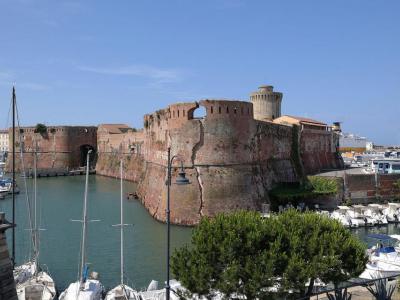
The Old Fort stands at the entrance to Livorno’s harbor and represents the city’s earliest phase as a strategic port. Long before Livorno was conceived as a planned Medici city, this site already controlled access to the coast and shipping routes. Over several centuries, it evolved from a medieval stronghold into a Renaissance fortress.
The fortress assumed its present form beginning in 1519, when a new defensive complex was commissioned by Cardinal Giulio de’ Medici, the future Pope Clement VII, and designed by Antonio da Sangallo the Elder, one of the leading military architects of the Renaissance. Completed in 1534, the fort integrated earlier structures into a modern artillery-resistant design. Its layout is defined by three major bastions, Ampolletta on the landward side, Canaviglia facing the port, and Capitana to the northeast.
Beneath this Medici construction lie much older elements. The oldest surviving part in the Old Fort is the Keep of Countess Matilda, which is also the oldest surviving structure in Livorno. The keep is traditionally linked to Matilda of Canossa and dated to the early 11th century. In 1377, the Republic of Pisa incorporated the tower into a larger fortress known as the Quadrature of the Pisans, establishing the site’s long-standing defensive role. Within the Medici fortress stands the Church of Saint Francis of Assisi, built in 1530, where in 1606 the ceremony officially proclaiming Livorno a city took place.
The fortress assumed its present form beginning in 1519, when a new defensive complex was commissioned by Cardinal Giulio de’ Medici, the future Pope Clement VII, and designed by Antonio da Sangallo the Elder, one of the leading military architects of the Renaissance. Completed in 1534, the fort integrated earlier structures into a modern artillery-resistant design. Its layout is defined by three major bastions, Ampolletta on the landward side, Canaviglia facing the port, and Capitana to the northeast.
Beneath this Medici construction lie much older elements. The oldest surviving part in the Old Fort is the Keep of Countess Matilda, which is also the oldest surviving structure in Livorno. The keep is traditionally linked to Matilda of Canossa and dated to the early 11th century. In 1377, the Republic of Pisa incorporated the tower into a larger fortress known as the Quadrature of the Pisans, establishing the site’s long-standing defensive role. Within the Medici fortress stands the Church of Saint Francis of Assisi, built in 1530, where in 1606 the ceremony officially proclaiming Livorno a city took place.
2) Duomo di Livorno (Livorno Cathedral)
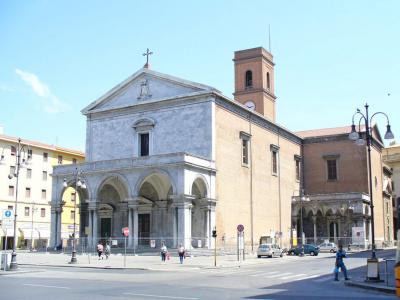
The Livorno Cathedral, officially dedicated to Saint Francis of Assisi, reflects the city’s status as a planned Medici foundation. Construction began in 1594 and was completed in the early 17th century, forming part of a broader effort to provide the new port city with a religious and civic center suited to its growing importance.
The cathedral was designed in a restrained late-Renaissance style, traditionally attributed to architects working within the Medici circle, including Alessandro Pieroni. Its original design favored balance and clarity over ornament, with a broad facade, measured proportions, and a spacious interior intended to accommodate large congregations. This sobriety echoed Livorno’s practical character and distinguished the cathedral from the more ornate churches of inland Tuscany.
The cathedral was largely rebuilt in the 1950s. As a result, much of what visitors see today reflects postwar reconstruction rather than the original interior. The rebuilt church preserves the historical basilica layout, with a wide central nave flanked by side chapels and a clear axial progression toward the high altar. The interior is notably bright and uncluttered.
Within this reconstructed space, artworks salvaged from the original building or reintroduced after the war provide points of historical continuity. These include altarpieces, devotional paintings, and liturgical furnishings that recall the cathedral’s earlier phases.
The cathedral was designed in a restrained late-Renaissance style, traditionally attributed to architects working within the Medici circle, including Alessandro Pieroni. Its original design favored balance and clarity over ornament, with a broad facade, measured proportions, and a spacious interior intended to accommodate large congregations. This sobriety echoed Livorno’s practical character and distinguished the cathedral from the more ornate churches of inland Tuscany.
The cathedral was largely rebuilt in the 1950s. As a result, much of what visitors see today reflects postwar reconstruction rather than the original interior. The rebuilt church preserves the historical basilica layout, with a wide central nave flanked by side chapels and a clear axial progression toward the high altar. The interior is notably bright and uncluttered.
Within this reconstructed space, artworks salvaged from the original building or reintroduced after the war provide points of historical continuity. These include altarpieces, devotional paintings, and liturgical furnishings that recall the cathedral’s earlier phases.
3) Fortezza Nuova (New Fort) (must see)
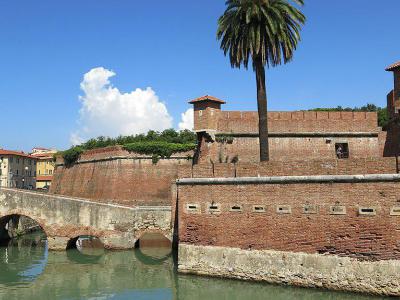
The New Fort was built in the late 16th century, shortly after the Old Fort, forming part of an ambitious Medici strategy to secure Livorno’s harbor and control access to the port. Unlike medieval fortresses that evolved gradually, the New Fort was conceived as a modern military structure, shaped by Renaissance engineering and a clear vision of Livorno’s future as a major Mediterranean port.
The fort’s design is closely linked to Bernardo Buontalenti, a Florentine polymath. In 1576, Buontalenti proposed the "Buontalenti Pentagon", a comprehensive defensive system enclosing the settlement. The New Fort itself was built on a canal-surrounded island within this defensive network, and even today the structure appears almost like a fortress rising directly out of the water. As Livorno expanded, parts of the fortifications were modified to allow the growth of commercial districts.
For centuries, the New Fort remained an active military installation and later served additional roles, including use as a prison. Heavily damaged during the Second World War, it was restored by 1972 and reimagined for civilian use. Today, the New Fort functions as a public park and cultural venue. Inside the walls, visitors can walk across grassy lawns and along gently rising ramparts, where the fort’s angular bastions and thick masonry remain clearly visible. Traces of embrasures, walls, and defensive geometry survive throughout the site, while the broad interior space is now used for quiet walks, informal gatherings, and occasional cultural events.
The fort’s design is closely linked to Bernardo Buontalenti, a Florentine polymath. In 1576, Buontalenti proposed the "Buontalenti Pentagon", a comprehensive defensive system enclosing the settlement. The New Fort itself was built on a canal-surrounded island within this defensive network, and even today the structure appears almost like a fortress rising directly out of the water. As Livorno expanded, parts of the fortifications were modified to allow the growth of commercial districts.
For centuries, the New Fort remained an active military installation and later served additional roles, including use as a prison. Heavily damaged during the Second World War, it was restored by 1972 and reimagined for civilian use. Today, the New Fort functions as a public park and cultural venue. Inside the walls, visitors can walk across grassy lawns and along gently rising ramparts, where the fort’s angular bastions and thick masonry remain clearly visible. Traces of embrasures, walls, and defensive geometry survive throughout the site, while the broad interior space is now used for quiet walks, informal gatherings, and occasional cultural events.
4) Cisternoni of Livorno
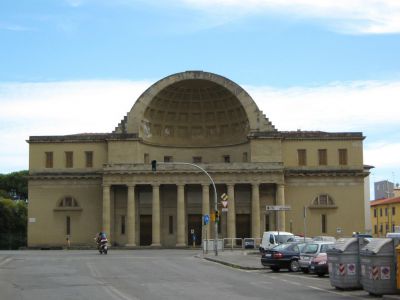
The Cisternoni of Livorno, particularly the Cisternone, stands as a testament to 19th-century Neoclassical architecture and advanced engineering. Designed by Pasquale Poccianti, construction of the Cisternone began in 1829 as part of the Acquedotto Leopoldino, intended to store and distribute water from the Colognole hills to Livorno. Its impressive semicircular dome, coffered ceilings, and solid colonnade make it a striking feature along the avenue leading from the Livorno train station to Republic Square (Piazza della Repubblica).
Poccianti, inspired by his correspondence with Giovanni Antonio Antolini, adapted his initial façade design into the grand structure we see today, featuring a large, shell-like dome resting on a portico. Completed in 1842, the Cisternone was operational as a water reservoir until the early 1900s, capable of holding up to 11,000 cubic meters of water. Its interior is marked by Tuscan-style pilasters supporting vaulted ceilings, and its original water filtration system, though replaced by chlorine treatment, exemplified the reservoir's functional prowess.
While the Cisternone served Livorno for decades, its aesthetic value also places it among the major Neoclassical works in Italy. Today, the building serves cultural purposes, hosting events and housing a theater, demonstrating its lasting impact on the city both architecturally and historically.
Poccianti, inspired by his correspondence with Giovanni Antonio Antolini, adapted his initial façade design into the grand structure we see today, featuring a large, shell-like dome resting on a portico. Completed in 1842, the Cisternone was operational as a water reservoir until the early 1900s, capable of holding up to 11,000 cubic meters of water. Its interior is marked by Tuscan-style pilasters supporting vaulted ceilings, and its original water filtration system, though replaced by chlorine treatment, exemplified the reservoir's functional prowess.
While the Cisternone served Livorno for decades, its aesthetic value also places it among the major Neoclassical works in Italy. Today, the building serves cultural purposes, hosting events and housing a theater, demonstrating its lasting impact on the city both architecturally and historically.
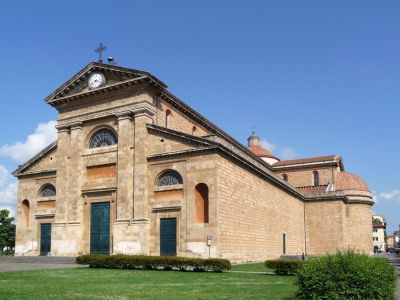
5) Chiesa di Santa Maria del Soccorso (Church of Santa Maria del Soccorso)
The Church of Santa Maria del Soccorso, located on Victory Square (Piazza della Vittoria), is Livorno's largest church. Its imposing façade is aligned with Magenta Street (Via Magenta), creating a striking urban axis. Before entering the church, visitors are greeted by the War Memorial, built between 1922 and 1924, depicting a solemn oath and a statue of Victory.
The church was conceived after a devastating cholera outbreak in 1835, with citizens raising funds to build a votive church to seek the Madonna's protection. Construction began in 1836, based on a design by Gaetano Gherardi, and the church was consecrated in 1856. Despite the grand vision, a planned bell tower and adjacent college were never completed, and the surrounding space became a vast park instead.
Santa Maria del Soccorso's Latin cross plan measures an impressive 90 meters in length and up to 60 meters in width at the transept. Its façade features three large doors, semicircular windows, and a pediment with a clock taken from Livorno's Cathedral in 1882. The church's interior is characterized by three naves separated by minimalist pillars, creating a more rigid neoclassical feel compared to Renaissance inspirations like Brunelleschi’s Santo Spirito in Florence.
The church survived World War II largely intact and briefly served as the center of religious celebrations for the Diocese of Livorno. Its artistic highlights include paintings by notable Livornese artists such as Enrico Pollastrini and Ferdinando Folchi. Additionally, two sculptures by Paolo Emilio Demi from the destroyed Armenian Church of San Gregorio have been housed here since the 1950s.
This grand temple remains a testament to Livorno’s resilience and artistic heritage, serving as a centerpiece of religious and cultural life in the city.
The church was conceived after a devastating cholera outbreak in 1835, with citizens raising funds to build a votive church to seek the Madonna's protection. Construction began in 1836, based on a design by Gaetano Gherardi, and the church was consecrated in 1856. Despite the grand vision, a planned bell tower and adjacent college were never completed, and the surrounding space became a vast park instead.
Santa Maria del Soccorso's Latin cross plan measures an impressive 90 meters in length and up to 60 meters in width at the transept. Its façade features three large doors, semicircular windows, and a pediment with a clock taken from Livorno's Cathedral in 1882. The church's interior is characterized by three naves separated by minimalist pillars, creating a more rigid neoclassical feel compared to Renaissance inspirations like Brunelleschi’s Santo Spirito in Florence.
The church survived World War II largely intact and briefly served as the center of religious celebrations for the Diocese of Livorno. Its artistic highlights include paintings by notable Livornese artists such as Enrico Pollastrini and Ferdinando Folchi. Additionally, two sculptures by Paolo Emilio Demi from the destroyed Armenian Church of San Gregorio have been housed here since the 1950s.
This grand temple remains a testament to Livorno’s resilience and artistic heritage, serving as a centerpiece of religious and cultural life in the city.
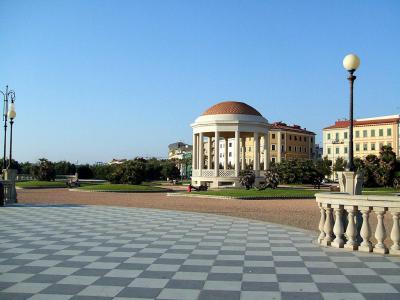
6) Terrazza Mascagni (Mascagni Terrace) (must see)
Terrazza Mascagni, known in English as Mascagni Terrace, is a piazza that overlooks the Ligurian Sea. The breathtaking square has a stunning black-and-white checkered floor that provides ample room for walking along the arm of the Mediterranean. There are a total of 34,000 tiles over 8,700 square meters (just over two acres).
The area was turned into a square in 1925 using a design by engineer Enrico Salvais. It was named afer composer Pietro Mascagni. Prior to this, Mascagni Terrace was the location for the Cavalleggeri Fort.
There are many notable spots within Mascagni Terrace. One of the most historically significant is the gazebo located in the southernmost portion of the square. The original gazebo was built by Ghino Venturi in the 1930s. It was destroyed during World War II but painstakingly rebuilt to look exactly like it did when it was new.
The Mascagni Terrace is home to the Livorno Aquarium, which allows patrons to learn more about the sea life of the Mediterranean. A swimming pool in the square is open to the public. It has a large slide with a stunning view of the sea.
Those wanting to take a break from sightseeing can rest on a sun bed. Each sun bed is equipped with a foldable umbrella to offer either sun or shade. There are several restaurants in and near the square and a large number of tables that are ideal for a quick bite while enjoying the atmosphere.
Other amenities at the Mascagni Terrace include walking paths, public restrooms and a playground for young children.
The area was turned into a square in 1925 using a design by engineer Enrico Salvais. It was named afer composer Pietro Mascagni. Prior to this, Mascagni Terrace was the location for the Cavalleggeri Fort.
There are many notable spots within Mascagni Terrace. One of the most historically significant is the gazebo located in the southernmost portion of the square. The original gazebo was built by Ghino Venturi in the 1930s. It was destroyed during World War II but painstakingly rebuilt to look exactly like it did when it was new.
The Mascagni Terrace is home to the Livorno Aquarium, which allows patrons to learn more about the sea life of the Mediterranean. A swimming pool in the square is open to the public. It has a large slide with a stunning view of the sea.
Those wanting to take a break from sightseeing can rest on a sun bed. Each sun bed is equipped with a foldable umbrella to offer either sun or shade. There are several restaurants in and near the square and a large number of tables that are ideal for a quick bite while enjoying the atmosphere.
Other amenities at the Mascagni Terrace include walking paths, public restrooms and a playground for young children.
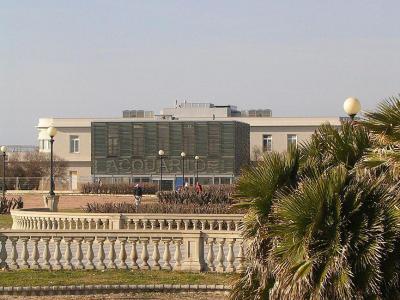
7) Acquario di Livorno (Livorno Aquarium) (must see)
The Livorno Aquarium (Acquario di Livorno), situated on the scenic Terrazza Mascagni, offers visitors a deep dive into the wonders of marine life and beyond. Located near the Cetacean Sanctuary, this aquarium is home to an impressive range of aquatic species, amphibians, reptiles, and insects from all over the world.
As you begin your visit, the first room is dedicated to Diacinto Cestoni and introduces the vibrant biodiversity of the Mediterranean Sea. You’ll explore themed exhibition tanks like “The Crustaceans of the Mediterranean” and “The Colors of the Mediterranean,” where you’ll discover the rich underwater landscapes of this region.
Among the aquarium's many highlights are the Indo-Pacific tank, where Ari and Cuba, the star turtles, swim alongside zebra sharks, Napoleon fish, and blacktip reef sharks. Another crowd favorite is the tactile tank, offering visitors the unique chance to get up close and touch rays as they glide gracefully through the water. The jellyfish exhibit serves as both a visual spectacle and a gentle reminder of environmental conservation, raising awareness about the threat plastic waste poses to sea turtles and other marine creatures.
The aquarium also boasts a mesmerizing reproduction of a Greek-Roman shipwreck in its Mediterranean tank, where species like great sea bass and rockfish swim around the ruins. Moving through the exhibits, visitors encounter the vibrant world of the Caribbean Sea, home to colorful creatures such as the green moray eel, surgeonfish, and fire angel fish.
A visit to the panoramic terrace provides sweeping views of Livorno's coastline and an opportunity to reflect on the aquarium’s incredible displays. For those fascinated by land creatures, the tour concludes with a diverse range of amphibians and reptiles, including chameleons, iguanas, dart frogs, and leafcutting ants.
Ideal for families and travelers alike, the Livorno Aquarium blends education with an engaging, immersive experience, making it a must-see attraction on any visit to Livorno.
As you begin your visit, the first room is dedicated to Diacinto Cestoni and introduces the vibrant biodiversity of the Mediterranean Sea. You’ll explore themed exhibition tanks like “The Crustaceans of the Mediterranean” and “The Colors of the Mediterranean,” where you’ll discover the rich underwater landscapes of this region.
Among the aquarium's many highlights are the Indo-Pacific tank, where Ari and Cuba, the star turtles, swim alongside zebra sharks, Napoleon fish, and blacktip reef sharks. Another crowd favorite is the tactile tank, offering visitors the unique chance to get up close and touch rays as they glide gracefully through the water. The jellyfish exhibit serves as both a visual spectacle and a gentle reminder of environmental conservation, raising awareness about the threat plastic waste poses to sea turtles and other marine creatures.
The aquarium also boasts a mesmerizing reproduction of a Greek-Roman shipwreck in its Mediterranean tank, where species like great sea bass and rockfish swim around the ruins. Moving through the exhibits, visitors encounter the vibrant world of the Caribbean Sea, home to colorful creatures such as the green moray eel, surgeonfish, and fire angel fish.
A visit to the panoramic terrace provides sweeping views of Livorno's coastline and an opportunity to reflect on the aquarium’s incredible displays. For those fascinated by land creatures, the tour concludes with a diverse range of amphibians and reptiles, including chameleons, iguanas, dart frogs, and leafcutting ants.
Ideal for families and travelers alike, the Livorno Aquarium blends education with an engaging, immersive experience, making it a must-see attraction on any visit to Livorno.
