Custom Walk in Cartagena, Colombia by federica_mazzucato_ded2e9 created on 2026-01-01
Guide Location: Colombia » Cartagena
Guide Type: Custom Walk
# of Sights: 9
Tour Duration: 1 Hour(s)
Travel Distance: 1.5 Km or 0.9 Miles
Share Key: PTMG5
Guide Type: Custom Walk
# of Sights: 9
Tour Duration: 1 Hour(s)
Travel Distance: 1.5 Km or 0.9 Miles
Share Key: PTMG5
How It Works
Please retrieve this walk in the GPSmyCity app. Once done, the app will guide you from one tour stop to the next as if you had a personal tour guide. If you created the walk on this website or come to the page via a link, please follow the instructions below to retrieve the walk in the app.
Retrieve This Walk in App
Step 1. Download the app "GPSmyCity: Walks in 1K+ Cities" on Apple App Store or Google Play Store.



Step 2. In the GPSmyCity app, download(or launch) the guide "Cartagena Map and Walking Tours".
Step 3. Tap the menu button located at upper right corner of the "Walks" screen and select "Retrieve custom walk". Enter the share key: PTMG5
1) Parque del Centenario (Centennial Park)
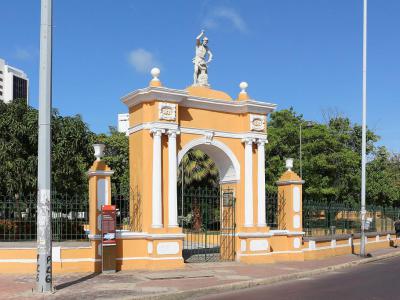
Centennial Park is a popular public park located in the historic center of Cartagena. Established in 1911 to commemorate the 100th anniversary of Catargena's independence from Spanish colonialism, the park is a beloved destination for locals and tourists, offering a tranquil oasis amid the bustling city.
The park's centerpiece is a large monument dedicated to the heroes of Colombia's independence. With pathways shaded by trees and dotted with statues and monuments, the park is a pleasant spot to hang out. Visitors will enjoy fountains, well-manicured gardens, palm trees, and shaded areas to relax.
In addition to its natural beauty, Centennial Park is a cultural hub, with regular events and activities throughout the year, such as concerts, art exhibitions, and traditional dance performances, providing visitors with a glimpse into the vibrant cultural heritage of Cartagena and Colombia.
Centennial Park was designed by Pedro Malabet and built under the direction of Luis Felipe Jaspe Franco. Park's design was influenced by the neoclassical style of French gardens and incorporated elements such as symmetrical designs, axial perspectives, and fountains. Pedro Malabet designed several of the park's notable features, including the octagonal kiosk, the gatehouse, and the Clock Gate (Puerta del Reloj), one of the park's most recognizable landmarks.
The park's centerpiece is a large monument dedicated to the heroes of Colombia's independence. With pathways shaded by trees and dotted with statues and monuments, the park is a pleasant spot to hang out. Visitors will enjoy fountains, well-manicured gardens, palm trees, and shaded areas to relax.
In addition to its natural beauty, Centennial Park is a cultural hub, with regular events and activities throughout the year, such as concerts, art exhibitions, and traditional dance performances, providing visitors with a glimpse into the vibrant cultural heritage of Cartagena and Colombia.
Centennial Park was designed by Pedro Malabet and built under the direction of Luis Felipe Jaspe Franco. Park's design was influenced by the neoclassical style of French gardens and incorporated elements such as symmetrical designs, axial perspectives, and fountains. Pedro Malabet designed several of the park's notable features, including the octagonal kiosk, the gatehouse, and the Clock Gate (Puerta del Reloj), one of the park's most recognizable landmarks.
2) Calle de la Sierpe (Serpent Street)
The first thing you notice on Calle de la Sierpe (Serpent Street) is the bright colors on the walls and the flags hanging over your head as you walk. Looping around from Calle Media Luna to the emblematic Plaza de la Trinidad (a place where important historical events once took place, determining the independence of Cartagena and consequently that of Colombia), this street – also known as Calle 29 – has a great deal of historical importance attached to it. However, it is the abundance of urban art illustrating the legends and mysteries surrounding Calle de la Sierpe's past that makes it one of the most popular destinations in the city.
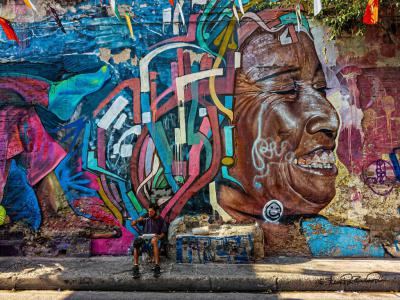
Indeed, the ubiquitous graffiti here is the main attraction; found practically everywhere – on the walls, doors, and windows, and sometimes even on ruined buildings, – they effectively turn the area into one big photo op.
Standing out among them, in particular, are the two artworks: the Grinning Afro-Colombian Woman, and La Sierpe. The former – a large, striking mural by Dexs – is one of the most photographed pieces of street art in Cartagena. As for the latter (La Sierpe), this depiction of a half-woman, half-snake refers to a legend that gave the street its name.
Back in 1608, locals were often bothered by a hissing sound at night that came from what seemed like a big creature crawling on the ground, making a rattling noise. Gripped by fear, the people complained to the city mayor, Don Antonio de Viloria, who bravely ventured out several nights to find out the cause of it. One night, he finally managed to unveil the mystery – a giant rattlesnake! The serpent appeared out of nowhere, with its menacing phosphorescent eyes, wriggling and noisily shaking the large rattles on its tail.
The mayor, armed with courage and the magic technique he had learned on the island of Santa Domingo, drew some magical figures in the air, immediately after which the snake started to writhe and transformed into a woman, who happened to be a witch. The sorceress begged for forgiveness and implored clemency. According to the legend, she was imprisoned until 1614 when the Holy Inquisition Court sentenced her to 200 lashes and final banishment – for heresy.
As you venture further down the street, keep your eyes peeled for the depictions of indigenous people, as well as some other images, to get a sense of the fascinating ethnic diversity of the local population.
Indeed, the ubiquitous graffiti here is the main attraction; found practically everywhere – on the walls, doors, and windows, and sometimes even on ruined buildings, – they effectively turn the area into one big photo op.
Standing out among them, in particular, are the two artworks: the Grinning Afro-Colombian Woman, and La Sierpe. The former – a large, striking mural by Dexs – is one of the most photographed pieces of street art in Cartagena. As for the latter (La Sierpe), this depiction of a half-woman, half-snake refers to a legend that gave the street its name.
Back in 1608, locals were often bothered by a hissing sound at night that came from what seemed like a big creature crawling on the ground, making a rattling noise. Gripped by fear, the people complained to the city mayor, Don Antonio de Viloria, who bravely ventured out several nights to find out the cause of it. One night, he finally managed to unveil the mystery – a giant rattlesnake! The serpent appeared out of nowhere, with its menacing phosphorescent eyes, wriggling and noisily shaking the large rattles on its tail.
The mayor, armed with courage and the magic technique he had learned on the island of Santa Domingo, drew some magical figures in the air, immediately after which the snake started to writhe and transformed into a woman, who happened to be a witch. The sorceress begged for forgiveness and implored clemency. According to the legend, she was imprisoned until 1614 when the Holy Inquisition Court sentenced her to 200 lashes and final banishment – for heresy.
As you venture further down the street, keep your eyes peeled for the depictions of indigenous people, as well as some other images, to get a sense of the fascinating ethnic diversity of the local population.
3) Plaza de La Trinidad (Trinity Square)
Plaza de la Trinidad in Cartagena's Getsemaní takes its name from the eponymous church, La Iglesia de la Santísima Trinidad, located right in front of it, completed in 1643.
The square is historically significant as the place of the country's first independence movement, the rebellion of Gethsemane lancers, in 1811, headed by blacksmith Pedro Romero. It ultimately led to the declaration of independence of what was then known as the city of Cartagena de Indias from the Spanish crown, some 11 years before the rest of the country became independent. Following the event, the square was renamed Plaza de la Libertad (Freedom Square).
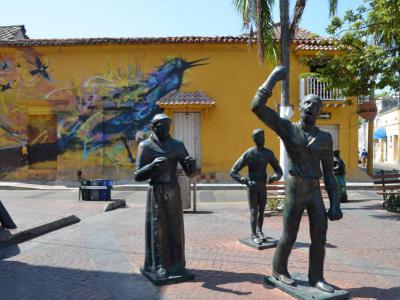
Today, there is a sculpture in the plaza paying tribute to Pedro Romero. Created by artist Nora Quintana, the sculptural group (made of fiberglass, resin and bronze patina) features Romero with his fist raised high in the air, accompanied by the Franciscan priest Father Umaña, and a Drummer.
Lately, the bohemian air of Getsemaní neighborhood found its way to this area in the form of graffiti. Alluding to the life and customs of the city, the graffiti create the image of a colonial-era plaza “disguised as a modern spot”, all the more beautiful in its own rustic way.
A piece of wall art to be noted in particular here is the picture-perfect mural of a black bird called Maria Mulata, which is the official bird of Cartagena. Painted by Colombian artist and graphic designer, Yurika MDC, at a glance, it seems just like an ordinary bird painted on yellow background, with some flashing lights of different colors added for decoration. However, locals know that, when the sun hits the bird from certain angles, these bright colors come to a full, meaningful display. Reportedly, the artist borrowed the idea for the mural from an old story told by a longtime Getsemaní resident.
Attractive by day, the square is also one of the coolest hangouts at night thanks to the street performers, food stands, and dine-in restaurants located nearby, largely stimulating the attendance by tourists and locals alike.
The square is historically significant as the place of the country's first independence movement, the rebellion of Gethsemane lancers, in 1811, headed by blacksmith Pedro Romero. It ultimately led to the declaration of independence of what was then known as the city of Cartagena de Indias from the Spanish crown, some 11 years before the rest of the country became independent. Following the event, the square was renamed Plaza de la Libertad (Freedom Square).
Today, there is a sculpture in the plaza paying tribute to Pedro Romero. Created by artist Nora Quintana, the sculptural group (made of fiberglass, resin and bronze patina) features Romero with his fist raised high in the air, accompanied by the Franciscan priest Father Umaña, and a Drummer.
Lately, the bohemian air of Getsemaní neighborhood found its way to this area in the form of graffiti. Alluding to the life and customs of the city, the graffiti create the image of a colonial-era plaza “disguised as a modern spot”, all the more beautiful in its own rustic way.
A piece of wall art to be noted in particular here is the picture-perfect mural of a black bird called Maria Mulata, which is the official bird of Cartagena. Painted by Colombian artist and graphic designer, Yurika MDC, at a glance, it seems just like an ordinary bird painted on yellow background, with some flashing lights of different colors added for decoration. However, locals know that, when the sun hits the bird from certain angles, these bright colors come to a full, meaningful display. Reportedly, the artist borrowed the idea for the mural from an old story told by a longtime Getsemaní resident.
Attractive by day, the square is also one of the coolest hangouts at night thanks to the street performers, food stands, and dine-in restaurants located nearby, largely stimulating the attendance by tourists and locals alike.
4) Iglesia de la Trinidad (Trinity Church)
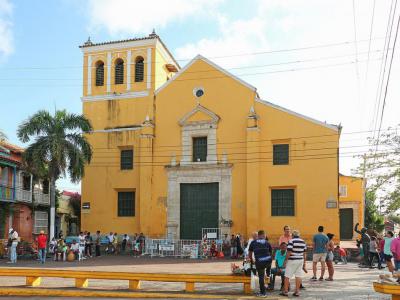
You can't miss this golden-painted church on colorful Trinity Square, located in the heart of the Getsemani neighborhood of Cartagena. The Church of the Holy Trinity (Iglesia de la Trinidad) dates from the beginning of the 17th century and is one of the oldest churches in the city.
The Trinity Square is a popular local hangout that comes alive each evening with vendors, street performers, and dancing. This charming little square offers long curved benches to relax on and bronze statues of freedom fighters outside the church. There are many restaurants, cafes, and bars in the surrounding neighborhood.
The Cathedral of Cartagena was the inspiration for the beautiful design of the church. The inside is striking, with three naves, arched columns, and a wooden ceiling. There is some fantastic artwork inside, and the altarpiece includes a painting of Purgatory. Take a stroll through the square as you visit this visually stunning church, a must-do on your tour through Cartagena.
The Trinity Square is a popular local hangout that comes alive each evening with vendors, street performers, and dancing. This charming little square offers long curved benches to relax on and bronze statues of freedom fighters outside the church. There are many restaurants, cafes, and bars in the surrounding neighborhood.
The Cathedral of Cartagena was the inspiration for the beautiful design of the church. The inside is striking, with three naves, arched columns, and a wooden ceiling. There is some fantastic artwork inside, and the altarpiece includes a painting of Purgatory. Take a stroll through the square as you visit this visually stunning church, a must-do on your tour through Cartagena.
5) Barrio Getsemani (Getsemani Neighborhood)
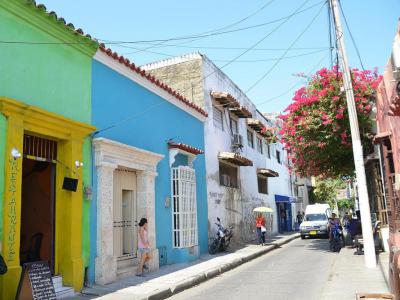
Getsemani neighborhood (Barrio Getsemani) is a trendy, artistic Cartagena district that centers around the picturesque Trinity Square (Plaza de la Trinidad). This once seedy area is now a thriving and beautiful place to explore. A rich array of brightly painted shops, street art, murals, vendors, and hip restaurants will greet you as you wander the streets of this colorful historical district.
The main thing to do in Getsemani is to explore the maze of streets and narrow alleyways as you experience the friendly, exhilarating atmosphere. Lovely Spanish Colonial architecture dominates the area. In the heart of Trinity Square is the Church of the Holy Trinity (Iglesia de la Trinidad), an impressive church dating back to 1600.
Head out from the Trinity Square down Serpent Street. You will see an impressive display of stunning murals on the walls of the buildings lining the street. Colorful international flags overhang the neighborhood alleyways as you wind around the corners. Other alleyways are strung with small colored banners and even umbrellas!
You won't want to miss exploring this vibrant neighborhood where everything around you is a rainbow of colors, art, tropical foliage, and lots of food. A walking tour is a perfect way to experience the area.
The main thing to do in Getsemani is to explore the maze of streets and narrow alleyways as you experience the friendly, exhilarating atmosphere. Lovely Spanish Colonial architecture dominates the area. In the heart of Trinity Square is the Church of the Holy Trinity (Iglesia de la Trinidad), an impressive church dating back to 1600.
Head out from the Trinity Square down Serpent Street. You will see an impressive display of stunning murals on the walls of the buildings lining the street. Colorful international flags overhang the neighborhood alleyways as you wind around the corners. Other alleyways are strung with small colored banners and even umbrellas!
You won't want to miss exploring this vibrant neighborhood where everything around you is a rainbow of colors, art, tropical foliage, and lots of food. A walking tour is a perfect way to experience the area.
6) Calle e Plazuela del Pozo (Well Street and Square)
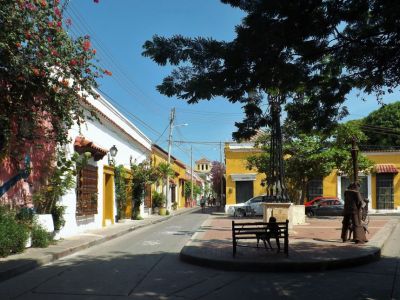
Calle del Pozo – one of the most romantic and beautiful streets in Getsemaní – stems from the homonymous square, Plazuela del Pozo. This cute little plaza was not part of the original urban plan and is said to have emerged spontaneously around the water well from which the locals used to collect "oily water" (unsuitable for human consumption but good for technical needs). It is from this well that both the plaza and the street subsequently got their name.
The area is rich in history and gets particularly lively at night, with live music, and plenty of food and drinks everywhere (thanks to the nearby eateries). And if you happen to be here at the right moment, you may even find yourself in the middle of a dance show on the street. Complete with the lovely murals, all this makes it hard to imagine that, in 1811, it was the epicenter of armed clashes against colonial authorities that would tip the balance in favor of declaring Cartagena's total independence from Spain.
Inside Getsemaní neighborhood you will find many depictions of Pedro Romero, a person of mixed European and African descent, who, in 1810, formed a militia to expel the Spanish governor. One such is in Plazuela del Pozo, created by graffiti artist Ceroker. Here, the national hero is painted as an astronaut bearing a flame in an outstretched hand. The inscription in the mural reads: "Here, the insurgency of the people began."
The area is rich in history and gets particularly lively at night, with live music, and plenty of food and drinks everywhere (thanks to the nearby eateries). And if you happen to be here at the right moment, you may even find yourself in the middle of a dance show on the street. Complete with the lovely murals, all this makes it hard to imagine that, in 1811, it was the epicenter of armed clashes against colonial authorities that would tip the balance in favor of declaring Cartagena's total independence from Spain.
Inside Getsemaní neighborhood you will find many depictions of Pedro Romero, a person of mixed European and African descent, who, in 1810, formed a militia to expel the Spanish governor. One such is in Plazuela del Pozo, created by graffiti artist Ceroker. Here, the national hero is painted as an astronaut bearing a flame in an outstretched hand. The inscription in the mural reads: "Here, the insurgency of the people began."
7) Calle de las Chancletas (Flip Flops Street)
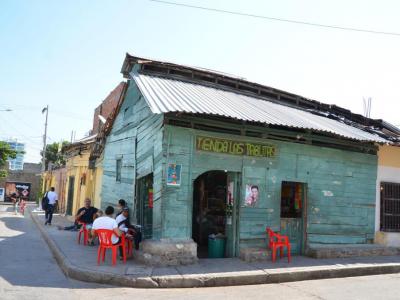
Curbed by Plazuela del Pozo, at one end, and the emblematic Tienda Las Tablitas shop at the other, lies yet another landmark of Gethsemane, Calle de las Chancletas or Flip Flops Street.
The origin of Tienda Las Tablitas – a liquor store, mini-market, bar, and even a casino, all wrapped into one (seemingly as old as the neighborhood itself, if only to believe that in the mid-1600s they already had this sort of establishments in Gethsemane) – is a mystery to many. Much like the Leaning Tower of Pisa, it seems miraculous that this iconic corner shop still stands. Aged definitely over 100 years, it was built from maritime timber packing material and is one of the top attractions in the area. As well as with locals it is very popular with photographers and is a must-see location for those visiting Cartagena's Gethsemane for the first time.
Back in colonial times, they say, boatmen from Barú and Tierrabomba used to come to the area to sell products, such as cassava and corn, on one of the nearby bridges. Their wives would come along and, with permission from locals, make them dinner, usually a sancocho (traditional soup/stew), in a designated spot on this street. The men, who had spent much time in the water, would leave their flip-flops drying in the sun on the sidewalk as they sat down to eat; this is how the street got its name.
And while the local residents are not strangers to flip flops either, it is the roses, creepers, and colonial architecture that are now the most prevalent illustration of this area. It is also safe to admit that, in terms of natural charm, Calle de las Chancletas is second to none in Gethsemane, always radiant and inviting to stop and contemplate the colorful facades, while snapping a few photos.
The origin of Tienda Las Tablitas – a liquor store, mini-market, bar, and even a casino, all wrapped into one (seemingly as old as the neighborhood itself, if only to believe that in the mid-1600s they already had this sort of establishments in Gethsemane) – is a mystery to many. Much like the Leaning Tower of Pisa, it seems miraculous that this iconic corner shop still stands. Aged definitely over 100 years, it was built from maritime timber packing material and is one of the top attractions in the area. As well as with locals it is very popular with photographers and is a must-see location for those visiting Cartagena's Gethsemane for the first time.
Back in colonial times, they say, boatmen from Barú and Tierrabomba used to come to the area to sell products, such as cassava and corn, on one of the nearby bridges. Their wives would come along and, with permission from locals, make them dinner, usually a sancocho (traditional soup/stew), in a designated spot on this street. The men, who had spent much time in the water, would leave their flip-flops drying in the sun on the sidewalk as they sat down to eat; this is how the street got its name.
And while the local residents are not strangers to flip flops either, it is the roses, creepers, and colonial architecture that are now the most prevalent illustration of this area. It is also safe to admit that, in terms of natural charm, Calle de las Chancletas is second to none in Gethsemane, always radiant and inviting to stop and contemplate the colorful facades, while snapping a few photos.
8) Callejón Angosto (Narrow Alley)/Calle de las Sombrillas (Umbrella Street)
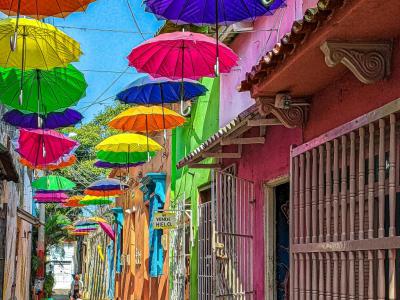
Formerly known as Callejón Angosto (Narrow Alley), this is indeed one of the narrowest streets in Getsemani. In recent years, in a bid to add color to its coral stone walls, the area – just like many other places around the world – embraced a new look with the help of an old accessory, the umbrella.
Being the first place in Colombia to put on such a look, the alleyway was subsequently renamed Calle de las Sombrillas (Umbrellas Street), becoming Cartagena's own Instagramable spot purposely designed for photo taking. A combination of overhanging umbrellas, colorful houses, and street art makes it undoubtedly one of the most picturesque locations in the city, especially when it's lit up at night.
The umbrellas proved a welcome addition from both artistic and practical standpoints, too, providing the much-needed shade from the scorching heat during midday, as well as protecting walkers from torrential rains when they come.
Having taken your must-have picture here, consider leaving a small tip in the box at the end of the street, as this is one of the few spots in Getsemaní that is still predominantly residential.
Being the first place in Colombia to put on such a look, the alleyway was subsequently renamed Calle de las Sombrillas (Umbrellas Street), becoming Cartagena's own Instagramable spot purposely designed for photo taking. A combination of overhanging umbrellas, colorful houses, and street art makes it undoubtedly one of the most picturesque locations in the city, especially when it's lit up at night.
The umbrellas proved a welcome addition from both artistic and practical standpoints, too, providing the much-needed shade from the scorching heat during midday, as well as protecting walkers from torrential rains when they come.
Having taken your must-have picture here, consider leaving a small tip in the box at the end of the street, as this is one of the few spots in Getsemaní that is still predominantly residential.
9) Calle de San Juan (San Juan Street)
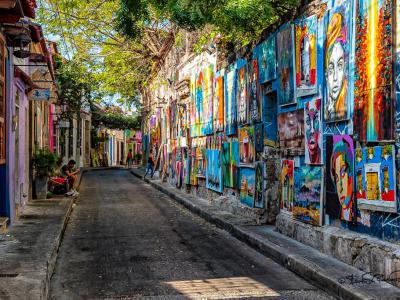
Stemming from Calle de la Sierpe to the south is a curved, narrow alley – Calle de San Juan (San Juan Street). Named after Saint John the Baptist, this is one of the few places in Cartagena to retain its original name from colonial times.
At 187 meters, this is also one of the longest “inner” streets in the Getsemaní neighborhood, and with a great deal of history packed inside these 187 meters, too. A century ago, this street was famed as the one inhabited by Admiral José Prudencio Padilla, the hero of the Expulsion of Mexico’s Spaniards in 1821-1836. More recently, it was the home of the notorious gangster, Samir Beetar, who made the name for himself among locals by helping needy neighbors and those with sick children pay for their medicine.
Still, what makes Calle de San Juan stand out today, at least in the eyes of numerous visitors, is the impressive collection of wall paintings coupled with an array of delightful cafes and restaurants lining the street. While the eateries and drinking establishments lure passers-by with their cozy atmosphere, the color palette of the surrounding artwork makes one feel as if drifting down the river of ink... Both pastimes are equally engaging!
At 187 meters, this is also one of the longest “inner” streets in the Getsemaní neighborhood, and with a great deal of history packed inside these 187 meters, too. A century ago, this street was famed as the one inhabited by Admiral José Prudencio Padilla, the hero of the Expulsion of Mexico’s Spaniards in 1821-1836. More recently, it was the home of the notorious gangster, Samir Beetar, who made the name for himself among locals by helping needy neighbors and those with sick children pay for their medicine.
Still, what makes Calle de San Juan stand out today, at least in the eyes of numerous visitors, is the impressive collection of wall paintings coupled with an array of delightful cafes and restaurants lining the street. While the eateries and drinking establishments lure passers-by with their cozy atmosphere, the color palette of the surrounding artwork makes one feel as if drifting down the river of ink... Both pastimes are equally engaging!
