Custom Walk in Lecce, Italy by warevans3243 created on 2026-02-04
Guide Location: Italy » Lecce
Guide Type: Custom Walk
# of Sights: 5
Tour Duration: 1 Hour(s)
Travel Distance: 2 Km or 1.2 Miles
Share Key:
Guide Type: Custom Walk
# of Sights: 5
Tour Duration: 1 Hour(s)
Travel Distance: 2 Km or 1.2 Miles
Share Key:
How It Works
Please retrieve this walk in the GPSmyCity app. Once done, the app will guide you from one tour stop to the next as if you had a personal tour guide. If you created the walk on this website or come to the page via a link, please follow the instructions below to retrieve the walk in the app.
Retrieve This Walk in App
Step 1. Download the app "GPSmyCity: Walks in 1K+ Cities" on Apple App Store or Google Play Store.



Step 2. In the GPSmyCity app, download(or launch) the guide "Lecce Map and Walking Tours".
Step 3. Tap the menu button located at upper right corner of the "Walks" screen and select "Retrieve custom walk". Enter the share key:
1) Porta Rudiae (Rudiae Gate)
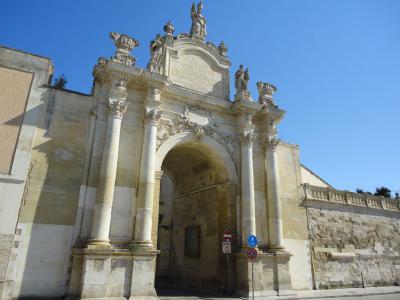
Rudiae Gate, is the oldest and most historically significant of the three city gates. It originally faced the ancient city of Rudiae, the birthplace of the poets Ennio and Virgilio. The current structure dates back to 1703 when it was rebuilt by the nobleman Prospero Lubelli after the earlier Gothic gate collapsed in the late 17th century.
The gate features a single arch flanked by pairs of columns resting on a podium, supporting a decorative frieze adorned with busts of Lecce’s mythical founders: Malennio, Dauno, Euippa, and Idomeneo.
Above the arch stand statues of Saint Oronzo, Lecce’s patron saint, along with other protectors Irene and San Domenico. A Latin inscription commemorates the gate’s reconstruction under Lubelli’s patronage.
Historically, Porta Rudiae served both defensive and commercial purposes, guarding the city and regulating trade from surrounding areas.
Today, it remains a symbolic entrance to Lecce’s baroque old town, hosting cultural and religious events that celebrate the city’s rich heritage and maintain its connection to longstanding traditions.
The gate features a single arch flanked by pairs of columns resting on a podium, supporting a decorative frieze adorned with busts of Lecce’s mythical founders: Malennio, Dauno, Euippa, and Idomeneo.
Above the arch stand statues of Saint Oronzo, Lecce’s patron saint, along with other protectors Irene and San Domenico. A Latin inscription commemorates the gate’s reconstruction under Lubelli’s patronage.
Historically, Porta Rudiae served both defensive and commercial purposes, guarding the city and regulating trade from surrounding areas.
Today, it remains a symbolic entrance to Lecce’s baroque old town, hosting cultural and religious events that celebrate the city’s rich heritage and maintain its connection to longstanding traditions.
2) Lecce Cathedral and Square (must see)
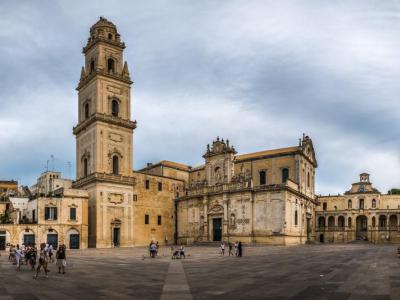
A step into Cathedral Square reveals Lecce’s secret garden of carved stone and Baroque bravado-hidden behind a slim passage off Libertini Street. Here, the Cathedral of the Assumption presides like a diva atop a set of cascading stairs, flanked by stout columns that guard niches boasting statues of Saints Giusto and Fortunato. Legend says Saint Orontius himself watches from his ornate arch above, forever grateful for slaying the plague rather than dragons.
This isn’t your average medieval church: since its inauguration in 1144, Lecce’s Cathedral has had two makeovers-first in 1230, then in 1659 when Giuseppe Zimbalo supercharged it with baroque exuberance. The majesty of the edifice invites anyone to cross the threshold into a world of three naves divided by sculpted pilasters and columns, under a 1685 wooden ceiling painted by Giuseppe da Brindisi. Twelve side chapels brim with altars honoring everyone from sacrament superstars to the lives of Jesus and Mary.
Guarding the square’s flanks are three other grand players: the Bishop’s Palace, which got its stately clock and facade facelift in 1758; the soaring 230-foot bell tower, another Zimbalo marvel from 1682; and the Seminary, Giuseppe Cino’s 1729 masterpiece that wraps the west side in Rococo ruffles. Together, they form Lecce’s ultimate architectural girl band-each with its own star turn, yet perfectly in sync.
So pause beneath those sculpted ledges, let your eyes follow the soaring bell tower skyward, and picture the endless parades that once wove through this secret square. In Lecce, even the quietest corner is a stage-and everyone gets front-row seats.
This isn’t your average medieval church: since its inauguration in 1144, Lecce’s Cathedral has had two makeovers-first in 1230, then in 1659 when Giuseppe Zimbalo supercharged it with baroque exuberance. The majesty of the edifice invites anyone to cross the threshold into a world of three naves divided by sculpted pilasters and columns, under a 1685 wooden ceiling painted by Giuseppe da Brindisi. Twelve side chapels brim with altars honoring everyone from sacrament superstars to the lives of Jesus and Mary.
Guarding the square’s flanks are three other grand players: the Bishop’s Palace, which got its stately clock and facade facelift in 1758; the soaring 230-foot bell tower, another Zimbalo marvel from 1682; and the Seminary, Giuseppe Cino’s 1729 masterpiece that wraps the west side in Rococo ruffles. Together, they form Lecce’s ultimate architectural girl band-each with its own star turn, yet perfectly in sync.
So pause beneath those sculpted ledges, let your eyes follow the soaring bell tower skyward, and picture the endless parades that once wove through this secret square. In Lecce, even the quietest corner is a stage-and everyone gets front-row seats.
3) Piazza Sant'Oronzo (St. Orontius Square) (must see)
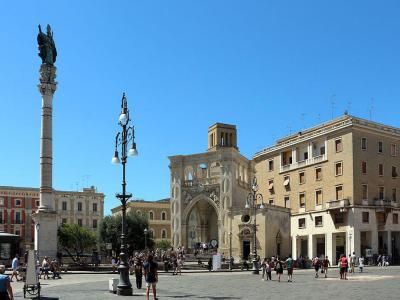
Welcome to St. Orontius Square, Lecce’s very own “all-you-can-feast” buffet of food, wine, music, and people-watching-truly the city’s beating heart. You can arrive here via practically any road or, if you’re feeling dramatic, pass under one of the ancient gates-Napoli, Rudiae, or San Biagio-and step straight into the action.
Look around: beneath your feet lies the mosaic “Oval,” laid in 1930 by Giuseppe Nicolardi (artisan at heart), flaunting Lecce’s coat of arms-a she-wolf under a holm oak. Locals treat it like sacred ground, hopping over it rather than risk the she-wolf’s anger. Half-buried under the elegant Church of Holy Mary of Grace, peek the arches of the Roman Amphitheater-a stage that’s been hiding in plain sight since the days of Emperors Hadrian and Augustus in the 2nd century AD. Flanking the square are contrasting palaces-one a monument to Fascist Rationalism, another the graceful “Seat of Venice”-and at its center, the bronze Saint Oronzo, Lecce’s patron saint, stranded atop a 95-foot Roman column since 1739, still blessing the Carafa Palace and the entire city he once saved from the plague of 1656.
Saint Orontius Square is the perfect launchpad to discover the wonders of Lecce. Just remember: don’t step on the oval, do raise your glass to Saint Oronzo, and savor every golden-hued moment in Lecce’s grandest gathering place.
Look around: beneath your feet lies the mosaic “Oval,” laid in 1930 by Giuseppe Nicolardi (artisan at heart), flaunting Lecce’s coat of arms-a she-wolf under a holm oak. Locals treat it like sacred ground, hopping over it rather than risk the she-wolf’s anger. Half-buried under the elegant Church of Holy Mary of Grace, peek the arches of the Roman Amphitheater-a stage that’s been hiding in plain sight since the days of Emperors Hadrian and Augustus in the 2nd century AD. Flanking the square are contrasting palaces-one a monument to Fascist Rationalism, another the graceful “Seat of Venice”-and at its center, the bronze Saint Oronzo, Lecce’s patron saint, stranded atop a 95-foot Roman column since 1739, still blessing the Carafa Palace and the entire city he once saved from the plague of 1656.
Saint Orontius Square is the perfect launchpad to discover the wonders of Lecce. Just remember: don’t step on the oval, do raise your glass to Saint Oronzo, and savor every golden-hued moment in Lecce’s grandest gathering place.
4) Anfiteatro Romano di Lecce (Roman Amphitheater of Lecce) (must see)
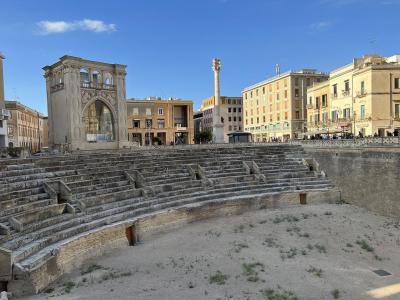
Right in the beating heart of Lecce’s Saint Orontius Square, you’ll stumble upon what looks like a half-hidden time capsule: the Roman Amphitheater of Lupiae. Imagine dusting off your morning espresso only to find you’re standing atop the ancient stage for gladiator brawls and lion-versus-man spectacles. Unearthed quite by accident in 1906-when builders digging for a bank vault hit marble instead of cashier’s drawers-this arena most likely dates from Emperor Augustus’s golden era, with Hadrian later tossing in a stately portico for good measure.
By the 11th century, the amphitheater’s glory days had faded, and locals liberally repurposed its stones for city walls-and rumor has it, even parts of Lecce stone ended up in the Cathedral of Otranto. By the 15th century, its remaining above-ground bits were folded into the foundations of the Island of the Governor complex. Yet when stripped back to its original oval-335 feet by 269 feet-you can still picture 15,000 cheering fans packed into tiered seating, peering down through 24 of the original 68 arches.
Today, the Amphitheater of Lupiae enjoys a peaceful second act. Its sun-baked limestone steps and radial tunnels now host concerts, theater, and festivals rather than chariot races. Ever since its designation as an Italian “National Monument” on February 1, 1906, this slice of antiquity has proven that sometimes the best way to experience Rome is not in Rome at all-but right here in Lecce, where ancient stones and modern stage lights share the spotlight.
By the 11th century, the amphitheater’s glory days had faded, and locals liberally repurposed its stones for city walls-and rumor has it, even parts of Lecce stone ended up in the Cathedral of Otranto. By the 15th century, its remaining above-ground bits were folded into the foundations of the Island of the Governor complex. Yet when stripped back to its original oval-335 feet by 269 feet-you can still picture 15,000 cheering fans packed into tiered seating, peering down through 24 of the original 68 arches.
Today, the Amphitheater of Lupiae enjoys a peaceful second act. Its sun-baked limestone steps and radial tunnels now host concerts, theater, and festivals rather than chariot races. Ever since its designation as an Italian “National Monument” on February 1, 1906, this slice of antiquity has proven that sometimes the best way to experience Rome is not in Rome at all-but right here in Lecce, where ancient stones and modern stage lights share the spotlight.
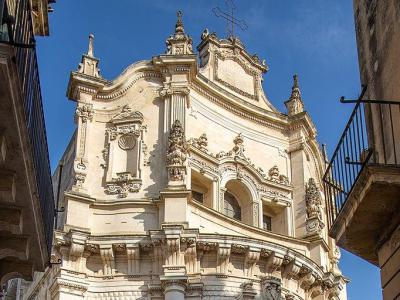
5) Chiesa di San Matteo (Church of Saint Mathew)
Imagine stepping into a Baroque time machine and landing in Lecce circa 1700-welcome to the Church of Saint Matthew, brainchild of Achille Larducci di Salo, nephew to Rome’s own star architect Borromini. In 1667, Bishop Luigi Pappacoda ceremoniously plopped down the first stone, replacing a humble 15th-century chapel. By 1700, Larducci’s vision had sprung into glorious reality.
Outside, the façade plays “concave above, convex below” in stunning limestone choreography. The lower register flaunts three sections framed by beefy columns and an ornate main portal crowned with the Franciscan coat of arms. Above, a grand three-part doorway stretches between sculpted columns and niches, all finished with a curving overhang and a tall triangular top that seems to nod hello as you walk by.
Slip inside, and you’ll find a single, sweeping nave traced in an elegant ellipse. Pilasters, each based on a plinth, salute the Twelve Apostles while the left side parades five jeweled altars honoring Saints Agatha, Francis, Rita, the Virgin, and the Pietà. Opposite them stand four more shrines-Madonna of the Light, Saint Anne, the Holy Family, and Saint Orontius-beneath a star-studded vault that feels straight out of a celestial blueprint. In Lecce, even a church floor plan is fit for Baroque stardom-this is Saint Matthew’s grand stage.
Outside, the façade plays “concave above, convex below” in stunning limestone choreography. The lower register flaunts three sections framed by beefy columns and an ornate main portal crowned with the Franciscan coat of arms. Above, a grand three-part doorway stretches between sculpted columns and niches, all finished with a curving overhang and a tall triangular top that seems to nod hello as you walk by.
Slip inside, and you’ll find a single, sweeping nave traced in an elegant ellipse. Pilasters, each based on a plinth, salute the Twelve Apostles while the left side parades five jeweled altars honoring Saints Agatha, Francis, Rita, the Virgin, and the Pietà. Opposite them stand four more shrines-Madonna of the Light, Saint Anne, the Holy Family, and Saint Orontius-beneath a star-studded vault that feels straight out of a celestial blueprint. In Lecce, even a church floor plan is fit for Baroque stardom-this is Saint Matthew’s grand stage.
