Custom Walk in Gibraltar, Gibraltar by tcpellis_4a5837 created on 2026-02-15
Guide Location: Gibraltar » Gibraltar
Guide Type: Custom Walk
# of Sights: 6
Tour Duration: 5 Hour(s)
Travel Distance: 13.2 Km or 8.2 Miles
Share Key: YA5LB
Guide Type: Custom Walk
# of Sights: 6
Tour Duration: 5 Hour(s)
Travel Distance: 13.2 Km or 8.2 Miles
Share Key: YA5LB
How It Works
Please retrieve this walk in the GPSmyCity app. Once done, the app will guide you from one tour stop to the next as if you had a personal tour guide. If you created the walk on this website or come to the page via a link, please follow the instructions below to retrieve the walk in the app.
Retrieve This Walk in App
Step 1. Download the app "GPSmyCity: Walks in 1K+ Cities" on Apple App Store or Google Play Store.



Step 2. In the GPSmyCity app, download(or launch) the guide "Gibraltar Map and Walking Tours".
Step 3. Tap the menu button located at upper right corner of the "Walks" screen and select "Retrieve custom walk". Enter the share key: YA5LB

1) Main Street (must see)
Main Street is Gibraltar’s most famous thoroughfare—a place where the story of the Rock unfolds in every stone and balcony. Once known as Royal Street, it was first laid out in 1575 with the opening of the Africa Gate, now called the Southport Gates. But the street we know today began to take shape after 1704, when the British took Gibraltar and transformed it into a fortified garrison town. Main Street became the city’s central artery, buzzing with the energy of soldiers, merchants, and sailors from across Europe and North Africa.
Its history has not always been peaceful. During the Great Siege of 1779–1783, when French and Spanish forces bombarded Gibraltar for four years, much of Main Street was reduced to rubble. Yet from the ashes, it rose again. Governor Charles O’Hara oversaw its rebuilding in 1801, straightening the road and reshaping its facades into the elegant blend of Georgian, Mediterranean, and Moorish styles that still defines it.
There’s a story that during the siege, locals carried on trading and chatting in defiance, even as cannon fire echoed overhead—a sign of the Gibraltarian resilience that still characterizes the street. Later, in the 19th century, it evolved into a thriving commercial center. Tailors, tobacconists, and perfumeries lined its length, serving travelers and British officers alike, while families lived in apartments above the shops.
Today, Main Street remains the heart of Gibraltar’s daily life. It’s pedestrianized now, filled with duty-free stores, cozy pubs, and sunlit cafés. Tourists stroll between the cathedrals and colonial façades, hearing snippets of both English and Spanish—sometimes even Llanito, Gibraltar’s unique local dialect. Walking down Main Street isn’t just a shopping trip; it’s a walk through centuries of endurance, adaptation, and cultural exchange, where the Mediterranean meets a touch of Britain under the Rock’s watchful gaze.
Its history has not always been peaceful. During the Great Siege of 1779–1783, when French and Spanish forces bombarded Gibraltar for four years, much of Main Street was reduced to rubble. Yet from the ashes, it rose again. Governor Charles O’Hara oversaw its rebuilding in 1801, straightening the road and reshaping its facades into the elegant blend of Georgian, Mediterranean, and Moorish styles that still defines it.
There’s a story that during the siege, locals carried on trading and chatting in defiance, even as cannon fire echoed overhead—a sign of the Gibraltarian resilience that still characterizes the street. Later, in the 19th century, it evolved into a thriving commercial center. Tailors, tobacconists, and perfumeries lined its length, serving travelers and British officers alike, while families lived in apartments above the shops.
Today, Main Street remains the heart of Gibraltar’s daily life. It’s pedestrianized now, filled with duty-free stores, cozy pubs, and sunlit cafés. Tourists stroll between the cathedrals and colonial façades, hearing snippets of both English and Spanish—sometimes even Llanito, Gibraltar’s unique local dialect. Walking down Main Street isn’t just a shopping trip; it’s a walk through centuries of endurance, adaptation, and cultural exchange, where the Mediterranean meets a touch of Britain under the Rock’s watchful gaze.
2) Great Siege Tunnels (must see)
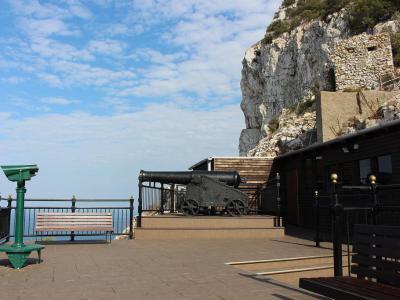
The Upper Galleries, also known as the Great Siege Tunnels, is an intricate network of tunnels situated within the northern section of the Rock of Gibraltar, a British Overseas Territory. These tunnels were painstakingly carved out of solid limestone by the British forces during the late 18th century's Great Siege of Gibraltar.
The Great Siege of Gibraltar took place during the American Revolutionary War when France and Spain sought to capture Gibraltar from Great Britain. Spanning from July 1779 to February 1783, it marked the fourteenth and final siege of Gibraltar. The motivation behind constructing the tunnels stemmed from the garrison's necessity to cover a blind spot on the Rock's northeast side. The only viable solution was to position a gun on a rock spur referred to as The Notch.
The laborious task was executed manually, primarily employing sledgehammers, crowbars, and the aid of gunpowder explosions. Initially, progress was slow, with a team of thirteen men requiring five weeks to dig an 82-foot (25 m) long tunnel. The diggers faced challenges from noxious fumes and dust resulting from frequent blasting. Consequently, a horizontal shaft was blasted to enhance ventilation, which unexpectedly yielded an additional advantage.
By the completion of the initial phase of tunneling, five galleries were excavated: Windsor Gallery, King's and Queen's Lines, St. George's Hall, and Cornwallis Chamber. The Windsor Gallery constituted the first segment of the tunnel system and housed four mounted guns. St. George's Hall stood as the largest of the original galleries, and the embrasures on the Rock's slopes could be observed when approaching Gibraltar from both land and sea.
The onset of World War II led to increased tunnel construction. Extensive work was done to accommodate 16,000 soldiers with supplies for a year. The Great Siege Tunnels were repurposed, including an extension known as the Holyland Tunnel. A staircase was also built to connect the Tunnels to the Middle Galleries.
Presently, the Great Siege Tunnels are accessible as part of the Upper Rock Nature Reserve, offering visitors the opportunity to explore their historical significance.
The Great Siege of Gibraltar took place during the American Revolutionary War when France and Spain sought to capture Gibraltar from Great Britain. Spanning from July 1779 to February 1783, it marked the fourteenth and final siege of Gibraltar. The motivation behind constructing the tunnels stemmed from the garrison's necessity to cover a blind spot on the Rock's northeast side. The only viable solution was to position a gun on a rock spur referred to as The Notch.
The laborious task was executed manually, primarily employing sledgehammers, crowbars, and the aid of gunpowder explosions. Initially, progress was slow, with a team of thirteen men requiring five weeks to dig an 82-foot (25 m) long tunnel. The diggers faced challenges from noxious fumes and dust resulting from frequent blasting. Consequently, a horizontal shaft was blasted to enhance ventilation, which unexpectedly yielded an additional advantage.
By the completion of the initial phase of tunneling, five galleries were excavated: Windsor Gallery, King's and Queen's Lines, St. George's Hall, and Cornwallis Chamber. The Windsor Gallery constituted the first segment of the tunnel system and housed four mounted guns. St. George's Hall stood as the largest of the original galleries, and the embrasures on the Rock's slopes could be observed when approaching Gibraltar from both land and sea.
The onset of World War II led to increased tunnel construction. Extensive work was done to accommodate 16,000 soldiers with supplies for a year. The Great Siege Tunnels were repurposed, including an extension known as the Holyland Tunnel. A staircase was also built to connect the Tunnels to the Middle Galleries.
Presently, the Great Siege Tunnels are accessible as part of the Upper Rock Nature Reserve, offering visitors the opportunity to explore their historical significance.
3) Rock of Gibraltar (must see)
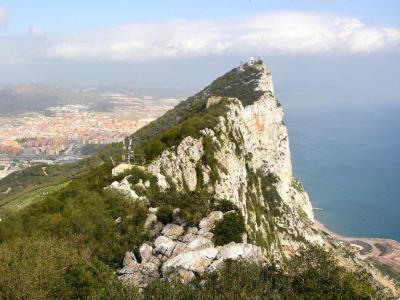
The Rock of Gibraltar stands as a majestic monolithic limestone promontory in the British territory of Gibraltar. Situated near the southwestern tip of Europe on the Iberian Peninsula, it guards the entrance to the Mediterranean Sea. Rising to an impressive height of 426 meters (1,398 feet), this iconic landmark captivates visitors with its natural beauty and rich history.
A significant portion of the Rock's upper area is dedicated to a nature reserve, creating a haven for diverse flora and fauna. One of the most famous inhabitants of the reserve is the Barbary macaque. Around 300 of these playful and charismatic monkeys roam freely on the Rock, delighting tourists with their antics. The presence of these macaques adds a unique and endearing aspect to the Rock's appeal.
Beyond its natural allure, the Rock of Gibraltar holds a prominent place in ancient mythology and historical significance. According to ancient legends propagated by the Greeks, Phoenicians, and later the Romans, the Rock, together with another pillar known as Mons Abila, formed the legendary Pillars of Hercules. These pillars were believed to mark the boundary of the known world.
The Rock of Gibraltar itself was known to the Romans as Mons Calpe. It served as a navigational landmark for ancient seafarers, symbolizing the end of the Mediterranean and the gateway to the vast Atlantic Ocean. While the Phoenicians had ventured beyond this point, exploring both northward and southward into the Atlantic, the Pillars of Hercules remained significant symbols of exploration and discovery.
In addition to its natural and mythological allure, the Rock of Gibraltar is also home to an intricate network of tunnels. These tunnels, created over centuries, were initially constructed for military purposes and later expanded during World War II. They served as a strategic defensive system, providing shelter, storage, and a hidden vantage point for the British forces.
Today, the Rock's tunnels are a popular attraction, offering visitors a glimpse into its military history and a chance to explore the subterranean world beneath the limestone cliffs. The combination of the Barbary macaques, the natural reserve, and the historical tunnels make the Rock of Gibraltar a captivating destination for tourists from around the world.
A significant portion of the Rock's upper area is dedicated to a nature reserve, creating a haven for diverse flora and fauna. One of the most famous inhabitants of the reserve is the Barbary macaque. Around 300 of these playful and charismatic monkeys roam freely on the Rock, delighting tourists with their antics. The presence of these macaques adds a unique and endearing aspect to the Rock's appeal.
Beyond its natural allure, the Rock of Gibraltar holds a prominent place in ancient mythology and historical significance. According to ancient legends propagated by the Greeks, Phoenicians, and later the Romans, the Rock, together with another pillar known as Mons Abila, formed the legendary Pillars of Hercules. These pillars were believed to mark the boundary of the known world.
The Rock of Gibraltar itself was known to the Romans as Mons Calpe. It served as a navigational landmark for ancient seafarers, symbolizing the end of the Mediterranean and the gateway to the vast Atlantic Ocean. While the Phoenicians had ventured beyond this point, exploring both northward and southward into the Atlantic, the Pillars of Hercules remained significant symbols of exploration and discovery.
In addition to its natural and mythological allure, the Rock of Gibraltar is also home to an intricate network of tunnels. These tunnels, created over centuries, were initially constructed for military purposes and later expanded during World War II. They served as a strategic defensive system, providing shelter, storage, and a hidden vantage point for the British forces.
Today, the Rock's tunnels are a popular attraction, offering visitors a glimpse into its military history and a chance to explore the subterranean world beneath the limestone cliffs. The combination of the Barbary macaques, the natural reserve, and the historical tunnels make the Rock of Gibraltar a captivating destination for tourists from around the world.
4) St. Michael's Cave (must see)
Rainwater, slowly seeping through limestone, will change into a weak solution of carbolic acid. The acid solution gradually erodes the limestone. It creates tunnels and caverns from cracks. This simple process has been carving away at the Rock of Gibraltar for thousands and thousands of years. The result is St. Michael's Cave.
St. Michael's Cave is really a vast network of tunnels and caves in the Upper Rock Nature Preserve of Gibraltar. Alonso Hernandez del Portillo, the leading historian of Gibraltar in the 17th century, held that the cave is named for the Grotto of Monte Gargano in Apulia, Italy, where archangel St. Michael is said to have appeared.
St. Michael would have felt at home. Humans certainly have, since Neolithic times. Pottery, utensils, weapons, and artwork of the Rock's prehistoric tenants have been found. A charcoal drawing of an Ibex is on a wall. The drawing is about 20,000 years old. There were two Neanderthal skulls found, dating from 40,000 years ago.
In 45 AD, geographer Pomponius Mela described Gibraltar as "A mountain with wonderful concavities." The caves were well-known to the ancient Greeks, Romans, and Phoenicians. In the Victorian era, the caves were used for picnics, concerts, marriages, and duels. In 1840 Colonel Mitchell and a friend went in and were never seen again.
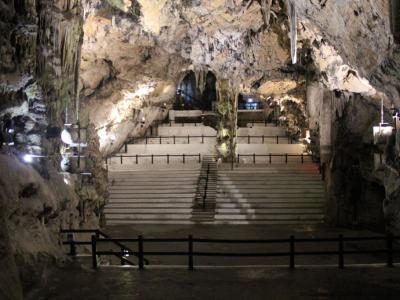
In 1942, while blasting rocks in the cave to improve ventilation, a deeper system of caves and underground lakes was discovered. It was called New St. Michael's Cave. The largest room is called the Auditorium. It is used for a theatre space showing sound and light shows, beauty pageants, operas, and concerts.
St. Michael's Cave attracts over 1,000,000 visitors a year. The cave can be reached by car, by foot, or by cable car. Tickets include visits to the Moorish Castle and the Great Siege Tunnels of the Rock. Safety helmets are available. Non-skid shoes are recommended.
St. Michael's Cave is really a vast network of tunnels and caves in the Upper Rock Nature Preserve of Gibraltar. Alonso Hernandez del Portillo, the leading historian of Gibraltar in the 17th century, held that the cave is named for the Grotto of Monte Gargano in Apulia, Italy, where archangel St. Michael is said to have appeared.
St. Michael would have felt at home. Humans certainly have, since Neolithic times. Pottery, utensils, weapons, and artwork of the Rock's prehistoric tenants have been found. A charcoal drawing of an Ibex is on a wall. The drawing is about 20,000 years old. There were two Neanderthal skulls found, dating from 40,000 years ago.
In 45 AD, geographer Pomponius Mela described Gibraltar as "A mountain with wonderful concavities." The caves were well-known to the ancient Greeks, Romans, and Phoenicians. In the Victorian era, the caves were used for picnics, concerts, marriages, and duels. In 1840 Colonel Mitchell and a friend went in and were never seen again.
In 1942, while blasting rocks in the cave to improve ventilation, a deeper system of caves and underground lakes was discovered. It was called New St. Michael's Cave. The largest room is called the Auditorium. It is used for a theatre space showing sound and light shows, beauty pageants, operas, and concerts.
St. Michael's Cave attracts over 1,000,000 visitors a year. The cave can be reached by car, by foot, or by cable car. Tickets include visits to the Moorish Castle and the Great Siege Tunnels of the Rock. Safety helmets are available. Non-skid shoes are recommended.
5) Europa Point (must see)
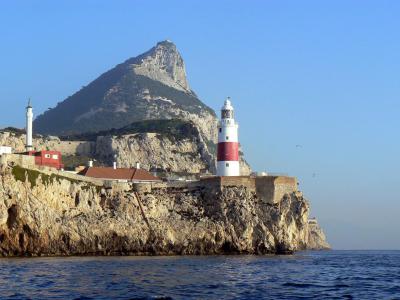
Europa Point (Punta de Europa) stands as the southernmost tip of Gibraltar. It holds significance as the southernmost point of the Iberian Peninsula, with Punta de Tarifa situated 25 kilometers southwest of Gibraltar. Nestled at the edge of the Rock of Gibraltar, this area boasts a level terrain adorned with notable features like a playing field and a handful of buildings.
On a clear day, one can admire panoramic views of North Africa across the Strait of Gibraltar, including sights of Ceuta and the Rif Mountains of Morocco. Additionally, the Bay of Gibraltar and the Spanish towns lining its shores can be seen. To reach Europa Point, one must traverse Europa Road starting from the old town.
Five remarkable buildings grace Europa Point, namely Harding's Battery, the Ibrahim-al-Ibrahim Mosque, the Roman Catholic Shrine of Our Lady of Europe, the Europa Point Lighthouse, and the Nun's Well. Moreover, Europa Point claims the distinction of housing Gibraltar's sole dedicated cricket oval, where the national cricket team competes. Since 2013, Europa Point has also served as the site of the Sikorski Memorial.
Dudley Ward Tunnel connects Europa Point to the eastern side of the Rock, linking it with Sandy Bay and Catalan Bay. After eight years of closure due to a tragic rockfall, the tunnel reopened in 2010.
In 2011, the Government of Gibraltar undertook a refurbishment project at Europa Point, which was inaugurated by Peter Caruana, the Chief Minister of Gibraltar at the time. As part of the renovations, an original RML 12.5-inch 38-ton gun was mounted on a custom-made replica carriage at Harding's Battery. Additionally, the memorial honoring General Wladislaw Sikorski was relocated to Europa Point from Sir Herbert Miles Road.
On a clear day, one can admire panoramic views of North Africa across the Strait of Gibraltar, including sights of Ceuta and the Rif Mountains of Morocco. Additionally, the Bay of Gibraltar and the Spanish towns lining its shores can be seen. To reach Europa Point, one must traverse Europa Road starting from the old town.
Five remarkable buildings grace Europa Point, namely Harding's Battery, the Ibrahim-al-Ibrahim Mosque, the Roman Catholic Shrine of Our Lady of Europe, the Europa Point Lighthouse, and the Nun's Well. Moreover, Europa Point claims the distinction of housing Gibraltar's sole dedicated cricket oval, where the national cricket team competes. Since 2013, Europa Point has also served as the site of the Sikorski Memorial.
Dudley Ward Tunnel connects Europa Point to the eastern side of the Rock, linking it with Sandy Bay and Catalan Bay. After eight years of closure due to a tragic rockfall, the tunnel reopened in 2010.
In 2011, the Government of Gibraltar undertook a refurbishment project at Europa Point, which was inaugurated by Peter Caruana, the Chief Minister of Gibraltar at the time. As part of the renovations, an original RML 12.5-inch 38-ton gun was mounted on a custom-made replica carriage at Harding's Battery. Additionally, the memorial honoring General Wladislaw Sikorski was relocated to Europa Point from Sir Herbert Miles Road.

6) Gibraltar Cable Car (must see)
The Gibraltar Cable Car offers a journey that’s as much about wonder as it is about height. Opened in 1966, it connects the bustling town below with the Upper Rock, where Gibraltar’s famous Barbary macaques roam freely among panoramic viewpoints. Built by a Swiss engineering company and designed by British architect Brian Helliwell, the cable car replaced an old military ropeway that once hauled supplies up to Signal Hill—a strategic site used for centuries to monitor the Strait. Its six-minute ascent from Alameda Gardens to the top of Signal Hill is short but unforgettable, revealing layer after layer of the Rock’s history as the scenery shifts from the orderly streets of town to windswept cliffs above the glittering Mediterranean.
Legend adds another layer of charm to the experience. The local saying goes that as long as the macaques remain on the Rock, Gibraltar will stay British. The superstition runs so deep that Winston Churchill himself once ordered reinforcements for the dwindling monkey population during World War II, fearing that their disappearance might be taken as a bad omen. Today, the macaques have become beloved symbols of the Rock, often lounging near the Top Station and posing for photos—though smart travelers keep their snacks well hidden.
At the summit, visitors step onto viewing terraces that offer some of the most remarkable vistas in Europe. On a clear day, one can see across the Bay of Gibraltar toward Spain, and even the distant mountains of Morocco shimmering on the horizon. A small café and exhibition space add comfort and context to the view, highlighting Gibraltar’s role as the meeting point between two continents. More than just a mode of transport, the Gibraltar Cable Car is a passage through time and myth—a modern reminder of the Rock’s enduring spirit and its breathtaking command of the Mediterranean landscape.
Legend adds another layer of charm to the experience. The local saying goes that as long as the macaques remain on the Rock, Gibraltar will stay British. The superstition runs so deep that Winston Churchill himself once ordered reinforcements for the dwindling monkey population during World War II, fearing that their disappearance might be taken as a bad omen. Today, the macaques have become beloved symbols of the Rock, often lounging near the Top Station and posing for photos—though smart travelers keep their snacks well hidden.
At the summit, visitors step onto viewing terraces that offer some of the most remarkable vistas in Europe. On a clear day, one can see across the Bay of Gibraltar toward Spain, and even the distant mountains of Morocco shimmering on the horizon. A small café and exhibition space add comfort and context to the view, highlighting Gibraltar’s role as the meeting point between two continents. More than just a mode of transport, the Gibraltar Cable Car is a passage through time and myth—a modern reminder of the Rock’s enduring spirit and its breathtaking command of the Mediterranean landscape.
