Custom Walk in Mainz, Germany by th_zick_884f94 created on 2026-02-20
Guide Location: Germany » Mainz
Guide Type: Custom Walk
# of Sights: 7
Tour Duration: 2 Hour(s)
Travel Distance: 5.2 Km or 3.2 Miles
Share Key: MV8DQ
Guide Type: Custom Walk
# of Sights: 7
Tour Duration: 2 Hour(s)
Travel Distance: 5.2 Km or 3.2 Miles
Share Key: MV8DQ
How It Works
Please retrieve this walk in the GPSmyCity app. Once done, the app will guide you from one tour stop to the next as if you had a personal tour guide. If you created the walk on this website or come to the page via a link, please follow the instructions below to retrieve the walk in the app.
Retrieve This Walk in App
Step 1. Download the app "GPSmyCity: Walks in 1K+ Cities" on Apple App Store or Google Play Store.



Step 2. In the GPSmyCity app, download(or launch) the guide "Mainz Map and Walking Tours".
Step 3. Tap the menu button located at upper right corner of the "Walks" screen and select "Retrieve custom walk". Enter the share key: MV8DQ
1) Central Station (Hauptbahnhof)
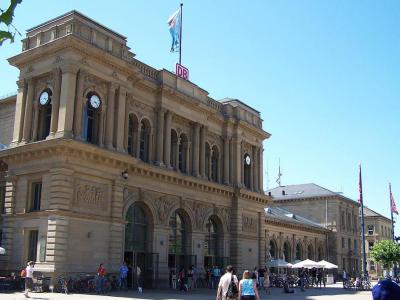
Mainz Central Station (Mainz Hauptbahnhof), the main railway station of Mainz, is an essential transport hub in Rhineland-Palatinate, serving approximately 60,000 travelers daily. This station, which became operational in 1884, was designed by Philipp Johann Berdellé in a blend of Italian neo-Renaissance with Baroque and Neoclassical influences. The structure is notable for its striking central section, adorned with intricate allegorical sculptures that depict the experiences of arrivals and departures, created by Mainz sculptors Valentin Barth and Anton Scholl.
The station's development reflects the broader history of Mainz's transition from a trading port to a key railway center. After losing its medieval trading rights in 1831 and facing competition from the Taunus Railway in 1840, Mainz regained significance when the Hessian Ludwig Railway Company initiated railway lines from the city in 1845. Key routes connected Mainz to Ludwigshafen, Aschaffenburg, Bingen, and Alzey, helping to solidify its position as a major railway hub. A permanent railway bridge over the Rhine, completed in 1862, further facilitated this growth.
Mainz Central Station is also known for its impressive train hall, which was the longest in Europe at the time of its opening. The hall spanned 300 meters in length and 47 meters in width, built with a structure of cast and wrought iron, glass, and corrugated iron, creating a vast space supported by 60 wrought-iron columns. This architectural marvel remains a symbol of the city’s industrial and architectural achievements.
The station's development reflects the broader history of Mainz's transition from a trading port to a key railway center. After losing its medieval trading rights in 1831 and facing competition from the Taunus Railway in 1840, Mainz regained significance when the Hessian Ludwig Railway Company initiated railway lines from the city in 1845. Key routes connected Mainz to Ludwigshafen, Aschaffenburg, Bingen, and Alzey, helping to solidify its position as a major railway hub. A permanent railway bridge over the Rhine, completed in 1862, further facilitated this growth.
Mainz Central Station is also known for its impressive train hall, which was the longest in Europe at the time of its opening. The hall spanned 300 meters in length and 47 meters in width, built with a structure of cast and wrought iron, glass, and corrugated iron, creating a vast space supported by 60 wrought-iron columns. This architectural marvel remains a symbol of the city’s industrial and architectural achievements.

2) Drusus Stone
The Drusus Stone (Drususstein) is a towering 20-meter-high structure of Roman origin located within the citadel of Mainz. Once encased in marble, this masonry block is widely accepted as the remains of the cenotaph erected in 9 BC by Roman troops to honor their deceased commander, General Nero Claudius Drusus. Writers such as Eutropius and Suetonius referenced this monument, which stands as a testament to Drusus's legacy in Mainz.
In the early Roman Empire, the Drusus Stone became the focal point of elaborate memorial ceremonies for Drusus and the center of the imperial cult in the region. A processional road once linked the structure to the grand Roman theatre of Mogontiacum (modern-day Mainz), which seated around 12,000 people, making it the largest known theatre north of the Alps. Annual ceremonies, marking both Drusus's death and his birthday, likely took place here.
Drusus, Emperor Augustus's stepson, established the Mogontiacum legionary camp for Roman campaigns in Magna Germania. After his death in 9 BC, his brother Tiberius and the Roman army brought his body back to Mogontiacum, where soldiers honored him with a memorial. Augustus later endorsed the cenotaph and wrote the inscription.
During the Middle Ages, the Drusus Stone's marble covering was stripped away, and by the 16th century, it had been repurposed as a watchtower, complete with a staircase and doorframe cut into the formerly solid structure. Along with the remnants of the Roman aqueducts and the theatre stage, the Drusus Stone is one of the last visible traces of ancient Roman Mogontiacum.
In the early Roman Empire, the Drusus Stone became the focal point of elaborate memorial ceremonies for Drusus and the center of the imperial cult in the region. A processional road once linked the structure to the grand Roman theatre of Mogontiacum (modern-day Mainz), which seated around 12,000 people, making it the largest known theatre north of the Alps. Annual ceremonies, marking both Drusus's death and his birthday, likely took place here.
Drusus, Emperor Augustus's stepson, established the Mogontiacum legionary camp for Roman campaigns in Magna Germania. After his death in 9 BC, his brother Tiberius and the Roman army brought his body back to Mogontiacum, where soldiers honored him with a memorial. Augustus later endorsed the cenotaph and wrote the inscription.
During the Middle Ages, the Drusus Stone's marble covering was stripped away, and by the 16th century, it had been repurposed as a watchtower, complete with a staircase and doorframe cut into the formerly solid structure. Along with the remnants of the Roman aqueducts and the theatre stage, the Drusus Stone is one of the last visible traces of ancient Roman Mogontiacum.
3) Cultural Center KUZ
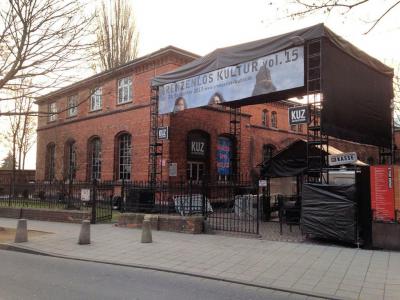
The KUZ – Mainz Cultural Center is a vibrant cultural and event hub located near the Rhine, blending its rich history with modern functionality. Originally established in 1981, the red brick building became a beloved venue for theatre, music, and cabaret performances, making it a central part of Mainz's cultural scene. After closing in 2015 for extensive renovation, the center reopened in 2018 with upgraded facilities and cutting-edge technology, revitalizing its role as a major regional and national event destination.
With an industrial-historic charm, the KUZ offers 706 square meters of event space spread over two levels, accommodating up to 1,200 guests. It provides an ideal setting for conferences, road shows, corporate events, and digital or hybrid productions, thanks to its mobile production studio. The venue includes several distinct spaces: the Workshop (Werkhalle), known for its industrial ambiance; the modern Lecture Hall (Lehrsaal) for smaller gatherings; and the Washhouse (Waschhaus), which features both indoor and outdoor areas with a casual, bar-like atmosphere.
The combination of modern technology and historic architecture makes the KUZ a unique and flexible venue for a wide range of events, all set against the scenic backdrop of the Rhine River.
With an industrial-historic charm, the KUZ offers 706 square meters of event space spread over two levels, accommodating up to 1,200 guests. It provides an ideal setting for conferences, road shows, corporate events, and digital or hybrid productions, thanks to its mobile production studio. The venue includes several distinct spaces: the Workshop (Werkhalle), known for its industrial ambiance; the modern Lecture Hall (Lehrsaal) for smaller gatherings; and the Washhouse (Waschhaus), which features both indoor and outdoor areas with a casual, bar-like atmosphere.
The combination of modern technology and historic architecture makes the KUZ a unique and flexible venue for a wide range of events, all set against the scenic backdrop of the Rhine River.
4) Kirschgarten (Cherry Orchard) (must see)
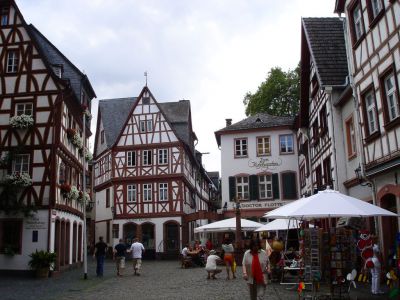
The Cherry Orchard in Mainz is one of the city’s most picturesque squares, rich with history and architectural charm. This square is lined with three-and-a-half-story half-timbered houses, some dating back to the 15th and 18th centuries. Originally part of the Nova Civitas urban expansion in the 13th and 14th centuries, the square has a long-standing presence in Mainz’s old town. The name “Kirschgarten” (Cherry Orchard) stems from the “Kirschborn” spring, which once rose near the old Rochus Hospital.
The Cherry Orchard features a unique combination of traditional Mainz architecture and cultural heritage. The square is a hub of narrow alleys, including the notable “Weihergarten,” which connects the half-timbered houses. The space once belonged to the immunity of the Mainz Cathedral Chapter, and by the 16th century, it had become a center for the book trade, housing a printing press established by Friedrich Heumann.
At the heart of the Cherry Orchard stands the Cherry Orchard Fountain, also called the Madonna Fountain, donated by the Mainz Beautification Association in 1932. Crafted from red sandstone, this fountain replaced an older iron one. The fountain is crowned with a statue of the Virgin Mary, a replica of the Harxheim Madonna, created by sculptor Jean Sauer. At the base of the fountain, a relief by Carl Moritz Hoffmann depicts the Blasius Chapel, which once stood at the entrance to the square until 1803.
Visitors can admire the well-preserved facades of the houses and search for historical inscriptions on the buildings. The Cherry Orchard remains a beautiful reminder of Mainz’s medieval history, offering both locals and tourists a glimpse into the city’s past.
The Cherry Orchard features a unique combination of traditional Mainz architecture and cultural heritage. The square is a hub of narrow alleys, including the notable “Weihergarten,” which connects the half-timbered houses. The space once belonged to the immunity of the Mainz Cathedral Chapter, and by the 16th century, it had become a center for the book trade, housing a printing press established by Friedrich Heumann.
At the heart of the Cherry Orchard stands the Cherry Orchard Fountain, also called the Madonna Fountain, donated by the Mainz Beautification Association in 1932. Crafted from red sandstone, this fountain replaced an older iron one. The fountain is crowned with a statue of the Virgin Mary, a replica of the Harxheim Madonna, created by sculptor Jean Sauer. At the base of the fountain, a relief by Carl Moritz Hoffmann depicts the Blasius Chapel, which once stood at the entrance to the square until 1803.
Visitors can admire the well-preserved facades of the houses and search for historical inscriptions on the buildings. The Cherry Orchard remains a beautiful reminder of Mainz’s medieval history, offering both locals and tourists a glimpse into the city’s past.
5) Mainz Cathedral (must see)
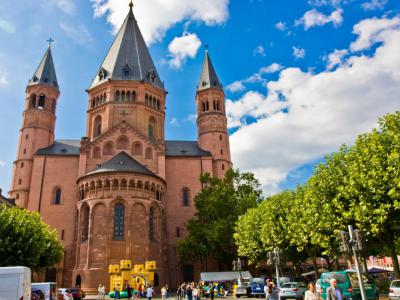
The Mainz Cathedral, a towering symbol of Christianity's long-standing presence in Mainz, traces its roots back to 746 when Saint Boniface introduced Christianity to the region. Archbishop Willigis, inspired by Saint Peter’s Basilica in Rome, ordered the construction of the cathedral, which was unfortunately ravaged by fire on the very day of its consecration in 1009. Despite the damage, the cathedral was repaired by 1036, and over time, it has evolved into a blend of styles that reflect centuries of architectural and historical changes.
The original Romanesque style is still visible in the cathedral’s triple-nave basilica and its bronze door facing the square. Over the years, additional chapels and structures have been added, each showcasing the design trends of their respective eras. One of the more notable additions is Saint Gotthard’s Chapel, built in 1137, which stands out with its lighter stone.
Fire has been a recurring adversary for Mainz Cathedral, striking seven times throughout its history. To prevent further damage, the spire was reconstructed from stone in 1767. The east chancel, the oldest part of the cathedral, features walls over two meters thick, providing a glimpse into its early construction. The Romanesque west chancel, dating to 1239, was later enhanced by a Gothic belfry in the 15th century.
Mainz Cathedral also holds historical significance as a site of royal coronations in the 11th, 12th, and 13th centuries. The Diet of Pentecost, one of the most legendary medieval feasts, was held here. Despite enduring heavy damage during attacks by French and Prussian troops in the late 18th century, as well as during World War II, the cathedral has been meticulously restored over the years. Its foundations were reinforced in the early 20th century after the Rhine River’s correction caused structural issues.
Inside, the cathedral remains a treasure trove of art and history. The Ketteler Chapel is home to an altar dedicated to the Virgin Mary, along with the serene statue of the "Serene Lady of Mainz," a wood-carved figure dating back to 1510. The cathedral also houses the tombs of its bishops and boasts a cherished portrait gallery of ecclesiastical dignitaries.
Today, Mainz Cathedral stands not only as a religious site but also as a testament to the city's resilience and rich history. It continues to be a focal point of Mainz, drawing visitors from around the world to marvel at its architecture, art, and historical significance.
The original Romanesque style is still visible in the cathedral’s triple-nave basilica and its bronze door facing the square. Over the years, additional chapels and structures have been added, each showcasing the design trends of their respective eras. One of the more notable additions is Saint Gotthard’s Chapel, built in 1137, which stands out with its lighter stone.
Fire has been a recurring adversary for Mainz Cathedral, striking seven times throughout its history. To prevent further damage, the spire was reconstructed from stone in 1767. The east chancel, the oldest part of the cathedral, features walls over two meters thick, providing a glimpse into its early construction. The Romanesque west chancel, dating to 1239, was later enhanced by a Gothic belfry in the 15th century.
Mainz Cathedral also holds historical significance as a site of royal coronations in the 11th, 12th, and 13th centuries. The Diet of Pentecost, one of the most legendary medieval feasts, was held here. Despite enduring heavy damage during attacks by French and Prussian troops in the late 18th century, as well as during World War II, the cathedral has been meticulously restored over the years. Its foundations were reinforced in the early 20th century after the Rhine River’s correction caused structural issues.
Inside, the cathedral remains a treasure trove of art and history. The Ketteler Chapel is home to an altar dedicated to the Virgin Mary, along with the serene statue of the "Serene Lady of Mainz," a wood-carved figure dating back to 1510. The cathedral also houses the tombs of its bishops and boasts a cherished portrait gallery of ecclesiastical dignitaries.
Today, Mainz Cathedral stands not only as a religious site but also as a testament to the city's resilience and rich history. It continues to be a focal point of Mainz, drawing visitors from around the world to marvel at its architecture, art, and historical significance.
6) Markt (Market Square) (must see)
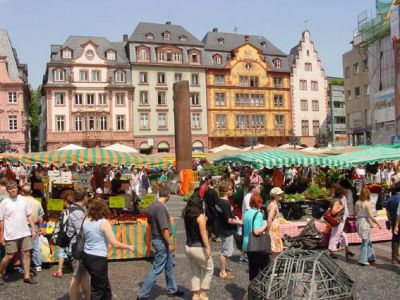
Market Square is Mainz's most popular square and is dominated by the iconic Mainz Cathedral. The square became a popular trading place when the cathedral was built in 975. Traditionally, merchants offered wool, cloth, fur, baked goods, and fruit and vegetables. Products were set out in large baskets on the floor.
The Renaissance market fountain was built in 1526. The water fountain was an important source of fresh water for nearby residents. In 1889, a Madonna figure was added to the fountain.
Most of the houses in the square date to the 18th century. World War II bombs heavily damaged Market Square. In 1975, Mainz celebrated the thousandth anniversary of the cathedral and committed to re-designing and rebuilding the square. Many of the buildings were rebuilt with historical facades.
The market takes place Tuesdays, Fridays, and Saturdays. Market Square hosts a vibrant Christmas Market during the Christmas holiday season.
The Renaissance market fountain was built in 1526. The water fountain was an important source of fresh water for nearby residents. In 1889, a Madonna figure was added to the fountain.
Most of the houses in the square date to the 18th century. World War II bombs heavily damaged Market Square. In 1975, Mainz celebrated the thousandth anniversary of the cathedral and committed to re-designing and rebuilding the square. Many of the buildings were rebuilt with historical facades.
The market takes place Tuesdays, Fridays, and Saturdays. Market Square hosts a vibrant Christmas Market during the Christmas holiday season.
7) Hof zum Gutenberg (Gutenberg's Birthplace)
Johannes Gutenberg was born here between 1394 and 1404, although no records indicate the exact day, month, or year. In the 1890s, the city of Mainz declared his symbolic date of birth to be June 24, 1400. Gutenberg didn't spend his entire life in Mainz but spent some time in Strasbourg.
By 1448, he returned to Mainz and set up his first printing press in his father's house. He extended his printing press in 1450 at Humbrecht Court and printed the Gutenberg Bible in 1455.
After a financial disagreement with a business partner, Gutenberg returned to his father's home.
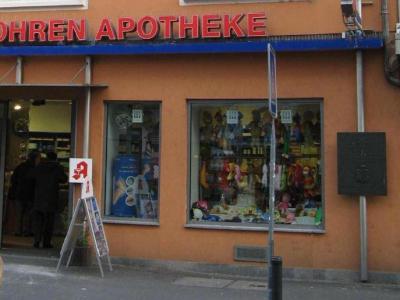
The Hof zum Gutenberg became part of Mainz University in 1477. The building is known as "Urdruckerei," or the original printing house. The building was rebuilt in the Baroque style but destroyed during World War II. Today, the site houses a pharmacy.
By 1448, he returned to Mainz and set up his first printing press in his father's house. He extended his printing press in 1450 at Humbrecht Court and printed the Gutenberg Bible in 1455.
After a financial disagreement with a business partner, Gutenberg returned to his father's home.
The Hof zum Gutenberg became part of Mainz University in 1477. The building is known as "Urdruckerei," or the original printing house. The building was rebuilt in the Baroque style but destroyed during World War II. Today, the site houses a pharmacy.
