Custom Walk in Florence, Italy by rafal_gorczyca95_56cf4c created on 2026-02-22
Guide Location: Italy » Florence
Guide Type: Custom Walk
# of Sights: 6
Tour Duration: 1 Hour(s)
Travel Distance: 2.6 Km or 1.6 Miles
Share Key: KTZGX
Guide Type: Custom Walk
# of Sights: 6
Tour Duration: 1 Hour(s)
Travel Distance: 2.6 Km or 1.6 Miles
Share Key: KTZGX
How It Works
Please retrieve this walk in the GPSmyCity app. Once done, the app will guide you from one tour stop to the next as if you had a personal tour guide. If you created the walk on this website or come to the page via a link, please follow the instructions below to retrieve the walk in the app.
Retrieve This Walk in App
Step 1. Download the app "GPSmyCity: Walks in 1K+ Cities" on Apple App Store or Google Play Store.



Step 2. In the GPSmyCity app, download(or launch) the guide "Florence Map and Walking Tours".
Step 3. Tap the menu button located at upper right corner of the "Walks" screen and select "Retrieve custom walk". Enter the share key: KTZGX
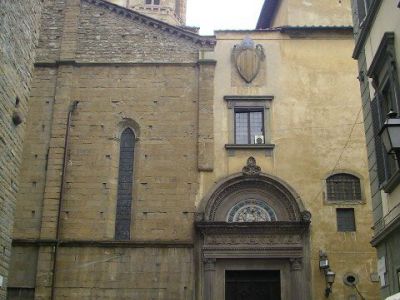
1) Badia Fiorentina (Florentine Abbey)
One of the oldest churches in Florence, this historic abbey dates all the way back to 978, founded by Willa, the widow of Count Uberto of Tuscany. It became the burial place of their son, Count Ugo, whose tomb still stands today as a tribute to the family’s legacy. Inside, visitors can also admire a powerful work of art: Filippino Lippi’s “Apparition of the Virgin to Saint Bernard”, painted in 1485. This Renaissance marvel adds a burst of emotion and life to the otherwise quiet interior and remains one of the city’s most admired paintings.
The abbey originally followed the Benedictine rule and held an important place in the spiritual and cultural life of medieval Florence. Over time, it went through several changes, especially during a major renovation in the 17th century that gave the building much of its Baroque character. Still, traces of its Romanesque and Gothic roots are easy to spot for those who know where to look.
If you’re visiting, try to make time for the “Cloister of the Orange Trees.” Although the real-life trees planted by monks are long gone, the space remains peaceful and visually striking, with early frescoes lining the walls and a view of the 14th-century hexagonal bell tower, mentioned by Dante in the “Paradiso” section of “The Divine Comedy”. The cloister is only open on Monday afternoons, and can be tricky to find-look for a small door to the right of the altar.
It is also said that Dante likely studied at this very abbey during his youth. Some even believe he first laid eyes on Beatrice, his lifelong muse, in the nearby church.
Today, this sacred place is cared for by the Fraternity of Jerusalem, a contemplative community whose members chant the Divine Office each evening around 6 PM. The experience is quietly moving, drawing tourists and locals alike.
The abbey originally followed the Benedictine rule and held an important place in the spiritual and cultural life of medieval Florence. Over time, it went through several changes, especially during a major renovation in the 17th century that gave the building much of its Baroque character. Still, traces of its Romanesque and Gothic roots are easy to spot for those who know where to look.
If you’re visiting, try to make time for the “Cloister of the Orange Trees.” Although the real-life trees planted by monks are long gone, the space remains peaceful and visually striking, with early frescoes lining the walls and a view of the 14th-century hexagonal bell tower, mentioned by Dante in the “Paradiso” section of “The Divine Comedy”. The cloister is only open on Monday afternoons, and can be tricky to find-look for a small door to the right of the altar.
It is also said that Dante likely studied at this very abbey during his youth. Some even believe he first laid eyes on Beatrice, his lifelong muse, in the nearby church.
Today, this sacred place is cared for by the Fraternity of Jerusalem, a contemplative community whose members chant the Divine Office each evening around 6 PM. The experience is quietly moving, drawing tourists and locals alike.
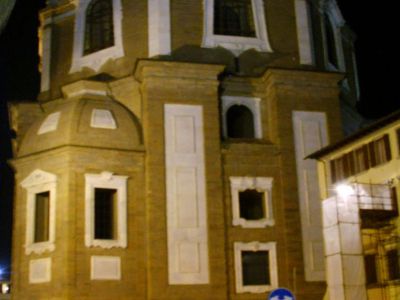
2) Cappelle Medicee (Medici Chapels)
This impressive complex encompasses the Chapel of the Princes ("Cappella dei Principi"), a mausoleum and chapel dedicated to the Medici family, which began construction in 1605 and engaged marble workers for several centuries. Additionally, it includes the New Sacristy ("Sagrestia Nuova"), designed by Michelangelo. The name distinguishes it from Brunelleschi's Old Sacristy ("Sagrestia Vecchia"), located in San Lorenzo. In 1520, Cardinal Giulio de' Medici, who later became Pope Clement VII, commissioned Michelangelo to create the New Sacristy as a new burial chapel for his cousins, while also intending to pay homage to his father, Giuliano, and his uncle, Lorenzo il Magnifico. The result was a masterpiece combining architecture and sculpture.
Architecturally, Michelangelo exhibited his characteristic originality and inventiveness in the New Sacristy. However, it is the commanding sculpted tombs that rightfully dominate the space. The tomb on the right features figures symbolizing Day and Night, while the tomb on the left showcases figures representing Dawn and Dusk. Above them, idealized sculptures of the two men are typically interpreted as representing the active life and the contemplative life. While these allegorical meanings add depth, the true impact lies in the powerful presence of the sculptural figures and their ability to captivate the viewer. The intensity and force with which they engage the viewer leave a lasting impression.
The magnificent octagonal Chapel of the Princes, crowned by an imposing 59-meter-tall dome, serves as a striking focal point of San Lorenzo when viewed from a distance. It occupies a central position within the church, akin to an apsidal chapel, and provides a grand entrance from the exterior via Piazza Madonna degli Aldobrandini. Access to the chapel is through a low vaulted crypt, carefully designed by Bernardo Buontalenti even before plans were formulated for the chapel above.
Architecturally, Michelangelo exhibited his characteristic originality and inventiveness in the New Sacristy. However, it is the commanding sculpted tombs that rightfully dominate the space. The tomb on the right features figures symbolizing Day and Night, while the tomb on the left showcases figures representing Dawn and Dusk. Above them, idealized sculptures of the two men are typically interpreted as representing the active life and the contemplative life. While these allegorical meanings add depth, the true impact lies in the powerful presence of the sculptural figures and their ability to captivate the viewer. The intensity and force with which they engage the viewer leave a lasting impression.
The magnificent octagonal Chapel of the Princes, crowned by an imposing 59-meter-tall dome, serves as a striking focal point of San Lorenzo when viewed from a distance. It occupies a central position within the church, akin to an apsidal chapel, and provides a grand entrance from the exterior via Piazza Madonna degli Aldobrandini. Access to the chapel is through a low vaulted crypt, carefully designed by Bernardo Buontalenti even before plans were formulated for the chapel above.
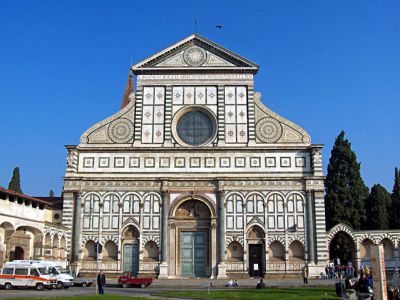
3) Basilica di Santa Maria Novella (Basilica of Santa Maria Novella)
Built in the 13th century, Santa Maria Novella is, chronologically, the first grand basilica in Florence, and stands as the city's principal Dominican church. Within its walls, along with the adjacent cloister and chapter house, lie a multitude of art treasures and funerary monuments. Especially famous are frescoes crafted by Gothic and early Renaissance masters, generously funded by prominent Florentine families, securing for themselves funerary chapels on consecrated ground.
The exterior showcases architectural elements inspired by antiquity, including the pediment and frieze; however, the upper portion introduces a novel and unprecedented design feature: S-curved scrolls. These scrolls, or variations thereof, can be found in churches across Italy and owe their origins to the innovative design of Santa Maria Novella, which ingeniously addressed the challenge of transitioning from wide to narrow storeys.
Beyond its architectural splendor and captivating cloisters, the basilica houses an array of artistic treasures, including frescoes, statues, paintings, and wooden crosses. Notable among them is the world-famous fresco "The Holy Trinity" by Masaccio, which had a profound impact on Florentine painting, inspiring future generations with its groundbreaking use of perspective and mathematical proportions. Additionally, the pulpit designed by Brunelleschi himself is of historical significance, as it was from this very pulpit that the first verbal attack against Galileo Galilei was launched, ultimately leading to his indictment.
Be sure not to overlook the Cappella Strozzi di Mantova, situated at the end of the left transept. Adorned with frescoes inspired by Dante's "Divine Comedy", this chapel portrays the Last Judgment (on the back wall, featuring a portrait of Dante), Hell (on the right wall), and Paradise (on the left wall). Executed between 1350 and 1357, these remarkable artworks vividly bring to life the essence of Dante's renowned literary masterpiece.
The exterior showcases architectural elements inspired by antiquity, including the pediment and frieze; however, the upper portion introduces a novel and unprecedented design feature: S-curved scrolls. These scrolls, or variations thereof, can be found in churches across Italy and owe their origins to the innovative design of Santa Maria Novella, which ingeniously addressed the challenge of transitioning from wide to narrow storeys.
Beyond its architectural splendor and captivating cloisters, the basilica houses an array of artistic treasures, including frescoes, statues, paintings, and wooden crosses. Notable among them is the world-famous fresco "The Holy Trinity" by Masaccio, which had a profound impact on Florentine painting, inspiring future generations with its groundbreaking use of perspective and mathematical proportions. Additionally, the pulpit designed by Brunelleschi himself is of historical significance, as it was from this very pulpit that the first verbal attack against Galileo Galilei was launched, ultimately leading to his indictment.
Be sure not to overlook the Cappella Strozzi di Mantova, situated at the end of the left transept. Adorned with frescoes inspired by Dante's "Divine Comedy", this chapel portrays the Last Judgment (on the back wall, featuring a portrait of Dante), Hell (on the right wall), and Paradise (on the left wall). Executed between 1350 and 1357, these remarkable artworks vividly bring to life the essence of Dante's renowned literary masterpiece.
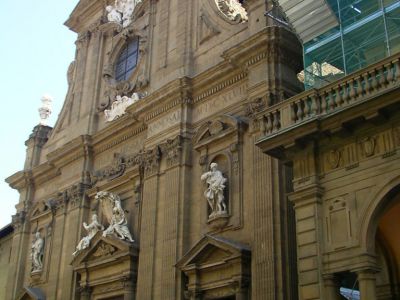
4) Chiesa dei Santi Michele e Gaetano (Church of Sts. Michael and Gaetano)
During the Counterreformation in 1592, the Theatine order took control of an 11th-century church dedicated to Saint Michael and embarked on the construction of a new building in 1604, following the design by Bernardo Buontalenti. The influential Medici family provided significant support and personal involvement in the church's development. Grand Duke Ferdinando I offered financial assistance during the initial stages of construction, while his son and Cardinal, Carlo de Medici, showed great concern for the project.
The newly constructed edifice, named the Church of Santi Michele e Gaetano, was erected on the site of a Romanesque Church and dedicated to Saint Gaetano, considering the previous church's dedication to Saint Michael. Over the course of the project, which concluded in 1648, multiple architects contributed to the construction, introducing variations to the original design.
Situated in a city known for its Renaissance architectural style, this church on Antinori Square stands out with its distinctive Baroque aesthetic. The façade, adorned with sculptures, exudes a captivating, dynamic, and theatrical quality. Designed by Florentine architects Gherardo and Pier Francesco Silvani, it appears to have been designed in imitation of Roman churches.. Inside, the single nave features a series of white marble sculptures that create a dramatic effect in the semi-darkness. Visitors can also explore the Chapel of the Nativity by Matteo Rosselli and the "Martyrdom of San Lorenzo" by Pietro da Cortona.
For those seeking a departure from the Renaissance style, a visit to this Church is highly recommended to appreciate its unique Baroque characteristics.
The newly constructed edifice, named the Church of Santi Michele e Gaetano, was erected on the site of a Romanesque Church and dedicated to Saint Gaetano, considering the previous church's dedication to Saint Michael. Over the course of the project, which concluded in 1648, multiple architects contributed to the construction, introducing variations to the original design.
Situated in a city known for its Renaissance architectural style, this church on Antinori Square stands out with its distinctive Baroque aesthetic. The façade, adorned with sculptures, exudes a captivating, dynamic, and theatrical quality. Designed by Florentine architects Gherardo and Pier Francesco Silvani, it appears to have been designed in imitation of Roman churches.. Inside, the single nave features a series of white marble sculptures that create a dramatic effect in the semi-darkness. Visitors can also explore the Chapel of the Nativity by Matteo Rosselli and the "Martyrdom of San Lorenzo" by Pietro da Cortona.
For those seeking a departure from the Renaissance style, a visit to this Church is highly recommended to appreciate its unique Baroque characteristics.
5) Caffe Gilli
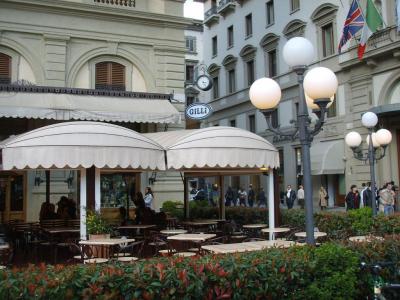
Established in 1733, this long-standing café on Piazza della Repubblica moved to its present site in 1910. With its wood paneling, marble surfaces, frescoed ceiling, and glass details catching the light of Murano chandeliers, the Belle Époque interior is a feature in itself (despite recurring rumors of an imminent modernization). Even so, most patrons choose to relax on the spacious outdoor terrace, well positioned for watching the steady flow of passersby.
The well-known cocktail Negroni, made with gin, vermouth, bitter Campari, and a slice of orange, takes its name from Count Camillo Negroni, who popularized the drink in Florence around 1919. On colder afternoons, many visitors instead opt for the café’s renowned hot chocolate, notably thick and closer to liquid pudding than a standard drink, topped with whipped cream and available in flavors such as almond, orange, coffee, gianduia, and cocoa. Gilli also serves a refined selection of pastries, including cakes, fruit tartlets, and millefoglie—layers of puff pastry filled with vanilla or chocolate Chantilly cream.
Tip:
Immerse yourself in the local culture by joining the locals who stand at the bar and enjoy an "aperitivo" drink accompanied by complimentary nibbles. Standing at the bar is also more cost-effective than sitting down, where prices tend to be higher.
Editor’s Note: Caffè Gilli closed on January 19, 2026, for scheduled, heritage-approved renovation works and is expected to reopen by the end of March 2026. The project aims to preserve the historic character and iconic status of Florence’s oldest café.
The well-known cocktail Negroni, made with gin, vermouth, bitter Campari, and a slice of orange, takes its name from Count Camillo Negroni, who popularized the drink in Florence around 1919. On colder afternoons, many visitors instead opt for the café’s renowned hot chocolate, notably thick and closer to liquid pudding than a standard drink, topped with whipped cream and available in flavors such as almond, orange, coffee, gianduia, and cocoa. Gilli also serves a refined selection of pastries, including cakes, fruit tartlets, and millefoglie—layers of puff pastry filled with vanilla or chocolate Chantilly cream.
Tip:
Immerse yourself in the local culture by joining the locals who stand at the bar and enjoy an "aperitivo" drink accompanied by complimentary nibbles. Standing at the bar is also more cost-effective than sitting down, where prices tend to be higher.
Editor’s Note: Caffè Gilli closed on January 19, 2026, for scheduled, heritage-approved renovation works and is expected to reopen by the end of March 2026. The project aims to preserve the historic character and iconic status of Florence’s oldest café.
6) Chiesa di San Pier Scheraggio (Church of San Pier Scheraggio)
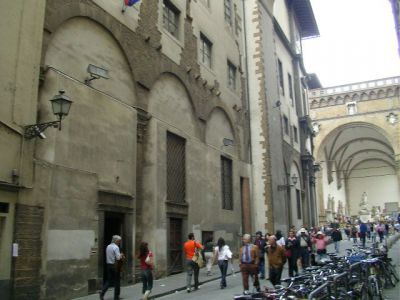
Via della Ninna emerged as a new street parallel to Palazzo Vecchio during the construction of the Uffizi Palace. During that time, the church of San Pier Scheraggio, once a prominent priory of one of Florence's districts, was unfortunately destroyed. Consecrated in 1068, the Romanesque church was once a remarkable architectural gem that housed the cherished Madonna della Ninna, lending its name to the street. The name "Scheraggio" derived from the clearing ditch that once ran alongside the city's ancient defensive walls.
The church played a vital role in the city's life, serving as the site of the election of gonfalonieri and priori, particularly when a municipal palace did not exist. Esteemed figures such as Dante and Boccaccio delivered significant speeches to the people within its walls.
The initial demolition occurred in 1298 when the nave, which housed the Madonna della Ninna, was brought down to make space for Palazzo Vecchio. Subsequent interventions took place in 1410.
In 1560, when Vasari constructed his Uffizi Palace, the church of San Pier Scheraggio was integrated into the building. Tragically, it lost not only its small cemetery but also its bell tower. However, it continued to serve religious functions until 1782, when it was transformed into the Archive of the Courts.
For an extended period, the church remained closed to the public, only opening its doors on special occasions. It was not until 1971, following an extensive restoration, that its treasures were brought back to light. The archaeological layers revealed the remains of an even older church, ancient Roman frescoes, and remnants of a staircase. Today, the former church stands as one of the rooms within the renowned Uffizi Gallery.
Along Via della Ninna, visitors can marvel at the surviving columns and arches of a nave, as well as glimpse a portion of its foundations. To commemorate the significance of this structure, a plaque proudly declares: "Remains and traces of the church of San Piero a Scheraggio, which gave its name to one of the city's districts and within whose walls, the voice of Dante echoed in the people's councils."
The church played a vital role in the city's life, serving as the site of the election of gonfalonieri and priori, particularly when a municipal palace did not exist. Esteemed figures such as Dante and Boccaccio delivered significant speeches to the people within its walls.
The initial demolition occurred in 1298 when the nave, which housed the Madonna della Ninna, was brought down to make space for Palazzo Vecchio. Subsequent interventions took place in 1410.
In 1560, when Vasari constructed his Uffizi Palace, the church of San Pier Scheraggio was integrated into the building. Tragically, it lost not only its small cemetery but also its bell tower. However, it continued to serve religious functions until 1782, when it was transformed into the Archive of the Courts.
For an extended period, the church remained closed to the public, only opening its doors on special occasions. It was not until 1971, following an extensive restoration, that its treasures were brought back to light. The archaeological layers revealed the remains of an even older church, ancient Roman frescoes, and remnants of a staircase. Today, the former church stands as one of the rooms within the renowned Uffizi Gallery.
Along Via della Ninna, visitors can marvel at the surviving columns and arches of a nave, as well as glimpse a portion of its foundations. To commemorate the significance of this structure, a plaque proudly declares: "Remains and traces of the church of San Piero a Scheraggio, which gave its name to one of the city's districts and within whose walls, the voice of Dante echoed in the people's councils."
