Custom Walk in Barcelona, Spain by marydarlene_6d9b2 created on 2026-03-20
Guide Location: Spain » Barcelona
Guide Type: Custom Walk
# of Sights: 11
Tour Duration: 4 Hour(s)
Travel Distance: 10.3 Km or 6.4 Miles
Share Key: 6HRVZ
Guide Type: Custom Walk
# of Sights: 11
Tour Duration: 4 Hour(s)
Travel Distance: 10.3 Km or 6.4 Miles
Share Key: 6HRVZ
How It Works
Please retrieve this walk in the GPSmyCity app. Once done, the app will guide you from one tour stop to the next as if you had a personal tour guide. If you created the walk on this website or come to the page via a link, please follow the instructions below to retrieve the walk in the app.
Retrieve This Walk in App
Step 1. Download the app "GPSmyCity: Walks in 1K+ Cities" on Apple App Store or Google Play Store.



Step 2. In the GPSmyCity app, download(or launch) the guide "Barcelona Map and Walking Tours".
Step 3. Tap the menu button located at upper right corner of the "Walks" screen and select "Retrieve custom walk". Enter the share key: 6HRVZ
1) Placa d'Espanya (Place of Spain)
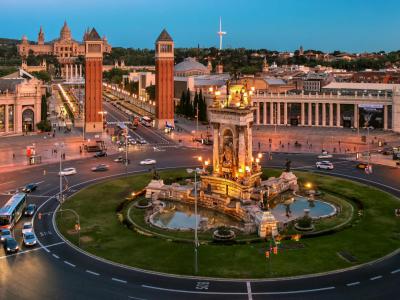
At some point during their stay in Barcelona, almost everyone finds themselves in the bustling traffic circle known as Plaça d'Espanya ("Place of Spain"), instantly recognizable by the presence of two life-sized replicas of Venice's Saint Mark's bell tower, which served as a gateway to the 1929 International Exhibition. Flanking the circle are two grand buildings dedicated to Work and Communications.
In the heart of this bustling roundabout stands a monumental fountain with a Baroque appearance, widely recognized as an iconic symbol of Barcelona. Interestingly, this fountain was commissioned as a last-minute addition in 1928 by the fair committee. What many may not realize is that it was designed by Josep Maria Jujol, a brilliant collaborator of Antoni Gaudí renowned for his spectacular tile work at Park Güell. Jujol's goal was to create a fountain that harmonized with the style of the 1929 International Exhibition, and he achieved this so perfectly that for many years it went largely unnoticed. Now, after receiving a meticulous restoration, the fountain gleams with a newfound radiance and is enchantingly illuminated at night.
Why You Should Visit:
An icon of Barcelona and also a transportation hub with shopping, dining, views, hotels, and lots of people. A great place to cool off and restore your energy while touring the city.
Tip:
Nice over day and night – try both! As the sun sets, the fountains may be turned off, but the illuminations come to life, transforming the surroundings and creating a whole new atmosphere to be enjoyed.
In the heart of this bustling roundabout stands a monumental fountain with a Baroque appearance, widely recognized as an iconic symbol of Barcelona. Interestingly, this fountain was commissioned as a last-minute addition in 1928 by the fair committee. What many may not realize is that it was designed by Josep Maria Jujol, a brilliant collaborator of Antoni Gaudí renowned for his spectacular tile work at Park Güell. Jujol's goal was to create a fountain that harmonized with the style of the 1929 International Exhibition, and he achieved this so perfectly that for many years it went largely unnoticed. Now, after receiving a meticulous restoration, the fountain gleams with a newfound radiance and is enchantingly illuminated at night.
Why You Should Visit:
An icon of Barcelona and also a transportation hub with shopping, dining, views, hotels, and lots of people. A great place to cool off and restore your energy while touring the city.
Tip:
Nice over day and night – try both! As the sun sets, the fountains may be turned off, but the illuminations come to life, transforming the surroundings and creating a whole new atmosphere to be enjoyed.
2) Castell de Montjuic (Montjuic Castle) (must see)
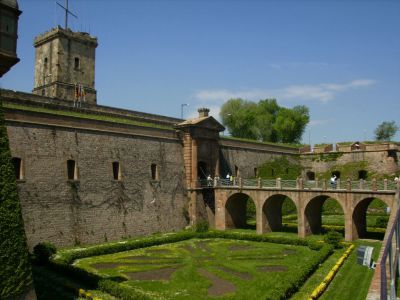
Perched at the very summit of Montjuïc, an 18th-century castle commands breathtaking views of the entire city and an expansive stretch of coastline. The initial fortress was constructed in 1640 and witnessed numerous battles during the War of the Spanish Succession in the early 1700s. Following the triumph of Felipe V, the Montjuïc fortress was reconstructed by the Bourbon rulers to maintain control over the local population. Infamous for its role as a prison and torture center, it continued to serve this purpose until after the Civil War, where notable Catalan leaders, including Lluís Companys, were imprisoned and executed.
While the castle once housed a military museum, the formal restoration of the castle to the Catalan authorities by the Spanish government in 2008 led to the transformation of the museum into a center dedicated to peace. Exhibits now chronicle the evolution of Montjuïc and the castle's tumultuous history. The castle's cable car ride and its dramatic location alone make it worth a visit. The views from the ramparts are truly magnificent, and below the castle walls, the panoramic Camí del Mar pathway stretches for one kilometer, leading to the Mirador del Migdia viewpoint. At this viewpoint, visitors can enjoy the pleasant outdoor bar named La Caseta, offering a great escape from the city and the added bonus of cool harbor views during the summer months.
Why You Should Visit:
Ideal for a lazy afternoon and quite fun to get to, taking the funicular railway first, then either the cable car (quite expensive but great views) or the bus (not so scenic but free on a T10 ticket).
Tip:
If you prefer to climb by foot, be prepared for a considerable amount of stair climbing, so please wear sturdy and comfortable shoes.
While the castle once housed a military museum, the formal restoration of the castle to the Catalan authorities by the Spanish government in 2008 led to the transformation of the museum into a center dedicated to peace. Exhibits now chronicle the evolution of Montjuïc and the castle's tumultuous history. The castle's cable car ride and its dramatic location alone make it worth a visit. The views from the ramparts are truly magnificent, and below the castle walls, the panoramic Camí del Mar pathway stretches for one kilometer, leading to the Mirador del Migdia viewpoint. At this viewpoint, visitors can enjoy the pleasant outdoor bar named La Caseta, offering a great escape from the city and the added bonus of cool harbor views during the summer months.
Why You Should Visit:
Ideal for a lazy afternoon and quite fun to get to, taking the funicular railway first, then either the cable car (quite expensive but great views) or the bus (not so scenic but free on a T10 ticket).
Tip:
If you prefer to climb by foot, be prepared for a considerable amount of stair climbing, so please wear sturdy and comfortable shoes.
3) Basilica de Santa Maria del Pi (Basilica of St. Mary of the Pine)
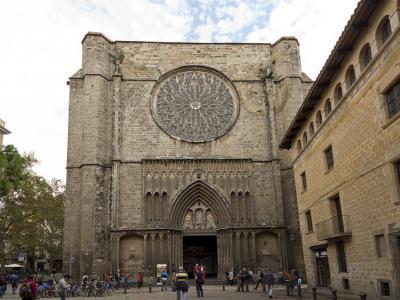
The Basilica of Saint Mary of the Pine, a quintessential 15th-century Gothic church in Barcelona, has weathered the passage of time, surviving natural disasters, wars, and deliberate destruction.
Initially documented in 987 as a small Romanesque church, it was dedicated to the Blessed Lady of the Pine Tree, which is one of the titles of the Virgin Mary. Others say that the church's name also derives from the solitary pine tree that once stood in the marshy lowland beyond the 4th-century Roman walls. The present church was constructed between 1319 and 1391 and was consecrated in 1453. Its design is noted for its Catalan Gothic style characterized by a stark, ornament-free single nave. The bell tower, initiated by Peter the Ceremonious, King of Aragon, in 1379, was completed almost 120 years later.
The catastrophic earthquake of 1428 and the early 18th-century bombings during the War of the Spanish Succession caused extensive damage to the church's facade, presbytery, main altarpiece, and stained glass windows. Restoration efforts, begun in 1717 and continued up until 1915, resulted in the removal of many Baroque decorations.
Another devastating event occurred in 1936 when anarchists set the church ablaze, seeking to destroy it. However, the church was meticulously restored after the Civil War. The restoration included the Gothic arch marking the main entrance and the large front façade rose window, destroyed by fire and replaced by a replica in 1940. The side façade displays prominent buttresses and lancet windows, while the rear façade continues this theme and includes an ancient door from 1578. The oldest surviving windows in the church date back to 1718.
Internally, the church's nave extends 54 meters in length and is defined by vaulted ceilings and side chapels. Upon entering, two interesting features await – the original wooden choir loft and the painting of "Our Lady of the Helpless" by the 18th-century Spanish artist Ramón Amadeu. The latter is said to have used his wife and children as models for the Virgin and children in the painting.
Presently, the church frequently hosts classical guitar concerts by renowned soloists. Guided tours of the basilica and the bell tower are available in English, with prior reservation.
Tip:
If you visit early or late, admission to the church is free (otherwise, there is a nominal fee). For a few extra euros, you can ascend the bell tower and enjoy a panoramic 360-degree view of the city. However, do take note of the timing, as the tower closes after dusk.
Initially documented in 987 as a small Romanesque church, it was dedicated to the Blessed Lady of the Pine Tree, which is one of the titles of the Virgin Mary. Others say that the church's name also derives from the solitary pine tree that once stood in the marshy lowland beyond the 4th-century Roman walls. The present church was constructed between 1319 and 1391 and was consecrated in 1453. Its design is noted for its Catalan Gothic style characterized by a stark, ornament-free single nave. The bell tower, initiated by Peter the Ceremonious, King of Aragon, in 1379, was completed almost 120 years later.
The catastrophic earthquake of 1428 and the early 18th-century bombings during the War of the Spanish Succession caused extensive damage to the church's facade, presbytery, main altarpiece, and stained glass windows. Restoration efforts, begun in 1717 and continued up until 1915, resulted in the removal of many Baroque decorations.
Another devastating event occurred in 1936 when anarchists set the church ablaze, seeking to destroy it. However, the church was meticulously restored after the Civil War. The restoration included the Gothic arch marking the main entrance and the large front façade rose window, destroyed by fire and replaced by a replica in 1940. The side façade displays prominent buttresses and lancet windows, while the rear façade continues this theme and includes an ancient door from 1578. The oldest surviving windows in the church date back to 1718.
Internally, the church's nave extends 54 meters in length and is defined by vaulted ceilings and side chapels. Upon entering, two interesting features await – the original wooden choir loft and the painting of "Our Lady of the Helpless" by the 18th-century Spanish artist Ramón Amadeu. The latter is said to have used his wife and children as models for the Virgin and children in the painting.
Presently, the church frequently hosts classical guitar concerts by renowned soloists. Guided tours of the basilica and the bell tower are available in English, with prior reservation.
Tip:
If you visit early or late, admission to the church is free (otherwise, there is a nominal fee). For a few extra euros, you can ascend the bell tower and enjoy a panoramic 360-degree view of the city. However, do take note of the timing, as the tower closes after dusk.
4) Pont del Bisbe (Bishop's Bridge)
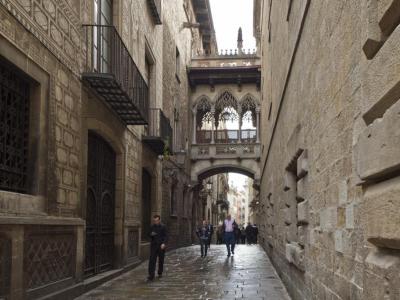
Despite its medieval, centuries-old appearance, Bishop's Bridge is a modern addition to the Gothic Quarter. Constructed in 1928 on the narrow street bearing the same name, the bridge seamlessly blends with the prevalent architectural style of the Gothic Quarter. It was designed by Catalan architect Joan Rubió during his tenure as the official architect of Barcelona in the 1920s.
The neo-Gothic marvel showcases striking architectural elements, such as arched windows, columns, gargoyles, and elaborate stone tracery, making it one of the most photogenic spots in the city. The idea of the bridge connecting the Palace of the Generalitat to the Canons House on the opposite side of the street was inspired by the Bridge of Sighs in Venice.
Joan Rubió, a keen disciple of Antoni Gaudí, had previously worked with the master until 1905. He took part in several iconic projects such as the Sagrada Família, the Batlló House, and Park Güell. Rubió's broader vision to remodel the Gothic Quarter in a neo-Gothic style for the 1929 International Exposition was ultimately rejected by the Barcelona City Council, limiting his influence to this single structure.
A notable feature of the bridge is an eerie skull with a dagger pierced through it, positioned at the bottom of the structure. This grim decoration, added by Rubió in defiance of the council's rejections, has birthed various urban legends. One such myth suggests that Barcelona will fall if the dagger is removed, whereas the other claims that walking backward while looking at the skull grants the viewer a wish. These legends add an element of mystique and allure to the bridge, enhancing its appeal as a curiosity worth visiting in Barcelona.
Tip:
For the best photo opportunities, visit the bridge in the morning or late afternoon when the lighting conditions are favorable.
The neo-Gothic marvel showcases striking architectural elements, such as arched windows, columns, gargoyles, and elaborate stone tracery, making it one of the most photogenic spots in the city. The idea of the bridge connecting the Palace of the Generalitat to the Canons House on the opposite side of the street was inspired by the Bridge of Sighs in Venice.
Joan Rubió, a keen disciple of Antoni Gaudí, had previously worked with the master until 1905. He took part in several iconic projects such as the Sagrada Família, the Batlló House, and Park Güell. Rubió's broader vision to remodel the Gothic Quarter in a neo-Gothic style for the 1929 International Exposition was ultimately rejected by the Barcelona City Council, limiting his influence to this single structure.
A notable feature of the bridge is an eerie skull with a dagger pierced through it, positioned at the bottom of the structure. This grim decoration, added by Rubió in defiance of the council's rejections, has birthed various urban legends. One such myth suggests that Barcelona will fall if the dagger is removed, whereas the other claims that walking backward while looking at the skull grants the viewer a wish. These legends add an element of mystique and allure to the bridge, enhancing its appeal as a curiosity worth visiting in Barcelona.
Tip:
For the best photo opportunities, visit the bridge in the morning or late afternoon when the lighting conditions are favorable.
5) Temple d'August - MUHBA (Temple of Augustus)
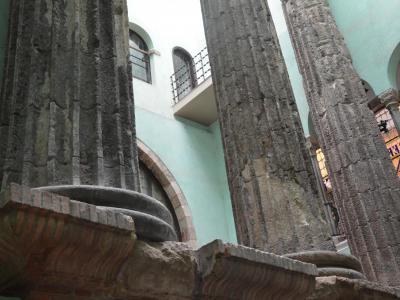
The Temple of Augustus, formerly a central piece of the Roman colony of Bàrcino, is a significant historical site preserved within the headquarters of the Excursionist Center of Catalonia. Embedded within a Gothic-period building, it features four Corinthian columns, remnants of the only known temple in Roman Barcino. Believed to have been dedicated to Emperor Augustus, the temple occupied the highest position of the ancient city, near the current Saint James's Square.
At some point, it was demolished, and its remains were hidden until the late 19th century when three of its columns emerged at the construction site of Catalonia's Hiking Club. Subsequently, a fourth column was revealed at King's Square and later incorporated into the structure, as it stands today.
According to research, the temple was originally surrounded by 11 columns on each side, including corner columns, with six columns at the front and another six at the rear. The entire building would have measured 17.5 by 44 meters, elevated on a podium approximately one-third the height of the columns. Noted for their fluted design and Corinthian capitals, the columns have been documented since the 14th century, although their origin is subject to various interpretations. Historical figures, from mythical kings to suggestions of aqueduct parts, have been proposed as explanations for their presence.
Although initially misattributed to the Carthaginians, later studies by Modernist architect Josep Puig reaffirmed the temple’s dedication to Emperor Augustus, placing its construction in the early Roman Empire, which indeed correlates with Barcino’s founding during Augustus's rule.
When visiting this site, keep an eye out for helpful photographs and recreations of this ancient landmark.
At some point, it was demolished, and its remains were hidden until the late 19th century when three of its columns emerged at the construction site of Catalonia's Hiking Club. Subsequently, a fourth column was revealed at King's Square and later incorporated into the structure, as it stands today.
According to research, the temple was originally surrounded by 11 columns on each side, including corner columns, with six columns at the front and another six at the rear. The entire building would have measured 17.5 by 44 meters, elevated on a podium approximately one-third the height of the columns. Noted for their fluted design and Corinthian capitals, the columns have been documented since the 14th century, although their origin is subject to various interpretations. Historical figures, from mythical kings to suggestions of aqueduct parts, have been proposed as explanations for their presence.
Although initially misattributed to the Carthaginians, later studies by Modernist architect Josep Puig reaffirmed the temple’s dedication to Emperor Augustus, placing its construction in the early Roman Empire, which indeed correlates with Barcino’s founding during Augustus's rule.
When visiting this site, keep an eye out for helpful photographs and recreations of this ancient landmark.
6) Capella Reial de Santa Agata (Royal Chapel of St. Agatha)
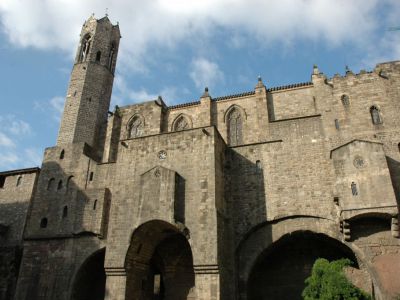
Another beautiful Catalan monument in the Gothic Quarter not to be missed, when visiting the Barcelona History Museum, is the Chapel of Saint Agatha. A remarkable example of Catalan Gothic architecture, it was constructed in 1302 under King James II of Aragon and his wife Queen Blanca of Naples as an extension to the Royal Palace, replacing its older oratory. Today, the chapel forms part of the History Museum along with the Tinell Hall.
Significant contributions to the building, such as the addition of the chapel of the Queens and a baptistery, were made in the 14th century during the reigns of King Peter IV of Aragon, popularly known as Peter the Ceremonious, and King Martín I the Humane. Originally dedicated to Santa Maria, its dedication was changed to Santa Àgata in 1601 after the papacy authorized the custody of the saint's relics.
The chapel underwent various uses following the confiscation of ecclesiastical properties in Spain in 1835. Architecturally, it features a single nave with a polygonal apse and a small cross structure, embellished with the coats of arms of Maria of Navarre and Eleonora of Sicily. The nave boasts polychrome wooden roofs with diaphragm arches, while the apse is topped with cross vaults. Stained glass windows with Gothic traceries brighten the interior, and the sacristy is uniquely integrated into the Roman wall.
Adjacent to the sacristy is a 14th-century octagonal bell tower adorned with eight triangular pediments resembling a royal crown. Prominent historical artworks within the chapel include sixty terracotta tiles decorated with images of angels and the coats of arms of Aragon and Sicily.
In 1990, extensive archaeological excavations were conducted in a temple prior to its restoration, uncovering significant historical layers. The work was divided into five areas, revealing structures from the High Imperial period (between 27 BC and 284 AD) through to the 19th century. Key findings included Roman walls, Gothic vaults, and medieval chapels.
Tip:
Admission to the Chapel is included in the Barcelona History Museum entrance fee.
Visitors are permitted to take non-commercial photos inside the chapel, as long as flash photography is avoided. Don't miss the intricately decorated ceiling timbers, the stunning Epiphany altarpiece from 1465, and the Table of Saint Agatha in the Queen's Chapel, dating back to around 1500. Also, keep an eye out for temporary exhibitions in both the chapel and the Tinell Hall, as they offer access to these remarkable buildings without requiring a full museum tour.
Significant contributions to the building, such as the addition of the chapel of the Queens and a baptistery, were made in the 14th century during the reigns of King Peter IV of Aragon, popularly known as Peter the Ceremonious, and King Martín I the Humane. Originally dedicated to Santa Maria, its dedication was changed to Santa Àgata in 1601 after the papacy authorized the custody of the saint's relics.
The chapel underwent various uses following the confiscation of ecclesiastical properties in Spain in 1835. Architecturally, it features a single nave with a polygonal apse and a small cross structure, embellished with the coats of arms of Maria of Navarre and Eleonora of Sicily. The nave boasts polychrome wooden roofs with diaphragm arches, while the apse is topped with cross vaults. Stained glass windows with Gothic traceries brighten the interior, and the sacristy is uniquely integrated into the Roman wall.
Adjacent to the sacristy is a 14th-century octagonal bell tower adorned with eight triangular pediments resembling a royal crown. Prominent historical artworks within the chapel include sixty terracotta tiles decorated with images of angels and the coats of arms of Aragon and Sicily.
In 1990, extensive archaeological excavations were conducted in a temple prior to its restoration, uncovering significant historical layers. The work was divided into five areas, revealing structures from the High Imperial period (between 27 BC and 284 AD) through to the 19th century. Key findings included Roman walls, Gothic vaults, and medieval chapels.
Tip:
Admission to the Chapel is included in the Barcelona History Museum entrance fee.
Visitors are permitted to take non-commercial photos inside the chapel, as long as flash photography is avoided. Don't miss the intricately decorated ceiling timbers, the stunning Epiphany altarpiece from 1465, and the Table of Saint Agatha in the Queen's Chapel, dating back to around 1500. Also, keep an eye out for temporary exhibitions in both the chapel and the Tinell Hall, as they offer access to these remarkable buildings without requiring a full museum tour.
7) Placa del Rei (King's Square)
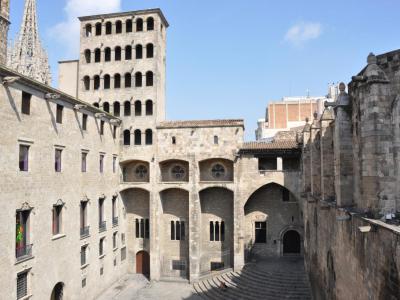
King's Square epitomizes Barcelona's historical essence as the center of county and royal authority. Originating from an urbanization initiative by King Martí I of Aragon, otherwise known as Martí the Human, in the late 14th century, the square was designed to host tournaments, displacing the traditional market. It retains a rectangular shape and is encased by Gothic and Renaissance buildings, creating a closed circuit except for its southwest end.
The square's name comes from the Grand Royal Palace of the Counts of Barcelona whose Gothic facade dominates its north side. The palace complex also encompasses the exquisite 13th-century Royal Chapel of Santa Agata and the romantic Renaissance Tower of King Martí, which offers views over the medieval city. The eastern edge is marked by the 14th-century Tinell Hall, the palace's central hall, accessible via a staircase.
According to historians, it was on these very steps, which spread out from the corner of the square, that in 1493 King Ferdinand and Queen Isabella welcomed Christopher Columbus and his crew upon their return from the first successful voyage to the New World. Once used as a meeting place for the Spanish Inquisition, the hall capitalized on the popular belief that its walls would reveal any lies spoken within. Nowadays, the building hosts temporary exhibitions and occasional concerts.
This square's main royal edifices can be accessed through the Barcelona History Museum, housed in the impressive Gothic Padellàs building. Together with the 16th-century Renaissance Lieutenant’s Palace, they complete the square's layout.
Additionally, King's Square's underground shelters extensive Roman ruins, uncovered in 1935. Ten years later, during renovations on the neighboring Counts Street, another archaeological discovery was made – an early Christian basilica, initially thought to be a primitive cathedral. In 1954, they also unearthed a 1st-century Roman pavement and nymphaeum (a shrine to the nymphs), providing insights into the area's historical development.
Due to its tremendous acoustic and almost enclosed structure, the square often serves as a venue for musical concerts and public events.
Tip:
The Barcelona History Museum, open Tuesday through Saturday from 10 am–7 pm and on Sunday from 10 am–8 pm, offers a fascinating glimpse into Roman and early Christian Barcelona. Visitors can explore ancient Roman ruins on a tour beginning underground and concluding in a lively square, perfect for relaxing with a drink.
The square's name comes from the Grand Royal Palace of the Counts of Barcelona whose Gothic facade dominates its north side. The palace complex also encompasses the exquisite 13th-century Royal Chapel of Santa Agata and the romantic Renaissance Tower of King Martí, which offers views over the medieval city. The eastern edge is marked by the 14th-century Tinell Hall, the palace's central hall, accessible via a staircase.
According to historians, it was on these very steps, which spread out from the corner of the square, that in 1493 King Ferdinand and Queen Isabella welcomed Christopher Columbus and his crew upon their return from the first successful voyage to the New World. Once used as a meeting place for the Spanish Inquisition, the hall capitalized on the popular belief that its walls would reveal any lies spoken within. Nowadays, the building hosts temporary exhibitions and occasional concerts.
This square's main royal edifices can be accessed through the Barcelona History Museum, housed in the impressive Gothic Padellàs building. Together with the 16th-century Renaissance Lieutenant’s Palace, they complete the square's layout.
Additionally, King's Square's underground shelters extensive Roman ruins, uncovered in 1935. Ten years later, during renovations on the neighboring Counts Street, another archaeological discovery was made – an early Christian basilica, initially thought to be a primitive cathedral. In 1954, they also unearthed a 1st-century Roman pavement and nymphaeum (a shrine to the nymphs), providing insights into the area's historical development.
Due to its tremendous acoustic and almost enclosed structure, the square often serves as a venue for musical concerts and public events.
Tip:
The Barcelona History Museum, open Tuesday through Saturday from 10 am–7 pm and on Sunday from 10 am–8 pm, offers a fascinating glimpse into Roman and early Christian Barcelona. Visitors can explore ancient Roman ruins on a tour beginning underground and concluding in a lively square, perfect for relaxing with a drink.
8) Palau del Lloctinent (Lieutenant’s Palace)
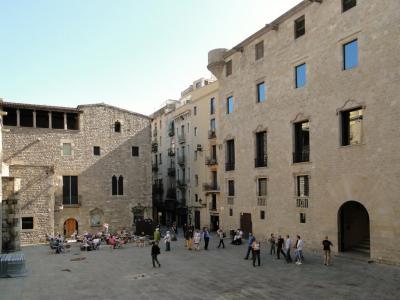
Just past the Frederic Marès Museum, a handsome doorway beckons you into the refined courtyard of the Lieutenant’s Palace, adorned with its three facades. As part of the former royal palace, the Lieutenant’s Palace boasts a typical mix of late Gothic and early Renaissance Catalan design. One of the most elegant buildings in the Gothic Quarter, it was constructed between 1549 and 1557 by master builder Antoni Carbonell, commissioned by the Government of Catalonia (known as the Generalitat).
During the 16th and 17th centuries, the Palace served as the residence of the king's official emissary (or viceroy) in Barcelona. From 1836 until 1994, the graceful structure served as the headquarters for the General Archive of the Crown of Aragon and today offers an excellent exhibition on the life and era of James I the Conqueror, King of Aragon, one of Catalonia's prominent historic figures from the 13th century.
The building features a rectangular plan with four floors and basements, centering around a large courtyard. The ground floor includes four large carpanel arches on pillars, supporting a Tuscan-type gallery with semicircular arches, and an Italian palace-style staircase leading to the upper floors. The weighty stone arches adorning the entrance, the central patio, and the intricately adorned wooden roof above the staircase all exemplify the noble architecture of the 16th century. The door on the stairway, dating to 1975, showcases scenes from the life of Saint George and the history of Catalonia.
The courtyard also occasionally hosts concerts featuring early music. Additionally, during the Corpus Christi celebration, it becomes one of the main venues for the "dancing egg" spectacle, featuring an egg "dancing" on the fountain jet amidst an elaborate floral arrangement.
During the 16th and 17th centuries, the Palace served as the residence of the king's official emissary (or viceroy) in Barcelona. From 1836 until 1994, the graceful structure served as the headquarters for the General Archive of the Crown of Aragon and today offers an excellent exhibition on the life and era of James I the Conqueror, King of Aragon, one of Catalonia's prominent historic figures from the 13th century.
The building features a rectangular plan with four floors and basements, centering around a large courtyard. The ground floor includes four large carpanel arches on pillars, supporting a Tuscan-type gallery with semicircular arches, and an Italian palace-style staircase leading to the upper floors. The weighty stone arches adorning the entrance, the central patio, and the intricately adorned wooden roof above the staircase all exemplify the noble architecture of the 16th century. The door on the stairway, dating to 1975, showcases scenes from the life of Saint George and the history of Catalonia.
The courtyard also occasionally hosts concerts featuring early music. Additionally, during the Corpus Christi celebration, it becomes one of the main venues for the "dancing egg" spectacle, featuring an egg "dancing" on the fountain jet amidst an elaborate floral arrangement.
9) Placa Sant Just (St. Justus Square)
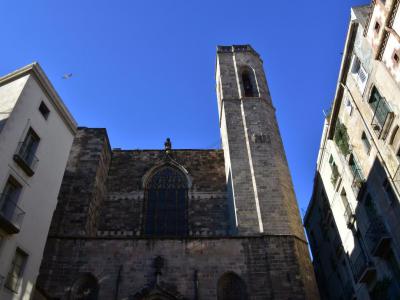
At the intersection of Hèrcules Street and Dagueria Street in Barcelona lies a square housing one of the city's oldest Christian churches. The 14th-century Basilica of Saint Justus and Pastor overlooking the square stands on the site of a 4th-century Christian basilica, which was the seat of the archbishop until the Barcelona Cathedral was built. The current basilica is dedicated to the boy martyrs Justus and Pastor, who, as recounted by the Roman poet Prudentius, bravely opposed the persecutions of Christians by the Roman Emperor Diocletian. The boys were captured, whipped, and beheaded near the Spanish city of Alcalá de Henares. Some of the relics associated with these saints have been preserved in a chest that is now housed inside the basilica.
Through the glass openings in the floor inside the basilica, you can see the remains of its 4th-century predecessor. The interior of the basilica is full of mysterious surprises, including several images of the damned burning in hell. Only one tower of the two planned was built to give the church its asymmetrical look. You can climb to the top for the awesome views of the Gothic Quarter.
Underneath the square itself, they say, lie the Christian catacombs.
During the Middle Ages, Saint Justus Square was the only place in town where Jews and Christians were permitted to engage in legal trade together. A reminder of that era is the Gothic fountain, the oldest water source in Barcelona, carved of Montjuïc stone in 1367. Back in the day, various commercial transactions and information exchanges took place here. Between its pipes, you can see three human faces carved in stone beneath a relief of Saint Justus flanked by two shields: one royal and one showing a hawk catching a partridge. These are relatively new additions, dating back to the 19th century.
Through the glass openings in the floor inside the basilica, you can see the remains of its 4th-century predecessor. The interior of the basilica is full of mysterious surprises, including several images of the damned burning in hell. Only one tower of the two planned was built to give the church its asymmetrical look. You can climb to the top for the awesome views of the Gothic Quarter.
Underneath the square itself, they say, lie the Christian catacombs.
During the Middle Ages, Saint Justus Square was the only place in town where Jews and Christians were permitted to engage in legal trade together. A reminder of that era is the Gothic fountain, the oldest water source in Barcelona, carved of Montjuïc stone in 1367. Back in the day, various commercial transactions and information exchanges took place here. Between its pipes, you can see three human faces carved in stone beneath a relief of Saint Justus flanked by two shields: one royal and one showing a hawk catching a partridge. These are relatively new additions, dating back to the 19th century.
10) Basilica de Santa Maria del Mar (Basilica of St. Mary of the Sea) (must see)
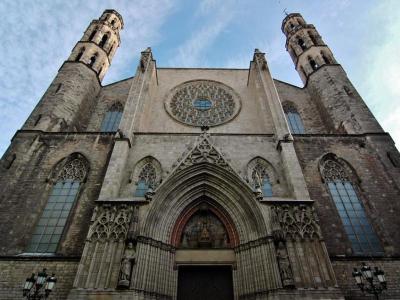
The Basilica of Saint Mary of the Sea is an outstanding example of early Catalan Gothic architecture, known for its uninterrupted lines and grace. Situated at the former water's edge, the edifice was constructed by skilled stonemasons who meticulously selected, fitted, and carved each stone sourced from the Montjuïc quarry, which had also supplied the sandstone for the 4th-century Roman walls. The number eight, symbolizing the Virgin Mary in medieval numerology, permeates every aspect of the basilica's design: the 16 octagonal pillars have a diameter of 2 meters and extend into rib vaulting arches at a height of 16 meters; the painted keystones at the apex of the arches are 32 meters above the floor; and the central nave is twice as wide as the lateral naves, measuring 8 meters each.
Despite enduring the destructive fires set by anarchists in 1936 during the rebellion, when numerous churches in Barcelona were targeted, Saint Mary of the Sea withstood the onslaught. Adorned with ornate side chapels and choir stalls at the time, the basilica burned for eleven days, nearly collapsing. It was later restored by a group of architects trained in the Bauhaus style following the Civil War, transforming it into an architectural marvel.
Why You Should Visit:
Remarkably grand and impeccably preserved; offers a lift to the roof, a small "art gallery", an intriguing crypt, beautiful stone carvings, a choir gallery, and the most astoundingly peaceful courtyard with a large pond. In addition, the surrounding area is dotted with charming local cafes offering outdoor seating, making it a delightful place to explore and wander.
Tips:
You have the option to participate in a guided tour that takes you up to the roof, providing a fascinating experience along with breathtaking views of Barcelona. Additionally, guided tours are available to explore areas that are usually restricted to the public, including the crypt. It's important to note that proper attire is required to enter these areas, as the guards at the entrance may refuse entry if the dress code is not followed.
Despite enduring the destructive fires set by anarchists in 1936 during the rebellion, when numerous churches in Barcelona were targeted, Saint Mary of the Sea withstood the onslaught. Adorned with ornate side chapels and choir stalls at the time, the basilica burned for eleven days, nearly collapsing. It was later restored by a group of architects trained in the Bauhaus style following the Civil War, transforming it into an architectural marvel.
Why You Should Visit:
Remarkably grand and impeccably preserved; offers a lift to the roof, a small "art gallery", an intriguing crypt, beautiful stone carvings, a choir gallery, and the most astoundingly peaceful courtyard with a large pond. In addition, the surrounding area is dotted with charming local cafes offering outdoor seating, making it a delightful place to explore and wander.
Tips:
You have the option to participate in a guided tour that takes you up to the roof, providing a fascinating experience along with breathtaking views of Barcelona. Additionally, guided tours are available to explore areas that are usually restricted to the public, including the crypt. It's important to note that proper attire is required to enter these areas, as the guards at the entrance may refuse entry if the dress code is not followed.
11) Palau de la Musica Catalana (Palace of Catalan Music) (must see)
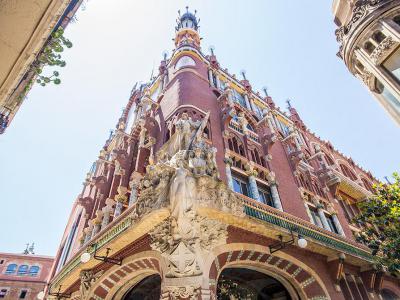
The Palace of Catalan Music in Barcelona, designed by Lluís Domènech i Montaner, is a hallmark of Catalan Art Nouveau architecture. Built between 1905 and 1908 for the Orfeó Català choral society, it was inaugurated in 1908 and awarded the Barcelona City Council’s 1909 prize for best building. The Palace represents a unique blend of curves, floral motifs, and advanced materials like steel framing.
The exterior features a fusion of Spanish and Arabic architectural elements, including exposed red brick, iron, mosaics, and stained glass. Two colonnades with colorful tiles and busts of composers, such as Bach, Beethoven, and Wagner, adorn the façade. Inside, the concert hall-Europe’s only auditorium illuminated entirely by natural light during daytime-seats around 2,200 people. Among other elements, it features a large stained-glass skylight by Antoni Rigalt and sculptures by artists like Eusebi Arnau and Lluís Bru, portraying themes of choral and classical music.
The Palace's main attraction is on the first floor, where modernist artistry is showcased through a spectacular stained glass ceiling and intricately decorated surfaces. The highlights include three-dimensional muses emerging from the walls and a stunning proscenium featuring Valkyries in motion. Despite its visual beauty, the hall’s glass walls present acoustic challenges, as noted by certain critics. Nevertheless, the Palace remains a symbol of Catalan modernism and a must-visit landmark in Barcelona.
Major renovations between 1982 and 1989 restored it to its original grandeur while adding modern amenities like dressing rooms, a library, and an archive in an adjoining six-story building. Further restoration in 2006–2008 included reinstalling the lantern and other ornamental features.
To fully appreciate the craftsmanship, guided tours are recommended and often require advance booking. For a more casual experience, visitors can enjoy coffee or tapas at the foyer bar, while admiring the detailed interior. Presently a UNESCO World Heritage Site since 1997, the Palace hosts over half a million visitors each year, drawn by its architectural splendor and vibrant cultural programs ranging from classical music to jazz, with top-notch lighting making each show a memorable experience.
Tip:
Don't forget to bring opera glasses or binoculars to fully appreciate the details, and be sure to check out the café on the ground floor for a pleasant treat.
Daily Tours:
10 am–3:30 pm (advance booking recommended)
The exterior features a fusion of Spanish and Arabic architectural elements, including exposed red brick, iron, mosaics, and stained glass. Two colonnades with colorful tiles and busts of composers, such as Bach, Beethoven, and Wagner, adorn the façade. Inside, the concert hall-Europe’s only auditorium illuminated entirely by natural light during daytime-seats around 2,200 people. Among other elements, it features a large stained-glass skylight by Antoni Rigalt and sculptures by artists like Eusebi Arnau and Lluís Bru, portraying themes of choral and classical music.
The Palace's main attraction is on the first floor, where modernist artistry is showcased through a spectacular stained glass ceiling and intricately decorated surfaces. The highlights include three-dimensional muses emerging from the walls and a stunning proscenium featuring Valkyries in motion. Despite its visual beauty, the hall’s glass walls present acoustic challenges, as noted by certain critics. Nevertheless, the Palace remains a symbol of Catalan modernism and a must-visit landmark in Barcelona.
Major renovations between 1982 and 1989 restored it to its original grandeur while adding modern amenities like dressing rooms, a library, and an archive in an adjoining six-story building. Further restoration in 2006–2008 included reinstalling the lantern and other ornamental features.
To fully appreciate the craftsmanship, guided tours are recommended and often require advance booking. For a more casual experience, visitors can enjoy coffee or tapas at the foyer bar, while admiring the detailed interior. Presently a UNESCO World Heritage Site since 1997, the Palace hosts over half a million visitors each year, drawn by its architectural splendor and vibrant cultural programs ranging from classical music to jazz, with top-notch lighting making each show a memorable experience.
Tip:
Don't forget to bring opera glasses or binoculars to fully appreciate the details, and be sure to check out the café on the ground floor for a pleasant treat.
Daily Tours:
10 am–3:30 pm (advance booking recommended)
