Custom Walk in Charleston, South Carolina by bethandbenw_ae79c3 created on 2026-03-20
Guide Location: USA » Charleston
Guide Type: Custom Walk
# of Sights: 10
Tour Duration: 2 Hour(s)
Travel Distance: 2.9 Km or 1.8 Miles
Share Key: 7DYLQ
Guide Type: Custom Walk
# of Sights: 10
Tour Duration: 2 Hour(s)
Travel Distance: 2.9 Km or 1.8 Miles
Share Key: 7DYLQ
How It Works
Please retrieve this walk in the GPSmyCity app. Once done, the app will guide you from one tour stop to the next as if you had a personal tour guide. If you created the walk on this website or come to the page via a link, please follow the instructions below to retrieve the walk in the app.
Retrieve This Walk in App
Step 1. Download the app "GPSmyCity: Walks in 1K+ Cities" on Apple App Store or Google Play Store.



Step 2. In the GPSmyCity app, download(or launch) the guide "Charleston Map and Walking Tours".
Step 3. Tap the menu button located at upper right corner of the "Walks" screen and select "Retrieve custom walk". Enter the share key: 7DYLQ
1) Joe Riley Waterfront Park (must see)
Charleston’s waterfront, right along the Cooper River, didn’t always look this relaxed. For centuries, this stretch was all business—wharves, cargo, ships coming and going like clockwork. Then came a glow-up. In 1990, the area was reimagined into what is now Waterfront Park, earning praise from the American Society of Landscape Architects and the National Trust for Historic Preservation, which is basically the architectural world’s version of a standing ovation.
The park unfolds in stages, like a well-paced story. Start at the northern entrance near Vendue Range, where a large fountain immediately sets the tone—less “working port,” more “take a breath, you’ve arrived.” A few steps further, Vendue Wharf stretches out into the river, complete with shaded swings that invite you to sit, sway, and briefly forget your schedule.
Move along, and the space opens up. On the one side, a canopy of oak trees lines Concord and Prioleau Streets, shading a calm, green corridor that runs for about a quarter-mile. On the other, a long esplanade—about 1,200 feet of palmettos and open views—follows the natural curve of the shoreline. It’s a simple idea done well: keep the water in sight, and let people enjoy it.
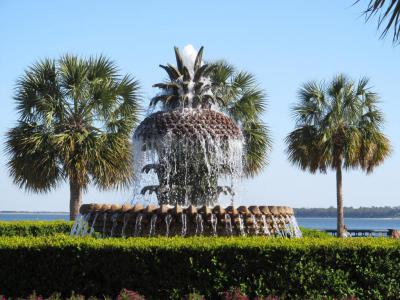
Then comes the scene-stealer. Set into a wide lawn, the Pineapple Fountain bubbles away in front of the City Gallery, framed by benches and just enough shade to make lingering feel like a plan rather than an accident.
And that’s really the rhythm here. Bring a picnic, or don’t. Sit for five minutes, or stay for an hour. Watch cruise ships glide past, cargo vessels edge into one of the country’s busiest ports, and the light shift slowly toward sunset. Add a steady breeze off the river, and suddenly doing nothing feels like the main event...
The park unfolds in stages, like a well-paced story. Start at the northern entrance near Vendue Range, where a large fountain immediately sets the tone—less “working port,” more “take a breath, you’ve arrived.” A few steps further, Vendue Wharf stretches out into the river, complete with shaded swings that invite you to sit, sway, and briefly forget your schedule.
Move along, and the space opens up. On the one side, a canopy of oak trees lines Concord and Prioleau Streets, shading a calm, green corridor that runs for about a quarter-mile. On the other, a long esplanade—about 1,200 feet of palmettos and open views—follows the natural curve of the shoreline. It’s a simple idea done well: keep the water in sight, and let people enjoy it.
Then comes the scene-stealer. Set into a wide lawn, the Pineapple Fountain bubbles away in front of the City Gallery, framed by benches and just enough shade to make lingering feel like a plan rather than an accident.
And that’s really the rhythm here. Bring a picnic, or don’t. Sit for five minutes, or stay for an hour. Watch cruise ships glide past, cargo vessels edge into one of the country’s busiest ports, and the light shift slowly toward sunset. Add a steady breeze off the river, and suddenly doing nothing feels like the main event...
2) Old Slave Mart (must see)
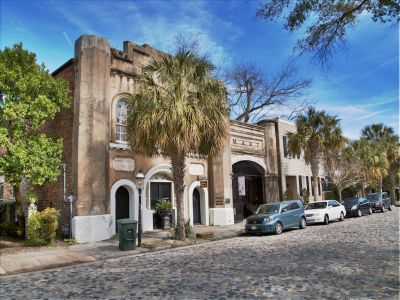
Constructed in 1859, this building doesn’t just appear as another historic façade—it carries weight. Designed in a mix of Gothic Revival and Romanesque styles, with a plain stuccoed façade, it once formed part of Ryan’s Mart, a slave market named after city alderman Thomas Ryan, who profited directly from the trade. Behind these walls stood a self-contained complex enclosed between Chalmers and Queen Streets that included a four-story slave jail, a kitchen, and a grimly so-called “dead house.” People were held here before being sold, making it not just a marketplace but a place of confinement and separation, too.
With most such sites erased or lost over time, this site is believed to be the last surviving example of a slave auction facility in the United States. Slide ahead to 1938, and the building takes on a different role, becoming the Old Slave Mart Museum, dedicated to documenting the slave trade that operated here between 1856 and 1863.
Inside, the approach is direct and unembellished. Exhibits rely on large storyboards, personal narratives, and original artifacts—shackles worn by enslaved people, whips used to punish them, and even a recorded deed of sale—presented without softening the reality. The aim is not to dramatize, but to present the facts clearly and allow visitors to absorb their meaning.
Among the most striking elements is a recorded account by Elijah Green, born in 1843, who shared his life story in 1937. Hearing his voice offers a sobering, realistic, and educational perspective on the nation's and Charleston’s African-American past—from slavery through emancipation—and reminds visitors that this history is not distant, but deeply personal and enduring...
With most such sites erased or lost over time, this site is believed to be the last surviving example of a slave auction facility in the United States. Slide ahead to 1938, and the building takes on a different role, becoming the Old Slave Mart Museum, dedicated to documenting the slave trade that operated here between 1856 and 1863.
Inside, the approach is direct and unembellished. Exhibits rely on large storyboards, personal narratives, and original artifacts—shackles worn by enslaved people, whips used to punish them, and even a recorded deed of sale—presented without softening the reality. The aim is not to dramatize, but to present the facts clearly and allow visitors to absorb their meaning.
Among the most striking elements is a recorded account by Elijah Green, born in 1843, who shared his life story in 1937. Hearing his voice offers a sobering, realistic, and educational perspective on the nation's and Charleston’s African-American past—from slavery through emancipation—and reminds visitors that this history is not distant, but deeply personal and enduring...
3) Heyward-Washington House (must see)
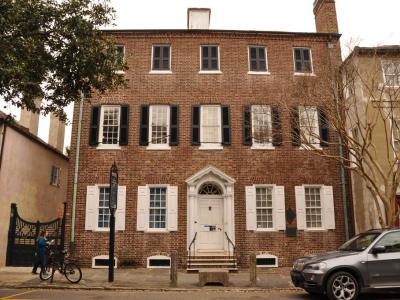
This early Charleston “dwelling house” goes by two names—because, apparently, one wasn’t enough. The first part of it comes from Daniel Heyward, a wealthy rice planter, who built it in 1772. The other comes from a rather overqualified houseguest: President George Washington. Heyward’s son, Thomas Heyward Jr.—yes, one of the signers of the Declaration of Independence—lived here until 1794, which already gives the place a strong historical résumé.
Now, picture this: it’s 1791, and Washington is on his grand tour of the brand-new United States, doing a sort of presidential road trip before road trips were a thing. Charleston wants to impress, so the city rents Heyward’s house for him—politely relocating Heyward himself to the countryside. Washington, ever the gentleman reviewer, noted in his diary that the lodgings were “very good,” essentially giving it an 18th-century five-star rating.
Today, the house leans fully into its past, filled with period antiques that look like they’ve never heard of modern furniture. One standout is the 1770 Chippendale-style Holmes bookcase—praised as one of the finest pieces of American-made furniture. It even carries scars from a British mortar strike, which is about as close as furniture gets to having a war story.
What also sets this place apart is what’s still standing outside. It’s the only 18th-century house museum in Charleston with its original outbuildings intact—think carriage shed and a kitchen building dating back to the 1740s. Inside the garden, you’ll find a neat arrangement of plants typical of the Lowcountry in the late 1700s—less decorative flourish, more practical elegance.
And if you’re planning to explore more of Charleston’s historic homes, here’s a useful move: the Charleston Heritage Passport. It bundles access to several houses, museums, and plantations into one tidy ticket, available at the Visitors Center on John Street.
Now, picture this: it’s 1791, and Washington is on his grand tour of the brand-new United States, doing a sort of presidential road trip before road trips were a thing. Charleston wants to impress, so the city rents Heyward’s house for him—politely relocating Heyward himself to the countryside. Washington, ever the gentleman reviewer, noted in his diary that the lodgings were “very good,” essentially giving it an 18th-century five-star rating.
Today, the house leans fully into its past, filled with period antiques that look like they’ve never heard of modern furniture. One standout is the 1770 Chippendale-style Holmes bookcase—praised as one of the finest pieces of American-made furniture. It even carries scars from a British mortar strike, which is about as close as furniture gets to having a war story.
What also sets this place apart is what’s still standing outside. It’s the only 18th-century house museum in Charleston with its original outbuildings intact—think carriage shed and a kitchen building dating back to the 1740s. Inside the garden, you’ll find a neat arrangement of plants typical of the Lowcountry in the late 1700s—less decorative flourish, more practical elegance.
And if you’re planning to explore more of Charleston’s historic homes, here’s a useful move: the Charleston Heritage Passport. It bundles access to several houses, museums, and plantations into one tidy ticket, available at the Visitors Center on John Street.

4) St. Michael's Church (must see)
If Charleston’s churches were competing in a historical contest, St. Philip's Church could claim the prize for oldest congregation—but when it comes to the oldest church building still standing, the crown goes to St. Michael's Church, completed in 1761. While no one knows exactly who designed this elegant landmark, the architect clearly took inspiration from St Martin-in-the-Fields, the famous London church created in the 1720s, giving Charleston its own colonial-era version of a British classic.
Take a look at the front: the two-story portico supported by Tuscan columns was a bold architectural feature for colonial America. On the north wall, a stained-glass window, titled Easter Morning, adds a splash of color. Installed in 1898, it was designed by Louis Lederle for Tiffany Studios and assembled from roughly two thousand pieces of glass.
Above it all, the tower keeps time for the neighborhood. The clock marks the hours and quarters, while eight historic change-ringing bells—one of only four such sets in the Charleston area—fill the air with sound. The bells were cast in London in 1764 and recast there again in 1866.
Remarkably, the church itself has changed very little since the 18th century. Aside from a sacristy added in 1883, the structure remains largely intact, though history has tested its strength. The earthquake of 1886 pushed the steeple eight inches into the ground and cracked parts of the building, while a 1935 tornado and Hurricane Hugo in 1989 caused further damage. During both the American Revolution and the Civil War, the spire was even painted black to make it less visible to enemy gunners.
One notable visitor, namely George Washington, attended a service here in 1791, sitting in what is now known as the Governor’s Pew. The churchyard also holds the graves of prominent Americans, such as Charles Cotesworth Pinckney, a Revolutionary War general and signer of the Constitution, and John Rutledge, another signer of the Constitution and later a justice of the U.S. Supreme Court.
In short, St. Michael is not only as a place of worship, but a place where Charleston’s history continues to echo, much like the bells in its tower...
Take a look at the front: the two-story portico supported by Tuscan columns was a bold architectural feature for colonial America. On the north wall, a stained-glass window, titled Easter Morning, adds a splash of color. Installed in 1898, it was designed by Louis Lederle for Tiffany Studios and assembled from roughly two thousand pieces of glass.
Above it all, the tower keeps time for the neighborhood. The clock marks the hours and quarters, while eight historic change-ringing bells—one of only four such sets in the Charleston area—fill the air with sound. The bells were cast in London in 1764 and recast there again in 1866.
Remarkably, the church itself has changed very little since the 18th century. Aside from a sacristy added in 1883, the structure remains largely intact, though history has tested its strength. The earthquake of 1886 pushed the steeple eight inches into the ground and cracked parts of the building, while a 1935 tornado and Hurricane Hugo in 1989 caused further damage. During both the American Revolution and the Civil War, the spire was even painted black to make it less visible to enemy gunners.
One notable visitor, namely George Washington, attended a service here in 1791, sitting in what is now known as the Governor’s Pew. The churchyard also holds the graves of prominent Americans, such as Charles Cotesworth Pinckney, a Revolutionary War general and signer of the Constitution, and John Rutledge, another signer of the Constitution and later a justice of the U.S. Supreme Court.
In short, St. Michael is not only as a place of worship, but a place where Charleston’s history continues to echo, much like the bells in its tower...
5) Nathaniel Russell House (must see)
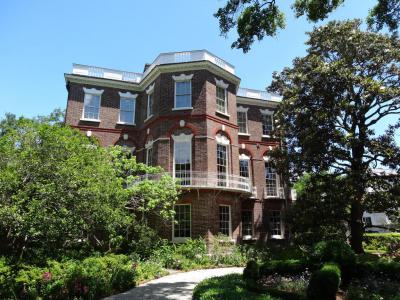
Had Charleston had a real estate leaderboard in the early 1800s, Nathaniel Russell would have comfortably ranked near the top. A successful shipping merchant, he placed his grand “mansionhouse” on Meeting Street, within the sight of the wharves that built his fortune. By 1808, at age 71, he saw the residence completed—at a reported cost of $80,000, a staggering sum for that time. The design followed the refined style of Robert Adam, drawing on classical ideas inspired by the rediscovered cities of Pompeii and Herculaneum, thus giving the house a polished, cosmopolitan edge.
Inside, the first impression is hard to miss. An elliptical staircase rises through three floors, appearing to float without support, as if it has forgotten to obey gravity, all set against warm golden walls. Around it, finely detailed Adamesque ornamentation decorates mantels and cornices with quiet precision—subtle, but clearly meant to impress...
The rooms continue the theme with a sense of balance and restraint, furnished with a mix of Charleston, English, and French pieces—china, silver, and paintings included. Upstairs, the oval drawing room stands out. Once used as a post-dinner retreat for women, it is finished in soft apricot tones, with ornate plasterwork highlighted in 24-karat gold leaf.
Unlike many historic houses that come with a chapter of neglect, this one never slipped into decline. Over time, it has shifted roles, serving as a private home, a governor’s residence, a girls’ school, and even a convent—yet always remained consistently maintained. Today, it is preserved by the Historic Charleston Foundation as one of the city’s key architectural landmarks.
Outside, the mood softens. A formal English garden stretches to the south, with gravel paths and neatly clipped boxwood hedges arranged in tidy patterns. At the rear, the two-story slave quarters, where 18 enslaved individuals once lived and worked, remain an essential part of the site’s history.
If you’re planning a visit, arriving early is wise—as tours run on a first-come, first-served basis. And while here, you might also explore the nearby old graveyard, or continue uptown to the Aiken-Rhett House for a broader view of Charleston’s past—for a small extra fee and a bit more walking...
Inside, the first impression is hard to miss. An elliptical staircase rises through three floors, appearing to float without support, as if it has forgotten to obey gravity, all set against warm golden walls. Around it, finely detailed Adamesque ornamentation decorates mantels and cornices with quiet precision—subtle, but clearly meant to impress...
The rooms continue the theme with a sense of balance and restraint, furnished with a mix of Charleston, English, and French pieces—china, silver, and paintings included. Upstairs, the oval drawing room stands out. Once used as a post-dinner retreat for women, it is finished in soft apricot tones, with ornate plasterwork highlighted in 24-karat gold leaf.
Unlike many historic houses that come with a chapter of neglect, this one never slipped into decline. Over time, it has shifted roles, serving as a private home, a governor’s residence, a girls’ school, and even a convent—yet always remained consistently maintained. Today, it is preserved by the Historic Charleston Foundation as one of the city’s key architectural landmarks.
Outside, the mood softens. A formal English garden stretches to the south, with gravel paths and neatly clipped boxwood hedges arranged in tidy patterns. At the rear, the two-story slave quarters, where 18 enslaved individuals once lived and worked, remain an essential part of the site’s history.
If you’re planning a visit, arriving early is wise—as tours run on a first-come, first-served basis. And while here, you might also explore the nearby old graveyard, or continue uptown to the Aiken-Rhett House for a broader view of Charleston’s past—for a small extra fee and a bit more walking...
6) Williams Mansion (aka Calhoun Mansion) (must see)
Back in the late 1800s, when Charleston was still recovering from the Civil War, keeping things modest, this house showed up, casually ignoring the mood...
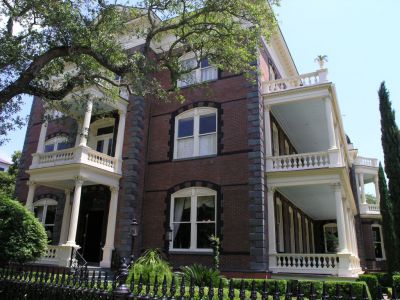
Indeed, this is one of the city’s rare Victorian showpieces, built in the Italianate style, when Charleston wasn’t exactly in a mansion-building phase. Most people were tightening their belts. But George Walton Williams was doing just fine, thanks to having wisely invested in England and the North before the war. In 1876, he went ahead and built what newspapers confidently called the finest home in the South… maybe even the entire country.
And the house still backs up that claim. We’re talking 35 rooms, 24,000 square feet, 23 fireplaces—because one or two simply wouldn’t do—a three-tiered piazza, Italian-style water gardens with fountains, and a cupola soaring 90 feet above the harbor. Not so much a home as a statement...
The name “Calhoun” enters the story later, when Williams’s son-in-law, Patrick Calhoun—grandson of John C. Calhoun—lived here until the 1929 stock market crash took both his fortune and house with it. After that, the mansion drifted through uncertain years, gradually falling into disrepair, until it was actually condemned in the 1970s. Not exactly the ending you’d expect for a place once called the finest in the country...
Luckily, then came the turnaround. A local attorney stepped in, took on the challenge, and spent 25 years—and a small fortune—bringing the house back to life. Today, it feels less like a restoration and more like a carefully staged time capsule.
Inside, you’ll find an extensive collection of English and American furniture from the 18th and 19th centuries, with a strong Southern accent in the decorative arts. Add impressionist paintings, Chinese ceramics, and a mix of carefully chosen objects, and the whole place leans into its original purpose: to impress.
And it still does. The mansion has appeared in magazines, played a role in the miniseries “North and South,” and continues to draw visitors curious enough to step inside.
Mind you, photography is not allowed on the premises, so you’ll have to rely on your memory. Tours run about 35 minutes, and once you step back outside, the gardens—with their statues and fountains—offer a quieter moment to process what you’ve just seen. Because this house is, in essence, Charleston deciding, at least once, to go all in...
Indeed, this is one of the city’s rare Victorian showpieces, built in the Italianate style, when Charleston wasn’t exactly in a mansion-building phase. Most people were tightening their belts. But George Walton Williams was doing just fine, thanks to having wisely invested in England and the North before the war. In 1876, he went ahead and built what newspapers confidently called the finest home in the South… maybe even the entire country.
And the house still backs up that claim. We’re talking 35 rooms, 24,000 square feet, 23 fireplaces—because one or two simply wouldn’t do—a three-tiered piazza, Italian-style water gardens with fountains, and a cupola soaring 90 feet above the harbor. Not so much a home as a statement...
The name “Calhoun” enters the story later, when Williams’s son-in-law, Patrick Calhoun—grandson of John C. Calhoun—lived here until the 1929 stock market crash took both his fortune and house with it. After that, the mansion drifted through uncertain years, gradually falling into disrepair, until it was actually condemned in the 1970s. Not exactly the ending you’d expect for a place once called the finest in the country...
Luckily, then came the turnaround. A local attorney stepped in, took on the challenge, and spent 25 years—and a small fortune—bringing the house back to life. Today, it feels less like a restoration and more like a carefully staged time capsule.
Inside, you’ll find an extensive collection of English and American furniture from the 18th and 19th centuries, with a strong Southern accent in the decorative arts. Add impressionist paintings, Chinese ceramics, and a mix of carefully chosen objects, and the whole place leans into its original purpose: to impress.
And it still does. The mansion has appeared in magazines, played a role in the miniseries “North and South,” and continues to draw visitors curious enough to step inside.
Mind you, photography is not allowed on the premises, so you’ll have to rely on your memory. Tours run about 35 minutes, and once you step back outside, the gardens—with their statues and fountains—offer a quieter moment to process what you’ve just seen. Because this house is, in essence, Charleston deciding, at least once, to go all in...
7) The Battery (must see)
Charleston has no shortage of headline attractions—churches, mansions, and museums that politely remind you they’ve been around longer than certain countries. And then there’s White Point Garden, better known as the Battery, which, although it quietly ignores the label of “official attraction,” still ends up on everyone’s must-see list. Call it a tradition, a habit, or just curiosity with good timing—but sooner or later, nearly every first-time visitor to Charleston finds themselves walking here. It’s one of those places where the city’s long story doesn’t just sit behind glass—it spreads out around you.
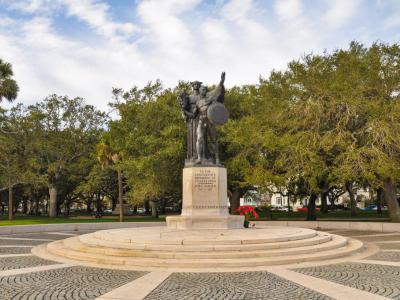
At the eastern edge of East Bay Street, the setting feels calm enough to convince anyone it has always been this way: a shaded park dotted with statues, old cannons, and sprawling live oaks that seem to have opinions about everything. But roll things back a few centuries, and the mood is quite different. This place was once Oyster Point, named so for its shell-covered shoreline, serving as a handy marker for ships navigating the harbor.
Then the tone darkened dramatically, when pirate Stede Bonnet and his crew met their end here in the 1720s—a public finale that helped clear the Carolina coast of its more entrepreneurial seafarers. By the time the War of 1812 erupted, the area had taken on a more official defensive role, earning the moniker “the Battery”.
Move along to 1837, when the city reshaped the area into White Point Garden, and the story shifts again—from military edge to public space. But history wasn’t quite finished yet. From this very spot, on April 12, 1861, residents witnessed the opening shots of the Civil War, as Fort Sumter came under fire across the water. During the conflict, the park itself turned back into a defensive position, layered with earthwork batteries. When the war ended, the cannons stayed behind—less as weapons, more as reminders—joined by monuments that quietly mark later conflicts and the people tied to them.
And then, just when you think the place has said it all, you look up and notice the houses. Lining the nearby streets, these grand antebellum homes form a kind of architectural encore—elegant, measured, and very aware of their own good angles. It’s a fitting finish: a spot where Charleston’s history doesn’t follow a straight line, but lingers, overlaps, and occasionally pauses under the shade of a live oak.
At the eastern edge of East Bay Street, the setting feels calm enough to convince anyone it has always been this way: a shaded park dotted with statues, old cannons, and sprawling live oaks that seem to have opinions about everything. But roll things back a few centuries, and the mood is quite different. This place was once Oyster Point, named so for its shell-covered shoreline, serving as a handy marker for ships navigating the harbor.
Then the tone darkened dramatically, when pirate Stede Bonnet and his crew met their end here in the 1720s—a public finale that helped clear the Carolina coast of its more entrepreneurial seafarers. By the time the War of 1812 erupted, the area had taken on a more official defensive role, earning the moniker “the Battery”.
Move along to 1837, when the city reshaped the area into White Point Garden, and the story shifts again—from military edge to public space. But history wasn’t quite finished yet. From this very spot, on April 12, 1861, residents witnessed the opening shots of the Civil War, as Fort Sumter came under fire across the water. During the conflict, the park itself turned back into a defensive position, layered with earthwork batteries. When the war ended, the cannons stayed behind—less as weapons, more as reminders—joined by monuments that quietly mark later conflicts and the people tied to them.
And then, just when you think the place has said it all, you look up and notice the houses. Lining the nearby streets, these grand antebellum homes form a kind of architectural encore—elegant, measured, and very aware of their own good angles. It’s a fitting finish: a spot where Charleston’s history doesn’t follow a straight line, but lingers, overlaps, and occasionally pauses under the shade of a live oak.
8) Edmondston-Alston House (must see)
Let’s roll back to 1825, when Charles Edmondston—a merchant with both ambition and a waterfront address—decided he deserved a house to match the view. Thus, up went his three-story residence in English Regency style, perfectly positioned to keep an eye on Charleston Harbor.
Inside, the layout follows the social choreography of the time: a front staircase leading to two elegant drawing rooms upstairs, with smaller “retreat zones” tucked behind—one for ladies and one for gentlemen, because apparently conversations, too, needed separating... Add in the soaring 14-foot ceilings, oversized windows for catching every possible breeze, and a proper library, and you’ve got a home designed to impress while staying just shy of melting in the southern heat. Out back, the supporting cast in the form of kitchen, servants’ quarters, stables, and carriage space complete the picture.
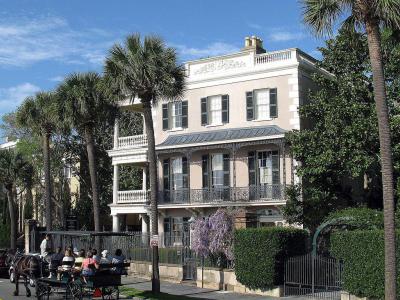
Amid the financial panic of 1837, Edmondston left the stage, and Charles Alston—member of a prominent Low Country rice-planting family—stepped in. He wasted no time giving the place a Greek Revival glow-up. Think Corinthian columns on a third-story piazza, a cast-iron balcony stretching across the front, and a rooftop railing proudly displaying the family coat of arms—subtle, but not really... The Alstons reworked the social flow, too: visitors received on the first floor, proper gatherings moved upstairs, where things could unfold with a bit more ceremony.
What’s striking is how much of that world is still here. Family papers, portraits, silver, and furnishings from the 1830s remain in place, along with Charles Alston’s almost untouched library. Between the finely detailed Regency woodwork and those steady harbor views, the house doesn’t feel frozen—it feels paused, just as if the family simply stepped out for a country visit and might be back any minute...
Inside, the layout follows the social choreography of the time: a front staircase leading to two elegant drawing rooms upstairs, with smaller “retreat zones” tucked behind—one for ladies and one for gentlemen, because apparently conversations, too, needed separating... Add in the soaring 14-foot ceilings, oversized windows for catching every possible breeze, and a proper library, and you’ve got a home designed to impress while staying just shy of melting in the southern heat. Out back, the supporting cast in the form of kitchen, servants’ quarters, stables, and carriage space complete the picture.
Amid the financial panic of 1837, Edmondston left the stage, and Charles Alston—member of a prominent Low Country rice-planting family—stepped in. He wasted no time giving the place a Greek Revival glow-up. Think Corinthian columns on a third-story piazza, a cast-iron balcony stretching across the front, and a rooftop railing proudly displaying the family coat of arms—subtle, but not really... The Alstons reworked the social flow, too: visitors received on the first floor, proper gatherings moved upstairs, where things could unfold with a bit more ceremony.
What’s striking is how much of that world is still here. Family papers, portraits, silver, and furnishings from the 1830s remain in place, along with Charles Alston’s almost untouched library. Between the finely detailed Regency woodwork and those steady harbor views, the house doesn’t feel frozen—it feels paused, just as if the family simply stepped out for a country visit and might be back any minute...
9) Rainbow Row (must see)
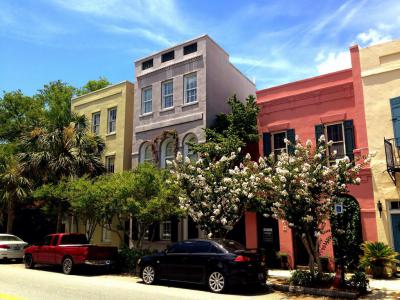
Rainbow Row lines up like a box of carefully arranged pastels—13 historic houses facing the Cooper River, each one competing quietly for your attention. Those soft pinks, blues, greens, and yellows aren’t random choices. They echo Charleston’s Caribbean connections, brought here by early settlers from Barbados, who left behind more than just footprints—they left a color palette.
What makes these houses even more impressive is that they’re still standing at all. Built between about 1730 and 1750, they once sat right on the waterfront, working as busy commercial storefronts along the wharf. The ground you’re standing on now didn’t even exist back then—it was created later through landfill, pushing the shoreline outward and turning trade space into a residential street.
As for the colors, explanations range from practical to playful. One story suggests that slightly intoxicated sailors couldn't find their lodgings other than by remembering the shade of their façade. Another points to function—bright colors helped people who couldn’t read identify different shops. Whether either of these stories is true or not, they’ve stuck around almost as stubbornly as the buildings themselves.
Look a little closer, and you’ll notice that time hasn’t passed without leaving its mark. Metal earthquake rods, stretching across some of the façades, quietly remind us of Charleston’s seismic past, while subtle repairs and reinforcements hint at centuries of use, damage, and care. Fires, hurricanes, even war—these houses have seen it all and stayed put.
Their survival isn’t just luck; it’s also where historic preservation in the United States found its footing. In the early 20th century, when these buildings had started to fall into disrepair, restoration efforts here helped spark the creation of the Preservation Society of Charleston—the first organization of its kind in the U.S. So, ultimately, what you’re looking at is more than just a picturesque street—it’s a turning point in how America decided to protect its past.
What makes these houses even more impressive is that they’re still standing at all. Built between about 1730 and 1750, they once sat right on the waterfront, working as busy commercial storefronts along the wharf. The ground you’re standing on now didn’t even exist back then—it was created later through landfill, pushing the shoreline outward and turning trade space into a residential street.
As for the colors, explanations range from practical to playful. One story suggests that slightly intoxicated sailors couldn't find their lodgings other than by remembering the shade of their façade. Another points to function—bright colors helped people who couldn’t read identify different shops. Whether either of these stories is true or not, they’ve stuck around almost as stubbornly as the buildings themselves.
Look a little closer, and you’ll notice that time hasn’t passed without leaving its mark. Metal earthquake rods, stretching across some of the façades, quietly remind us of Charleston’s seismic past, while subtle repairs and reinforcements hint at centuries of use, damage, and care. Fires, hurricanes, even war—these houses have seen it all and stayed put.
Their survival isn’t just luck; it’s also where historic preservation in the United States found its footing. In the early 20th century, when these buildings had started to fall into disrepair, restoration efforts here helped spark the creation of the Preservation Society of Charleston—the first organization of its kind in the U.S. So, ultimately, what you’re looking at is more than just a picturesque street—it’s a turning point in how America decided to protect its past.

10) Old Exchange and Provost Dungeon (must see)
This site at the corner of East Bay and Broad Streets has been pulling its weight since 1680—precisely when Charles Towne decided to relocate from its original settlement. The first structure on this spot was a practical one: downstairs, a guardhouse for locking up pirates and Native Americans, and upstairs, the upper hall for town meetings. Justice below, debate above—efficient, if not exactly comforting…
Then, the British stepped in with a firm intention “to make it look impressive.” The result was the Exchange building, completed in 1771 in full Palladian style—symmetry, columns, and just enough grandeur to remind everyone who was in charge. It quickly became the city’s main stage for everything that mattered: trade, politics, and public life. And in March 1776, standing right here on its steps, South Carolina declared itself an independent colony—so, yes, history didn’t just pass by, it made announcements.
The Revolutionary War brought a darker chapter. The building was turned into a British prison, holding, among others, even the signers of the Declaration of Independence. A decade later, in 1788, it hosted the convention to ratify the U.S. Constitution, and not long after, George Washington stopped by and was treated like the celebrity he was. For much of the 19th century, the building served as Charleston’s post office—first Federal, then Confederate—quietly handling letters while history kept unfolding around it.
Fast-forward to 1965, when excavations uncovered part of the original seawall from as early back as 1698—because, of course, this place still had more stories buried underneath. Today, it stands as a National Historic Landmark, open as a museum, with grand halls upstairs and something far more atmospheric below.
And yes, you can visit the Provost Dungeon, too, with costumed guides leading you through dim, echoing spaces where tales of pirates, prisoners, and colonial intrigue feel just close enough to be real. It is equal parts history lesson and theatrical experience—so, if stepping into an actual dungeon has ever crossed your mind, this is your moment.
One last thing: beyond the exhibits, there are occasional reenactments—complete with declarations and period flair—that bring the 1700s back to life. Not every day do you get to watch history rehearse itself on the very spot where it first happened...
Then, the British stepped in with a firm intention “to make it look impressive.” The result was the Exchange building, completed in 1771 in full Palladian style—symmetry, columns, and just enough grandeur to remind everyone who was in charge. It quickly became the city’s main stage for everything that mattered: trade, politics, and public life. And in March 1776, standing right here on its steps, South Carolina declared itself an independent colony—so, yes, history didn’t just pass by, it made announcements.
The Revolutionary War brought a darker chapter. The building was turned into a British prison, holding, among others, even the signers of the Declaration of Independence. A decade later, in 1788, it hosted the convention to ratify the U.S. Constitution, and not long after, George Washington stopped by and was treated like the celebrity he was. For much of the 19th century, the building served as Charleston’s post office—first Federal, then Confederate—quietly handling letters while history kept unfolding around it.
Fast-forward to 1965, when excavations uncovered part of the original seawall from as early back as 1698—because, of course, this place still had more stories buried underneath. Today, it stands as a National Historic Landmark, open as a museum, with grand halls upstairs and something far more atmospheric below.
And yes, you can visit the Provost Dungeon, too, with costumed guides leading you through dim, echoing spaces where tales of pirates, prisoners, and colonial intrigue feel just close enough to be real. It is equal parts history lesson and theatrical experience—so, if stepping into an actual dungeon has ever crossed your mind, this is your moment.
One last thing: beyond the exhibits, there are occasional reenactments—complete with declarations and period flair—that bring the 1700s back to life. Not every day do you get to watch history rehearse itself on the very spot where it first happened...
