Custom Walk in Gibraltar, Gibraltar by lamb616_a229c5 created on 2026-04-26
Guide Location: Gibraltar » Gibraltar
Guide Type: Custom Walk
# of Sights: 7
Tour Duration: 2 Hour(s)
Travel Distance: 4.3 Km or 2.7 Miles
Share Key: CYQFN
Guide Type: Custom Walk
# of Sights: 7
Tour Duration: 2 Hour(s)
Travel Distance: 4.3 Km or 2.7 Miles
Share Key: CYQFN
How It Works
Please retrieve this walk in the GPSmyCity app. Once done, the app will guide you from one tour stop to the next as if you had a personal tour guide. If you created the walk on this website or come to the page via a link, please follow the instructions below to retrieve the walk in the app.
Retrieve This Walk in App
Step 1. Download the app "GPSmyCity: Walks in 1K+ Cities" on Apple App Store or Google Play Store.



Step 2. In the GPSmyCity app, download(or launch) the guide "Gibraltar Map and Walking Tours".
Step 3. Tap the menu button located at upper right corner of the "Walks" screen and select "Retrieve custom walk". Enter the share key: CYQFN
1) Apes' Den
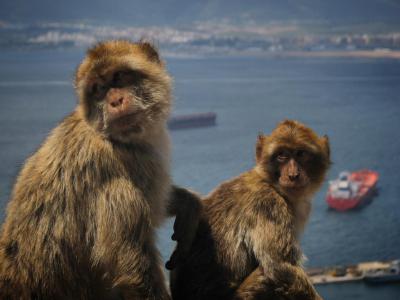
Apes' Den is a captivating destination nestled within the Upper Rock Nature Reserve in Gibraltar. Home to the famous Barbary macaques, also known as the Barbary apes, this natural habitat offers visitors an up-close and personal encounter with these charismatic and playful creatures.
Located within the stunning limestone cliffs of the Upper Rock, Apes' Den provides a sanctuary for the Barbary macaques, the only wild monkeys in Europe. These mischievous primates have inhabited Gibraltar for centuries, becoming an iconic symbol of the Rock and an integral part of its cultural heritage.
As visitors venture into Apes' Den, they are greeted by a lush and scenic environment, featuring a mixture of rocky terrain and verdant vegetation. The natural habitat offers the perfect setting for the monkeys to roam freely, providing an authentic experience of observing them in their natural element.
The Barbary macaques of Gibraltar are a protected species, and Apes' Den serves as their primary home. It is an incredible opportunity to witness their social interactions, playful antics, and natural behaviors firsthand. Visitors can observe these fascinating creatures as they swing from tree branches, forage for food, and interact with each other, creating memorable moments and unique photo opportunities.
Aside from being a tourist attraction, Apes' Den also serves as an important conservation site. The authorities in Gibraltar actively work to protect and preserve the Barbary macaques' population, ensuring their long-term survival and well-being. Visitors to Apes' Den have the chance to learn about ongoing conservation efforts and gain a deeper understanding of the significance of these primates within the local ecosystem.
Located within the stunning limestone cliffs of the Upper Rock, Apes' Den provides a sanctuary for the Barbary macaques, the only wild monkeys in Europe. These mischievous primates have inhabited Gibraltar for centuries, becoming an iconic symbol of the Rock and an integral part of its cultural heritage.
As visitors venture into Apes' Den, they are greeted by a lush and scenic environment, featuring a mixture of rocky terrain and verdant vegetation. The natural habitat offers the perfect setting for the monkeys to roam freely, providing an authentic experience of observing them in their natural element.
The Barbary macaques of Gibraltar are a protected species, and Apes' Den serves as their primary home. It is an incredible opportunity to witness their social interactions, playful antics, and natural behaviors firsthand. Visitors can observe these fascinating creatures as they swing from tree branches, forage for food, and interact with each other, creating memorable moments and unique photo opportunities.
Aside from being a tourist attraction, Apes' Den also serves as an important conservation site. The authorities in Gibraltar actively work to protect and preserve the Barbary macaques' population, ensuring their long-term survival and well-being. Visitors to Apes' Den have the chance to learn about ongoing conservation efforts and gain a deeper understanding of the significance of these primates within the local ecosystem.
2) Skywalk
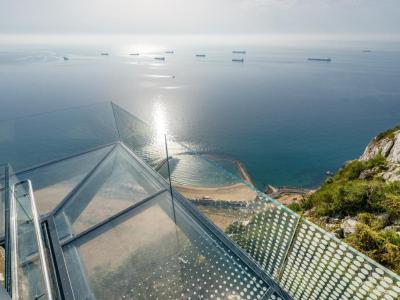
The Skywalk in Gibraltar is an awe-inspiring attraction that offers visitors an unparalleled experience of panoramic views from a remarkable vantage point. Perched at an impressive height of 340 meters above sea level, the Skywalk surpasses even the tallest point of London's iconic Shard. From here, visitors are treated to breathtaking 360-degree views that span across three countries and two continents.
Located within the Gibraltar Nature Reserve, Upper Rock, the Skywalk is not just a standalone attraction but also serves as a link to other captivating sites. Visitors can embark on a thrilling journey along the walking trails that connect the Skywalk to the Windsor Suspension Bridge and the famous Apes' Den. These interconnected destinations provide an opportunity to explore the natural wonders and wildlife of Gibraltar's renowned Upper Rock.
The Skywalk itself is a marvel of engineering and design. It is built on the foundations of a former WWII base structure, giving it a historical context that adds to its allure. Designed to withstand winds reaching speeds of over 150 km/hour, the Skywalk ensures a safe and secure experience for visitors. In fact, it can support the weight of an astounding 5 Asian elephants or approximately 340 people standing on it simultaneously (although visitor numbers are limited to 50 at any given time). The floor and balustrade panels are constructed from four layers of laminated glass, with a combined thickness of approximately 4.2 cm, providing both durability and transparency.
If the 42 glass panels of the Skywalk were laid out side-by-side, they would cover an area exceeding 750 square meters, equivalent to approximately four tennis courts. The walkway itself measures 2.5 meters wide and projects a maximum distance of 6.7 meters from the main structural support point. To ensure the utmost safety, 70 meters of rock anchors and an impressive 30,000 kilograms of steel secure the Skywalk firmly to the Rock of Gibraltar, providing stability and peace of mind for visitors.
Stepping onto the Skywalk is an extraordinary experience, where visitors can feel as if they are walking on air, suspended high above the stunning landscape. The unparalleled views offer a unique perspective of Gibraltar's natural beauty, the vast expanse of the Mediterranean Sea, and the surrounding areas. It is a truly unforgettable moment that allows visitors to appreciate the grandeur of the Rock and the splendor of the picturesque surroundings.
Located within the Gibraltar Nature Reserve, Upper Rock, the Skywalk is not just a standalone attraction but also serves as a link to other captivating sites. Visitors can embark on a thrilling journey along the walking trails that connect the Skywalk to the Windsor Suspension Bridge and the famous Apes' Den. These interconnected destinations provide an opportunity to explore the natural wonders and wildlife of Gibraltar's renowned Upper Rock.
The Skywalk itself is a marvel of engineering and design. It is built on the foundations of a former WWII base structure, giving it a historical context that adds to its allure. Designed to withstand winds reaching speeds of over 150 km/hour, the Skywalk ensures a safe and secure experience for visitors. In fact, it can support the weight of an astounding 5 Asian elephants or approximately 340 people standing on it simultaneously (although visitor numbers are limited to 50 at any given time). The floor and balustrade panels are constructed from four layers of laminated glass, with a combined thickness of approximately 4.2 cm, providing both durability and transparency.
If the 42 glass panels of the Skywalk were laid out side-by-side, they would cover an area exceeding 750 square meters, equivalent to approximately four tennis courts. The walkway itself measures 2.5 meters wide and projects a maximum distance of 6.7 meters from the main structural support point. To ensure the utmost safety, 70 meters of rock anchors and an impressive 30,000 kilograms of steel secure the Skywalk firmly to the Rock of Gibraltar, providing stability and peace of mind for visitors.
Stepping onto the Skywalk is an extraordinary experience, where visitors can feel as if they are walking on air, suspended high above the stunning landscape. The unparalleled views offer a unique perspective of Gibraltar's natural beauty, the vast expanse of the Mediterranean Sea, and the surrounding areas. It is a truly unforgettable moment that allows visitors to appreciate the grandeur of the Rock and the splendor of the picturesque surroundings.
3) St. Michael's Cave (must see)
Rainwater, slowly seeping through limestone, will change into a weak solution of carbolic acid. The acid solution gradually erodes the limestone. It creates tunnels and caverns from cracks. This simple process has been carving away at the Rock of Gibraltar for thousands and thousands of years. The result is St. Michael's Cave.
St. Michael's Cave is really a vast network of tunnels and caves in the Upper Rock Nature Preserve of Gibraltar. Alonso Hernandez del Portillo, the leading historian of Gibraltar in the 17th century, held that the cave is named for the Grotto of Monte Gargano in Apulia, Italy, where archangel St. Michael is said to have appeared.
St. Michael would have felt at home. Humans certainly have, since Neolithic times. Pottery, utensils, weapons, and artwork of the Rock's prehistoric tenants have been found. A charcoal drawing of an Ibex is on a wall. The drawing is about 20,000 years old. There were two Neanderthal skulls found, dating from 40,000 years ago.
In 45 AD, geographer Pomponius Mela described Gibraltar as "A mountain with wonderful concavities." The caves were well-known to the ancient Greeks, Romans, and Phoenicians. In the Victorian era, the caves were used for picnics, concerts, marriages, and duels. In 1840 Colonel Mitchell and a friend went in and were never seen again.
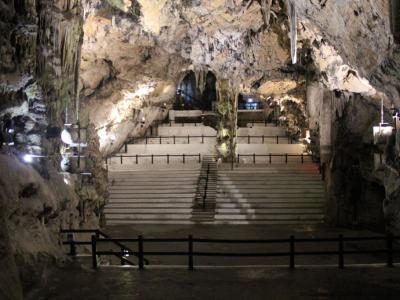
In 1942, while blasting rocks in the cave to improve ventilation, a deeper system of caves and underground lakes was discovered. It was called New St. Michael's Cave. The largest room is called the Auditorium. It is used for a theatre space showing sound and light shows, beauty pageants, operas, and concerts.
St. Michael's Cave attracts over 1,000,000 visitors a year. The cave can be reached by car, by foot, or by cable car. Tickets include visits to the Moorish Castle and the Great Siege Tunnels of the Rock. Safety helmets are available. Non-skid shoes are recommended.
St. Michael's Cave is really a vast network of tunnels and caves in the Upper Rock Nature Preserve of Gibraltar. Alonso Hernandez del Portillo, the leading historian of Gibraltar in the 17th century, held that the cave is named for the Grotto of Monte Gargano in Apulia, Italy, where archangel St. Michael is said to have appeared.
St. Michael would have felt at home. Humans certainly have, since Neolithic times. Pottery, utensils, weapons, and artwork of the Rock's prehistoric tenants have been found. A charcoal drawing of an Ibex is on a wall. The drawing is about 20,000 years old. There were two Neanderthal skulls found, dating from 40,000 years ago.
In 45 AD, geographer Pomponius Mela described Gibraltar as "A mountain with wonderful concavities." The caves were well-known to the ancient Greeks, Romans, and Phoenicians. In the Victorian era, the caves were used for picnics, concerts, marriages, and duels. In 1840 Colonel Mitchell and a friend went in and were never seen again.
In 1942, while blasting rocks in the cave to improve ventilation, a deeper system of caves and underground lakes was discovered. It was called New St. Michael's Cave. The largest room is called the Auditorium. It is used for a theatre space showing sound and light shows, beauty pageants, operas, and concerts.
St. Michael's Cave attracts over 1,000,000 visitors a year. The cave can be reached by car, by foot, or by cable car. Tickets include visits to the Moorish Castle and the Great Siege Tunnels of the Rock. Safety helmets are available. Non-skid shoes are recommended.
4) Windsor Suspension Bridge
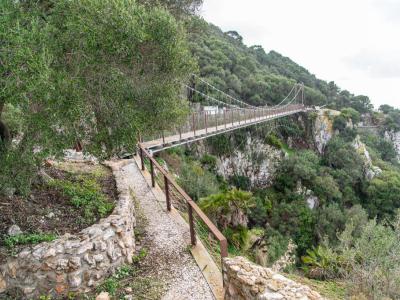
The Windsor Suspension Bridge in Gibraltar is a spectacular feat of engineering that spans a deep gorge, offering visitors magnificent views of the strait, bay, and city. With a length of 71 meters, this suspension bridge stands tall, providing an exhilarating experience for all who visit.
Located between two World War II artillery batteries, the Windsor Suspension Bridge has become one of Gibraltar's newer attractions. Its strategic placement amidst the natural beauty of the area makes it an ideal stop along your journey through Upper Rock Nature.
Walking across the Windsor Suspension Bridge is an experience that offers breathtaking views of the surrounding area. From the bridge, visitors can marvel at the panoramic vistas of the Strait of Gibraltar, with the Mediterranean Sea on one side and the Atlantic Ocean on the other. The Rock of Gibraltar stands proudly in the backdrop, providing a dramatic and awe-inspiring setting.
The Windsor Suspension Bridge was inaugurated to the public by Chief Minister Fabian Picardo on 21st June 2016.
Located between two World War II artillery batteries, the Windsor Suspension Bridge has become one of Gibraltar's newer attractions. Its strategic placement amidst the natural beauty of the area makes it an ideal stop along your journey through Upper Rock Nature.
Walking across the Windsor Suspension Bridge is an experience that offers breathtaking views of the surrounding area. From the bridge, visitors can marvel at the panoramic vistas of the Strait of Gibraltar, with the Mediterranean Sea on one side and the Atlantic Ocean on the other. The Rock of Gibraltar stands proudly in the backdrop, providing a dramatic and awe-inspiring setting.
The Windsor Suspension Bridge was inaugurated to the public by Chief Minister Fabian Picardo on 21st June 2016.
5) Moorish Castle
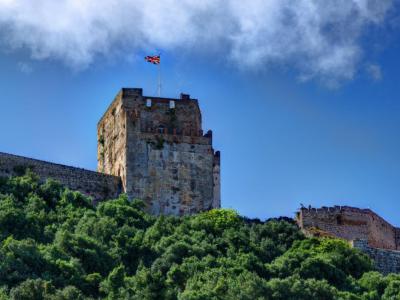
The medieval fortress in Gibraltar, known as the Moorish Castle, consists of various structures, gates, and fortified walls, prominently featuring the Tower of Homage and the Gate House. Until 2010, a section of the castle served as the prison of Gibraltar. The Tower of Homage, with its remarkable architecture and strategic position, is visible to all visitors.
The Moorish Castle was built by the Marinid dynasty, making it distinctive in the Iberian Peninsula. Construction of the castle began in the 8th century AD, potentially around AD 711, although the exact completion date remains unknown. The castle encompassed a substantial area, extending from the upper part of the Rock of Gibraltar down to the sea. The most prominent remaining parts of the structure are the Tower of Homage, along with terraces and battlements below it, as well as the substantial Gate House with its distinctive cupola roof.
Today, the Moorish Castle stands as a significant tourist attraction in Gibraltar and is featured on the reverse side of the still-circulating 1995 design of the Gibraltar five-pound banknote. Locally, the name "Moorish Castle" (or "El Castillo" in Spanish) also refers to the residential area surrounding the castle, known as the Moorish Castle Estate.
The Moorish Castle was built by the Marinid dynasty, making it distinctive in the Iberian Peninsula. Construction of the castle began in the 8th century AD, potentially around AD 711, although the exact completion date remains unknown. The castle encompassed a substantial area, extending from the upper part of the Rock of Gibraltar down to the sea. The most prominent remaining parts of the structure are the Tower of Homage, along with terraces and battlements below it, as well as the substantial Gate House with its distinctive cupola roof.
Today, the Moorish Castle stands as a significant tourist attraction in Gibraltar and is featured on the reverse side of the still-circulating 1995 design of the Gibraltar five-pound banknote. Locally, the name "Moorish Castle" (or "El Castillo" in Spanish) also refers to the residential area surrounding the castle, known as the Moorish Castle Estate.

6) World War II Tunnels
During the Second World War, Gibraltar witnessed the most extensive phase of tunneling in its history, playing a crucial role in the North Atlantic and Mediterranean arenas. The war prompted a substantial increase in the length of tunnels, expanding from 7 miles (11 km) to 25 miles (40 km).
At the war's outset, the civilian population was evacuated, and the garrison size was significantly augmented. Numerous fresh tunnels were excavated to accommodate the expanded garrison and store vast quantities of provisions, equipment, and ammunition. This tunneling endeavor was undertaken by four specialized tunneling companies from the Royal Engineers and the Canadian Army.
A new Main Base Area was established in the southeastern part of Gibraltar, along the Mediterranean coast of the peninsula. This location protected the potentially hostile Spanish mainland while connecting tunnels were constructed to link it with the existing military bases on the western side. Two tunnels, known as the Great North Road and the Foss Way, were painstakingly dug, spanning nearly the entire length of the Rock, interconnecting the majority of the wartime tunnels.
The tunnels served as an underground city, capable of accommodating the entire 16,000-strong garrison and storing enough food to sustain them for 16 months. Within this subterranean complex, various facilities were established, including an underground telephone exchange, a power generating station, a water distillation plant, a hospital, a bakery, ammunition storage areas, and a vehicle maintenance workshop.
At the war's outset, the civilian population was evacuated, and the garrison size was significantly augmented. Numerous fresh tunnels were excavated to accommodate the expanded garrison and store vast quantities of provisions, equipment, and ammunition. This tunneling endeavor was undertaken by four specialized tunneling companies from the Royal Engineers and the Canadian Army.
A new Main Base Area was established in the southeastern part of Gibraltar, along the Mediterranean coast of the peninsula. This location protected the potentially hostile Spanish mainland while connecting tunnels were constructed to link it with the existing military bases on the western side. Two tunnels, known as the Great North Road and the Foss Way, were painstakingly dug, spanning nearly the entire length of the Rock, interconnecting the majority of the wartime tunnels.
The tunnels served as an underground city, capable of accommodating the entire 16,000-strong garrison and storing enough food to sustain them for 16 months. Within this subterranean complex, various facilities were established, including an underground telephone exchange, a power generating station, a water distillation plant, a hospital, a bakery, ammunition storage areas, and a vehicle maintenance workshop.
7) Great Siege Tunnels (must see)
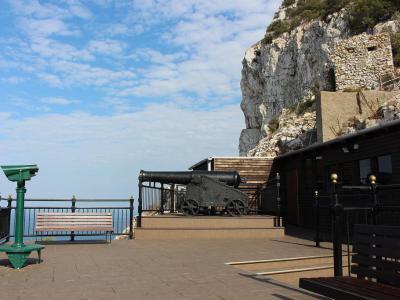
The Upper Galleries, also known as the Great Siege Tunnels, is an intricate network of tunnels situated within the northern section of the Rock of Gibraltar, a British Overseas Territory. These tunnels were painstakingly carved out of solid limestone by the British forces during the late 18th century's Great Siege of Gibraltar.
The Great Siege of Gibraltar took place during the American Revolutionary War when France and Spain sought to capture Gibraltar from Great Britain. Spanning from July 1779 to February 1783, it marked the fourteenth and final siege of Gibraltar. The motivation behind constructing the tunnels stemmed from the garrison's necessity to cover a blind spot on the Rock's northeast side. The only viable solution was to position a gun on a rock spur referred to as The Notch.
The laborious task was executed manually, primarily employing sledgehammers, crowbars, and the aid of gunpowder explosions. Initially, progress was slow, with a team of thirteen men requiring five weeks to dig an 82-foot (25 m) long tunnel. The diggers faced challenges from noxious fumes and dust resulting from frequent blasting. Consequently, a horizontal shaft was blasted to enhance ventilation, which unexpectedly yielded an additional advantage.
By the completion of the initial phase of tunneling, five galleries were excavated: Windsor Gallery, King's and Queen's Lines, St. George's Hall, and Cornwallis Chamber. The Windsor Gallery constituted the first segment of the tunnel system and housed four mounted guns. St. George's Hall stood as the largest of the original galleries, and the embrasures on the Rock's slopes could be observed when approaching Gibraltar from both land and sea.
The onset of World War II led to increased tunnel construction. Extensive work was done to accommodate 16,000 soldiers with supplies for a year. The Great Siege Tunnels were repurposed, including an extension known as the Holyland Tunnel. A staircase was also built to connect the Tunnels to the Middle Galleries.
Presently, the Great Siege Tunnels are accessible as part of the Upper Rock Nature Reserve, offering visitors the opportunity to explore their historical significance.
The Great Siege of Gibraltar took place during the American Revolutionary War when France and Spain sought to capture Gibraltar from Great Britain. Spanning from July 1779 to February 1783, it marked the fourteenth and final siege of Gibraltar. The motivation behind constructing the tunnels stemmed from the garrison's necessity to cover a blind spot on the Rock's northeast side. The only viable solution was to position a gun on a rock spur referred to as The Notch.
The laborious task was executed manually, primarily employing sledgehammers, crowbars, and the aid of gunpowder explosions. Initially, progress was slow, with a team of thirteen men requiring five weeks to dig an 82-foot (25 m) long tunnel. The diggers faced challenges from noxious fumes and dust resulting from frequent blasting. Consequently, a horizontal shaft was blasted to enhance ventilation, which unexpectedly yielded an additional advantage.
By the completion of the initial phase of tunneling, five galleries were excavated: Windsor Gallery, King's and Queen's Lines, St. George's Hall, and Cornwallis Chamber. The Windsor Gallery constituted the first segment of the tunnel system and housed four mounted guns. St. George's Hall stood as the largest of the original galleries, and the embrasures on the Rock's slopes could be observed when approaching Gibraltar from both land and sea.
The onset of World War II led to increased tunnel construction. Extensive work was done to accommodate 16,000 soldiers with supplies for a year. The Great Siege Tunnels were repurposed, including an extension known as the Holyland Tunnel. A staircase was also built to connect the Tunnels to the Middle Galleries.
Presently, the Great Siege Tunnels are accessible as part of the Upper Rock Nature Reserve, offering visitors the opportunity to explore their historical significance.
