Custom Walk in Chania, Greece by cohnect_559452 created on 2026-05-06
Guide Location: Greece » Chania
Guide Type: Custom Walk
# of Sights: 7
Tour Duration: 3 Hour(s)
Travel Distance: 7.1 Km or 4.4 Miles
Share Key: VDX97
Guide Type: Custom Walk
# of Sights: 7
Tour Duration: 3 Hour(s)
Travel Distance: 7.1 Km or 4.4 Miles
Share Key: VDX97
How It Works
Please retrieve this walk in the GPSmyCity app. Once done, the app will guide you from one tour stop to the next as if you had a personal tour guide. If you created the walk on this website or come to the page via a link, please follow the instructions below to retrieve the walk in the app.
Retrieve This Walk in App
Step 1. Download the app "GPSmyCity: Walks in 1K+ Cities" on Apple App Store or Google Play Store.



Step 2. In the GPSmyCity app, download(or launch) the guide "Chania Map and Walking Tours".
Step 3. Tap the menu button located at upper right corner of the "Walks" screen and select "Retrieve custom walk". Enter the share key: VDX97
1) Chania Lighthouse (must see)
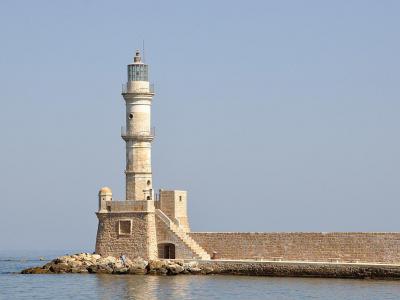
The Lighthouse of Chania stands at the mouth of the Old Venetian Harbor, a sentinel that has seen centuries of conquest, decay, and renewal. Its story begins in the late 16th century, when the Venetians fortified the harbor as part of their defense against the advancing Ottomans. The lighthouse originally had a fortified base and was part of a system that included the Firkas Fortress on the opposite side of the harbor. A heavy chain could even be stretched across the entrance to block enemy ships, a vivid reminder of the constant threat of invasion.
Despite these efforts, the Ottoman forces seized Chania in 1645 after a brutal siege, and the once-proud Venetian lighthouse fell into neglect. For nearly two centuries, the structure crumbled, no longer serving its role as a guardian for sailors. Its revival came between 1824 and 1832, when Crete fell under Egyptian administration. Rebuilt in a minaret-like style, the lighthouse took on its distinctive shape that still captures attention today. Locals often refer to it as the “Egyptian Lighthouse,” a nod to the period when Egypt briefly held sway over Crete on behalf of the Ottoman Empire.
The lighthouse endured its share of hardships in modern times as well. Bombings during World War II and earthquakes weakened the structure, leaving it scarred but not broken. A major renovation in 2005 ensured its survival, restoring its domed tower and securing its place as one of Chania’s most iconic landmarks.
Today, the lighthouse is no longer used for navigation but remains deeply woven into the identity of the city. The long mole leading out to it has become a favorite promenade for locals and visitors alike, especially at sunset when the tower casts its silhouette across the sea. For those who walk its length, the lighthouse offers more than a view-it is a connection to Chania’s layered past, a reminder of fleets, battles, and the enduring relationship between the city and the sea.
Despite these efforts, the Ottoman forces seized Chania in 1645 after a brutal siege, and the once-proud Venetian lighthouse fell into neglect. For nearly two centuries, the structure crumbled, no longer serving its role as a guardian for sailors. Its revival came between 1824 and 1832, when Crete fell under Egyptian administration. Rebuilt in a minaret-like style, the lighthouse took on its distinctive shape that still captures attention today. Locals often refer to it as the “Egyptian Lighthouse,” a nod to the period when Egypt briefly held sway over Crete on behalf of the Ottoman Empire.
The lighthouse endured its share of hardships in modern times as well. Bombings during World War II and earthquakes weakened the structure, leaving it scarred but not broken. A major renovation in 2005 ensured its survival, restoring its domed tower and securing its place as one of Chania’s most iconic landmarks.
Today, the lighthouse is no longer used for navigation but remains deeply woven into the identity of the city. The long mole leading out to it has become a favorite promenade for locals and visitors alike, especially at sunset when the tower casts its silhouette across the sea. For those who walk its length, the lighthouse offers more than a view-it is a connection to Chania’s layered past, a reminder of fleets, battles, and the enduring relationship between the city and the sea.
2) Sabbionara Rampart
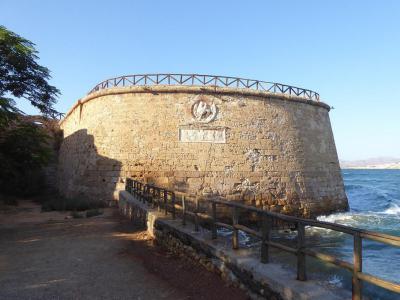
The Sabbionara Rampart, perched on the northeastern edge of Chania’s Venetian-era fortifications, is a rare surviving gate from the outer city wall constructed in the 16th century. Named Sabbionara-Italian for “sand”-because it once opened onto a sandy shoreline, this gate has preserved its steadfast role in the city’s architectural tapestry.
Throughout history, this gate and adjacent rampart have borne the brunt of conflict and change. During the Ottoman siege that led to Chania’s fall in 1645, the gate was destroyed-later rebuilt in more compact form for easier defense-and came to be known as “Kum Kapısı” in Turkish, meaning “Gate of Sand.”
Today the Sabbionara Rampart has been thoughtfully restored and repurposed into an exhibition space, linking Chania’s living culture with its layered past. Visiting the rampart invites contemplation of the city's Venetian and Ottoman eras, the tides of history that shaped them, and the urban fabric they left behind.
Throughout history, this gate and adjacent rampart have borne the brunt of conflict and change. During the Ottoman siege that led to Chania’s fall in 1645, the gate was destroyed-later rebuilt in more compact form for easier defense-and came to be known as “Kum Kapısı” in Turkish, meaning “Gate of Sand.”
Today the Sabbionara Rampart has been thoughtfully restored and repurposed into an exhibition space, linking Chania’s living culture with its layered past. Visiting the rampart invites contemplation of the city's Venetian and Ottoman eras, the tides of history that shaped them, and the urban fabric they left behind.
3) Chatzimichali Ntaliani Street
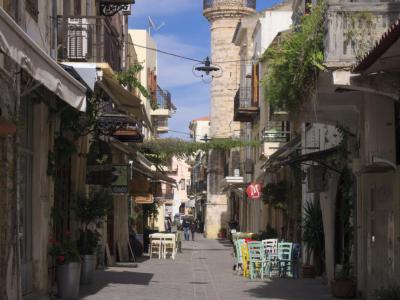
Chatzimichali Ntaliani Street-better known to locals as Daliani Street-winds through Chania’s Old Town with a character that feels both historic and alive. The name honors Hatzimichalis Dalianis, a revolutionary hero from Epirus who fought for Crete’s freedom in 1828 and died in battle. His story lingers in the background, reminding visitors that beneath the easy charm of this lane lies the memory of Crete’s long struggle for independence.
During Ottoman times, this was part of the Turkish quarter, and its past still lingers in the atmosphere. Low houses, arched doorways, and hints of Venetian and Ottoman design recall the street’s layered heritage. For generations, it was a working-class neighborhood, filled with workshops and tavernas that anchored daily life. Though it fell into decline in the early 20th century, restoration and renewed energy have transformed it into one of Chania’s most vibrant corners.
By day, the street hums softly with cafés, souvenir shops, and the slow pace of Old Town wanderers. But as evening arrives, it comes alive in full force. Taverns and mezedopoleia set tables along the narrow passage, locals and travelers mingle over food and wine, and the sound of music often drifts into the night. Adding to the atmosphere, the Minaret of Ahmet Aga rises nearby, one of the last Ottoman minarets in Chania, while the 16th-century Venetian Monastery of Karolo adds yet another layer of history.
Walking down Daliani Street today is less about monuments and more about spirit-an experience where centuries of change blend seamlessly with the lively rhythm of modern Chania.
During Ottoman times, this was part of the Turkish quarter, and its past still lingers in the atmosphere. Low houses, arched doorways, and hints of Venetian and Ottoman design recall the street’s layered heritage. For generations, it was a working-class neighborhood, filled with workshops and tavernas that anchored daily life. Though it fell into decline in the early 20th century, restoration and renewed energy have transformed it into one of Chania’s most vibrant corners.
By day, the street hums softly with cafés, souvenir shops, and the slow pace of Old Town wanderers. But as evening arrives, it comes alive in full force. Taverns and mezedopoleia set tables along the narrow passage, locals and travelers mingle over food and wine, and the sound of music often drifts into the night. Adding to the atmosphere, the Minaret of Ahmet Aga rises nearby, one of the last Ottoman minarets in Chania, while the 16th-century Venetian Monastery of Karolo adds yet another layer of history.
Walking down Daliani Street today is less about monuments and more about spirit-an experience where centuries of change blend seamlessly with the lively rhythm of modern Chania.
4) Skridlof Street (Leather Street)
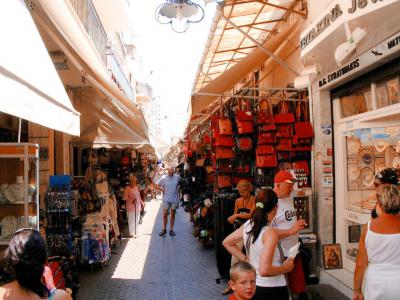
Skridlof Street, better known as Leather Lane, is one of those places where history lingers in the air even as the present bustles around it. Tucked into the Old Town near the Municipal Market, the lane earned its reputation in the 19th century when shoemakers and bootmakers set up their workshops here. Their craft was legendary-this was the birthplace of the tall Cretan boots known as stivania, worn by shepherds roaming the White Mountains and later by rebels fighting for independence. The clatter of hammers on wooden lasts and the earthy scent of hides once filled the alley, giving it both its name and its identity.
Although the golden age of the bootmakers has long passed, echoes of it remain. Family-run shops still display traditional footwear alongside belts, bags, and sandals, some hand-made by descendants of those earlier craftsmen. Ordering a custom pair of boots, complete with the traditional wide trousers and headscarf that once accompanied them, is still possible for those who want a piece of living heritage.
Over time, the street has expanded beyond leather goods, and today its stalls and shops also sell jewelry, embroidery, and keepsakes of Crete. Yet Leather Street retains its role as a bridge between Chania’s mercantile traditions and modern life. Walking its narrow length, with shops pressing close and voices carrying down the alley, visitors glimpse how one trade once shaped a whole neighborhood and how its legacy still weaves into the city’s story.
Although the golden age of the bootmakers has long passed, echoes of it remain. Family-run shops still display traditional footwear alongside belts, bags, and sandals, some hand-made by descendants of those earlier craftsmen. Ordering a custom pair of boots, complete with the traditional wide trousers and headscarf that once accompanied them, is still possible for those who want a piece of living heritage.
Over time, the street has expanded beyond leather goods, and today its stalls and shops also sell jewelry, embroidery, and keepsakes of Crete. Yet Leather Street retains its role as a bridge between Chania’s mercantile traditions and modern life. Walking its narrow length, with shops pressing close and voices carrying down the alley, visitors glimpse how one trade once shaped a whole neighborhood and how its legacy still weaves into the city’s story.
5) Old Venetian Harbor (must see)
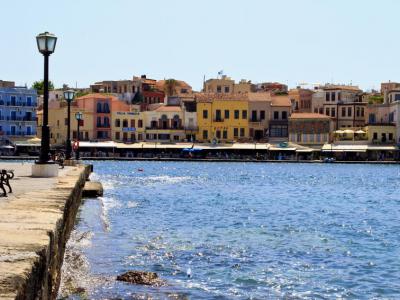
Long before Venetian galleys filled the bay, this stretch of Crete’s north coast sheltered the Minoans of Kydonia, who traded here as early as the 14th century BC. By the time the Venetians arrived in 1320, they saw not just a natural inlet but a jewel worth fortifying. Over the next three centuries, they poured stone and sweat into creating one of the strongest ports in the eastern Mediterranean. The harbor became both a marketplace and a fortress, where merchants unloaded cloth and spices under the shadow of warships waiting in the basins.
The eastern side rang with the sound of shipbuilding inside the great arsenals. Seventeen vast halls rose between 1467 and 1599, their arched openings facing the sea so galleys could be hauled inside for repair. In 1607, three more-called the Moro Docks-were added, just as the Republic of Venice prepared for renewed conflict with the Ottomans. Sailors’ songs and hammer strikes once filled those halls, a contrast to the art exhibitions they house today.
At the harbor’s mouth, a lighthouse was added between 1570 and 1590, its flame guiding ships returning from Venice or Alexandria. In 1645, during the Ottoman siege of Chania, it stood as a witness to weeks of bombardment that reduced much of the city to rubble. When the Ottomans triumphed, they raised mosques and hammams around the waterfront, leaving their own imprint on the Venetian skeleton. The lighthouse itself would later be rebuilt by the Egyptians in the 19th century, giving it the curious blend of Venetian bones and Ottoman-Egyptian dress that survives today.
Every corner of the harbor carries such stories: the Firkas Fortress, where the Venetian banner once flew, now holds a Nautical Museum with a replica Minoan ship; the Yali Tzamii Mosque recalls centuries of Ottoman prayer; and the café-lined promenade still hums with conversation much like it did when sailors struck bargains over wine. Walk the mole to the lighthouse at sunset, and the layers of history fall into place-the Minoan traders, the Venetian shipwrights, the Ottoman conquerors-all bound to this same stretch of sea.
The eastern side rang with the sound of shipbuilding inside the great arsenals. Seventeen vast halls rose between 1467 and 1599, their arched openings facing the sea so galleys could be hauled inside for repair. In 1607, three more-called the Moro Docks-were added, just as the Republic of Venice prepared for renewed conflict with the Ottomans. Sailors’ songs and hammer strikes once filled those halls, a contrast to the art exhibitions they house today.
At the harbor’s mouth, a lighthouse was added between 1570 and 1590, its flame guiding ships returning from Venice or Alexandria. In 1645, during the Ottoman siege of Chania, it stood as a witness to weeks of bombardment that reduced much of the city to rubble. When the Ottomans triumphed, they raised mosques and hammams around the waterfront, leaving their own imprint on the Venetian skeleton. The lighthouse itself would later be rebuilt by the Egyptians in the 19th century, giving it the curious blend of Venetian bones and Ottoman-Egyptian dress that survives today.
Every corner of the harbor carries such stories: the Firkas Fortress, where the Venetian banner once flew, now holds a Nautical Museum with a replica Minoan ship; the Yali Tzamii Mosque recalls centuries of Ottoman prayer; and the café-lined promenade still hums with conversation much like it did when sailors struck bargains over wine. Walk the mole to the lighthouse at sunset, and the layers of history fall into place-the Minoan traders, the Venetian shipwrights, the Ottoman conquerors-all bound to this same stretch of sea.
6) Nautical Museum of Crete (must see)
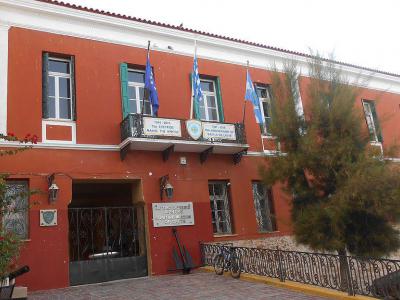
The Nautical Museum of Crete, also called the Maritime Museum, was founded in 1973 on the anniversary of the Battle of Crete, a date chosen deliberately to tie modern memory to centuries of maritime struggle. Its home, the red-walled Firkas Fortress at the western entrance to Chania’s Venetian Harbor, carries layers of symbolism. Built by the Venetians in 1620 to guard the harbor, it was later used by the Ottomans-its very name “Firkas” means “barracks” in Turkish-and in 1913 it became the site where the Greek flag was first raised to mark Crete’s union with Greece. Cannons once aimed through its arched embrasures and chains stretched to the lighthouse across the mole remind visitors that this harbor was never merely picturesque-it was a frontline of power.
Inside the fortress, the museum is laid out as a journey through time. The lower floors move from antiquity through the Venetian and Ottoman eras, with ship models, navigational instruments, and artifacts recovered from the seabed. A model of Venetian Chania depicts the arsenals in full use, while a highlight is the replica of a Minoan ship, reconstructed using Bronze Age techniques, which recalls the daring seamanship of Crete’s earliest sailors. Upstairs, the focus shifts to modern naval history, with models of destroyers, frigates, and even a full bridge of a Greek navy destroyer. Exhibits tell of the Greek War of Independence, the Balkan Wars, and the dramatic role of the navy in the 1941 Battle of Crete.
The museum’s reach extends to the Moro Shipyard on the harbor’s eastern end, where a 56-foot Minoan ship replica, built in 2001–2004, is displayed after sailing from Piraeus to Crete. Beyond the artifacts, what lingers is the human dimension-photographs, uniforms, and testimonies that link strategy to lived experience. For visitors, the Nautical Museum offers more than models behind glass. It connects the fortress walls, the harbor waters outside, and the centuries of conflict, trade, and survival that shaped Chania into the maritime city it remains today.
Inside the fortress, the museum is laid out as a journey through time. The lower floors move from antiquity through the Venetian and Ottoman eras, with ship models, navigational instruments, and artifacts recovered from the seabed. A model of Venetian Chania depicts the arsenals in full use, while a highlight is the replica of a Minoan ship, reconstructed using Bronze Age techniques, which recalls the daring seamanship of Crete’s earliest sailors. Upstairs, the focus shifts to modern naval history, with models of destroyers, frigates, and even a full bridge of a Greek navy destroyer. Exhibits tell of the Greek War of Independence, the Balkan Wars, and the dramatic role of the navy in the 1941 Battle of Crete.
The museum’s reach extends to the Moro Shipyard on the harbor’s eastern end, where a 56-foot Minoan ship replica, built in 2001–2004, is displayed after sailing from Piraeus to Crete. Beyond the artifacts, what lingers is the human dimension-photographs, uniforms, and testimonies that link strategy to lived experience. For visitors, the Nautical Museum offers more than models behind glass. It connects the fortress walls, the harbor waters outside, and the centuries of conflict, trade, and survival that shaped Chania into the maritime city it remains today.
7) Iguana Beach
Iguana Beach is a popular destination for both locals and tourists due to its stunning location just a few kilometers west of the city center. Situated next to Golden Beach and only a few meters off the road from Chania to Platanias, it is easily accessible by car or bus.
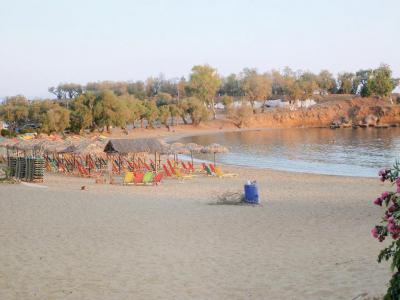
This picturesque urban beach boasts crystal-clear turquoise waters and golden sand, making it perfect for a relaxing day by the sea. The smooth entrance to the water is suitable for all ages, from families with children to seniors and lone travelers. During the high season, the beach can get partially crowded, but it still maintains a serene atmosphere.
Visitors to Iguana Beach can enjoy a range of amenities, including loungers and umbrellas, a beach restaurant, changing rooms, showers, and toilets. The beach is also supervised by a lifeguard during the season, ensuring a safe and enjoyable swimming experience.
In addition to swimming and sunbathing, there are other activities to enjoy at Iguana Beach. The area nearby is suitable for wild camping, and visitors can also take part in water sports such as paddleboarding, kayaking, and snorkeling.
This picturesque urban beach boasts crystal-clear turquoise waters and golden sand, making it perfect for a relaxing day by the sea. The smooth entrance to the water is suitable for all ages, from families with children to seniors and lone travelers. During the high season, the beach can get partially crowded, but it still maintains a serene atmosphere.
Visitors to Iguana Beach can enjoy a range of amenities, including loungers and umbrellas, a beach restaurant, changing rooms, showers, and toilets. The beach is also supervised by a lifeguard during the season, ensuring a safe and enjoyable swimming experience.
In addition to swimming and sunbathing, there are other activities to enjoy at Iguana Beach. The area nearby is suitable for wild camping, and visitors can also take part in water sports such as paddleboarding, kayaking, and snorkeling.
