Custom Walk in Tirana, Albania by violetashtereva_69efc created on 2026-05-07
Guide Location: Albania » Tirana
Guide Type: Custom Walk
# of Sights: 10
Tour Duration: 2 Hour(s)
Travel Distance: 3.1 Km or 1.9 Miles
Share Key: G4UMF
Guide Type: Custom Walk
# of Sights: 10
Tour Duration: 2 Hour(s)
Travel Distance: 3.1 Km or 1.9 Miles
Share Key: G4UMF
How It Works
Please retrieve this walk in the GPSmyCity app. Once done, the app will guide you from one tour stop to the next as if you had a personal tour guide. If you created the walk on this website or come to the page via a link, please follow the instructions below to retrieve the walk in the app.
Retrieve This Walk in App
Step 1. Download the app "GPSmyCity: Walks in 1K+ Cities" on Apple App Store or Google Play Store.



Step 2. In the GPSmyCity app, download(or launch) the guide "Tirana Map and Walking Tours".
Step 3. Tap the menu button located at upper right corner of the "Walks" screen and select "Retrieve custom walk". Enter the share key: G4UMF
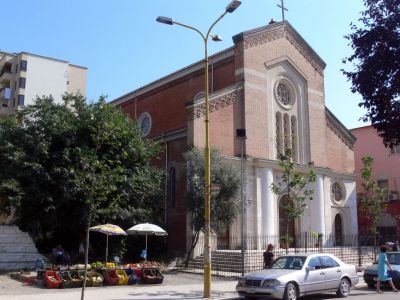
1) Catholic Church of St. Marie (Sacred Heart Church)
The Sacred Heart Church, known also as the Catholic Church of Saint Marie, stands as a historic symbol of faith and resilience in Tirana. Constructed in 1939 amidst the tumultuous era of the Italian invasion, this Roman Catholic edifice is the oldest Catholic church in the city, showcasing the architectural brilliance of Giovanni Santi through its neo-Romanesque design.
The establishment of the church during a time of foreign rule is an important part of its history. But its challenges didn't end there. In 1967, Albania banned all religious activities, putting the church at risk of closure. This ban lasted until 1990. Despite this, the Sacred Heart Church was used secretly by Catholics to practice their faith, even though the building was falling apart. A visible reminder of this time is a wall built in front of the church to hide its religious nature.
The reopening of the church in 1990 was a significant event, not only for the Catholic community but also for the wider religious community in Tirana. Despite the destruction of its bell tower, the bell itself was saved and donated to a nearby Orthodox church that didn't have one. This gesture of goodwill represented unity among different faiths, supported by the Muslim community in Albania, which also provided assistance to the Catholic church.
A notable highlight in the church's history is the visit from Mother Teresa in 1991, who had a personal connection to the site as it once served as her elementary school and was situated on the street where she lived. Though Mother Teresa received her sacraments in Skopje, her visit to the Sacred Heart Church underscores the deep spiritual and historical ties that bind individuals to places of worship.
The establishment of the church during a time of foreign rule is an important part of its history. But its challenges didn't end there. In 1967, Albania banned all religious activities, putting the church at risk of closure. This ban lasted until 1990. Despite this, the Sacred Heart Church was used secretly by Catholics to practice their faith, even though the building was falling apart. A visible reminder of this time is a wall built in front of the church to hide its religious nature.
The reopening of the church in 1990 was a significant event, not only for the Catholic community but also for the wider religious community in Tirana. Despite the destruction of its bell tower, the bell itself was saved and donated to a nearby Orthodox church that didn't have one. This gesture of goodwill represented unity among different faiths, supported by the Muslim community in Albania, which also provided assistance to the Catholic church.
A notable highlight in the church's history is the visit from Mother Teresa in 1991, who had a personal connection to the site as it once served as her elementary school and was situated on the street where she lived. Though Mother Teresa received her sacraments in Skopje, her visit to the Sacred Heart Church underscores the deep spiritual and historical ties that bind individuals to places of worship.
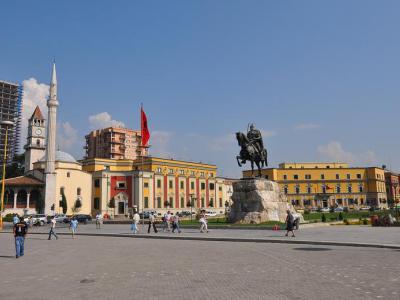
2) Skanderbeg Square (must see)
Skanderbeg Square, known in Albanian as Sheshi Skënderbej, is the primary square in Tirana. It was named after Gjergj Kastrioti Skenderbeu, a military leader who led a rebellion against the Ottoman Empire. Usually referred to as Skanderbeg, he referred to himself as the "Lord of Albania" and is considered a national hero.
The public square was originally built in 1917. It was primarily comprised of a fountain in the center of a square surrounded by the Old Bazaar, the Orthodox Cathedral and the City Hall. The main feature of the square is the Skanderbeg Monument, erected in honor of Skanderbeg.
Buildings around the square include City Hall, Ethem Bey Mosque, National Bank, National Historical Museum, National Library, National Opera, Palace of Culture and several governmental ministry buildings. The Clock Tower is also located along Skanderbeg Square.
Skanderbeg Square received the European Prize for Urban Public Space in 2018. It also received a prize from the European Union for Contemporary Architecture in 2019.
The public square was originally built in 1917. It was primarily comprised of a fountain in the center of a square surrounded by the Old Bazaar, the Orthodox Cathedral and the City Hall. The main feature of the square is the Skanderbeg Monument, erected in honor of Skanderbeg.
Buildings around the square include City Hall, Ethem Bey Mosque, National Bank, National Historical Museum, National Library, National Opera, Palace of Culture and several governmental ministry buildings. The Clock Tower is also located along Skanderbeg Square.
Skanderbeg Square received the European Prize for Urban Public Space in 2018. It also received a prize from the European Union for Contemporary Architecture in 2019.
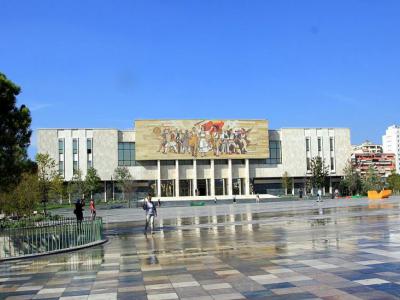
3) National History Museum (must see)
The National History Museum was established in 1981. The museum contains over 5000 items in its permanent exhibits.
The museum includes eight pavilions that focus on different aspects of Albanian history. These include the pavilions of Antiquity, Middle Ages, Renaissance, Independence, Communist Terror and the National Liberation Antifascist War. There are also pavilions dedicated to Iconography and Mother Teresa.
The National History Museum considers the Pavilion of Antiquity to be its most important. Items on display date from the 4th century BCE and go through the early middle ages, ending in the 8th century. Most of the items on display are sculptures like the God Apollo and the head of Artemis. Other important exhibits in this pavilion include the findings of the Monumental Tomb of Lower Selca and the mosaic of the Beauty of Durres.
Those who wish to learn more about the modern history of Albania can find plenty of materials at this museum. The Pavilion of Independence focuses on the most important historical moments in Albania after the Declaration of Independence in 1912 through the start of World War II.
The pavilions of antifascist war and communist terror display relics from those who died in the War of Vlora. Visitors can read about the war, find documents that show the protection of the Jewish population during the Holocaust, watch a documentary and view photographs.
The Pavilion of Mother Teresa contains exhibits that showcase the life and work of Mother Teresa. Visitors will see photos of Mother Teresa as well as objects that once belonged to her.
The museum includes eight pavilions that focus on different aspects of Albanian history. These include the pavilions of Antiquity, Middle Ages, Renaissance, Independence, Communist Terror and the National Liberation Antifascist War. There are also pavilions dedicated to Iconography and Mother Teresa.
The National History Museum considers the Pavilion of Antiquity to be its most important. Items on display date from the 4th century BCE and go through the early middle ages, ending in the 8th century. Most of the items on display are sculptures like the God Apollo and the head of Artemis. Other important exhibits in this pavilion include the findings of the Monumental Tomb of Lower Selca and the mosaic of the Beauty of Durres.
Those who wish to learn more about the modern history of Albania can find plenty of materials at this museum. The Pavilion of Independence focuses on the most important historical moments in Albania after the Declaration of Independence in 1912 through the start of World War II.
The pavilions of antifascist war and communist terror display relics from those who died in the War of Vlora. Visitors can read about the war, find documents that show the protection of the Jewish population during the Holocaust, watch a documentary and view photographs.
The Pavilion of Mother Teresa contains exhibits that showcase the life and work of Mother Teresa. Visitors will see photos of Mother Teresa as well as objects that once belonged to her.

4) Skanderbeg Monument
The Skanderbeg Monument is a statue of Albanian hero Gjergj Kastrioti Skënderbeu, often referred to as simply Skanderbeg. The statue stands in the main square of Tirana, also named in honor of this military commander. Skanderbeg
The bronze statue stands on a stone pedestal showing Skanderbeg on horseback. The 36-foot monument was designed by Odhise Paskali. It was installed at Skanderbeg Square in 1968 on the 500th anniversary of Skanderbeg's death.
The monument was erected in place of a statue of Joseph Stalin, facing the square and all of its cultural sites like the National Museum, the Clock Tower, Et'hem Bey Mosque and the Palace of Culture.
Behind the statue is a Park of Europe, a large, grassy area that is surrounded by a paved walkway and numerous shade trees. Surrounding Park of Europe are the government buildings of the square. These include the Tirana City Hall and numerous ministry buildings.
The bronze statue stands on a stone pedestal showing Skanderbeg on horseback. The 36-foot monument was designed by Odhise Paskali. It was installed at Skanderbeg Square in 1968 on the 500th anniversary of Skanderbeg's death.
The monument was erected in place of a statue of Joseph Stalin, facing the square and all of its cultural sites like the National Museum, the Clock Tower, Et'hem Bey Mosque and the Palace of Culture.
Behind the statue is a Park of Europe, a large, grassy area that is surrounded by a paved walkway and numerous shade trees. Surrounding Park of Europe are the government buildings of the square. These include the Tirana City Hall and numerous ministry buildings.

5) Et'hem Bey Mosque (must see)
The Hajji Et'hem Bey Mosque, usually shortened to Et'hem Bey Mosque, is a mosque in the center of Tirana. Facing Skanderbeg Square, the mosque functions both as a religious building and a historical, cultural treasure to the city.
The mosque was built from 1791 through 1821. Construction began under Molla Bey of Petrela who died before the building was complete. Construction continued under Molla Bey's son, Haxhi Ethem Bey. At that time, it was part of a building complex that included the Sulejman Pasha Mosque, the Karapici Mosque and the Old Bazaar.
Some of the more unique features of Et'hem Bey Mosque are the frescoes located on the exterior of the building and in the portico. These frescoes have themes that are rarely found in Islamic art. Trees, waterfalls and bridges are featured within the ornate paintings, which are easily viewed on the mosque's northern wall.
It was closed during communist rule but reopened in 1991 shortly before communism fell in the country. Today, visitors may take enter the mosque for prayer service or they may take one of the daily tours.
The mosque was built from 1791 through 1821. Construction began under Molla Bey of Petrela who died before the building was complete. Construction continued under Molla Bey's son, Haxhi Ethem Bey. At that time, it was part of a building complex that included the Sulejman Pasha Mosque, the Karapici Mosque and the Old Bazaar.
Some of the more unique features of Et'hem Bey Mosque are the frescoes located on the exterior of the building and in the portico. These frescoes have themes that are rarely found in Islamic art. Trees, waterfalls and bridges are featured within the ornate paintings, which are easily viewed on the mosque's northern wall.
It was closed during communist rule but reopened in 1991 shortly before communism fell in the country. Today, visitors may take enter the mosque for prayer service or they may take one of the daily tours.
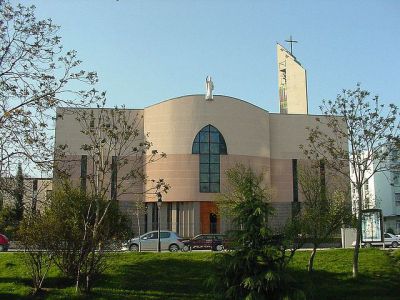
6) Catholic Cathedral of St. Paul
Saint Paul's Cathedral in Tirana is a modern architectural marvel that serves as a significant landmark for the Catholic community. Established under the Roman Catholic Archdiocese of Tiranë-Durrës, this cathedral stands out for its unique design and the meaningful symbols it houses. Unlike traditional church buildings, Saint Paul’s Cathedral showcases a contemporary look, defined by a combination of geometric shapes-a triangle and a circle-symbolizing the Holy Trinity and the eternity of God, respectively.
The cathedral was inaugurated on January 26, 2002, following a cornerstone laid by Pope John Paul II in 1993, marking a historic visit that underscored the church's importance. The exterior and interior of the cathedral are noted for their simplicity and modernist approach. A distinctive feature is the stained glass window next to the front door, which depicts Pope John Paul II and Mother Teresa, both pivotal figures in the Catholic Church. Additionally, a statue of Mother Teresa, who has been canonized by Pope Francis, greets visitors at the entrance, reinforcing the cathedral’s dedication to celebrating significant Catholic figures.
Surrounding the cathedral is a spacious courtyard that not only accentuates the cathedral's modern architecture but also hosts the offices and residences of the priests and the Metropolitan Archbishop of the Diocese of Tirana and Durrës. The presence of a statue of the Apostle Paul atop the building and another of Mother Teresa in the main courtyard further cements the cathedral's role as a beacon of faith and dedication in the community.
The cathedral was inaugurated on January 26, 2002, following a cornerstone laid by Pope John Paul II in 1993, marking a historic visit that underscored the church's importance. The exterior and interior of the cathedral are noted for their simplicity and modernist approach. A distinctive feature is the stained glass window next to the front door, which depicts Pope John Paul II and Mother Teresa, both pivotal figures in the Catholic Church. Additionally, a statue of Mother Teresa, who has been canonized by Pope Francis, greets visitors at the entrance, reinforcing the cathedral’s dedication to celebrating significant Catholic figures.
Surrounding the cathedral is a spacious courtyard that not only accentuates the cathedral's modern architecture but also hosts the offices and residences of the priests and the Metropolitan Archbishop of the Diocese of Tirana and Durrës. The presence of a statue of the Apostle Paul atop the building and another of Mother Teresa in the main courtyard further cements the cathedral's role as a beacon of faith and dedication in the community.
7) Clock Tower of Tirana
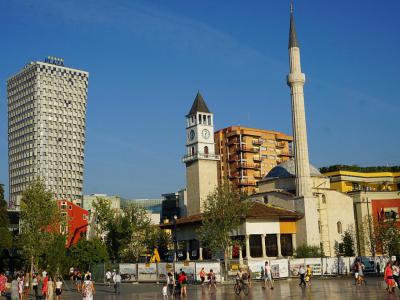
The Clock Tower of Tirana, known in Albanian as Kulla e Sahatit, is a 115-foot tall clock tower built in 1822. The tower is located near Skanderbeg Square, between Lulishte Park and the Et'hem Bey Mosque. It offers a unique and beautiful vista of the city from its viewing platform.
Construction of the tower was completed in 1822 by Etehem Bey Mollaj in the Islamic style. It was the tallest building in Tirana at the time it was built. The clock was assembled by watchmaker Ismail Tufina. The Tufina family continued to oversee the clock through 1973 when the communist regime forcibly removed them.
The clock was severely damaged in 1916 during World War I. A new clock was not installed until 1928, which was also installed by the Tufina family. An additional construction and new roof were required in order to install this new, larger clock face. These upper floors were once again destroyed during World War II. The clock has been replaced twice since 1946. Today, it holds a Chinese clock that was added in 1970.
Renovations over the years have allowed the public to access the viewing platform by climbing a narrow case of 90 wooden stairs. Access to the Clock Tower of Tirana is free.
Construction of the tower was completed in 1822 by Etehem Bey Mollaj in the Islamic style. It was the tallest building in Tirana at the time it was built. The clock was assembled by watchmaker Ismail Tufina. The Tufina family continued to oversee the clock through 1973 when the communist regime forcibly removed them.
The clock was severely damaged in 1916 during World War I. A new clock was not installed until 1928, which was also installed by the Tufina family. An additional construction and new roof were required in order to install this new, larger clock face. These upper floors were once again destroyed during World War II. The clock has been replaced twice since 1946. Today, it holds a Chinese clock that was added in 1970.
Renovations over the years have allowed the public to access the viewing platform by climbing a narrow case of 90 wooden stairs. Access to the Clock Tower of Tirana is free.

8) BunkArt 2 (must see)
BunkArt 2 is located in a large bunker in the center of Tirana near Skanderbeg Square. This bunker was intended for the Ministry of Internal Affairs during the communist regime. The museum exhibits life in the Albanian military and the work of the communist police. There is a strong focus on prisoners and work camps.
The bunker was constructed between 1981 and 1986. It consists of 24 rooms and one apartment to be used by the minister of the interior. It also has a large meeting hall that is now used to display exhibits. The bunker was code-named "Pillar Object" through the end of communist rule.
BunkArt 2 is just one of many bunkers built by Enver Hoxha. It is thought that he built more than 150,000 bunkers throughout the country. His fear of invasion from the United States and the Soviet Union caused him to have these bunkers built throughout his rule. It is thought that BunkArt 2 is the last of these.
Tourists are confronted by an audio recording when they enter BunkArt 2. This voiceover provides names of political prisoners who were victims of communist rule. The museum also has photographs and equipment that show the persecution of 100,000 Albanians under the communist regime.
BunkArt 2 offers three historical exhibits covering dates from 1913 to 1939, 1939 to 1944 and 1944 to 1991. There are also artistic installations throughout the bunker. Tourists will also see rooms dedicated to surveillance and investigation. Investigation could be conducted on anyone who was thought to be an enemy of the state; the type of room that was used for interrogation is part of the tour.
The bunker was constructed between 1981 and 1986. It consists of 24 rooms and one apartment to be used by the minister of the interior. It also has a large meeting hall that is now used to display exhibits. The bunker was code-named "Pillar Object" through the end of communist rule.
BunkArt 2 is just one of many bunkers built by Enver Hoxha. It is thought that he built more than 150,000 bunkers throughout the country. His fear of invasion from the United States and the Soviet Union caused him to have these bunkers built throughout his rule. It is thought that BunkArt 2 is the last of these.
Tourists are confronted by an audio recording when they enter BunkArt 2. This voiceover provides names of political prisoners who were victims of communist rule. The museum also has photographs and equipment that show the persecution of 100,000 Albanians under the communist regime.
BunkArt 2 offers three historical exhibits covering dates from 1913 to 1939, 1939 to 1944 and 1944 to 1991. There are also artistic installations throughout the bunker. Tourists will also see rooms dedicated to surveillance and investigation. Investigation could be conducted on anyone who was thought to be an enemy of the state; the type of room that was used for interrogation is part of the tour.
9) Murat Toptani Road
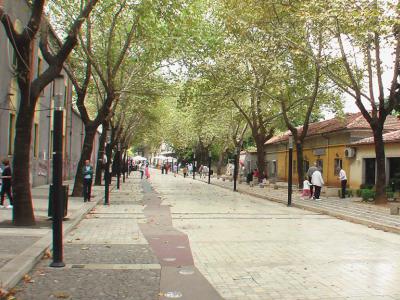
Murat Toptani Road is a popular pedestrian street in Tirana. It is named for the Toptani family, the leading Albanian noble family while Albania was under Ottoman rule. The name is derived from a word meaning "cannon," as the Toptani family owned cannons at a time when few others did.
Many streets around central Tirana are named for the Toptani family. Murat Toptani Road is arguably the most famous due to its location and its walkability. The stone-paved street rests between the Parliament House and the National Art Gallery. It is also possible to see the city's old fort from the street. It is not far from the residence of the Albanian Royal Family.
Plenty of entertainment, dining and shopping options are available a few steps away from the cobbled Murat Toptani Road. The Toptani Shopping Mall, Fan Stilian Noli Park and the open-air art installation Reja, or The Cloud, are all worth visiting.
Many streets around central Tirana are named for the Toptani family. Murat Toptani Road is arguably the most famous due to its location and its walkability. The stone-paved street rests between the Parliament House and the National Art Gallery. It is also possible to see the city's old fort from the street. It is not far from the residence of the Albanian Royal Family.
Plenty of entertainment, dining and shopping options are available a few steps away from the cobbled Murat Toptani Road. The Toptani Shopping Mall, Fan Stilian Noli Park and the open-air art installation Reja, or The Cloud, are all worth visiting.
10) Tirana Castle
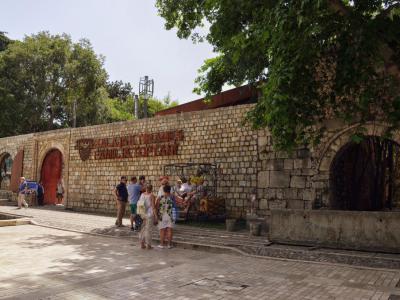
Tirana Castle is a 14th century castle that sits in the center of Tirana. It is also known as the Fortress of Justinian. The fortress has three towers along with numerous buildings that are open to the public. They currently contain hotels, restaurants and shopping.
A favorite among tourists is the traditional bazaar located inside Tirana Castle. This relatively new shopping area was created to resemble bazaars that would have been seen during the Byzantine era. Visitors can purchase traditional hand crafts or try local foods while they stroll around the ruins.
Most of what is left of the castle ruins is a 20-foot tall wall, usually referred to as the Justinian Fortress Wall. It is a vine-covered wall that runs along Murat Toptani Road. A plan to preserve the wall is in place, which has led to uncovered wall foundations that were added to Murat Toptani Road.
Tirana Castle was declared a first category monument of culture in 1973. The new tracks of preserved walls were declared cultural monuments in 2008.
A favorite among tourists is the traditional bazaar located inside Tirana Castle. This relatively new shopping area was created to resemble bazaars that would have been seen during the Byzantine era. Visitors can purchase traditional hand crafts or try local foods while they stroll around the ruins.
Most of what is left of the castle ruins is a 20-foot tall wall, usually referred to as the Justinian Fortress Wall. It is a vine-covered wall that runs along Murat Toptani Road. A plan to preserve the wall is in place, which has led to uncovered wall foundations that were added to Murat Toptani Road.
Tirana Castle was declared a first category monument of culture in 1973. The new tracks of preserved walls were declared cultural monuments in 2008.
