Custom Walk in Brussels, Belgium by b_lee_a6d34d created on 2026-06-03
Guide Location: Belgium » Brussels
Guide Type: Custom Walk
# of Sights: 9
Tour Duration: 2 Hour(s)
Travel Distance: 3.6 Km or 2.2 Miles
Share Key: 9WMYT
Guide Type: Custom Walk
# of Sights: 9
Tour Duration: 2 Hour(s)
Travel Distance: 3.6 Km or 2.2 Miles
Share Key: 9WMYT
How It Works
Please retrieve this walk in the GPSmyCity app. Once done, the app will guide you from one tour stop to the next as if you had a personal tour guide. If you created the walk on this website or come to the page via a link, please follow the instructions below to retrieve the walk in the app.
Retrieve This Walk in App
Step 1. Download the app "GPSmyCity: Walks in 1K+ Cities" on Apple App Store or Google Play Store.



Step 2. In the GPSmyCity app, download(or launch) the guide "Brussels Map and Walking Tours".
Step 3. Tap the menu button located at upper right corner of the "Walks" screen and select "Retrieve custom walk". Enter the share key: 9WMYT
1) Parc du Cinquantenaire (Jubilee Park) (must see)
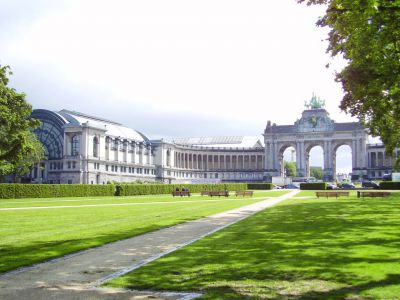
The Jubilee Park features expansive, leafy lawns that slope upward to a colossal triumphal arch crowned with a massive bronze sculpture called "Brabant Raising the National Flag". This arch, along with the two substantial stone buildings it connects, makes up Le Cinquantenaire ("Fiftieth Anniversary"), established by King Léopold II to commemorate the golden jubilee of the Belgian state in 1880. The exhibition at the time showcased products from Belgium and its colonies and was a great success. Today, the park continues to host various shows and trade fairs, while the buildings house extensive collections of art and applied art, weapons, and cars, displayed across three separate museums.
One notable attraction within the park itself is the Pavillon Horta, tucked away in the northwest corner. This Neoclassical structure, covered in graffiti, is known as the "pavilion of human passions" due to the controversial sculpture inside, created by Jef Lambeaux in 1886, which depicts writhing naked figures overseen by a shrouded Death. The pavilion was specifically designed to house this provocative work and was architect Victor Horta's first public commission, quite different from the later organic decorative style for which he became renowned. Interestingly, the building was closed just three days after opening due to the controversy generated by the bold artwork.
Next to the pavilion is a large cream-colored building, which houses Brussels' main mosque. This modern Arabic-style mosque was built in 1978 by a Tunisian architect, serving as a replacement for an earlier structure dating back to 1897.
Why You Should Visit:
A great place to relax, jog, enjoy picturesque views, and explore the diverse range of museums.
It's also a perfect spot for picnicking, especially on weekends when people and dog watching are popular activities.
Tip:
Visitors to the Royal Military Museum can take an elevator to the top of the Arch to enjoy wonderful views of Brussels, and this access is free of charge.
One notable attraction within the park itself is the Pavillon Horta, tucked away in the northwest corner. This Neoclassical structure, covered in graffiti, is known as the "pavilion of human passions" due to the controversial sculpture inside, created by Jef Lambeaux in 1886, which depicts writhing naked figures overseen by a shrouded Death. The pavilion was specifically designed to house this provocative work and was architect Victor Horta's first public commission, quite different from the later organic decorative style for which he became renowned. Interestingly, the building was closed just three days after opening due to the controversy generated by the bold artwork.
Next to the pavilion is a large cream-colored building, which houses Brussels' main mosque. This modern Arabic-style mosque was built in 1978 by a Tunisian architect, serving as a replacement for an earlier structure dating back to 1897.
Why You Should Visit:
A great place to relax, jog, enjoy picturesque views, and explore the diverse range of museums.
It's also a perfect spot for picnicking, especially on weekends when people and dog watching are popular activities.
Tip:
Visitors to the Royal Military Museum can take an elevator to the top of the Arch to enjoy wonderful views of Brussels, and this access is free of charge.
2) Arc de Triomphe (Triumphal Arch) (must see)
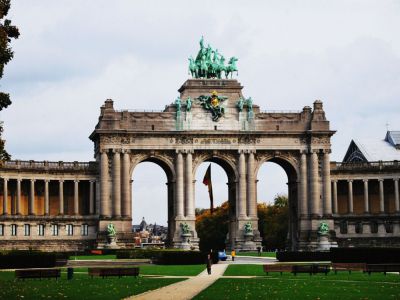
The wide and verdant lawns of Jubilee Park ("Parc du Cinquantenaire") slope upward to meet a grandiose triumphal arch of monumental proportions. Crowning this arch is a colossal bronze statue titled "Brabant Raising the National Flag", featuring a chariot drawn by four horses, symbolizing the Brabant province. Statues representing other provinces are positioned at the base of the columns surrounding the arch, whose sides are adorned with "galleries of the columns", embellished with mosaics illustrating Belgium's commitment to peace.
Le Cinquantenaire, which comprises the arch and the two substantial stone buildings it connects, was established by King Leopold II to commemorate the golden jubilee of the Belgian state in 1880. While the arch was intended to serve as a new entrance gate to the area, its funding and construction sparked controversy, as the king aspired to create an exceedingly extravagant structure, while the government was reluctant to allocate excessive funds. The financing and construction process proved protracted, spanning 25 years until its completion in 1905, with King Leopold II and private donors ultimately covering the costs.
On a positive note, Jubilee Park continues to host a variety of shows and trade fairs, maintaining its role as a versatile public space. The buildings within the park now house extensive collections of art and applied art, weaponry, and automobiles, exhibited across three distinct museums.
Why You Should Visit:
Because the best things in life are free.
Tip:
Just head to the top of the arch to admire Brussels' interesting panorama.
Le Cinquantenaire, which comprises the arch and the two substantial stone buildings it connects, was established by King Leopold II to commemorate the golden jubilee of the Belgian state in 1880. While the arch was intended to serve as a new entrance gate to the area, its funding and construction sparked controversy, as the king aspired to create an exceedingly extravagant structure, while the government was reluctant to allocate excessive funds. The financing and construction process proved protracted, spanning 25 years until its completion in 1905, with King Leopold II and private donors ultimately covering the costs.
On a positive note, Jubilee Park continues to host a variety of shows and trade fairs, maintaining its role as a versatile public space. The buildings within the park now house extensive collections of art and applied art, weaponry, and automobiles, exhibited across three distinct museums.
Why You Should Visit:
Because the best things in life are free.
Tip:
Just head to the top of the arch to admire Brussels' interesting panorama.
3) Memorial to Robert Schuman
Robert Schuman (1886-1963) was a French statesman known for his vital role in the early development of the European Union. He was born on June 29, 1886, in Luxembourg, which was then part of the German Empire. Schuman came from a family of Lorraine descent and grew up in a bilingual and bicultural environment, speaking both French and German.
His political career began after World War I when he became a member of the French National Assembly. He represented the Moselle department in northeastern France and held various parliamentary roles. During World War II, Schuman opposed the Nazi occupation of France and was briefly arrested by the Gestapo but managed to escape and go into hiding.
One of his most significant contributions to European history was the Schuman Declaration in 1950. As the French Foreign Minister, he proposed the creation of the European Coal and Steel Community (ECSC). This proposal aimed to integrate coal and steel industries among European nations to prevent future wars by making it impossible for individual countries to control these key resources. The Schuman Declaration is considered the birth of the European Union, celebrated on May 9 as Europe Day.
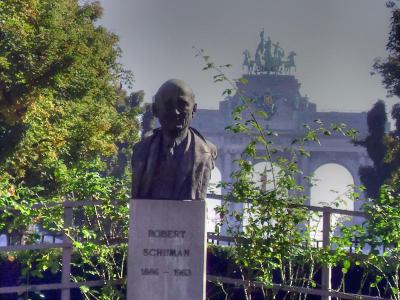
Schuman served as the Prime Minister of France, Foreign Minister, and played a vital role in the Treaty of Paris in 1951, which established the ECSC. He also served as the President of the European Parliamentary Assembly. Schuman's commitment to European unity and peace earned him the title "Father of Europe". This statue of him in Jubilee ("Cinquantenaire") Park marks the beginning of the "Schuman district", which includes a metro station, tunnel, and a roundabout named in his honor. In the vicinity of the latter, you can find various European institutions, such as the Berlaymont building, the European Commission's headquarters, featuring a monument to Schuman, as well as important European Parliament facilities.
His political career began after World War I when he became a member of the French National Assembly. He represented the Moselle department in northeastern France and held various parliamentary roles. During World War II, Schuman opposed the Nazi occupation of France and was briefly arrested by the Gestapo but managed to escape and go into hiding.
One of his most significant contributions to European history was the Schuman Declaration in 1950. As the French Foreign Minister, he proposed the creation of the European Coal and Steel Community (ECSC). This proposal aimed to integrate coal and steel industries among European nations to prevent future wars by making it impossible for individual countries to control these key resources. The Schuman Declaration is considered the birth of the European Union, celebrated on May 9 as Europe Day.
Schuman served as the Prime Minister of France, Foreign Minister, and played a vital role in the Treaty of Paris in 1951, which established the ECSC. He also served as the President of the European Parliamentary Assembly. Schuman's commitment to European unity and peace earned him the title "Father of Europe". This statue of him in Jubilee ("Cinquantenaire") Park marks the beginning of the "Schuman district", which includes a metro station, tunnel, and a roundabout named in his honor. In the vicinity of the latter, you can find various European institutions, such as the Berlaymont building, the European Commission's headquarters, featuring a monument to Schuman, as well as important European Parliament facilities.
4) Berlaymont
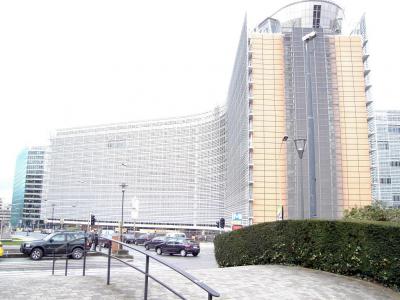
The Berlaymont (sometimes nicknamed "the Berlaymonster") is an office building in Brussels that houses the headquarters of the European Commission, the executive of the European Union. The unique form of the Berlaymont's architecture is used in the European Commission's official emblem.
The building now has 240,000 m² of floor space on 18 levels, connected by 42 lifts and 12 escalators. Offices for 3,000 officials and meeting rooms are in the tower. Restaurant and services, a 900-seat cafeteria, TV studio, conference rooms, storage rooms, Nordic sauna, car parking for over 1,100 vehicles and various services occupy the basement.
The building now has 240,000 m² of floor space on 18 levels, connected by 42 lifts and 12 escalators. Offices for 3,000 officials and meeting rooms are in the tower. Restaurant and services, a 900-seat cafeteria, TV studio, conference rooms, storage rooms, Nordic sauna, car parking for over 1,100 vehicles and various services occupy the basement.
Sight description based on Wikipedia.
5) Europa Building
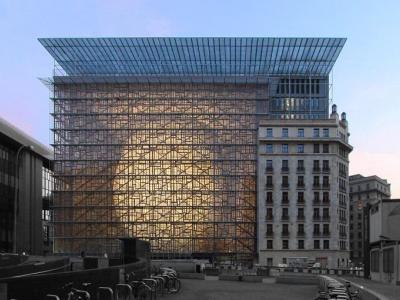
The Europa building is the seat of the European Council and Council of the European Union. Its defining feature is the multi-storey "lantern-shaped" construct holding the main meeting rooms; a representation of which has been adopted by both the European Council and Council of the EU as their official emblems.
The Europa building is situated on the former site of the partially demolished and renovated Bloc A of the Residence Palace. Its exterior combines the listed Art Deco façade of the original 1920s building with the contemporary design of architect Philippe Samyn. The building is linked via two skyways and a service tunnel to the adjacent Justus Lipsius building, which provides for additional office space, meeting rooms and press facilities.
The Europa building is situated on the former site of the partially demolished and renovated Bloc A of the Residence Palace. Its exterior combines the listed Art Deco façade of the original 1920s building with the contemporary design of architect Philippe Samyn. The building is linked via two skyways and a service tunnel to the adjacent Justus Lipsius building, which provides for additional office space, meeting rooms and press facilities.
6) Lex Building
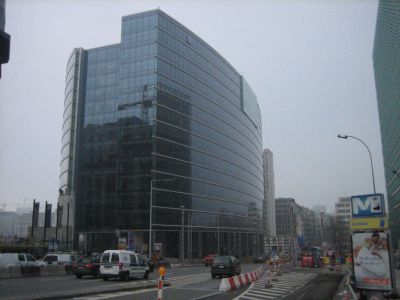
The 15-story Lex Building is a government office in the European Quarter of Brussels. The building was constructed over a two year period and completed in 2006. The facade is made of a glass curtain system. Prior to construction of the Lex, an old mansion on the site had to be demolished. Instead of trying to renovate or incorporate the old building, it was demolished in favor of starting with a blank slate and designing a building that could suit the end users needs more appropriately. The desire for additional government offices was driven by the fact that the European Union (EU) was expanded in based upon the Treaty of Accession 2003 with the Czech Republic, Estonia, Cyprus, Latvia, Lithuania, Hungary, Malta, Poland, Slovenia, and Slovakia.
The design for the building came out of an international competition, with Belgian architects Jasper-Eyers having the winning design. The design features two opposing shells. The building served as an annex to the Council of Ministers, which represents the Member States’ governments. Any acts that are relevant to the lives of EU citizens or have a large international impact are adopted by the Council, typically in conjunction with the European Parliament.
The design for the building came out of an international competition, with Belgian architects Jasper-Eyers having the winning design. The design features two opposing shells. The building served as an annex to the Council of Ministers, which represents the Member States’ governments. Any acts that are relevant to the lives of EU citizens or have a large international impact are adopted by the Council, typically in conjunction with the European Parliament.
Sight description based on Wikipedia.
7) Delors Building
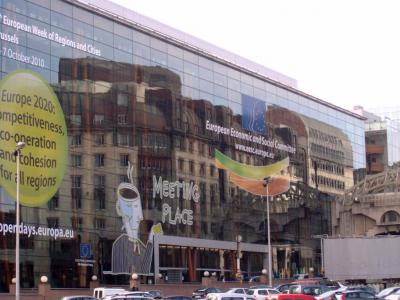
The European Economic and Social Committee (EESC) Building, which is also known as the Delors Building, is the home of EESC. It was named after the French economist and politician, Jacques Delors, who was a prominent President of the European Commission from 1985 to 1994. He was the only president of the European Commission to serve three terms.
The EESC is an assembly of employer organizations, trade unions and other representative groups of related interest. The EESC was established in 1957 under the Treaty of Rome, with the goal of establishing a single market out of differing economic interest groups. The EESC acts in a consultancy role, however, based upon provisions of the Treaty of Maastricht, the EESC has influence in the areas of social policy, environment, education, health, consumer protection and indirect taxation, among other areas. The EESC provides input on subjects relating to European integration and issues opinion papers on various topics.
The EESC is an assembly of employer organizations, trade unions and other representative groups of related interest. The EESC was established in 1957 under the Treaty of Rome, with the goal of establishing a single market out of differing economic interest groups. The EESC acts in a consultancy role, however, based upon provisions of the Treaty of Maastricht, the EESC has influence in the areas of social policy, environment, education, health, consumer protection and indirect taxation, among other areas. The EESC provides input on subjects relating to European integration and issues opinion papers on various topics.
Sight description based on Wikipedia.
8) Espace Leopold
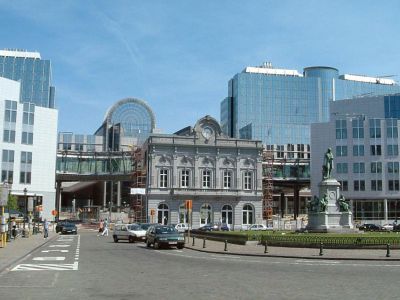
The Espace Léopold is the complex of parliament buildings in Brussels housing the European Parliament, a legislative chamber of the European Union.
It consists of a number of buildings, primarily the oldest, the Paul-Henri Spaak building, which houses the debating chamber and the President's offices, and the Altiero Spinelli building which is the largest. The buildings are located in the European quarter in the east of Brussels, with building starting in 1989.
The complex is not the official seat of Parliament, which is the Immeuble Louise Weiss in Strasbourg, France, but as most of the other institutions of the European Union are in Brussels, Parliament built the Brussels complex to be closer to their activities. A majority of the Parliament's work is now geared to its Brussels site, but it is legally bound to keep Strasbourg as its official home.
It consists of a number of buildings, primarily the oldest, the Paul-Henri Spaak building, which houses the debating chamber and the President's offices, and the Altiero Spinelli building which is the largest. The buildings are located in the European quarter in the east of Brussels, with building starting in 1989.
The complex is not the official seat of Parliament, which is the Immeuble Louise Weiss in Strasbourg, France, but as most of the other institutions of the European Union are in Brussels, Parliament built the Brussels complex to be closer to their activities. A majority of the Parliament's work is now geared to its Brussels site, but it is legally bound to keep Strasbourg as its official home.
Sight description based on Wikipedia.
9) Parc Leopold (Leopold Park)
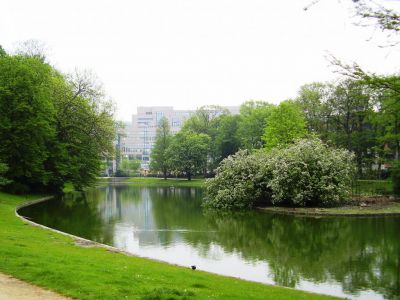
Nestled at the heart of the European Quarter, adjacent to the Paul-Henri Spaak building, which houses the European Parliament, this picturesque landscape with rolling hills, covering 10 hectares (25 acres) and surrounding a serene lake, has replaced the former Royal Zoological Gardens that once occupied the site. The park was established in 1880 and initially served as the backdrop for the Solvay School of Commerce campus buildings.
While the school desired to expand its campus with additional structures, concerns arose from the public that such expansion might encroach too much on the park, diminishing the enjoyment of its visitors. The original campus buildings still stand within the park, with only one of them remaining under the ownership of the school: the impressive Solvay Library ("Bibliothèque Solvay"), a magnificent barrel-vaulted edifice adorned with splendid mahogany paneling.
The park is a popular destination for both locals and tourists, offering a lush and tranquil escape from the bustling city of Brussels. Visitors can explore the remnants of the medieval Eggevoort tower, and the lake itself, one of the last remaining in the entire Maalbek Valley, serves as a prominent focal point. The park is also home to several bird species, including coots, mallards, geese, parakeets, and moorhens. Admission is free, and there is a play area that is particularly enjoyed by young visitors.
While the school desired to expand its campus with additional structures, concerns arose from the public that such expansion might encroach too much on the park, diminishing the enjoyment of its visitors. The original campus buildings still stand within the park, with only one of them remaining under the ownership of the school: the impressive Solvay Library ("Bibliothèque Solvay"), a magnificent barrel-vaulted edifice adorned with splendid mahogany paneling.
The park is a popular destination for both locals and tourists, offering a lush and tranquil escape from the bustling city of Brussels. Visitors can explore the remnants of the medieval Eggevoort tower, and the lake itself, one of the last remaining in the entire Maalbek Valley, serves as a prominent focal point. The park is also home to several bird species, including coots, mallards, geese, parakeets, and moorhens. Admission is free, and there is a play area that is particularly enjoyed by young visitors.
