Custom Walk in Genoa, Italy by jeffpkaefer_23225c created on 2026-06-03
Guide Location: Italy » Genoa
Guide Type: Custom Walk
# of Sights: 6
Tour Duration: 1 Hour(s)
Travel Distance: 1.9 Km or 1.2 Miles
Share Key: WU5WU
Guide Type: Custom Walk
# of Sights: 6
Tour Duration: 1 Hour(s)
Travel Distance: 1.9 Km or 1.2 Miles
Share Key: WU5WU
How It Works
Please retrieve this walk in the GPSmyCity app. Once done, the app will guide you from one tour stop to the next as if you had a personal tour guide. If you created the walk on this website or come to the page via a link, please follow the instructions below to retrieve the walk in the app.
Retrieve This Walk in App
Step 1. Download the app "GPSmyCity: Walks in 1K+ Cities" on Apple App Store or Google Play Store.



Step 2. In the GPSmyCity app, download(or launch) the guide "Genoa Map and Walking Tours".
Step 3. Tap the menu button located at upper right corner of the "Walks" screen and select "Retrieve custom walk". Enter the share key: WU5WU
1) Porto Antico di Genova (Genoa Old Port) (must see)
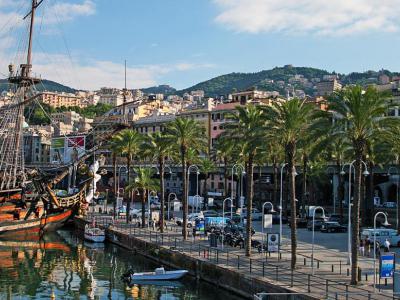
Genoa’s Old Port is where the city casually reminds you that it once ruled the waves-and then invites you to hang around and enjoy the view. This is Genoa’s maritime past brought back to life with a distinctly modern attitude. In the harbor, old-style galleons share space with polished yachts and towering cruise ships, all floating together like different centuries decided to meet for an aperitivo.
There’s plenty to keep you busy without ever leaving the waterfront. You’ll find restaurants, museums, an aquarium, an auditorium, and even a botanical garden sealed inside a glass bubble. And yes, there’s also a giant octopus-shaped crane, which politely lifts visitors into the air for a better look-because in Genoa, even heavy machinery appears to enjoy a bit of showmanship. The Old Port works just as well for a slow sunset walk as it does for a late-evening stroll, when the lights reflect off the water, and the city feels momentarily hushed.
This transformation didn’t happen by accident. The redesign followed the vision of Renzo Piano, a world-renowned architect, who happens to be a Genoa native. He aimed to turn a neglected industrial harbor into a cultural and social hub-less rust and warehouses, more people, views, and public space. The result is a port that feels open and inviting, without pretending it ever stopped being a working harbor.
The official comeback moment came in 1992, during the International Exhibition known as Genoa ’92 – Colombo ’92. Held from May to August, the event marked 500 years since Christopher Columbus’s first voyage to the Americas and served as the grand debut of the restored Old Port. Its theme-“Christopher Columbus, the Ship, and the Sea”-could hardly have been more fitting. Since then, the Old Port has remained one of the clearest places to see how Genoa connects its past to the present, without losing its sea legs along the way.
There’s plenty to keep you busy without ever leaving the waterfront. You’ll find restaurants, museums, an aquarium, an auditorium, and even a botanical garden sealed inside a glass bubble. And yes, there’s also a giant octopus-shaped crane, which politely lifts visitors into the air for a better look-because in Genoa, even heavy machinery appears to enjoy a bit of showmanship. The Old Port works just as well for a slow sunset walk as it does for a late-evening stroll, when the lights reflect off the water, and the city feels momentarily hushed.
This transformation didn’t happen by accident. The redesign followed the vision of Renzo Piano, a world-renowned architect, who happens to be a Genoa native. He aimed to turn a neglected industrial harbor into a cultural and social hub-less rust and warehouses, more people, views, and public space. The result is a port that feels open and inviting, without pretending it ever stopped being a working harbor.
The official comeback moment came in 1992, during the International Exhibition known as Genoa ’92 – Colombo ’92. Held from May to August, the event marked 500 years since Christopher Columbus’s first voyage to the Americas and served as the grand debut of the restored Old Port. Its theme-“Christopher Columbus, the Ship, and the Sea”-could hardly have been more fitting. Since then, the Old Port has remained one of the clearest places to see how Genoa connects its past to the present, without losing its sea legs along the way.
2) Cattedrale di San Lorenzo (Cathedral of St. Lawrence) (must see)
The Cathedral of San Lorenzo doesn’t just stand in Genoa-it dominates the conversation. Construction began around 1098, and by 1118, Pope Gelasius II was here to inaugurate it, which already tells you this wasn’t a modest parish project. Once the city walls went up, the area around San Lorenzo became Genoa’s beating heart. In medieval times, this wasn’t only a place to pray; it was where religion, politics, and public life all collided, usually quite loudly.
Disaster struck in 1296 when a fire tore through the building, but Genoa responded the way Genoa usually does: by rebuilding bigger and better. The striped façade you see today was finished in 1312, colonnades were restored, matron galleries added, and work continued well into the 17th century. Later still, between 1894 and 1900, restorers stepped in to tidy up the medieval sections and the dome, making sure San Lorenzo looked suitably timeless for the modern age.
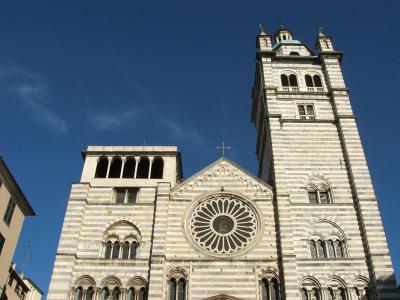
Take a moment to face the main façade. Three Gothic portals open beneath recessed arches, with Christ and Saint Lawrence watching calmly from the lunette above the central door. A large rose window sits above, because understatement clearly didn’t make the cut. Two stone lions flank the steps, looking eternally unimpressed, while two towers of different heights rise above them-a reminder that architectural symmetry was never a strict requirement.
Inside, the cathedral follows a basilica plan with a transept and choir. Three naves stretch ahead, divided by marble columns and striped arches in alternating light and dark stone. Above them, smaller Romanesque arches in grey stone add another visual rhythm, creating an interior that feels both ordered and dramatic.
On the left, you’ll find the chapel dedicated to Saint John the Baptist, Genoa’s patron saint. Inside is an urn holding his relics, brought here at the end of the First Crusade-because Genoa never missed an opportunity to bring something significant home.
And then there’s the shell. On February 9, 1941, an English battleship fired an armor-piercing shell straight into the cathedral. It punched through a corner of the nave and… didn’t explode. The shell is still there today, quietly minding its own business. Keep an eye out-it’s one of the most unusual souvenirs of World War II.
Entry to the cathedral is free, though you’ll need a ticket for the treasure museum. Either way, San Lorenzo makes it very clear why it has been running the show in Genoa for centuries.
Disaster struck in 1296 when a fire tore through the building, but Genoa responded the way Genoa usually does: by rebuilding bigger and better. The striped façade you see today was finished in 1312, colonnades were restored, matron galleries added, and work continued well into the 17th century. Later still, between 1894 and 1900, restorers stepped in to tidy up the medieval sections and the dome, making sure San Lorenzo looked suitably timeless for the modern age.
Take a moment to face the main façade. Three Gothic portals open beneath recessed arches, with Christ and Saint Lawrence watching calmly from the lunette above the central door. A large rose window sits above, because understatement clearly didn’t make the cut. Two stone lions flank the steps, looking eternally unimpressed, while two towers of different heights rise above them-a reminder that architectural symmetry was never a strict requirement.
Inside, the cathedral follows a basilica plan with a transept and choir. Three naves stretch ahead, divided by marble columns and striped arches in alternating light and dark stone. Above them, smaller Romanesque arches in grey stone add another visual rhythm, creating an interior that feels both ordered and dramatic.
On the left, you’ll find the chapel dedicated to Saint John the Baptist, Genoa’s patron saint. Inside is an urn holding his relics, brought here at the end of the First Crusade-because Genoa never missed an opportunity to bring something significant home.
And then there’s the shell. On February 9, 1941, an English battleship fired an armor-piercing shell straight into the cathedral. It punched through a corner of the nave and… didn’t explode. The shell is still there today, quietly minding its own business. Keep an eye out-it’s one of the most unusual souvenirs of World War II.
Entry to the cathedral is free, though you’ll need a ticket for the treasure museum. Either way, San Lorenzo makes it very clear why it has been running the show in Genoa for centuries.

3) Palazzo Ducale (Doge's Palace) (must see)
The Doge’s Palace, one of Genoa’s most recognizable power statements, has been making an impression since the late 13th century. This was the political engine room of the Republic of Genoa and the official home of its doges. The building plays both sides of the city, stretching confidently between Giacomo Matteotti Square on the one end and De Ferrari Square on the other-because a ruling palace, apparently, should never have just one front.
What you see today is the result of centuries of architectural remixing. The palace began with a solid medieval core, complete with the 14th-century Grimaldina Tower and prison cells that were not designed with comfort in mind. Gothic flair arrived with features like the Paper Gate, built between 1438 and 1442, which once controlled official access to the seat of power.
Later on, Renaissance and Mannerist architects, such as Andrea Ceresola and Simone Cantoni, stepped in, expanding and reshaping the palace during the late 16th and 18th centuries. Then came the fire of 1777-a disaster that prompted a full makeover. Out of the ashes emerged the elegant neoclassical façade and the grand ceremonial halls that now define the palace’s interior.
Once inside, you move through spaces designed to impress and intimidate in equal measure. The Halls of the Major and Minor Councils recall heated political debates and carefully negotiated decisions, while the Doge’s Chapel adds a layer of solemn grandeur with its rich decoration. Down below, the restored medieval prison cells offer a sobering contrast-proof that justice in the old republic could be swift and uncomfortable.
Today, the Doge’s Palace has traded governing power for cultural influence. It functions as one of Genoa’s main cultural venues, hosting major art exhibitions, concerts, talks, and public events. Politics may have moved elsewhere, but this palace still knows how to draw a crowd...
What you see today is the result of centuries of architectural remixing. The palace began with a solid medieval core, complete with the 14th-century Grimaldina Tower and prison cells that were not designed with comfort in mind. Gothic flair arrived with features like the Paper Gate, built between 1438 and 1442, which once controlled official access to the seat of power.
Later on, Renaissance and Mannerist architects, such as Andrea Ceresola and Simone Cantoni, stepped in, expanding and reshaping the palace during the late 16th and 18th centuries. Then came the fire of 1777-a disaster that prompted a full makeover. Out of the ashes emerged the elegant neoclassical façade and the grand ceremonial halls that now define the palace’s interior.
Once inside, you move through spaces designed to impress and intimidate in equal measure. The Halls of the Major and Minor Councils recall heated political debates and carefully negotiated decisions, while the Doge’s Chapel adds a layer of solemn grandeur with its rich decoration. Down below, the restored medieval prison cells offer a sobering contrast-proof that justice in the old republic could be swift and uncomfortable.
Today, the Doge’s Palace has traded governing power for cultural influence. It functions as one of Genoa’s main cultural venues, hosting major art exhibitions, concerts, talks, and public events. Politics may have moved elsewhere, but this palace still knows how to draw a crowd...

4) Piazza De Ferrari (Ferrari Square) (must see)
This place's story starts with the man whose name ended up on Genoa’s biggest calling card, Raffaele Luigi De Ferrari. He wasn’t just wealthy-he was spectacularly so. Prince of Lucedio, Duke of Galliera, senator of the Kingdom of Sardinia, Grand Officer of the Order of Italy… and that’s just the short list of his titles. In 1837, De Ferrari even managed to acquire properties once handed out by Napoleon I, via Prince Oscar of Sweden. Indeed, when your résumé reads like that, having the main square of Genoa named after you feels less like flattery and more like inevitability.
Ferrari Square itself is anything but modest. Spreading across roughly 120,000 square feet, it works as Genoa’s grand urban stage. At its center sits a massive bronze fountain completed in 1936, designed by Giuseppe Crosa di Vergagni-a piece that manages to be both monumental and unapologetically dramatic, very much in keeping with the square’s personality...
This space, however, didn’t always look the way it does now. In 1814, the Church of San Domenico was demolished to make room for the Carlo Felice Theater, designed by Carlo Barabino and completed in 1827. A few years later, in 1831, a two-story Linguistic Academy appeared nearby. The square officially became Ferrari Square in 1877-one year after De Ferrari’s death-because timing, apparently, matters even in commemoration. By 1893, Giuseppe Garibaldi, a hero of the Italian revolution, appeared here on horseback in bronze form in front of the theater.
As the late 19th and early 20th centuries rolled in, the square filled out with confident, eclectic architecture. The New Bourse Palace opened in 1912, followed by the Italian Credit Palace in 1914, and the Liguria Region Palace in 1923-each one keen to make its presence felt.
And then there are the veterans. The Doge's Palace, dating back to the 13th century and restored in 1992, now serves as a museum and cultural hub. Nearby stand the Giulio Pallavicini Palace from 1586 and the Agostino Spinola Palace, built in the 18th century and now home to a bank. Together, they turn Ferrari Square into a crash course in Genoa’s favorite subject: power, displayed loudly and over several centuries.
Ferrari Square itself is anything but modest. Spreading across roughly 120,000 square feet, it works as Genoa’s grand urban stage. At its center sits a massive bronze fountain completed in 1936, designed by Giuseppe Crosa di Vergagni-a piece that manages to be both monumental and unapologetically dramatic, very much in keeping with the square’s personality...
This space, however, didn’t always look the way it does now. In 1814, the Church of San Domenico was demolished to make room for the Carlo Felice Theater, designed by Carlo Barabino and completed in 1827. A few years later, in 1831, a two-story Linguistic Academy appeared nearby. The square officially became Ferrari Square in 1877-one year after De Ferrari’s death-because timing, apparently, matters even in commemoration. By 1893, Giuseppe Garibaldi, a hero of the Italian revolution, appeared here on horseback in bronze form in front of the theater.
As the late 19th and early 20th centuries rolled in, the square filled out with confident, eclectic architecture. The New Bourse Palace opened in 1912, followed by the Italian Credit Palace in 1914, and the Liguria Region Palace in 1923-each one keen to make its presence felt.
And then there are the veterans. The Doge's Palace, dating back to the 13th century and restored in 1992, now serves as a museum and cultural hub. Nearby stand the Giulio Pallavicini Palace from 1586 and the Agostino Spinola Palace, built in the 18th century and now home to a bank. Together, they turn Ferrari Square into a crash course in Genoa’s favorite subject: power, displayed loudly and over several centuries.

5) Via Giuseppe Garibaldi (Giuseppe Garibaldi Street) (must see)
Giuseppe Garibaldi Street is where Genoa is showing off-and doing it with historical justification. This was one of the famous “New Streets,” laid out in 1583 when Genoese aristocrats decided their medieval lanes no longer matched their wealth.
At first, it went by practical names like Strada Maggiore (or Major Street) and Strada Nuova (New Street) before confidence kicked in, and it earned the nickname Strada Aurea, the Golden Street. Only in 1882 did it take on the name Giuseppe Garibaldi in honor of the general and revolutionary who greatly contributed to the Unification of Italy. The street's measurements were precise, but the ambition was anything but modest: just under a 1,000 feet long, relatively narrow, and packed edge to edge with palaces.
By the late 16th and 17th centuries, Genoa had enough money to burn and no interest in hiding it. The city’s oligarchs pushed north, reshaping the urban map and imagining a city of grand palaces and elegant villas beyond the old medieval core. This street became their architectural calling card-a place where wealth, taste, and rivalry all competed for attention, façade by façade.
Names changed as fortunes rose, but the message stayed the same. Today, Garibaldi Street anchors the New Streets Museum complex, linking three high-end properties: the Doria Tursi Palace, now Genoa’s City Hall; the White Palace, home to major art collections; and the former Podestà’s Palace. Together, they read like a résumé written in stone.
Back in the days of the Republic, these palaces served a very practical purpose. Genoa kept official Rolli lists-ranked registers of noble homes approved to host visiting kings, princes, diplomats, and church authorities. The higher the guest, the grander the palace. Hospitality here was a civic duty, but also a competitive sport.
Today, you can time your visit with Rolli Days, held each spring and autumn, when normally closed palaces open their doors to the public. And if you’re wondering whether all this repetition ever becomes too much, Charles Dickens had an answer. Writing in Pictures from Italy, he confessed he couldn’t forget these “streets of palaces,” where one grand building follows another, again and again. Genoa, it seems, has always liked to leave a strong impression-and then add one more...
At first, it went by practical names like Strada Maggiore (or Major Street) and Strada Nuova (New Street) before confidence kicked in, and it earned the nickname Strada Aurea, the Golden Street. Only in 1882 did it take on the name Giuseppe Garibaldi in honor of the general and revolutionary who greatly contributed to the Unification of Italy. The street's measurements were precise, but the ambition was anything but modest: just under a 1,000 feet long, relatively narrow, and packed edge to edge with palaces.
By the late 16th and 17th centuries, Genoa had enough money to burn and no interest in hiding it. The city’s oligarchs pushed north, reshaping the urban map and imagining a city of grand palaces and elegant villas beyond the old medieval core. This street became their architectural calling card-a place where wealth, taste, and rivalry all competed for attention, façade by façade.
Names changed as fortunes rose, but the message stayed the same. Today, Garibaldi Street anchors the New Streets Museum complex, linking three high-end properties: the Doria Tursi Palace, now Genoa’s City Hall; the White Palace, home to major art collections; and the former Podestà’s Palace. Together, they read like a résumé written in stone.
Back in the days of the Republic, these palaces served a very practical purpose. Genoa kept official Rolli lists-ranked registers of noble homes approved to host visiting kings, princes, diplomats, and church authorities. The higher the guest, the grander the palace. Hospitality here was a civic duty, but also a competitive sport.
Today, you can time your visit with Rolli Days, held each spring and autumn, when normally closed palaces open their doors to the public. And if you’re wondering whether all this repetition ever becomes too much, Charles Dickens had an answer. Writing in Pictures from Italy, he confessed he couldn’t forget these “streets of palaces,” where one grand building follows another, again and again. Genoa, it seems, has always liked to leave a strong impression-and then add one more...

6) Spianata di Castelletto (Esplanade of Castelletto) (must see)
“Castelletto” literally means a “small castle” in Italian, which sounds cozy and medieval-until you learn it’s mostly a neighborhood, not a toy-sized fortress. Yes, there was a small stronghold up here, keeping an eye on Genoa from the 10th century onward, but by the 19th century, it was politely removed to make way for housing. Progress, Genoese style...
What the demolition left behind is far more generous: the Belvedere Montaldo, perched about 240 feet above the city and serving up one of Genoa’s best views. Getting there is half the fun. You take the public lift from Portale Square, famously described by poet Giorgio Caproni as “the best route to heaven”-and he wasn’t being ironic. The lift delivers you into daylight through a graceful Art Nouveau tower, which feels like an architectural curtain call.
Here’s a detail most visitors miss: beneath what once was Castelletto lie the city’s old water reservoirs. These massive tanks collected water carried by the ancient aqueduct from the Bisagno Valley, quietly supporting Genoa long before anyone came here for the view. So, while you’re admiring rooftops and harbors, remember there’s an entire hidden infrastructure beneath your feet, doing its job centuries ahead of schedule.
Today, the Esplanade of Castelletto sits calmly above the city, very much alive as a residential neighborhood. This isn’t a postcard-only viewpoint-it’s a place with streets, cafés, and a local rhythm that comes into its own in the late afternoon or early evening. Easy to reach from the city center, it offers a pause from the dense streets below and a reminder that Genoa doesn’t just rise vertically in buildings, but in layers of history, practicality, and excellent timing for sunset.
What the demolition left behind is far more generous: the Belvedere Montaldo, perched about 240 feet above the city and serving up one of Genoa’s best views. Getting there is half the fun. You take the public lift from Portale Square, famously described by poet Giorgio Caproni as “the best route to heaven”-and he wasn’t being ironic. The lift delivers you into daylight through a graceful Art Nouveau tower, which feels like an architectural curtain call.
Here’s a detail most visitors miss: beneath what once was Castelletto lie the city’s old water reservoirs. These massive tanks collected water carried by the ancient aqueduct from the Bisagno Valley, quietly supporting Genoa long before anyone came here for the view. So, while you’re admiring rooftops and harbors, remember there’s an entire hidden infrastructure beneath your feet, doing its job centuries ahead of schedule.
Today, the Esplanade of Castelletto sits calmly above the city, very much alive as a residential neighborhood. This isn’t a postcard-only viewpoint-it’s a place with streets, cafés, and a local rhythm that comes into its own in the late afternoon or early evening. Easy to reach from the city center, it offers a pause from the dense streets below and a reminder that Genoa doesn’t just rise vertically in buildings, but in layers of history, practicality, and excellent timing for sunset.
