Custom Walk in Toledo, Spain by katrobinson777_b7eac9 created on 2026-06-10
Guide Location: Spain » Toledo
Guide Type: Custom Walk
# of Sights: 10
Tour Duration: 3 Hour(s)
Travel Distance: 5.2 Km or 3.2 Miles
Share Key: 83FJ7
Guide Type: Custom Walk
# of Sights: 10
Tour Duration: 3 Hour(s)
Travel Distance: 5.2 Km or 3.2 Miles
Share Key: 83FJ7
How It Works
Please retrieve this walk in the GPSmyCity app. Once done, the app will guide you from one tour stop to the next as if you had a personal tour guide. If you created the walk on this website or come to the page via a link, please follow the instructions below to retrieve the walk in the app.
Retrieve This Walk in App
Step 1. Download the app "GPSmyCity: Walks in 1K+ Cities" on Apple App Store or Google Play Store.



Step 2. In the GPSmyCity app, download(or launch) the guide "Toledo Map and Walking Tours".
Step 3. Tap the menu button located at upper right corner of the "Walks" screen and select "Retrieve custom walk". Enter the share key: 83FJ7
1) Mirador del Valle (Valley Lookout) (must see)
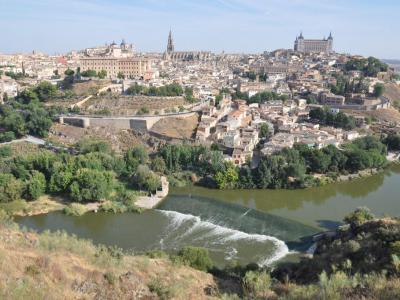
The ultimate photo of Toledo, similar to El Greco's 16th-century landscape painting, "Vista de Toledo," takes a mini journey to reach it. One may cross the Tagus River and climb the road on the other side. Or walk up from the New Bridge of Alcantara (Puente Nuevo de Alcantara) or catch the Trainvision from Plaza de Zocodover for a scenic 45-minute ride.
The best views are located about 1.5 miles from the train station in Madrid. The walk is hilly but not overlong. There are stunning views along the way. After arriving in Toledo, turn right from the station, and stay on the main road. It's a forty-minute walk to the Valley Lookout (Mirador del Valle). Or, of course, one may take a taxi.
Another touring method is the Hop-On Hop-Off bus. One may hop on or off at ten different stops. Valley Lookout is one of them. Sightseeing builds an appetite, not to mention a thirst. Try the cold Sangria at Valley Lookout Terrace (Terraza del Mirador). It has the same incredible views. Seeing the city from the south side is recommended.
Other restaurants within a half mile of Mirador include Restaurante del Parador de Toledo; Restaurante La Ermita; Adolfo; Kiosko Base; Alqahirra Rincon de Oriente; El Brocal Taberna-Restaurant; and Taberna El Botero.
Standing on the Valley Watching Platform, one has a matchless overlook of the Old Town of Toledo: ancient churches, castles, old mansions, and palaces ruled by the mighty Alcazar. Time slows down, looking along the winding medieval walls to the river quietly flowing far below. Before and after twilight is the best time.
The best views are located about 1.5 miles from the train station in Madrid. The walk is hilly but not overlong. There are stunning views along the way. After arriving in Toledo, turn right from the station, and stay on the main road. It's a forty-minute walk to the Valley Lookout (Mirador del Valle). Or, of course, one may take a taxi.
Another touring method is the Hop-On Hop-Off bus. One may hop on or off at ten different stops. Valley Lookout is one of them. Sightseeing builds an appetite, not to mention a thirst. Try the cold Sangria at Valley Lookout Terrace (Terraza del Mirador). It has the same incredible views. Seeing the city from the south side is recommended.
Other restaurants within a half mile of Mirador include Restaurante del Parador de Toledo; Restaurante La Ermita; Adolfo; Kiosko Base; Alqahirra Rincon de Oriente; El Brocal Taberna-Restaurant; and Taberna El Botero.
Standing on the Valley Watching Platform, one has a matchless overlook of the Old Town of Toledo: ancient churches, castles, old mansions, and palaces ruled by the mighty Alcazar. Time slows down, looking along the winding medieval walls to the river quietly flowing far below. Before and after twilight is the best time.
2) Monasterio de San Juan de los Reyes (Monastery of Saint John of the Monarchs) (must see)
Saint John of the Monarchs doesn’t merely occupy a corner of Toledo’s Town Hall Square-it embodies the aspirations, triumphs, and scars of a city that once served as the heartbeat of Spain. Its story is tied to one of the most famous unions in European history: the 1469 marriage of Isabella of Castile, then only eighteen, and Ferdinand of Aragon, nineteen. That political and romantic alliance set the foundations for the unification of Spain, and in gratitude for their victory over King Afonso V of Portugal at the Battle of Toro in 1476, the Catholic Monarchs commissioned a new Franciscan monastery in Toledo the following year. They intended it to serve as both a spiritual offering and their future burial place.
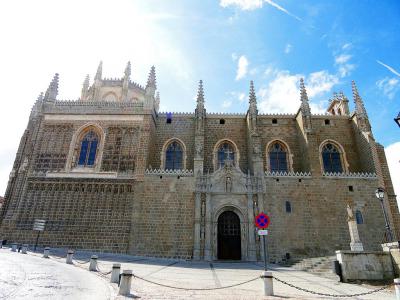
The architect chosen, Juan Guas-master of the flamboyant Isabelline Gothic style-oversaw the project between 1477 and 1504. The result was a monumental complex, a Latin-cross church with three naves, a tall nave flanked by side chapels, and a polygonal chancel. Overhead, star-shaped ribbed vaults unfold like stone lacework, while the cloisters combine Gothic verticality with ornate carvings of saints, plants, and mythical beasts. Later additions in the 16th century included a Renaissance altarpiece by Felipe Bigarny and striking paintings of the Passion and Resurrection by Francisco de Comontes, which brought warmth and color to the otherwise austere interior.
The exterior makes an equally powerful statement. The façade is framed by two elegant towers capped with spires, while heavy chains dangle along the walls-grim relics taken from Christians once held captive by the Moors, now transformed into symbols of liberation after the Reconquista.
Though Ferdinand and Isabella were ultimately buried in Granada, their intended mausoleum in Toledo still stands as a testament to their ambition and their role in shaping a united Spain. Today, visitors who step into San Juan de los Reyes can feel the blend of history and devotion in every arch and courtyard. The monastery’s survival through wars, including the damage inflicted during the Napoleonic occupation of 1808 before its careful restoration in the 20th century, has only deepened its aura.
The monastery offers a rare chance to experience Spain’s history not through books or monuments alone, but within the very walls that once echoed with the footsteps of monarchs, friars, and the faithful.
The architect chosen, Juan Guas-master of the flamboyant Isabelline Gothic style-oversaw the project between 1477 and 1504. The result was a monumental complex, a Latin-cross church with three naves, a tall nave flanked by side chapels, and a polygonal chancel. Overhead, star-shaped ribbed vaults unfold like stone lacework, while the cloisters combine Gothic verticality with ornate carvings of saints, plants, and mythical beasts. Later additions in the 16th century included a Renaissance altarpiece by Felipe Bigarny and striking paintings of the Passion and Resurrection by Francisco de Comontes, which brought warmth and color to the otherwise austere interior.
The exterior makes an equally powerful statement. The façade is framed by two elegant towers capped with spires, while heavy chains dangle along the walls-grim relics taken from Christians once held captive by the Moors, now transformed into symbols of liberation after the Reconquista.
Though Ferdinand and Isabella were ultimately buried in Granada, their intended mausoleum in Toledo still stands as a testament to their ambition and their role in shaping a united Spain. Today, visitors who step into San Juan de los Reyes can feel the blend of history and devotion in every arch and courtyard. The monastery’s survival through wars, including the damage inflicted during the Napoleonic occupation of 1808 before its careful restoration in the 20th century, has only deepened its aura.
The monastery offers a rare chance to experience Spain’s history not through books or monuments alone, but within the very walls that once echoed with the footsteps of monarchs, friars, and the faithful.
3) Museo del Greco (El Greco Museum) (must see)
The El Greco Museum preserves the memory of one of Spain’s most distinctive painters, Domenikos Theotokopoulos, universally known as El Greco. Born in Crete and trained in Venice and Rome, he arrived in Spain in the 1570s. Toledo, then a thriving religious and cultural capital, became his permanent home. The city’s dramatic landscapes and spiritual atmosphere suited his bold artistic style, defined by elongated figures, vibrant colors, and an intensity that baffled many of his contemporaries but later influenced masters such as Picasso, Cézanne, and even modern expressionists.
The museum itself has an unusual history. Despite its name, El Greco never actually lived in the building. In the early 20th century, the Marquis of Vega-Inclán, a passionate patron of Spanish culture, purchased a cluster of houses in Toledo’s former Jewish quarter. With architect Eladio Laredo, he transformed them into a reconstruction of a 16th- and 17th-century residence reminiscent of where El Greco might have lived. This project was part of a broader effort by the Marquis to preserve Spain’s cultural heritage; he also created the Museum of Romanticism in Madrid and restored Cervantes’ house in Valladolid. The El Greco Museum opened its doors in 1911, bringing together many of the artist’s scattered works and later, in 1964, was officially designated the Museum of the Sephardic heritage as well, ensuring its protection under the state.
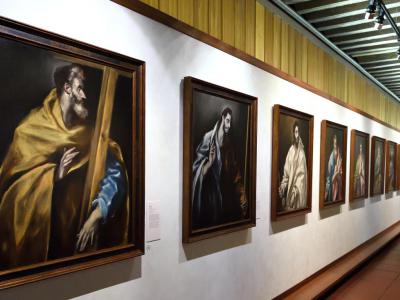
Inside, the museum houses more than 3,000 objects, from Talavera de la Reina ceramics to antique furnishings and beautifully decorated Moorish-style wooden ceilings, which reflect the city’s long history of cultural fusion. Yet the most dazzling treasures are El Greco’s own canvases. The museum preserves an extraordinary series of thirteen portraits of Christ and the Apostles, painted between 1610 and 1614, alongside masterpieces such as The Tears of Saint Peter and View and Plan of Toledo. Together, these works reveal the artist’s visionary approach, bridging Byzantine tradition with Renaissance and mannerist experimentation.
For visitors, the El Greco Museum is not only an art gallery but a time capsule of Toledo’s Golden Age. To explore its rooms and courtyards is to step into the world that inspired El Greco, where religion, art, and history intertwined to leave a legacy that still captivates travelers today.
The museum itself has an unusual history. Despite its name, El Greco never actually lived in the building. In the early 20th century, the Marquis of Vega-Inclán, a passionate patron of Spanish culture, purchased a cluster of houses in Toledo’s former Jewish quarter. With architect Eladio Laredo, he transformed them into a reconstruction of a 16th- and 17th-century residence reminiscent of where El Greco might have lived. This project was part of a broader effort by the Marquis to preserve Spain’s cultural heritage; he also created the Museum of Romanticism in Madrid and restored Cervantes’ house in Valladolid. The El Greco Museum opened its doors in 1911, bringing together many of the artist’s scattered works and later, in 1964, was officially designated the Museum of the Sephardic heritage as well, ensuring its protection under the state.
Inside, the museum houses more than 3,000 objects, from Talavera de la Reina ceramics to antique furnishings and beautifully decorated Moorish-style wooden ceilings, which reflect the city’s long history of cultural fusion. Yet the most dazzling treasures are El Greco’s own canvases. The museum preserves an extraordinary series of thirteen portraits of Christ and the Apostles, painted between 1610 and 1614, alongside masterpieces such as The Tears of Saint Peter and View and Plan of Toledo. Together, these works reveal the artist’s visionary approach, bridging Byzantine tradition with Renaissance and mannerist experimentation.
For visitors, the El Greco Museum is not only an art gallery but a time capsule of Toledo’s Golden Age. To explore its rooms and courtyards is to step into the world that inspired El Greco, where religion, art, and history intertwined to leave a legacy that still captivates travelers today.
4) Iglesia de Santo Tome (Church of Saint Thomas) (must see)
The Church of Saint Thomas sits in the heart of Toledo and holds nearly a millennium of history within its walls. Its origins go back to the aftermath of 1085, when King Alfonso VI of León reclaimed the city from Muslim rule. Instead of demolishing the mosque that already stood on the site, he consecrated it as a Christian church-a common practice in reconquered cities, where sacred spaces were repurposed rather than destroyed. By the 14th century, however, the building had fallen into disrepair. The task of restoring and expanding it fell to Ruiz de Toledo, Lord of Orgaz and then mayor of the city. A generous patron of the Church, Ruiz de Toledo commissioned a reconstruction in which the former minaret was transformed into a graceful Mudéjar-style bell tower, its brick patterns and horseshoe arches preserving a hint of the site’s Islamic past within a Christian setting.
The architecture of the church reveals Toledo’s distinctive cultural layering. The layout follows the Latin cross, with three naves, a barrel vault, and a polygonal apse. The side chapels display ornate Baroque altarpieces, while the main chapel combines Gothic structure with Mudéjar decoration, crowned by a dome shaped like the eight-pointed Islamic Rub el Hizb star. A 16th-century baptismal font survives, and a later 19th-century chapel houses The Incredulity of Saint Thomas, a moving canvas by Vicente Portaña.
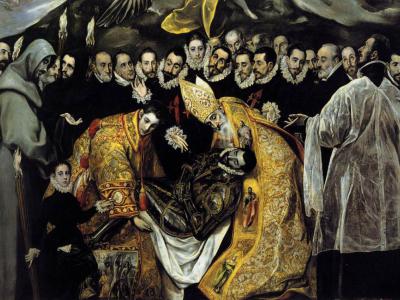
Yet what truly draws visitors from around the world is El Greco’s celebrated masterpiece, The Burial of the Count of Orgaz. Commissioned in 1586 to honor Ruiz de Toledo, the painting dramatizes the miraculous moment when Saints Stephen and Augustine descended from heaven to lay the Count in his grave. El Greco inserted his own likeness and that of his young son into the crowd of mourners, blending personal presence with historical memory in a swirl of elongated figures and luminous color. The painting remains one of the defining works of European Mannerism and a testament to Toledo’s role as the adopted home of the Cretan-born artist.
Saint Thomas offers more than a church visit. It is a vivid page from Spain’s past, where Roman, Islamic, Gothic, Renaissance, and Baroque traditions all converge. Standing within its star-vaulted nave, you glimpse the city’s shifting identities-and the extraordinary artistry that has made Toledo a cultural treasure.
The architecture of the church reveals Toledo’s distinctive cultural layering. The layout follows the Latin cross, with three naves, a barrel vault, and a polygonal apse. The side chapels display ornate Baroque altarpieces, while the main chapel combines Gothic structure with Mudéjar decoration, crowned by a dome shaped like the eight-pointed Islamic Rub el Hizb star. A 16th-century baptismal font survives, and a later 19th-century chapel houses The Incredulity of Saint Thomas, a moving canvas by Vicente Portaña.
Yet what truly draws visitors from around the world is El Greco’s celebrated masterpiece, The Burial of the Count of Orgaz. Commissioned in 1586 to honor Ruiz de Toledo, the painting dramatizes the miraculous moment when Saints Stephen and Augustine descended from heaven to lay the Count in his grave. El Greco inserted his own likeness and that of his young son into the crowd of mourners, blending personal presence with historical memory in a swirl of elongated figures and luminous color. The painting remains one of the defining works of European Mannerism and a testament to Toledo’s role as the adopted home of the Cretan-born artist.
Saint Thomas offers more than a church visit. It is a vivid page from Spain’s past, where Roman, Islamic, Gothic, Renaissance, and Baroque traditions all converge. Standing within its star-vaulted nave, you glimpse the city’s shifting identities-and the extraordinary artistry that has made Toledo a cultural treasure.
5) Ayuntamiento de Toledo (Toledo City Hall)
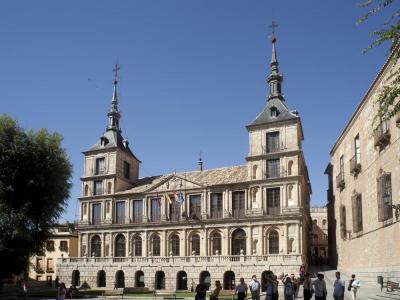
On the north side of Toledo’s Town Hall Square, directly facing the towering Cathedral, stands the City Hall, a building that took nearly 130 years to complete. Its story begins in 1575, when the city’s leaders decided that their growing power deserved a civic palace to match the grandeur of the church across the square. They entrusted the initial design to Juan de Herrera, the celebrated royal architect of El Escorial historic complex, whose strict, geometric Herrerian style gave the project an air of gravity and authority. The building’s deliberate position-staring straight at the Cathedral and sharing the square with the Archbishop’s Palace-was a stone-carved statement of balance between civic and ecclesiastical power in a city that had once been the capital of Castile.
The construction was anything but swift. After Herrera’s death, a plethora of architects took the job and finally completed the work in 1703. The result is an austere yet elegant façade, flanked by two slender towers and marked by a central loggia that mirrors the solemnity of the Cathedral opposite. The very architecture seems to embody a centuries-long negotiation between spiritual and civic authority.
Inside, visitors find a grand courtyard ringed by arcades, an ornate Baroque staircase, and the council chambers where the city’s 25-member council still meets. The building has also served varied functions over time, reflecting Toledo’s changing role in Spanish history.
The City Hall is an architectural document in stone, telling the story of a city that has always seen power not just in its churches but in its civic institutions. A stroll across Town Hall Square, with the Cathedral on one side and the Ayuntamiento on the other, reveals the dialogue between faith and governance that helped shape Toledo’s identity.
The construction was anything but swift. After Herrera’s death, a plethora of architects took the job and finally completed the work in 1703. The result is an austere yet elegant façade, flanked by two slender towers and marked by a central loggia that mirrors the solemnity of the Cathedral opposite. The very architecture seems to embody a centuries-long negotiation between spiritual and civic authority.
Inside, visitors find a grand courtyard ringed by arcades, an ornate Baroque staircase, and the council chambers where the city’s 25-member council still meets. The building has also served varied functions over time, reflecting Toledo’s changing role in Spanish history.
The City Hall is an architectural document in stone, telling the story of a city that has always seen power not just in its churches but in its civic institutions. A stroll across Town Hall Square, with the Cathedral on one side and the Ayuntamiento on the other, reveals the dialogue between faith and governance that helped shape Toledo’s identity.
6) Toledo Cathedral and Monstrance of Arfe (must see)
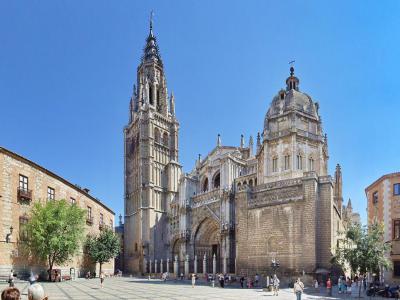
The Cathedral of Saint Mary of Toledo, often simply called Toledo Cathedral, is more than a place of worship-it is a monument that mirrors the city’s long and complex history. The site itself had already been sacred for centuries before the Gothic masterpiece rose above Toledo. In the 6th century, under the Visigothic Kingdom, a church dedicated to Saint Mary was consecrated here. When Muslim forces seized the city in 711, the church was replaced with a mosque, its qibla wall oriented toward Mecca and its minaret rising over the skyline. Even today, attentive visitors can still pick out traces of these earlier layers: a Visigothic column in the Chapel of Saint Lucy, or the horseshoe arches that echo Islamic design. When King Alfonso VI of León and Castile retook Toledo in 1085, he converted the mosque into a Christian place of worship, setting the stage for an even greater project.
That project began in 1226, under the reign of King Ferdinand III, who envisioned a grand cathedral to symbolize the triumph of Christianity and the new power of Castile. For nearly two centuries, master architects, including Master Martín and the renowned Alonso de Covarrubias, labored to complete the vast structure. The result was one of the largest Gothic cathedrals in Europe, with five sweeping naves, a towering spire, and a façade adorned with ornate portals bearing names as dramatic as their sculptures: the Gate of Forgiveness, the Gate of the Last Judgment, and the ominous Gate of Hell. The building itself embodies Gothic grandeur, yet whispers of earlier civilizations remain embedded in its walls.
Inside, the cathedral unfolds as a treasury of Spanish art. The high altar rises like a forest of gilded wood and sculpted scenes from Christ’s Passion, while Narciso Tomé’s spectacular Baroque masterpiece, El Transparente, floods the interior with heavenly light. The Chapel of the New Monarchs houses the tombs of Castilian royalty, a reminder that Toledo was once the beating heart of Spain’s political power. Among the cathedral’s greatest treasures is the Monstrance of Arfe, a dazzling Gothic creation of gilded silver and gold, encrusted with 260 figures and, according to tradition, fashioned partly from gold brought back by Columbus from the Americas. Every year during the Corpus Christi festival, this masterpiece takes center stage in a grand procession that fills the city with music, flowers, and pageantry.
Toledo Cathedral offers a vivid immersion into Spain’s past, where Roman stones, Islamic arches, Gothic vaults, and Renaissance splendor coexist under one magnificent roof. To step inside is to witness the centuries that forged both the city and the nation.
That project began in 1226, under the reign of King Ferdinand III, who envisioned a grand cathedral to symbolize the triumph of Christianity and the new power of Castile. For nearly two centuries, master architects, including Master Martín and the renowned Alonso de Covarrubias, labored to complete the vast structure. The result was one of the largest Gothic cathedrals in Europe, with five sweeping naves, a towering spire, and a façade adorned with ornate portals bearing names as dramatic as their sculptures: the Gate of Forgiveness, the Gate of the Last Judgment, and the ominous Gate of Hell. The building itself embodies Gothic grandeur, yet whispers of earlier civilizations remain embedded in its walls.
Inside, the cathedral unfolds as a treasury of Spanish art. The high altar rises like a forest of gilded wood and sculpted scenes from Christ’s Passion, while Narciso Tomé’s spectacular Baroque masterpiece, El Transparente, floods the interior with heavenly light. The Chapel of the New Monarchs houses the tombs of Castilian royalty, a reminder that Toledo was once the beating heart of Spain’s political power. Among the cathedral’s greatest treasures is the Monstrance of Arfe, a dazzling Gothic creation of gilded silver and gold, encrusted with 260 figures and, according to tradition, fashioned partly from gold brought back by Columbus from the Americas. Every year during the Corpus Christi festival, this masterpiece takes center stage in a grand procession that fills the city with music, flowers, and pageantry.
Toledo Cathedral offers a vivid immersion into Spain’s past, where Roman stones, Islamic arches, Gothic vaults, and Renaissance splendor coexist under one magnificent roof. To step inside is to witness the centuries that forged both the city and the nation.

7) Ermita "Mezquita" del Cristo de la Luz (Mosque of Cristo de la Luz)
The Mosque of Cristo de la Luz may be small-barely a square of 26 feet on each side-but it carries more than a millennium of history in its brick and stone. Built in 999 CE, when Toledo was under Muslim rule, it was originally known as the Mosque of Bāb al-Mardūm, taking its name from the nearby “Blocked Gate.” Its founder, the wealthy courtier Ahmad ibn Ḥadīdī, employed an Moorish architect to design it. The latter left his name in an Arabic inscription on the façade, alongside a declaration that the patron hoped the building would secure him a place in paradise.
The design is a jewel of Mudéjar artistry shaped by Islamic tradition. Inside, four slender columns divide the space into nine bays, each crowned with a unique ribbed vault that creates a play of light and shadow. The arches are of the horseshoe type familiar from Córdoba, and one wall still preserves the mihrab, the niche indicating the direction of Mecca. In the 14th century, the original minaret was reworked into a bell tower, symbolizing the city’s shifting religious identity.
That transformation had begun centuries earlier: when King Alfonso VI of Castile retook Toledo in 1085, many mosques were converted into churches rather than destroyed. This one was dedicated to the Holy Cross, later acquiring the name “Christ of the Light” from a legend about King Alfonso’s horse kneeling to reveal a long-hidden statue of Saint Ildefonso.
Visitors are able to step into a serene hall where Mudéjar arches and Christian additions coexist. The effect is both scholarly and atmospheric, a vivid reminder of Toledo’s unique role as a meeting ground of civilizations.
The design is a jewel of Mudéjar artistry shaped by Islamic tradition. Inside, four slender columns divide the space into nine bays, each crowned with a unique ribbed vault that creates a play of light and shadow. The arches are of the horseshoe type familiar from Córdoba, and one wall still preserves the mihrab, the niche indicating the direction of Mecca. In the 14th century, the original minaret was reworked into a bell tower, symbolizing the city’s shifting religious identity.
That transformation had begun centuries earlier: when King Alfonso VI of Castile retook Toledo in 1085, many mosques were converted into churches rather than destroyed. This one was dedicated to the Holy Cross, later acquiring the name “Christ of the Light” from a legend about King Alfonso’s horse kneeling to reveal a long-hidden statue of Saint Ildefonso.
Visitors are able to step into a serene hall where Mudéjar arches and Christian additions coexist. The effect is both scholarly and atmospheric, a vivid reminder of Toledo’s unique role as a meeting ground of civilizations.
8) Puerta del Sol (Sun Gate)
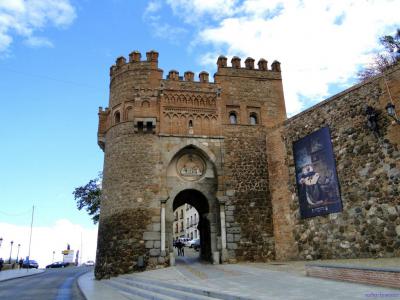
The Sun Gate is one of Toledo’s most recognizable entrances, a structure that has watched centuries of travelers climb the steep slope toward the old city. Its name is thought to come either from a carved sun that once adorned its façade or from its orientation toward the rising sun in the east. The gate itself was built in the 14th century by the Knights Hospitaller, the military order founded in Jerusalem, who clearly wanted their handiwork to make a lasting impression.
Although the gate was part of Toledo’s defensive walls, it also drew on the city’s rich multicultural legacy. The design incorporates the graceful horseshoe arches of Islamic art, a style that remained influential long after Christian forces recaptured Toledo in 1085. The façade carries decorative brick patterns typical of Mudéjar architecture, while a central medallion shows Saint Ildefonso-Toledo’s patron saint-receiving his miraculous chasuble, framed by the radiant sun symbol that gave the gate its name.
For centuries, the square before the gate served as both marketplace and stage. Merchants and travelers once streamed through this entryway with caravans of goods, while heralds proclaimed royal decrees beneath its arch. It was a place where commerce, ritual, and civic life converged.
Today, the Sun Gate remains a favorite backdrop for photographs, its brick towers standing firm against the sky. Visitors who arrive here can pause to take in the view over the Tagus and imagine the countless generations who crossed this very threshold into Toledo’s historic heart.
Although the gate was part of Toledo’s defensive walls, it also drew on the city’s rich multicultural legacy. The design incorporates the graceful horseshoe arches of Islamic art, a style that remained influential long after Christian forces recaptured Toledo in 1085. The façade carries decorative brick patterns typical of Mudéjar architecture, while a central medallion shows Saint Ildefonso-Toledo’s patron saint-receiving his miraculous chasuble, framed by the radiant sun symbol that gave the gate its name.
For centuries, the square before the gate served as both marketplace and stage. Merchants and travelers once streamed through this entryway with caravans of goods, while heralds proclaimed royal decrees beneath its arch. It was a place where commerce, ritual, and civic life converged.
Today, the Sun Gate remains a favorite backdrop for photographs, its brick towers standing firm against the sky. Visitors who arrive here can pause to take in the view over the Tagus and imagine the countless generations who crossed this very threshold into Toledo’s historic heart.
9) Plaza de Zocodover (Zocodover Square)
The name Zocodover has a curious ring to it, and for good reason. It comes from the Arabic word for “market of the beasts,” a straightforward reminder that what is today a lively plaza was once the place where horses, donkeys, and mules were traded. For medieval Toledo, this square was less a backdrop for leisurely promenades and more a utilitarian hub-part fairground, part marketplace, and, on occasion, even a bullring. The townspeople once entertained themselves here with cucañas, competitions to smash hanging clay pots, sometimes filled with sweets and, rather less delightfully, dead rats.
Commerce and spectacle were only half the story. Zocodover became Toledo’s civic stage, the space where victories were announced and grim punishments were carried out. During the Spanish Inquisition, public autos-de-fe were staged in the square, spectacles of fear designed to assert orthodoxy. Earlier, in the centuries of Muslim rule, the square thrived as a bustling bazaar filled with fabrics, spices, and voices in Arabic, Hebrew, and Latin dialects. When King Alfonso VI captured Toledo in 1085, reestablishing it as a Christian stronghold, the square did not lose its centrality; it simply changed costume, adapting to new rulers while retaining its role as the beating heart of the city.
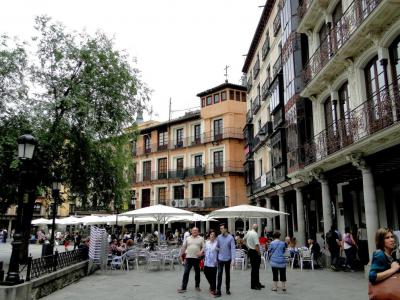
The architecture surrounding the plaza tells this story in brick and stone. Over time, elegant arcaded buildings rose to enclose the space, offering shade for shoppers and a frame for processions. The tradition of the Tuesday market still endures, spilling into the nearby Merchants’ Promenade. Cafés and shops now inhabit the ground floors, but the sense of community gathering has not faded.
Stand amid the arcades, listen to the chatter, and imagine the swirl of animals, merchants, nobles, and pilgrims who once crowded the same cobblestones-proof that in Toledo, history prefers to be lived out loud.
Commerce and spectacle were only half the story. Zocodover became Toledo’s civic stage, the space where victories were announced and grim punishments were carried out. During the Spanish Inquisition, public autos-de-fe were staged in the square, spectacles of fear designed to assert orthodoxy. Earlier, in the centuries of Muslim rule, the square thrived as a bustling bazaar filled with fabrics, spices, and voices in Arabic, Hebrew, and Latin dialects. When King Alfonso VI captured Toledo in 1085, reestablishing it as a Christian stronghold, the square did not lose its centrality; it simply changed costume, adapting to new rulers while retaining its role as the beating heart of the city.
The architecture surrounding the plaza tells this story in brick and stone. Over time, elegant arcaded buildings rose to enclose the space, offering shade for shoppers and a frame for processions. The tradition of the Tuesday market still endures, spilling into the nearby Merchants’ Promenade. Cafés and shops now inhabit the ground floors, but the sense of community gathering has not faded.
Stand amid the arcades, listen to the chatter, and imagine the swirl of animals, merchants, nobles, and pilgrims who once crowded the same cobblestones-proof that in Toledo, history prefers to be lived out loud.
10) Alcazar Fortress (must see)
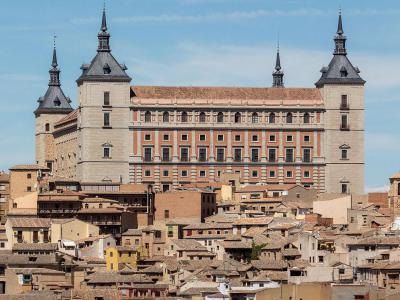
The Alcázar of Toledo has never been content to play a single role. Rising on the city’s highest hill above the sweep of the Tagus River, it has been a Roman fortress, a Visigothic palace, a Muslim stronghold, a Renaissance residence for monarchs, and finally a national symbol forged in fire and war. Its name, “Alcázar,” comes from the Arabic al-qasr, meaning “castle” or “fortress,” a reminder that Toledo was once a jewel of Al-Andalus. Yet even before the Moors, the Romans had fortified this commanding site in the 3rd century. Later, the Visigoths ruled from its walls, and after the Christian reconquest of 1085, King Alfonso VI of Castile rebuilt the structure, weaving it into the reborn Christian city.
By the 16th century, Toledo’s prominence as the capital of Castile inspired Emperor Charles V and his son Philip II to commission major renovations. They entrusted architects such as Alonso de Covarrubias and Juan de Herrera-masters of Renaissance classicism and austere symmetry-to transform the fortress into a palace that would rival anything in Europe. The result was a massive rectangular building anchored by four imposing towers at its corners, its stern Herrerian façade contrasting with the more flamboyant baroque style visible elsewhere in Toledo.
Yet the Alcázar is remembered not only for its stones but also for its stories. During the Spanish Civil War in 1936, Republican forces besieged the fortress for over two months. Inside, Colonel José Moscardó Ituarte held out with Nationalist supporters. In a tragic episode that became legendary, Moscardó’s son Luis was captured and executed after refusing to plead with his father to surrender. When Nationalist troops finally lifted the siege, the Alcázar lay in ruins, but its battered walls came to symbolize defiance and sacrifice for Franco’s regime. Rebuilt after the war, the scars were left visible as reminders of the city’s ordeal.
Today, the Alcázar is home to the Army Museum and the Castilla-La Mancha Regional Library. Tourists can wander its grand halls, admire centuries of military artifacts, and step out onto the ramparts for sweeping views of Toledo’s tangle of stone streets and the river below. A visit here is less about a single period and more about seeing how power, war, and memory have been carved into one commanding monument.
By the 16th century, Toledo’s prominence as the capital of Castile inspired Emperor Charles V and his son Philip II to commission major renovations. They entrusted architects such as Alonso de Covarrubias and Juan de Herrera-masters of Renaissance classicism and austere symmetry-to transform the fortress into a palace that would rival anything in Europe. The result was a massive rectangular building anchored by four imposing towers at its corners, its stern Herrerian façade contrasting with the more flamboyant baroque style visible elsewhere in Toledo.
Yet the Alcázar is remembered not only for its stones but also for its stories. During the Spanish Civil War in 1936, Republican forces besieged the fortress for over two months. Inside, Colonel José Moscardó Ituarte held out with Nationalist supporters. In a tragic episode that became legendary, Moscardó’s son Luis was captured and executed after refusing to plead with his father to surrender. When Nationalist troops finally lifted the siege, the Alcázar lay in ruins, but its battered walls came to symbolize defiance and sacrifice for Franco’s regime. Rebuilt after the war, the scars were left visible as reminders of the city’s ordeal.
Today, the Alcázar is home to the Army Museum and the Castilla-La Mancha Regional Library. Tourists can wander its grand halls, admire centuries of military artifacts, and step out onto the ramparts for sweeping views of Toledo’s tangle of stone streets and the river below. A visit here is less about a single period and more about seeing how power, war, and memory have been carved into one commanding monument.
