Custom Walk in Santorini, Greece by ke6n13_5a6555 created on 2026-06-18
Guide Location: Greece » Santorini
Guide Type: Custom Walk
# of Sights: 7
Tour Duration: 2 Hour(s)
Travel Distance: 2.9 Km or 1.8 Miles
Share Key: RGR4X
Guide Type: Custom Walk
# of Sights: 7
Tour Duration: 2 Hour(s)
Travel Distance: 2.9 Km or 1.8 Miles
Share Key: RGR4X
How It Works
Please retrieve this walk in the GPSmyCity app. Once done, the app will guide you from one tour stop to the next as if you had a personal tour guide. If you created the walk on this website or come to the page via a link, please follow the instructions below to retrieve the walk in the app.
Retrieve This Walk in App
Step 1. Download the app "GPSmyCity: Walks in 1K+ Cities" on Apple App Store or Google Play Store.



Step 2. In the GPSmyCity app, download(or launch) the guide "Santorini Map and Walking Tours".
Step 3. Tap the menu button located at upper right corner of the "Walks" screen and select "Retrieve custom walk". Enter the share key: RGR4X
1) Church of Panagia Platsani
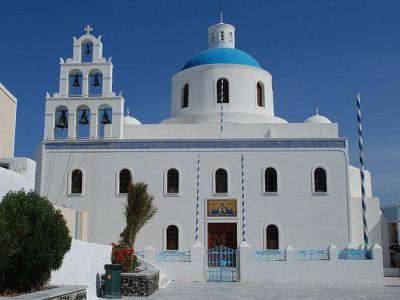
The Church of Panagia Platsani is closely tied to the history of the former castle settlement. The original church stood within the walls of Oia Castle, but after the devastating earthquake of 1956, it was relocated. Architecturally, it follows the Cycladic style, with whitewashed walls, a blue dome, arched openings, and a prominent bell tower.
According to local tradition, the church’s origins are linked to the discovery of a miraculous icon of the Virgin Mary, found floating in the sea by a fisherman. When the icon was brought to a safe place, it was said to have mysteriously returned overnight to the castle area. This was repeated several times, and the townspeople interpreted it as a sign that the Virgin wished her place of worship to stand there. As a result, a church was built at that location, overlooking the sea, symbolically watching over sailors and vessels passing below.
As you enter from the main square, a large, prominent golden mosaic icon of the Virgin Mary is located directly above the main door. Inside, visitors will find the revered icon of Panagia, along with votive offerings left by sailors and families, reflecting Oia’s long maritime tradition. As you stand in the nave facing the iconostasis, the icon of the Virgin Mary is positioned to the right of the Royal Doors, opposite the icon of Christ. Look closely at the silver ex-votos shaped like ships, the hanging lamps, and the framed inscriptions expressing gratitude for safe journeys.
Step outside into the small square in front of the church, which serves as a central gathering point in Oia. Set into the pavement of the square is a circular marble mosaic, added during post-1956 reconstruction, depicting Santorini and its caldera, including the volcanic islets at the centre. Facing the church, the view opens toward the sea, reinforcing the long-held belief that the Virgin watches over passing vessels and those who travel by water.
According to local tradition, the church’s origins are linked to the discovery of a miraculous icon of the Virgin Mary, found floating in the sea by a fisherman. When the icon was brought to a safe place, it was said to have mysteriously returned overnight to the castle area. This was repeated several times, and the townspeople interpreted it as a sign that the Virgin wished her place of worship to stand there. As a result, a church was built at that location, overlooking the sea, symbolically watching over sailors and vessels passing below.
As you enter from the main square, a large, prominent golden mosaic icon of the Virgin Mary is located directly above the main door. Inside, visitors will find the revered icon of Panagia, along with votive offerings left by sailors and families, reflecting Oia’s long maritime tradition. As you stand in the nave facing the iconostasis, the icon of the Virgin Mary is positioned to the right of the Royal Doors, opposite the icon of Christ. Look closely at the silver ex-votos shaped like ships, the hanging lamps, and the framed inscriptions expressing gratitude for safe journeys.
Step outside into the small square in front of the church, which serves as a central gathering point in Oia. Set into the pavement of the square is a circular marble mosaic, added during post-1956 reconstruction, depicting Santorini and its caldera, including the volcanic islets at the centre. Facing the church, the view opens toward the sea, reinforcing the long-held belief that the Virgin watches over passing vessels and those who travel by water.
2) Armeni Port of Oia
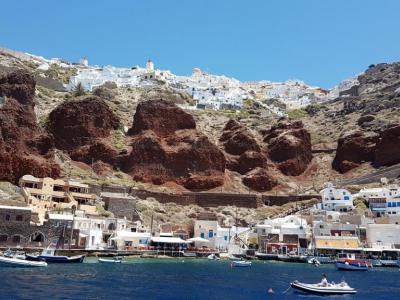
Armeni Port, nestled below the picturesque village of Oia on the northwest side of Santorini, is a quaint and historic harbor offering stunning views of the caldera, the volcanic islands, and the nearby island of Therasia. Believed to be the oldest port in this region of the island, Armeni once thrived as the main harbor of Oia, supporting wine trade and fishing activities. Large ships would anchor offshore, with sailors using small boats, known as "Lantzes," to reach the port.
Accessing Armeni can be somewhat challenging, particularly in the summer months. Visitors have three main options: a boat ride from Ammoudi Bay, a walk down 291 steep steps, or a mule ride to navigate the descent from Oia. Despite the effort required to reach Armeni, the serene environment is well worth the journey.
Today, Armeni is a peaceful retreat featuring a few whitewashed houses, a traditional tavern, and a concrete pier where small yachts and boats can moor. The harbor, although no longer bustling with trade, provides an idyllic setting for relaxation. The Tavern by the Sea offers savory local dishes, enhancing the experience with its serene ambiance and spectacular views.
The small beach at Armeni is ideal for swimming and wall diving, boasting deep, crystalline waters and volcanic pebbles. Though unorganized and lacking facilities, its unspoiled nature adds to the charm and natural beauty of the landscape. A diving center is also available for those interested in exploring the underwater scenery. As swimmers enjoy the clear waters, they are treated to awe-inspiring views of the caldera cliffs and the captivating settlement of Oia above, creating a thrilling and overwhelming experience.
Accessing Armeni can be somewhat challenging, particularly in the summer months. Visitors have three main options: a boat ride from Ammoudi Bay, a walk down 291 steep steps, or a mule ride to navigate the descent from Oia. Despite the effort required to reach Armeni, the serene environment is well worth the journey.
Today, Armeni is a peaceful retreat featuring a few whitewashed houses, a traditional tavern, and a concrete pier where small yachts and boats can moor. The harbor, although no longer bustling with trade, provides an idyllic setting for relaxation. The Tavern by the Sea offers savory local dishes, enhancing the experience with its serene ambiance and spectacular views.
The small beach at Armeni is ideal for swimming and wall diving, boasting deep, crystalline waters and volcanic pebbles. Though unorganized and lacking facilities, its unspoiled nature adds to the charm and natural beauty of the landscape. A diving center is also available for those interested in exploring the underwater scenery. As swimmers enjoy the clear waters, they are treated to awe-inspiring views of the caldera cliffs and the captivating settlement of Oia above, creating a thrilling and overwhelming experience.
3) Órmos Ammoúdi (Amoudi Bay)
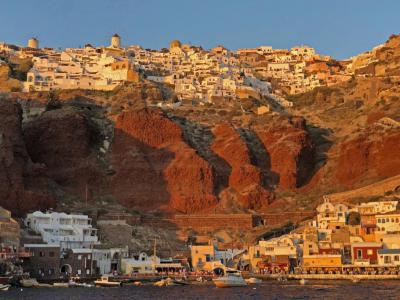
Amoudi Bay is a small inlet below Oia that attracts visitors for its clear blue waters and traditional harbor setting. The calm sea makes it suitable for swimming and small boats, and the bay is a frequent stopping point for vessels heading toward nearby Thirasia, a small island, or the rock-cut Church of the Seven Holy Youths, which lies along the coast beyond the harbor.
The bay is reached on foot by descending just over 200 steps from Oia, a well-known route that links the clifftop village with the water below. From the harbor, the caldera walls rise sharply overhead, while the open sea frames views that are especially distinctive late in the day. Sunsets are widely appreciated here, though the bay is primarily valued for its light, color, and proximity to the water rather than panoramic viewpoints.
A small hotel, a few cafes, and several fish taverns line the waterfront. The taverns are particularly known for serving fresh seafood brought in daily by local fishermen, maintaining a direct connection to the bay’s working-harbor character. The rocky shoreline nearby is popular for swimming; locals often recommend the rocks beyond the small lighthouse area as one of the better spots, especially away from the main jetty.
The bay is reached on foot by descending just over 200 steps from Oia, a well-known route that links the clifftop village with the water below. From the harbor, the caldera walls rise sharply overhead, while the open sea frames views that are especially distinctive late in the day. Sunsets are widely appreciated here, though the bay is primarily valued for its light, color, and proximity to the water rather than panoramic viewpoints.
A small hotel, a few cafes, and several fish taverns line the waterfront. The taverns are particularly known for serving fresh seafood brought in daily by local fishermen, maintaining a direct connection to the bay’s working-harbor character. The rocky shoreline nearby is popular for swimming; locals often recommend the rocks beyond the small lighthouse area as one of the better spots, especially away from the main jetty.
4) Oia Castle (must see)
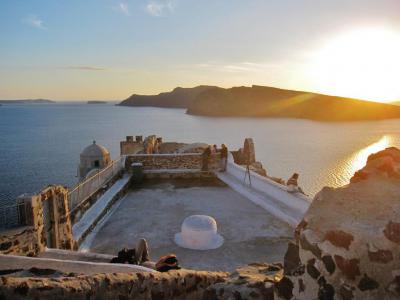
Oia Castle, often identified as the Castle of Saint Nicholas, is a late-15th-century fortified site and one of the best-known historical landmarks in Oia today. Its ruins remain a major gathering point, especially in the evening, because the exposed cliffside position offers wide caldera views.
The castle was developed during the period of Venetian domination as part of Santorini’s network of fortified settlements, created to guard against pirate raids in the Aegean. Raids could involve theft and the taking of captives, which helps explain why local settlement patterns favored compact building and rapid retreat to defensible points. Some accounts also describe residents hiding valuables in pits beneath buildings within the fortified area; this is often repeated in local narratives about the site.
Within the castle complex, there were residences associated with the Venetian rulers, and the high position functioned as a lookout over sea routes. The stronghold is often said to have been taken by Ottoman forces in 1577, while wider histories place the Ottoman conquest of Santorini within the broader annexation of the Cyclades in 1579, so it’s best understood as a late-16th-century transition from Venetian to Ottoman control.
The site was severely damaged in the 1956 earthquake, when large sections of the fortifications and parts of the surrounding settlement collapsed down the cliffs. What remains today are fragments of walls and the base of defensive elements, but the viewpoint is still exceptional. From the ruins, visitors can clearly see the volcanic islets of Nea Kameni and Palea Kameni in the center of the caldera, as well as the nearby island of Thirasia to the northwest.
The castle was developed during the period of Venetian domination as part of Santorini’s network of fortified settlements, created to guard against pirate raids in the Aegean. Raids could involve theft and the taking of captives, which helps explain why local settlement patterns favored compact building and rapid retreat to defensible points. Some accounts also describe residents hiding valuables in pits beneath buildings within the fortified area; this is often repeated in local narratives about the site.
Within the castle complex, there were residences associated with the Venetian rulers, and the high position functioned as a lookout over sea routes. The stronghold is often said to have been taken by Ottoman forces in 1577, while wider histories place the Ottoman conquest of Santorini within the broader annexation of the Cyclades in 1579, so it’s best understood as a late-16th-century transition from Venetian to Ottoman control.
The site was severely damaged in the 1956 earthquake, when large sections of the fortifications and parts of the surrounding settlement collapsed down the cliffs. What remains today are fragments of walls and the base of defensive elements, but the viewpoint is still exceptional. From the ruins, visitors can clearly see the volcanic islets of Nea Kameni and Palea Kameni in the center of the caldera, as well as the nearby island of Thirasia to the northwest.
5) Windmill of Oia
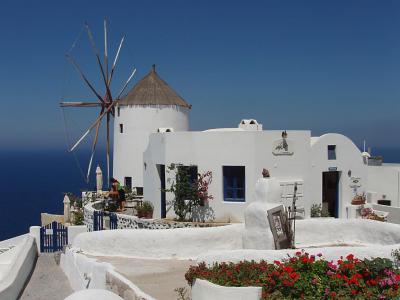
The windmills of Oia were originally part of the island’s agricultural infrastructure, built to harness the strong winds for grinding grain. In this western section of the village, often referred to as “Two Mill Oia”, two historic windmills stand side by side, both of which have been restored and adapted for private accommodation. Their distinctive silhouettes and exposed position along the caldera rim have made them closely associated with sunset viewing, although interior access is limited to guests when occupied.
Inside, the former industrial spaces have been reconfigured for residential use, with rooms arranged vertically and linked by narrow stone staircases that follow the original cylindrical form of the mills. While the interiors remain private, the large exterior terraces are a defining feature. These elevated decks provide a secluded vantage point for watching the sunset.
Santorini’s persistent winds once supported the widespread use of windmills across the island. Around 60 to 70 windmills are known to have operated historically, primarily for grinding grain into flour. The earliest examples date to the late medieval period, with most surviving structures built between the 17th and 19th centuries. Often connected to local bakeries, these windmills played a central role in everyday food production before industrial milling gradually rendered them obsolete.
Inside, the former industrial spaces have been reconfigured for residential use, with rooms arranged vertically and linked by narrow stone staircases that follow the original cylindrical form of the mills. While the interiors remain private, the large exterior terraces are a defining feature. These elevated decks provide a secluded vantage point for watching the sunset.
Santorini’s persistent winds once supported the widespread use of windmills across the island. Around 60 to 70 windmills are known to have operated historically, primarily for grinding grain into flour. The earliest examples date to the late medieval period, with most surviving structures built between the 17th and 19th centuries. Often connected to local bakeries, these windmills played a central role in everyday food production before industrial milling gradually rendered them obsolete.
6) Naval Maritime Museum
The Naval Maritime Museum is housed in a historic two-story mansion dating to the 19th century, originally built as a captain’s house. Its setting reflects Oia’s former prosperity during a period when maritime trade shaped much of the village’s economy and social structure.
Santorini played an important role in regional maritime trade rather than formal naval history. During the 19th and early 20th centuries, island-owned sailing vessels operated widely across the Aegean, the eastern Mediterranean, and as far as the Black Sea. These ships were primarily involved in commercial exchange, exporting local products such as wine and pumice stone, while importing essential goods including grain, timber, fabrics, and other materials needed for daily life on the island.
The museum’s collection focuses on traditional seafaring and merchant shipping. Displays include navigational instruments such as maps, compasses, sextants, log meters, and anchors, illustrating the practical tools used aboard sailing vessels. A small research library complements the exhibits, containing books, documents, nautical charts, logbooks, and shipping records related to local maritime activity.
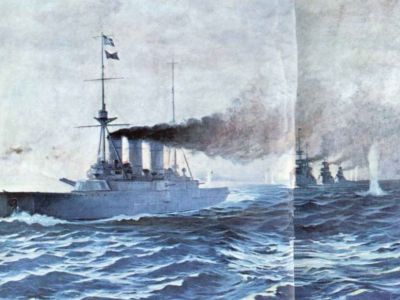
Additional exhibits feature detailed ship models, sailors’ uniforms, portraits of local captains, and carved figureheads. An extensive collection of paintings depicts historic sailing ships, while rare photographs provide visual insight into everyday life during Oia’s peak shipping era. Together, these materials present a focused picture of the island’s maritime heritage, emphasizing trade, navigation, and the people who sustained Santorini’s seafaring traditions.
Santorini played an important role in regional maritime trade rather than formal naval history. During the 19th and early 20th centuries, island-owned sailing vessels operated widely across the Aegean, the eastern Mediterranean, and as far as the Black Sea. These ships were primarily involved in commercial exchange, exporting local products such as wine and pumice stone, while importing essential goods including grain, timber, fabrics, and other materials needed for daily life on the island.
The museum’s collection focuses on traditional seafaring and merchant shipping. Displays include navigational instruments such as maps, compasses, sextants, log meters, and anchors, illustrating the practical tools used aboard sailing vessels. A small research library complements the exhibits, containing books, documents, nautical charts, logbooks, and shipping records related to local maritime activity.
Additional exhibits feature detailed ship models, sailors’ uniforms, portraits of local captains, and carved figureheads. An extensive collection of paintings depicts historic sailing ships, while rare photographs provide visual insight into everyday life during Oia’s peak shipping era. Together, these materials present a focused picture of the island’s maritime heritage, emphasizing trade, navigation, and the people who sustained Santorini’s seafaring traditions.
7) Art Gallery Stavros Galanopoulos
Located in the charming village of Oia in Santorini, the Galanopoulos Art Gallery offers a delightful fusion of culinary delights and artistic wonders. Founded back in 1986, the gallery seamlessly intertwines with the Karma Restaurant, providing a harmonious setting where art and cuisine converge.
The brainchild of the renowned Greek sculptor Stavros Galanopoulos and his spouse Bella, the gallery boasts Stavros' globally acclaimed three-dimensional artworks, which have graced museums, foundations, banks, and private collections worldwide. Following Stavros' unexpected demise in 2015, his family has dutifully carried on his legacy. Bella, alongside their son Giorgos and his wife Toto, who are both photographers, continue to showcase Stavros' original pieces alongside their creations.
The gallery predominantly showcases Giorgos Galanopoulos' mesmerizing photography, inspired by the organic shapes of Cycladic architecture and the bold lines of modern art. Giorgos' innovative compositions and adept manipulation of light and shadow invite viewers to delve into the intricate textures and dynamic forms of Cycladic design in a contemporary light. This visual dialogue celebrates the beauty and complexity of these unique structures, offering a captivating blend of tradition and innovation in every frame.
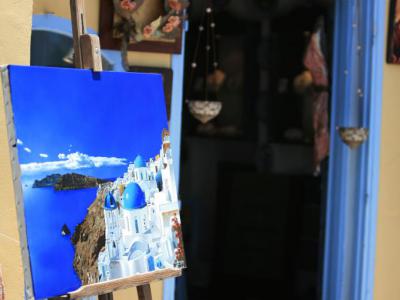
Aside from photography, visitors can also admire Bella’s distinctive miniature paintings, adding another dimension of artistic expression to the gallery's repertoire. Bella often graces the gallery, warmly welcoming visitors and sharing her profound passion for art.
At the Galanopoulos Art Gallery, there is a deep-seated belief in the transformative potential of art. The gallery endeavors to cultivate a space that nurtures creativity and prompts introspection, enabling visitors to reconnect with themselves through the allure of Santorini and the potency of artistic expression.
The brainchild of the renowned Greek sculptor Stavros Galanopoulos and his spouse Bella, the gallery boasts Stavros' globally acclaimed three-dimensional artworks, which have graced museums, foundations, banks, and private collections worldwide. Following Stavros' unexpected demise in 2015, his family has dutifully carried on his legacy. Bella, alongside their son Giorgos and his wife Toto, who are both photographers, continue to showcase Stavros' original pieces alongside their creations.
The gallery predominantly showcases Giorgos Galanopoulos' mesmerizing photography, inspired by the organic shapes of Cycladic architecture and the bold lines of modern art. Giorgos' innovative compositions and adept manipulation of light and shadow invite viewers to delve into the intricate textures and dynamic forms of Cycladic design in a contemporary light. This visual dialogue celebrates the beauty and complexity of these unique structures, offering a captivating blend of tradition and innovation in every frame.
Aside from photography, visitors can also admire Bella’s distinctive miniature paintings, adding another dimension of artistic expression to the gallery's repertoire. Bella often graces the gallery, warmly welcoming visitors and sharing her profound passion for art.
At the Galanopoulos Art Gallery, there is a deep-seated belief in the transformative potential of art. The gallery endeavors to cultivate a space that nurtures creativity and prompts introspection, enabling visitors to reconnect with themselves through the allure of Santorini and the potency of artistic expression.
