

Oia Castle, Santorini (must see)
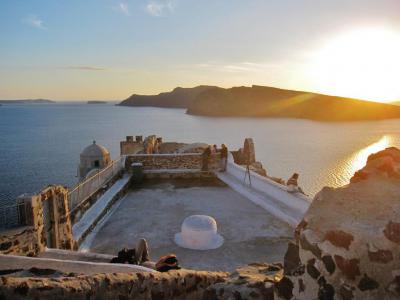
Oia Castle, often identified as the Castle of Saint Nicholas, is a late-15th-century fortified site and one of the best-known historical landmarks in Oia today. Its ruins remain a major gathering point, especially in the evening, because the exposed cliffside position offers wide caldera views.
The castle was developed during the period of Venetian domination as part of Santorini’s network of fortified settlements, created to guard against pirate raids in the Aegean. Raids could involve theft and the taking of captives, which helps explain why local settlement patterns favored compact building and rapid retreat to defensible points. Some accounts also describe residents hiding valuables in pits beneath buildings within the fortified area; this is often repeated in local narratives about the site.
Within the castle complex, there were residences associated with the Venetian rulers, and the high position functioned as a lookout over sea routes. The stronghold is often said to have been taken by Ottoman forces in 1577, while wider histories place the Ottoman conquest of Santorini within the broader annexation of the Cyclades in 1579, so it’s best understood as a late-16th-century transition from Venetian to Ottoman control.
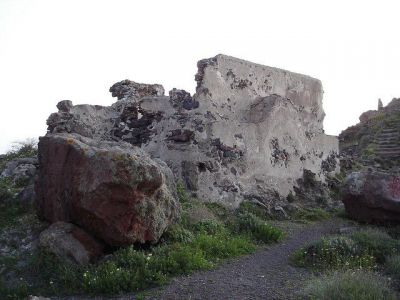
The site was severely damaged in the 1956 earthquake, when large sections of the fortifications and parts of the surrounding settlement collapsed down the cliffs. What remains today are fragments of walls and the base of defensive elements, but the viewpoint is still exceptional. From the ruins, visitors can clearly see the volcanic islets of Nea Kameni and Palea Kameni in the center of the caldera, as well as the nearby island of Thirasia to the northwest.
The castle was developed during the period of Venetian domination as part of Santorini’s network of fortified settlements, created to guard against pirate raids in the Aegean. Raids could involve theft and the taking of captives, which helps explain why local settlement patterns favored compact building and rapid retreat to defensible points. Some accounts also describe residents hiding valuables in pits beneath buildings within the fortified area; this is often repeated in local narratives about the site.
Within the castle complex, there were residences associated with the Venetian rulers, and the high position functioned as a lookout over sea routes. The stronghold is often said to have been taken by Ottoman forces in 1577, while wider histories place the Ottoman conquest of Santorini within the broader annexation of the Cyclades in 1579, so it’s best understood as a late-16th-century transition from Venetian to Ottoman control.
The site was severely damaged in the 1956 earthquake, when large sections of the fortifications and parts of the surrounding settlement collapsed down the cliffs. What remains today are fragments of walls and the base of defensive elements, but the viewpoint is still exceptional. From the ruins, visitors can clearly see the volcanic islets of Nea Kameni and Palea Kameni in the center of the caldera, as well as the nearby island of Thirasia to the northwest.
Want to visit this sight? Check out these Self-Guided Walking Tours in Santorini. Alternatively, you can download the mobile app "GPSmyCity: Walks in 1K+ Cities" from Apple App Store or Google Play Store. The app turns your mobile device to a personal tour guide and it works offline, so no data plan is needed when traveling abroad.
Download The GPSmyCity App



Oia Castle on Map
Sight Name: Oia Castle
Sight Location: Santorini, Greece (See walking tours in Santorini)
Sight Type: Attraction/Landmark
Guide(s) Containing This Sight:
Sight Location: Santorini, Greece (See walking tours in Santorini)
Sight Type: Attraction/Landmark
Guide(s) Containing This Sight:
Nearby Sights


Walking Tours in Santorini, Greece

Create Your Own Walk in Santorini
Creating your own self-guided walk in Santorini is easy and fun. Choose the city attractions that you want to see and a walk route map will be created just for you. You can even set your hotel as the start point of the walk.
Firostefani and Imerovigli Walking Tour
Away from the crowded Fira yet close to the famous Santorini caldera, there are two small settlements: Firostefani and Imerovigli. Each of these gorgeous neighborhoods has something unique to offer, and thus represents an attraction in its own right.
The quaint village of Firostefani, whose name translates as "The Crown of Fira", is now considered a suburb of Santorini's capital,... view more
Tour Duration: 1 Hour(s)
Travel Distance: 2.3 Km or 1.4 Miles
The quaint village of Firostefani, whose name translates as "The Crown of Fira", is now considered a suburb of Santorini's capital,... view more
Tour Duration: 1 Hour(s)
Travel Distance: 2.3 Km or 1.4 Miles
Oia Walking Tour
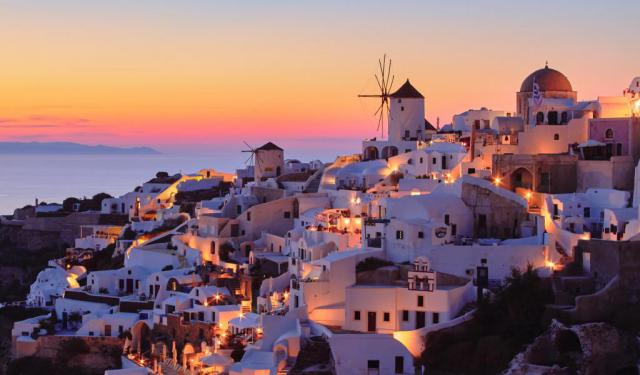
Oia is one of the oldest settlements on Santorini, with a history shaped by geography, seafaring, and repeated cycles of destruction and rebuilding. The village occupies the northwestern edge of the island, set along the rim of the volcanic caldera. This elevated position offered both strategic advantages and exposure to natural forces, particularly earthquakes, which have repeatedly altered the... view more
Tour Duration: 1 Hour(s)
Travel Distance: 1.0 Km or 0.6 Miles
Tour Duration: 1 Hour(s)
Travel Distance: 1.0 Km or 0.6 Miles
Fira Walking Tour
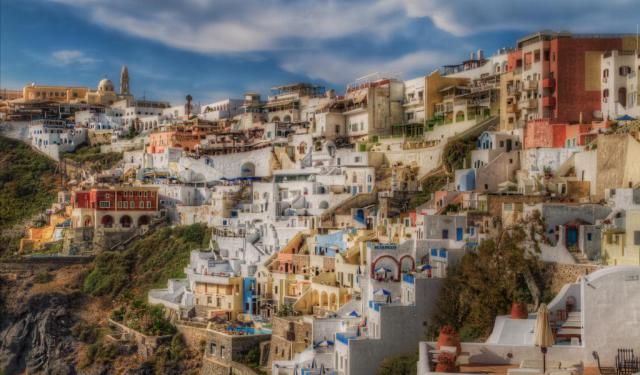
Known in antiquity as Thera, the island was originally a roughly circular landmass shaped by volcanic activity in the southern Aegean. Its earliest known settlement dates to the Neolithic period, but Santorini entered history more clearly during the Bronze Age, when it developed into an important center of Cycladic and later Minoan civilization.
Around the 17th century BCE, Santorini... view more
Tour Duration: 2 Hour(s)
Travel Distance: 3.4 Km or 2.1 Miles
Around the 17th century BCE, Santorini... view more
Tour Duration: 2 Hour(s)
Travel Distance: 3.4 Km or 2.1 Miles