Custom Walk in Tirana, Albania by aniko741102_2834a3 created on 2026-06-24
Guide Location: Albania » Tirana
Guide Type: Custom Walk
# of Sights: 6
Tour Duration: 1 Hour(s)
Travel Distance: 2.1 Km or 1.3 Miles
Share Key: BNYRG
Guide Type: Custom Walk
# of Sights: 6
Tour Duration: 1 Hour(s)
Travel Distance: 2.1 Km or 1.3 Miles
Share Key: BNYRG
How It Works
Please retrieve this walk in the GPSmyCity app. Once done, the app will guide you from one tour stop to the next as if you had a personal tour guide. If you created the walk on this website or come to the page via a link, please follow the instructions below to retrieve the walk in the app.
Retrieve This Walk in App
Step 1. Download the app "GPSmyCity: Walks in 1K+ Cities" on Apple App Store or Google Play Store.



Step 2. In the GPSmyCity app, download(or launch) the guide "Tirana Map and Walking Tours".
Step 3. Tap the menu button located at upper right corner of the "Walks" screen and select "Retrieve custom walk". Enter the share key: BNYRG
1) Skanderbeg Square (must see)
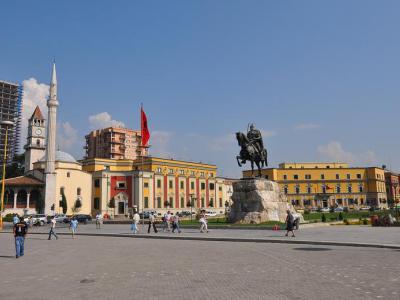
Skanderbeg Square is one of the best places to begin understanding the Albanian capital. Named after Gjergj Kastrioti Skanderbeg, the 15th-century military leader who resisted Ottoman rule and became Albania’s national hero, the square serves as both a civic gathering place and a visual summary of the country’s history. Its wide open space is anchored by the equestrian Skanderbeg Monument, which gives the square its main historical and symbolic focus.
The square first took shape in the early 20th century and has changed repeatedly along with the city around it. Earlier versions were surrounded by landmarks such as the Old Bazaar, City Hall, and religious buildings, while the communist period brought a more formal, monumental character. Today, the surrounding architecture reflects several eras at once.
The Skanderbeg Monument stands on the southern side of the square, while the Et’hem Bey Mosque is to the left of the statue, as you face it, near the corner of the square. The Clock Tower stands close behind the mosque. Across the square, on the northern side, the National History Museum is easy to identify by the large mosaic on its façade. Other major buildings show Tirana’s 20th-century development. The Palace of Culture occupies the eastern side of the square and includes the National Opera and Ballet, making it one of the city’s main cultural institutions.
In recent years, Skanderbeg Square has been transformed into a broad pedestrian space, with stone paving, open sightlines, and green areas around the edges.
The square first took shape in the early 20th century and has changed repeatedly along with the city around it. Earlier versions were surrounded by landmarks such as the Old Bazaar, City Hall, and religious buildings, while the communist period brought a more formal, monumental character. Today, the surrounding architecture reflects several eras at once.
The Skanderbeg Monument stands on the southern side of the square, while the Et’hem Bey Mosque is to the left of the statue, as you face it, near the corner of the square. The Clock Tower stands close behind the mosque. Across the square, on the northern side, the National History Museum is easy to identify by the large mosaic on its façade. Other major buildings show Tirana’s 20th-century development. The Palace of Culture occupies the eastern side of the square and includes the National Opera and Ballet, making it one of the city’s main cultural institutions.
In recent years, Skanderbeg Square has been transformed into a broad pedestrian space, with stone paving, open sightlines, and green areas around the edges.

2) Et'hem Bey Mosque (must see)
The Et’hem Bey Mosque is one of the most important surviving monuments of Ottoman Tirana. Construction began in the late 18th century under Molla Bey of Petrela and was completed in 1821 by his son, Haxhi Et’hem Bey. At the time, it formed part of Tirana’s historic center, close to the Old Bazaar and other religious buildings that once shaped the city’s Ottoman core.
The mosque is especially known for its painted decoration, which appears both inside and on the exterior portico. Its frescoes include trees, waterfalls, bridges, and architectural views, subjects not commonly associated with mosque decoration and therefore especially notable. These delicate landscapes give the building a distinctive character, softening its modest scale and making it one of Tirana’s most visually memorable historic sites. The northern wall and portico are particularly worth observing for these details.
Et’hem Bey Mosque also carries strong symbolic meaning in modern Albanian history. Under the communist regime, religion was banned and the mosque was closed, although it survived as a protected monument. On January 18, 1991, thousands of people gathered there for public prayer despite official restrictions, an event remembered as a major moment in the return of religious freedom in Albania. The mosque later underwent a major restoration supported by TİKA and reopened for worship after the work was completed.
For visitors, the mosque is worth seeing not only as a place of worship but also as part of the wider story of Skanderbeg Square. Visitors may enter when access is permitted outside prayer times, but even from the square, its minaret, portico, and painted details make it one of the capital’s most meaningful landmarks.
The mosque is especially known for its painted decoration, which appears both inside and on the exterior portico. Its frescoes include trees, waterfalls, bridges, and architectural views, subjects not commonly associated with mosque decoration and therefore especially notable. These delicate landscapes give the building a distinctive character, softening its modest scale and making it one of Tirana’s most visually memorable historic sites. The northern wall and portico are particularly worth observing for these details.
Et’hem Bey Mosque also carries strong symbolic meaning in modern Albanian history. Under the communist regime, religion was banned and the mosque was closed, although it survived as a protected monument. On January 18, 1991, thousands of people gathered there for public prayer despite official restrictions, an event remembered as a major moment in the return of religious freedom in Albania. The mosque later underwent a major restoration supported by TİKA and reopened for worship after the work was completed.
For visitors, the mosque is worth seeing not only as a place of worship but also as part of the wider story of Skanderbeg Square. Visitors may enter when access is permitted outside prayer times, but even from the square, its minaret, portico, and painted details make it one of the capital’s most meaningful landmarks.

3) BunkArt 2 (must see)
Bunk’Art 2 is one of Tirana’s most direct and unsettling encounters with Albania’s communist past. It occupies an underground anti-nuclear shelter built between 1981 and 1986. Code-named ‘Pillar Object,’ the bunker was intended for the Ministry of Internal Affairs and reflected the regime’s fear of foreign invasion.
The museum opened to the public in 2016 and reconstructs the history of Albania’s Ministry of Internal Affairs from 1912 to 1991. Its strongest focus is the communist period, especially the work of the Sigurimi, the political police used by the regime to monitor, intimidate, imprison, and persecute those considered enemies of the state. The exhibition is arranged through historical sections covering 1912–1939, 1939–1944, and 1944–1991, combining documents, photographs, equipment, video material, and artistic installations.
The building itself is part of the experience. The bunker contains 24 rooms, an apartment reserved for the Minister of Internal Affairs, and a large hall originally linked to communications. Visitors pass through narrow corridors and underground spaces that reinforce the themes of secrecy, surveillance, and control. Rooms dedicated to investigation, interrogation, border control, and political persecution show how fear became part of daily life under the dictatorship.
One detail worth noticing is the entrance itself: the large concrete dome above ground was added as part of the museum project and has become one of Bunk’Art 2’s most recognizable visual features. Its heavy, bunker-like form prepares visitors for the underground exhibition before they even enter. Inside, the experience is also shaped by sound; the entrance area includes recordings that recall the names and stories of people persecuted under the regime.
The museum opened to the public in 2016 and reconstructs the history of Albania’s Ministry of Internal Affairs from 1912 to 1991. Its strongest focus is the communist period, especially the work of the Sigurimi, the political police used by the regime to monitor, intimidate, imprison, and persecute those considered enemies of the state. The exhibition is arranged through historical sections covering 1912–1939, 1939–1944, and 1944–1991, combining documents, photographs, equipment, video material, and artistic installations.
The building itself is part of the experience. The bunker contains 24 rooms, an apartment reserved for the Minister of Internal Affairs, and a large hall originally linked to communications. Visitors pass through narrow corridors and underground spaces that reinforce the themes of secrecy, surveillance, and control. Rooms dedicated to investigation, interrogation, border control, and political persecution show how fear became part of daily life under the dictatorship.
One detail worth noticing is the entrance itself: the large concrete dome above ground was added as part of the museum project and has become one of Bunk’Art 2’s most recognizable visual features. Its heavy, bunker-like form prepares visitors for the underground exhibition before they even enter. Inside, the experience is also shaped by sound; the entrance area includes recordings that recall the names and stories of people persecuted under the regime.
4) Tirana Castle
Tirana Castle is best understood not as a complete castle, but as a surviving fragment of Tirana’s old fortified core. Its history dates back to at least the medieval period, with the site often associated with the Byzantine era and the fortifications of Emperor Justinian. The fortress stood near the point where important east–west and north–south routes crossed.
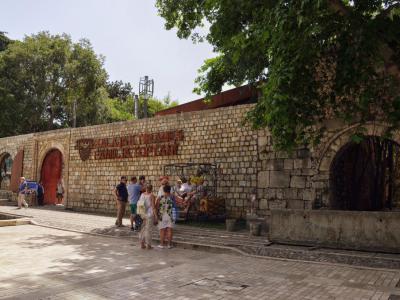
Today, the most visible remains are sections of wall, including a roughly 20-foot wall along Murat Toptani Road, often referred to as the Justinian Fortress Wall. Other wall foundations uncovered in recent years have been incorporated into the surrounding pedestrian area. Tirana Castle was declared a first-category cultural monument in 1973, while the newly preserved wall sections received cultural monument status in 2008.
For visitors, the castle area now functions as a compact cultural, dining, and shopping quarter rather than a traditional ruin. Inside and around the restored walls are cafés, restaurants, souvenir shops, and spaces connected with local history and art. A newer bazaar-style area evokes the atmosphere of older trading quarters.
The appeal of Tirana Castle lies in this blend of old stone and present-day city life. It does not offer towers, battlements, or a defensive panorama; instead, it gives a quieter glimpse of Tirana before it became a modern capital.
Today, the most visible remains are sections of wall, including a roughly 20-foot wall along Murat Toptani Road, often referred to as the Justinian Fortress Wall. Other wall foundations uncovered in recent years have been incorporated into the surrounding pedestrian area. Tirana Castle was declared a first-category cultural monument in 1973, while the newly preserved wall sections received cultural monument status in 2008.
For visitors, the castle area now functions as a compact cultural, dining, and shopping quarter rather than a traditional ruin. Inside and around the restored walls are cafés, restaurants, souvenir shops, and spaces connected with local history and art. A newer bazaar-style area evokes the atmosphere of older trading quarters.
The appeal of Tirana Castle lies in this blend of old stone and present-day city life. It does not offer towers, battlements, or a defensive panorama; instead, it gives a quieter glimpse of Tirana before it became a modern capital.
5) Pyramid
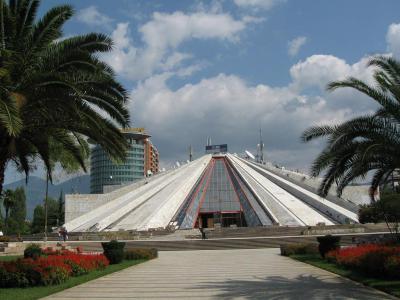
The Pyramid of Tirana is a structure that has served as a cultural center, museum, and NATO base. It first opened in 1988 and closed in 1991 after the collapse of communism in the country.
The first museum held in the pyramid was the Enver Hoxha Museum. It showcased the legacy and history of Enver Hoxha, leader of Communist Albania who died in 1985. Designed in part by Hoxha's daughter, Pranvera Hoxha, it was the most expensive building ever built in Albania.
After the fall of communism, The Pyramid was briefly used as an exhibition center. It became a base of operations for NATO in 1999 during the War in Kosovo. For years, most of the pyramid remained empty and experienced some vandalism. There were even plans to demolish the structure in 2017, but protests from citizens led to its preservation and renovation instead.
Presently, the Pyramid has been fully restored and is a beautiful place to visit – a definite must-see stop for anyone visiting Tirana, especially at sunset, as the views are very nice. The facility is currently used as an IT center for youth. The TUMO Center, its new name, educates young people on computer programming and robotics. It is also used as a broadcasting center for Top Channel and Top Albania Radio.
The first museum held in the pyramid was the Enver Hoxha Museum. It showcased the legacy and history of Enver Hoxha, leader of Communist Albania who died in 1985. Designed in part by Hoxha's daughter, Pranvera Hoxha, it was the most expensive building ever built in Albania.
After the fall of communism, The Pyramid was briefly used as an exhibition center. It became a base of operations for NATO in 1999 during the War in Kosovo. For years, most of the pyramid remained empty and experienced some vandalism. There were even plans to demolish the structure in 2017, but protests from citizens led to its preservation and renovation instead.
Presently, the Pyramid has been fully restored and is a beautiful place to visit – a definite must-see stop for anyone visiting Tirana, especially at sunset, as the views are very nice. The facility is currently used as an IT center for youth. The TUMO Center, its new name, educates young people on computer programming and robotics. It is also used as a broadcasting center for Top Channel and Top Albania Radio.

6) Skanderbeg Monument
The Skanderbeg Monument honors Gjergj Kastrioti Skanderbeg, the 15th-century Albanian nobleman and military leader remembered for resisting Ottoman expansion. Cast in bronze and set on a stone pedestal, the monument shows Skanderbeg on horseback, with a commanding posture that gives the square its main historical focus.
The statue was inaugurated in 1968, on the 500th anniversary of Skanderbeg’s death. It was created by Albanian sculptors Odhise Paskali, Andrea Mano, and Janaq Paço and stands about 11 meters, or 36 feet, high. Its placement was also symbolic: the monument took the place of an earlier statue of Joseph Stalin, marking a shift from Soviet-style political imagery toward a national hero deeply rooted in Albanian memory.
Today, the Skanderbeg Monument remains a popular meeting point and photo stop, but its importance goes beyond its size or location. In a square that has been redesigned many times, Skanderbeg still holds the center as a figure of resistance, independence, and national identity.
The statue was inaugurated in 1968, on the 500th anniversary of Skanderbeg’s death. It was created by Albanian sculptors Odhise Paskali, Andrea Mano, and Janaq Paço and stands about 11 meters, or 36 feet, high. Its placement was also symbolic: the monument took the place of an earlier statue of Joseph Stalin, marking a shift from Soviet-style political imagery toward a national hero deeply rooted in Albanian memory.
Today, the Skanderbeg Monument remains a popular meeting point and photo stop, but its importance goes beyond its size or location. In a square that has been redesigned many times, Skanderbeg still holds the center as a figure of resistance, independence, and national identity.
