Custom Walk in San Sebastian, Spain by kt73_279d9b created on 2026-07-18
Guide Location: Spain » San Sebastian
Guide Type: Custom Walk
# of Sights: 12
Tour Duration: 5 Hour(s)
Travel Distance: 13.1 Km or 8.1 Miles
Share Key: HSBSQ
Guide Type: Custom Walk
# of Sights: 12
Tour Duration: 5 Hour(s)
Travel Distance: 13.1 Km or 8.1 Miles
Share Key: HSBSQ
How It Works
Please retrieve this walk in the GPSmyCity app. Once done, the app will guide you from one tour stop to the next as if you had a personal tour guide. If you created the walk on this website or come to the page via a link, please follow the instructions below to retrieve the walk in the app.
Retrieve This Walk in App
Step 1. Download the app "GPSmyCity: Walks in 1K+ Cities" on Apple App Store or Google Play Store.



Step 2. In the GPSmyCity app, download(or launch) the guide "San Sebastian Map and Walking Tours".
Step 3. Tap the menu button located at upper right corner of the "Walks" screen and select "Retrieve custom walk". Enter the share key: HSBSQ
1) Parque Cristina Enea (Cristina Enea Park)
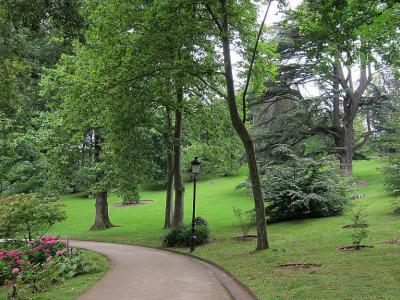
Cristina Enea Park, also known as the Gladys Park, is a magnificent urban park located in the Eguía neighborhood of San Sebastián. Covering an area of 94,960 m², the park is considered one of the most interesting historical urban parks in Spain, following the English garden typology. The park is situated on a small mound surrounded by the final meander of the Urumea river, providing a stunning view of the city.
The park is named after Cristina Brunetti y Gayoso de los Cobos, XIII Duchess of Mandas, who was married to Fermín de Lasala y Collado, an important businessman and politician from San Sebastian. The park was donated to the city by the Duke of Mandas, who stipulated that it must not be built on or used for any other purpose. In 2007, some renovation works were carried out to improve accessibility and enrich its biodiversity by planting a new range of trees and shrubs brought from Belgium and Germany.
The Palace of the Duke of Mandas, which is located at the top of the park and used to be the former residence of the Duke, has been converted into an Environmental Resource Center, an ecological laboratory, and a training center on environmental issues. The palace façades underwent substantial renovation works, and some interior refurbishment was also carried out. The park's pond and the lining of its roads were also modified, which received criticism from various groups.
The park's unique feature is the pedestrian walkway that was opened between the river and the park over the train tracks. Additionally, stairs and an elevator were built to bridge the gap between the river and the mound surrounded by the park. The walkway is known as Gladys del Estal, in memory of an environmentalist from the neighborhood murdered by the civil guard during an anti-nuclear demonstration in Tudela (Navarra). Another footbridge, named after the singer Mikel Laboa, was opened between the park and the new Riberas de Loiola neighborhood, increasing the flow of visitors.
Cristina Enea Park is a beautiful park with an interesting historical background and rich biodiversity. It offers a peaceful atmosphere with lush greenery, making it an ideal destination for nature lovers and a perfect escape from the bustling city life.
The park is named after Cristina Brunetti y Gayoso de los Cobos, XIII Duchess of Mandas, who was married to Fermín de Lasala y Collado, an important businessman and politician from San Sebastian. The park was donated to the city by the Duke of Mandas, who stipulated that it must not be built on or used for any other purpose. In 2007, some renovation works were carried out to improve accessibility and enrich its biodiversity by planting a new range of trees and shrubs brought from Belgium and Germany.
The Palace of the Duke of Mandas, which is located at the top of the park and used to be the former residence of the Duke, has been converted into an Environmental Resource Center, an ecological laboratory, and a training center on environmental issues. The palace façades underwent substantial renovation works, and some interior refurbishment was also carried out. The park's pond and the lining of its roads were also modified, which received criticism from various groups.
The park's unique feature is the pedestrian walkway that was opened between the river and the park over the train tracks. Additionally, stairs and an elevator were built to bridge the gap between the river and the mound surrounded by the park. The walkway is known as Gladys del Estal, in memory of an environmentalist from the neighborhood murdered by the civil guard during an anti-nuclear demonstration in Tudela (Navarra). Another footbridge, named after the singer Mikel Laboa, was opened between the park and the new Riberas de Loiola neighborhood, increasing the flow of visitors.
Cristina Enea Park is a beautiful park with an interesting historical background and rich biodiversity. It offers a peaceful atmosphere with lush greenery, making it an ideal destination for nature lovers and a perfect escape from the bustling city life.

2) Tabakalera
Tabakalera is a unique cultural center located in the Egia district of San Sebastián. What makes it so special is that it was once a tobacco factory that has now been transformed into a contemporary culture center. The building is massive, occupying one of the biggest plots (13.277 m2) in the urban area, and it is located next to the Estación del Norte railway station and the Cristina Enea Park.
For 90 years, from 1913 to 2003, Tabakalera was a tobacco factory, employing many people in San Sebastián. After the factory closed down in 2003, the San Sebastián City Council, the Provincial Council of Gipuzkoa, and the Basque Government purchased the building in 2004 to convert it into an International Centre for Contemporary Culture. Since then, Tabakalera has been a hub of cultural activity, hosting a wide variety of events and exhibitions.
One of the most notable features of Tabakalera is its range of facilities. The building contains exhibition halls, a multi-purpose plaza, a multi-purpose hall, a cinema theatre, a creation library called Ubik, media labs called Hirikilabs, spaces for art creation, a cafeteria called Taba, a residence for artists, and a four-star hotel, called One Shot Tabakalera House. It also hosts the headquarters of local culture institutions Kutxa Kultur, the Basque Film Archive, the San Sebastián International Film Festival, the Elías Querejeta Film School and the Etxepare Basque Institute.
The renovation work on Tabakalera began in 2010, and the building was inaugurated on September 11, 2015. While the main facade has been preserved, significant changes have taken place inside the building. Today, Tabakalera is a center of production as well as a space that offers a diverse range of activities for the public.
Overall, Tabakalera is a testament to the power of transformation and repurposing. What was once a tobacco factory now serves as a vibrant cultural center, showcasing the very best of contemporary art, film, and creative expression.
For 90 years, from 1913 to 2003, Tabakalera was a tobacco factory, employing many people in San Sebastián. After the factory closed down in 2003, the San Sebastián City Council, the Provincial Council of Gipuzkoa, and the Basque Government purchased the building in 2004 to convert it into an International Centre for Contemporary Culture. Since then, Tabakalera has been a hub of cultural activity, hosting a wide variety of events and exhibitions.
One of the most notable features of Tabakalera is its range of facilities. The building contains exhibition halls, a multi-purpose plaza, a multi-purpose hall, a cinema theatre, a creation library called Ubik, media labs called Hirikilabs, spaces for art creation, a cafeteria called Taba, a residence for artists, and a four-star hotel, called One Shot Tabakalera House. It also hosts the headquarters of local culture institutions Kutxa Kultur, the Basque Film Archive, the San Sebastián International Film Festival, the Elías Querejeta Film School and the Etxepare Basque Institute.
The renovation work on Tabakalera began in 2010, and the building was inaugurated on September 11, 2015. While the main facade has been preserved, significant changes have taken place inside the building. Today, Tabakalera is a center of production as well as a space that offers a diverse range of activities for the public.
Overall, Tabakalera is a testament to the power of transformation and repurposing. What was once a tobacco factory now serves as a vibrant cultural center, showcasing the very best of contemporary art, film, and creative expression.
3) Playa de La Zurriola (Zurriola Beach)
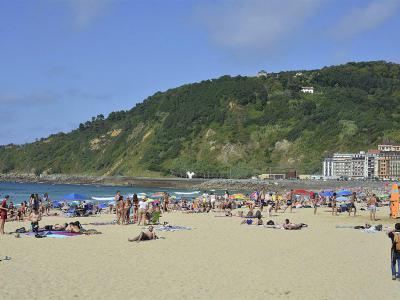
Located in the Gros district of San Sebastian, the Zurriola Beach is a lively and energetic surfing spot that attracts both local and international surfers. The beach stretches for 800 meters and is a hub for beach activity, including surfing competitions, daily surf classes, volleyball, football, and beach tennis.
The beach is situated on the other side of Monte Urgull and is different from the more famous La Concha Beach as it is a surfer's paradise, with waves that can reach up to 1.5 feet on a regular day. The best time to visit Zurriola Beach for surfing is during the fall and winter months when the waves reach their maximum height of 5 to 6 feet.
For those who are not interested in surfing, Zurriola Beach still has plenty to offer. There is ample space to stretch your legs and enjoy the sun, and the beach is entirely safe for swimming. However, due to the high number of surfers, the area of the beach dedicated to swimming may feel small compared to La Concha.
Zurriola Beach is also an excellent location for hillwalking, with Monte Ulía, a green area, only a moment's walk from the city centre. The hillwalking route follows part of the coastal route on the Way of Saint James and offers stunning sea views and relaxing spots along the way.
Crowning the easternmost end of the promenade is the Kursaal Congress Centre and Auditorium, a symbol of new modern architecture designed by Rafael Moneo. The building is the hub of San Sebastian's major festivals and cultural and congress activity.
Zurriola Beach is free and open 24 hours a day, but it's best to arrive early in the day to avoid crowded waters. Travelers who visited Zurriola's sands or rode its waves reported having a good time. Surfers complimented the conditions and recommended renting a board at one of the many nearby surf shops. Visitors can find Zurriola Beach in Gros, just across the Urumea River from Parte Vieja. Always swim when a lifeguard is present and don't venture too close to the water at night.
The beach is situated on the other side of Monte Urgull and is different from the more famous La Concha Beach as it is a surfer's paradise, with waves that can reach up to 1.5 feet on a regular day. The best time to visit Zurriola Beach for surfing is during the fall and winter months when the waves reach their maximum height of 5 to 6 feet.
For those who are not interested in surfing, Zurriola Beach still has plenty to offer. There is ample space to stretch your legs and enjoy the sun, and the beach is entirely safe for swimming. However, due to the high number of surfers, the area of the beach dedicated to swimming may feel small compared to La Concha.
Zurriola Beach is also an excellent location for hillwalking, with Monte Ulía, a green area, only a moment's walk from the city centre. The hillwalking route follows part of the coastal route on the Way of Saint James and offers stunning sea views and relaxing spots along the way.
Crowning the easternmost end of the promenade is the Kursaal Congress Centre and Auditorium, a symbol of new modern architecture designed by Rafael Moneo. The building is the hub of San Sebastian's major festivals and cultural and congress activity.
Zurriola Beach is free and open 24 hours a day, but it's best to arrive early in the day to avoid crowded waters. Travelers who visited Zurriola's sands or rode its waves reported having a good time. Surfers complimented the conditions and recommended renting a board at one of the many nearby surf shops. Visitors can find Zurriola Beach in Gros, just across the Urumea River from Parte Vieja. Always swim when a lifeguard is present and don't venture too close to the water at night.
4) Kursaal Congress Centre and Auditorium
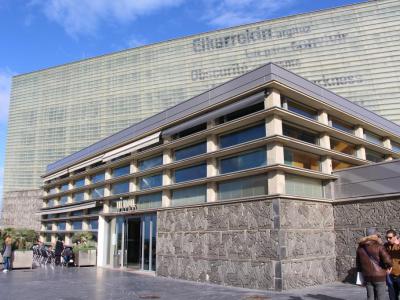
The Kursaal Congress Centre and Auditorium is a state-of-the-art complex situated in Donostia-San Sebastián. The building was designed by the renowned Spanish architect Rafael Moneo and opened in 1999. The complex comprises several spaces, including the Palacio de Congresos-Auditorio Kursaal, a multi-purpose hall, and exhibition halls.
The Kursaal building is located in a prime location on the Gros beachfront, next to the mouth of the Urumea river, and replaced the original Great Kursaal, an elegant palace built in 1921, which was demolished in 1973. The new building includes a 1,800-seat concert hall, which serves as the main venue for the San Sebastian International Film Festival, the largest film festival in Spain.
In addition to the auditorium, the Kubo-kutxa room is also located within the Kursaal building. This social work of the Kutxa Foundation was inaugurated in 2000 and covers approximately 1,000 square meters of space. The unique architecture of the Kubo-kutxa room makes it ideal for hosting large-scale exhibitions, and its programming is focused on temporary exhibitions of contemporary art, cinema, architecture, and design. The Kubo-kutxa room has become a cultural landmark, showcasing the works of local and international artists alike. The room has featured works by notable artists such as Marc Chagall, Joan Miró, and Miquel Barceló, among many others.
The Kursaal Congress Centre and Auditorium has established itself as an essential destination for art and culture enthusiasts, offering a diverse range of events and exhibitions that appeal to a broad audience.
The Kursaal building is located in a prime location on the Gros beachfront, next to the mouth of the Urumea river, and replaced the original Great Kursaal, an elegant palace built in 1921, which was demolished in 1973. The new building includes a 1,800-seat concert hall, which serves as the main venue for the San Sebastian International Film Festival, the largest film festival in Spain.
In addition to the auditorium, the Kubo-kutxa room is also located within the Kursaal building. This social work of the Kutxa Foundation was inaugurated in 2000 and covers approximately 1,000 square meters of space. The unique architecture of the Kubo-kutxa room makes it ideal for hosting large-scale exhibitions, and its programming is focused on temporary exhibitions of contemporary art, cinema, architecture, and design. The Kubo-kutxa room has become a cultural landmark, showcasing the works of local and international artists alike. The room has featured works by notable artists such as Marc Chagall, Joan Miró, and Miquel Barceló, among many others.
The Kursaal Congress Centre and Auditorium has established itself as an essential destination for art and culture enthusiasts, offering a diverse range of events and exhibitions that appeal to a broad audience.
5) Plaza de Gipuzkoa (Gipuzkoa Square)
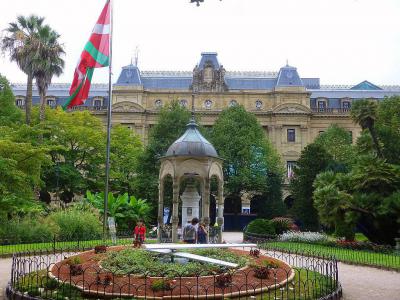
Gipuzkoa Square is a picturesque square situated in the heart of San Sebastian. The square covers an area of more than 5,000 m2 and is a popular spot for locals and tourists alike. The square is also home to the building of the Provincial Council of Gipuzkoa.
In 2014, the Provincial Council of Gipuzkoa paid homage to the Spanish flag by installing it on a flagpole in Plaza de Gipuzkoa. The monument dedicated to Jose Maria Usanditzaga is another prominent feature of the square. Visitors can take a stroll through the gardens, feed the ducks, swans, and pigeons, or simply relax and enjoy the greenery.
The irregular rectangular plan of Plaza de Gipuzkoa is lined with elegant neoclassical ashlar porticoes. The plaza's design was inspired by the Plaza de la Constitución in San Sebastian and other central plazas across the Basque Country. The architect, José Eleuterio Escoriaza, originally planned to close off the four access gates to the plaza, but this idea was eventually abandoned.
Gipuzkoa Square is located at the junction of Calle Andia and Calle Bengoetxea, close to the Parte Vieja neighbourhood, the promenade, the Town Hall, and the Boulevard. This central location makes it a popular spot for locals and tourists to relax, unwind, and take in the sights and sounds of San Sebastian. The square's charm and romanticism, along with its lush greenery, create an English forest-like atmosphere, despite being in the heart of the city.
In 2014, the Provincial Council of Gipuzkoa paid homage to the Spanish flag by installing it on a flagpole in Plaza de Gipuzkoa. The monument dedicated to Jose Maria Usanditzaga is another prominent feature of the square. Visitors can take a stroll through the gardens, feed the ducks, swans, and pigeons, or simply relax and enjoy the greenery.
The irregular rectangular plan of Plaza de Gipuzkoa is lined with elegant neoclassical ashlar porticoes. The plaza's design was inspired by the Plaza de la Constitución in San Sebastian and other central plazas across the Basque Country. The architect, José Eleuterio Escoriaza, originally planned to close off the four access gates to the plaza, but this idea was eventually abandoned.
Gipuzkoa Square is located at the junction of Calle Andia and Calle Bengoetxea, close to the Parte Vieja neighbourhood, the promenade, the Town Hall, and the Boulevard. This central location makes it a popular spot for locals and tourists to relax, unwind, and take in the sights and sounds of San Sebastian. The square's charm and romanticism, along with its lush greenery, create an English forest-like atmosphere, despite being in the heart of the city.
6) Paseo de la Concha (Concha Promenade)
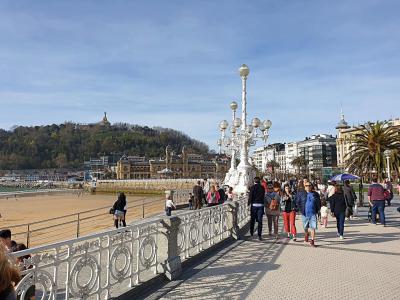
La Concha Promenade is San Sebastián’s grand stage, a graceful sweep of pavement following the arc of its famous bay from Liberty Avenue to the El Antiguo tunnel. Entirely pedestrian, it has defined the city’s image since the late 19th century, when royalty traded fortresses for parasols and San Sebastián was recast as Spain’s most fashionable resort. Queen Isabella II and later Queen María Cristina spent summers here, bringing with them a retinue of nobles, diplomats, and artists eager to parade along the shoreline in full view of one another.
The promenade itself became the backdrop for this spectacle. Its white balustrade, designed in 1910 and installed a few years later, is more than decoration-it’s practically the city’s signature, its flowing forms repeating like the rhythm of the waves they overlook. Bronze lampposts, benches, and carefully landscaped gardens completed the set, turning what had once been simple sand and surf into an outdoor salon. Along its length, the walkway ties together landmarks that echo San Sebastián’s evolution: the Alderdi Eder Gardens beside the Town Hall, the Miramar Palace built in English style for royalty, and La Perla spa, a glittering reminder of the city’s reputation as a place to see and be seen.
Flanked by Mount Urgull on one end and Mount Igeldo on the other, the promenade offers sweeping views of Santa Clara Island and the elegant facades lining the bay, including the historic Hotel Londres. Today, it’s less about royal carriages and more about joggers, cyclists, and families, yet the spirit remains the same: La Concha Promenade still frames San Sebastián’s story, one steady step at a time.
The promenade itself became the backdrop for this spectacle. Its white balustrade, designed in 1910 and installed a few years later, is more than decoration-it’s practically the city’s signature, its flowing forms repeating like the rhythm of the waves they overlook. Bronze lampposts, benches, and carefully landscaped gardens completed the set, turning what had once been simple sand and surf into an outdoor salon. Along its length, the walkway ties together landmarks that echo San Sebastián’s evolution: the Alderdi Eder Gardens beside the Town Hall, the Miramar Palace built in English style for royalty, and La Perla spa, a glittering reminder of the city’s reputation as a place to see and be seen.
Flanked by Mount Urgull on one end and Mount Igeldo on the other, the promenade offers sweeping views of Santa Clara Island and the elegant facades lining the bay, including the historic Hotel Londres. Today, it’s less about royal carriages and more about joggers, cyclists, and families, yet the spirit remains the same: La Concha Promenade still frames San Sebastián’s story, one steady step at a time.
7) Palacio de Miramar (Miramar Palace) (must see)
Miramar Palace rises between La Concha and Ondarreta beaches, a reminder of the moment San Sebastián swapped its fortified past for royal summers and high society. The story began in the mid-19th century, when Queen Isabel II turned to the city’s waters for relief from her ailments, drawing Spain’s elite in her wake. Her successor, Queen María Cristina, widow of Alfonso XII, sealed the city’s status as a seasonal capital by commissioning a proper residence fit for a royal court.
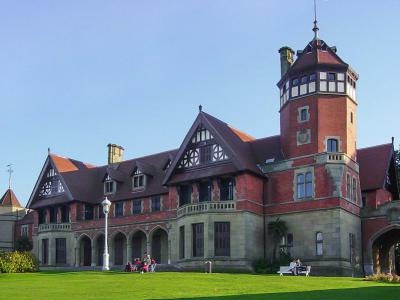
Completed in 1893, the palace was the work of English architect Selden Wornum, who imported Tudor country house flair to the Basque coast. Gables, red brick, and Neo-Gothic touches created a decidedly British silhouette against the Bay of Biscay, while gardens rolled theatrically toward the sea. This deliberate departure from local style signaled cosmopolitan ambition at the height of San Sebastián’s Belle Époque. The Prince’s Pavilion, added in 1920, expanded the complex for a new generation of royals.
Political upheavals reshaped the palace’s fate. Abolished monarchy in 1931 meant a transfer of ownership to the city, though Franco later handed it back to the crown. By 1972, San Sebastián reclaimed the estate for good. Over the years, the palace adapted: a university, a school, and eventually a cultural venue.
Miramar Municipal Palace balances nostalgia with activity. Visitors find historic interiors-the White Room, Music Room, Library, and Royal Dining Room-largely intact, while cultural events and parts of the San Sebastián Film Festival give the building fresh life. The gardens, open to all, remain the real treasure, offering sweeping views of La Concha Bay and Santa Clara Island. Here, the city’s royal past and cultural present continue their dialogue in the open air.
Completed in 1893, the palace was the work of English architect Selden Wornum, who imported Tudor country house flair to the Basque coast. Gables, red brick, and Neo-Gothic touches created a decidedly British silhouette against the Bay of Biscay, while gardens rolled theatrically toward the sea. This deliberate departure from local style signaled cosmopolitan ambition at the height of San Sebastián’s Belle Époque. The Prince’s Pavilion, added in 1920, expanded the complex for a new generation of royals.
Political upheavals reshaped the palace’s fate. Abolished monarchy in 1931 meant a transfer of ownership to the city, though Franco later handed it back to the crown. By 1972, San Sebastián reclaimed the estate for good. Over the years, the palace adapted: a university, a school, and eventually a cultural venue.
Miramar Municipal Palace balances nostalgia with activity. Visitors find historic interiors-the White Room, Music Room, Library, and Royal Dining Room-largely intact, while cultural events and parts of the San Sebastián Film Festival give the building fresh life. The gardens, open to all, remain the real treasure, offering sweeping views of La Concha Bay and Santa Clara Island. Here, the city’s royal past and cultural present continue their dialogue in the open air.
8) Parque de Atracciones Monte Igueldo (Monte Igueldo Amusement Park)
The Monte Igueldo Amusement Park is a historic amusement park situated on top of Mount Igueldo in the El Antiguo neighborhood of San Sebastián. Inaugurated on August 25, 1912, the park is one of the three amusement parks that were established in San Sebastián at the beginning of the 20th century, with Ulía and Martutene having since closed down.
Access to the park can be done by car or by the funicular, which was designed by architect Luis Elizalde and remains one of the park's attractions to this day. Visitors are required to pay an admission fee to enter the park, and attractions are paid for separately.
The idea of creating a leisure area on Mount Igueldo came from lawyer Evaristo San Martín, who established the Monte Igueldo Society in 1911 and purchased the necessary land. The park initially featured a casino, restaurant, and assembly hall, with the funicular stations and restaurant being designed by Luis Elizalde. The regent María Cristina inaugurated the park and the funicular on August 25, 1912, and it has remained operational ever since.
Over the years, Monte Igueldo Amusement Park has added more attractions to its roster, with some of its most notable attractions dating back to the 1920s, such as Montaña Suiza, Río Misterioso, Barcas del Estanque, and Gran Laberinto, all of which are still in operation today. In 1925, gambling was banned and the casino was converted into a dance hall. In the 1960s, two movie theaters were built in the park but were later demolished.
In 2014, the amusement park and funicular were designated as Assets of Cultural Interest in the Monumental Complex category. Today, the park offers a variety of attractions, including the oldest steel roller coaster in operation in the world, which is its main attraction, along with stunning views of La Concha Bay.
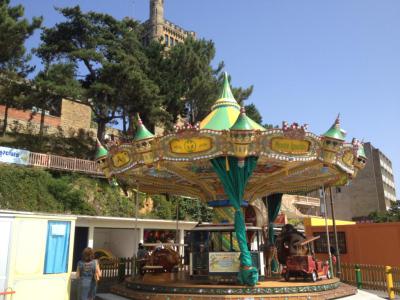
Visitors to Monte Igueldo Amusement Park can enjoy a range of attractions that are up to 90 years old, including magic carpets, Swiss mountains that dance on the sea, haunted houses, infinite mazes, and mermaids that can be greeted while navigating the mysterious river. The park offers a total of 20 attractions that retain the beauty and essence of amusement parks from the early 20th century, providing a unique and delightful experience for the whole family. The park is not known for its high-speed attractions but rather for a more relaxed and enjoyable experience, with attractions such as the Swiss Mountain, Paseo de la Risa, and Magic Maze, providing entertainment and laughter for all ages.
Access to the park can be done by car or by the funicular, which was designed by architect Luis Elizalde and remains one of the park's attractions to this day. Visitors are required to pay an admission fee to enter the park, and attractions are paid for separately.
The idea of creating a leisure area on Mount Igueldo came from lawyer Evaristo San Martín, who established the Monte Igueldo Society in 1911 and purchased the necessary land. The park initially featured a casino, restaurant, and assembly hall, with the funicular stations and restaurant being designed by Luis Elizalde. The regent María Cristina inaugurated the park and the funicular on August 25, 1912, and it has remained operational ever since.
Over the years, Monte Igueldo Amusement Park has added more attractions to its roster, with some of its most notable attractions dating back to the 1920s, such as Montaña Suiza, Río Misterioso, Barcas del Estanque, and Gran Laberinto, all of which are still in operation today. In 1925, gambling was banned and the casino was converted into a dance hall. In the 1960s, two movie theaters were built in the park but were later demolished.
In 2014, the amusement park and funicular were designated as Assets of Cultural Interest in the Monumental Complex category. Today, the park offers a variety of attractions, including the oldest steel roller coaster in operation in the world, which is its main attraction, along with stunning views of La Concha Bay.
Visitors to Monte Igueldo Amusement Park can enjoy a range of attractions that are up to 90 years old, including magic carpets, Swiss mountains that dance on the sea, haunted houses, infinite mazes, and mermaids that can be greeted while navigating the mysterious river. The park offers a total of 20 attractions that retain the beauty and essence of amusement parks from the early 20th century, providing a unique and delightful experience for the whole family. The park is not known for its high-speed attractions but rather for a more relaxed and enjoyable experience, with attractions such as the Swiss Mountain, Paseo de la Risa, and Magic Maze, providing entertainment and laughter for all ages.

9) Monte Igueldo (Igueldo Mountain)
Igueldo Mountain is a unique destination that combines the past and present. The site offers visitors a chance to relive their childhood by visiting a picturesque fairground from yesteryear, complete with vintage attractions that still retain the beauty and spirit of the fairgrounds of the turn of the 20th century.
The journey to the fairground begins with a ride on a 1912 funicular railway, the oldest of its kind in the Basque Country. As you ascend to the top of the mountain, you can enjoy breathtaking views of the city and the Gipuzkoan coastline. Upon arrival at the fairground, visitors can enjoy a variety of charmingly old-fashioned attractions, such as a wooden rollercoaster, trampolines, and game booths.
Monte Igueldo fairground has a magical and romantic essence, with its mermaids, haunted houses, and mysterious river. The fairground has 20 vintage attractions that delight both children and grown-ups, including the "Paseo de la Risa" comic walkway, the Magical Labyrinth, and the wooden rollercoaster that dances over the sea. The tranquil atmosphere of the Bay and the impressive power of the waves breaking against the cliffs add to the charm of the site.
Visiting Monte Igueldo is a unique experience that transports visitors back to the past. The Igeldo funicular and the fairground capture the essence of the "Belle Epoque" and allow visitors to relive the journey that Donostians made in times gone by when they would go up to visit the casino and the dance hall located at the mountain's peak. With its picturesque journey and vintage attractions, Monte Igueldo offers a taste of the past in a beautiful and magical setting.
The journey to the fairground begins with a ride on a 1912 funicular railway, the oldest of its kind in the Basque Country. As you ascend to the top of the mountain, you can enjoy breathtaking views of the city and the Gipuzkoan coastline. Upon arrival at the fairground, visitors can enjoy a variety of charmingly old-fashioned attractions, such as a wooden rollercoaster, trampolines, and game booths.
Monte Igueldo fairground has a magical and romantic essence, with its mermaids, haunted houses, and mysterious river. The fairground has 20 vintage attractions that delight both children and grown-ups, including the "Paseo de la Risa" comic walkway, the Magical Labyrinth, and the wooden rollercoaster that dances over the sea. The tranquil atmosphere of the Bay and the impressive power of the waves breaking against the cliffs add to the charm of the site.
Visiting Monte Igueldo is a unique experience that transports visitors back to the past. The Igeldo funicular and the fairground capture the essence of the "Belle Epoque" and allow visitors to relive the journey that Donostians made in times gone by when they would go up to visit the casino and the dance hall located at the mountain's peak. With its picturesque journey and vintage attractions, Monte Igueldo offers a taste of the past in a beautiful and magical setting.
10) Peine del Viento (The Comb of the Wind)
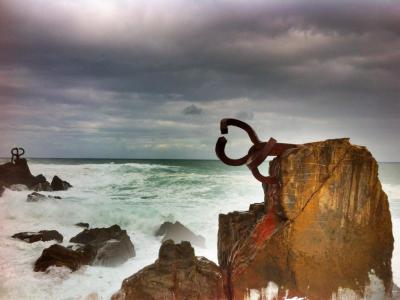
The Comb of the Wind, is a striking installation in San Sebastian, that is widely considered to be one of the most important works of both the Basque architect Luis Peña Ganchegui and the Basque sculptor Eduardo Chillida. This collection of three steel sculptures, each weighing over nine tons, is embedded in natural rocks rising from the Cantabrian Sea, creating an architectural work that is seamlessly integrated into its surroundings.
The location of The Comb of the Wind at the western end of La Concha Bay, at the end of Ondarreta beach, is particularly significant. This is a place where the sea and the wind come together with a sense of abandon, whipping the rocks and creating a dramatic landscape. Chillida was inspired by this unique environment to create sculptures that would interact with the natural elements, anchored to the rocks so that the incoming wind would be continually "combed" at La Concha Bay.
The result is a powerful and dynamic installation that appears to emerge from the rocks themselves. The positioning of the sculptures creates a sense of movement and energy, with waves dancing between the tines of the steel and challenging its strength. On the stormiest of days, Peine del Viento becomes a unique representation of the power of nature, with the sound of the whistling wind and the crashing waves creating an unparalleled performance.
Visitors to The Comb of the Wind can not only admire the sculptures but also play with the wind and the sea, watching the waves rising and falling and mischievously shooting through the blow-holes in the nearby viewing area. However, it's important to be mindful of safety, particularly on the stormiest of days when the police may cordon off the area for safety reasons.
Overall, Peine del Viento is a testament to the beauty and power of nature and the creativity of human beings. It's a must-visit destination for anyone interested in architecture, sculpture, or simply the breathtaking beauty of the natural world.
The location of The Comb of the Wind at the western end of La Concha Bay, at the end of Ondarreta beach, is particularly significant. This is a place where the sea and the wind come together with a sense of abandon, whipping the rocks and creating a dramatic landscape. Chillida was inspired by this unique environment to create sculptures that would interact with the natural elements, anchored to the rocks so that the incoming wind would be continually "combed" at La Concha Bay.
The result is a powerful and dynamic installation that appears to emerge from the rocks themselves. The positioning of the sculptures creates a sense of movement and energy, with waves dancing between the tines of the steel and challenging its strength. On the stormiest of days, Peine del Viento becomes a unique representation of the power of nature, with the sound of the whistling wind and the crashing waves creating an unparalleled performance.
Visitors to The Comb of the Wind can not only admire the sculptures but also play with the wind and the sea, watching the waves rising and falling and mischievously shooting through the blow-holes in the nearby viewing area. However, it's important to be mindful of safety, particularly on the stormiest of days when the police may cordon off the area for safety reasons.
Overall, Peine del Viento is a testament to the beauty and power of nature and the creativity of human beings. It's a must-visit destination for anyone interested in architecture, sculpture, or simply the breathtaking beauty of the natural world.
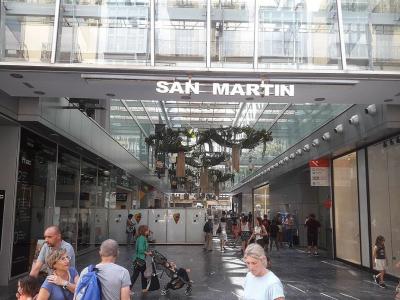
11) Mercado San Martin (San Martin Market)
San Martin Market has a rich history dating back to 1884 when the first pavilion of the food market was inaugurated. The market was designed by architect José de Goicoa, who drew inspiration from the Les Halles de Bayonne. The market underwent several expansions and renovations over the years, with the most significant change happening in 2003 due to new urban needs and demographics.
The San Sebastián City Council decided to demolish the historic building in 2005 to build a new shopping center that would combine tradition and modernity. The new building was designed by architect Luis Uzcanga and features a 1,900 m2 supermarket, leading fashion brands, and leisure and culture spaces, along with traditional market vendors.
The new San Martín market perfectly integrates the advantages of a traditional market and modern shopping centers. The market has a covered pedestrian path and large windows on its facades that symbolize the original character of the building. The project also created a new public space by pedestrianizing three surrounding streets and building an underground car park with 600 spaces to improve accessibility.
The new San Martín market received the "Prize for the best implementation of new integrated commerce formulas" from the Spanish Association of Shopping Centers in 2006 for successfully and profitably recovering an urban space. The market remains a symbol of the social, cultural, and economic evolution of San Sebastian, reflecting numerous architectural changes throughout its history.
The San Sebastián City Council decided to demolish the historic building in 2005 to build a new shopping center that would combine tradition and modernity. The new building was designed by architect Luis Uzcanga and features a 1,900 m2 supermarket, leading fashion brands, and leisure and culture spaces, along with traditional market vendors.
The new San Martín market perfectly integrates the advantages of a traditional market and modern shopping centers. The market has a covered pedestrian path and large windows on its facades that symbolize the original character of the building. The project also created a new public space by pedestrianizing three surrounding streets and building an underground car park with 600 spaces to improve accessibility.
The new San Martín market received the "Prize for the best implementation of new integrated commerce formulas" from the Spanish Association of Shopping Centers in 2006 for successfully and profitably recovering an urban space. The market remains a symbol of the social, cultural, and economic evolution of San Sebastian, reflecting numerous architectural changes throughout its history.
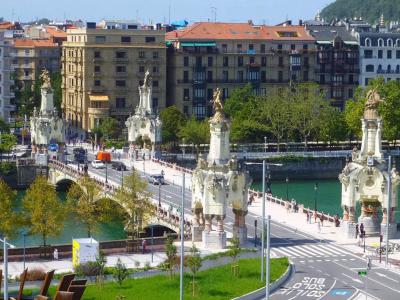
12) Puente de Maria Cristina (Maria Cristina Bridge)
The María Cristina Bridge is a historical landmark in the Basque city of San Sebastián. The bridge spans the Urumea river and connects the downtown area to the North Station, the bullfighting arena, and the velodrome. The bridge was originally built as a temporary wooden walkway in 1893 to provide direct access to these locations.
The construction of the permanent bridge began soon after, and it was completed in 1905. The bridge was financed by the Caja de Ahorros of the municipality, which provided a credit for a hundred years without interest. The project was designed by Ribera and Zapata, and the engineering and architectural work was done by Marcelo Sarasola and José de Goicoa, respectively.
One of the most striking features of the María Cristina Bridge are the four monumental obelisks located at its ends. These obelisks are replicas of those found on the Alexander III bridge in Paris and are 18 meters high, crowned by sculptural groups. The bridge was built using reinforced concrete, which was a novel material at that time. It features three arches that are 24 meters long, 20 meters wide, and 88 meters long.
The opening of the bridge was a cause for great celebration in the city. The festivities began with the performance of the music band La Unión, followed by the music bands of two infantry companies. The band of the city council entered with the corporation, press, and others, and all the balconies along the route were decorated for the occasion. The opening also featured a hymn composed for the occasion by the master Santesteban and performed by the Orfeón Donostiarra and the Choir of the Municipal Academy of Music of San Sebastián, which consisted of 110 children.
The day of the opening also featured a fireworks display and a "toro de fuego" (bull of fire), which was a traditional celebration that had been banned in the city for the previous three years. The ban had caused unrest among the young people, who had protested by stoning lampposts, shop windows, and official centers and newsrooms. To prevent any disturbances during the opening, the police took precautions and many serenos (night watchmen) were present along the bull route, prompting loud protests from the neighborhood.
In summary, the María Cristina Bridge is a significant historical landmark in San Sebastián, Spain, with a fascinating history and striking architectural features. The bridge continues to be an important part of the city's transportation infrastructure and a popular destination for tourists and locals alike.
The construction of the permanent bridge began soon after, and it was completed in 1905. The bridge was financed by the Caja de Ahorros of the municipality, which provided a credit for a hundred years without interest. The project was designed by Ribera and Zapata, and the engineering and architectural work was done by Marcelo Sarasola and José de Goicoa, respectively.
One of the most striking features of the María Cristina Bridge are the four monumental obelisks located at its ends. These obelisks are replicas of those found on the Alexander III bridge in Paris and are 18 meters high, crowned by sculptural groups. The bridge was built using reinforced concrete, which was a novel material at that time. It features three arches that are 24 meters long, 20 meters wide, and 88 meters long.
The opening of the bridge was a cause for great celebration in the city. The festivities began with the performance of the music band La Unión, followed by the music bands of two infantry companies. The band of the city council entered with the corporation, press, and others, and all the balconies along the route were decorated for the occasion. The opening also featured a hymn composed for the occasion by the master Santesteban and performed by the Orfeón Donostiarra and the Choir of the Municipal Academy of Music of San Sebastián, which consisted of 110 children.
The day of the opening also featured a fireworks display and a "toro de fuego" (bull of fire), which was a traditional celebration that had been banned in the city for the previous three years. The ban had caused unrest among the young people, who had protested by stoning lampposts, shop windows, and official centers and newsrooms. To prevent any disturbances during the opening, the police took precautions and many serenos (night watchmen) were present along the bull route, prompting loud protests from the neighborhood.
In summary, the María Cristina Bridge is a significant historical landmark in San Sebastián, Spain, with a fascinating history and striking architectural features. The bridge continues to be an important part of the city's transportation infrastructure and a popular destination for tourists and locals alike.
